





















Salzburg Cathedral, DomQuartier State Rooms, St. Peter's Abbey, Catacombs & Kapitelplatz Guide
Explore Salzburg's sacred and princely Baroque heart: Salzburg Cathedral and Mozart's 1321 baptismal font, the elevated DomQuartier museum loop, 696 CE St. Peter's Abbey and Catacombs, and Kapitelplatz.
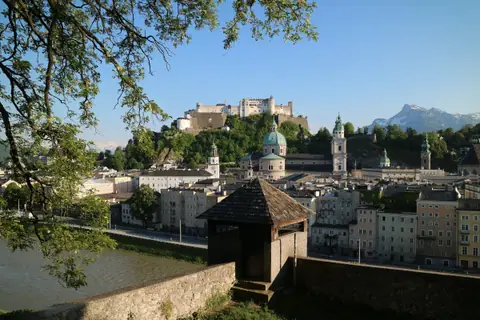
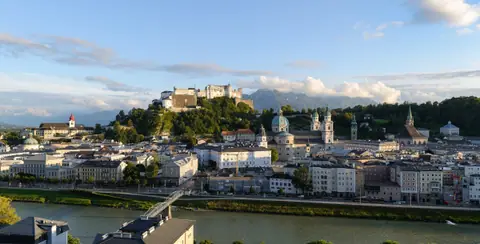
Between 1587 and 1680, three ambitious Prince-Archbishops reshaped the medieval ecclesiastical core of Salzburg into the "Rome of the North". Those rulers were Wolf Dietrich von Raitenau, Markus Sittikus von Hohenems, and Paris Lodron. After a fire damaged the old eight-towered Romanesque basilica in 1598, Wolf Dietrich demolished the cathedral ruins and 55 adjacent burgher houses. Bringing in Italian architects Vincenzo Scamozzi and Santino Solari, the archbishops laid out four interconnected open plazas around the new cathedral. Today those squares are Residenzplatz, Domplatz, Kapitelplatz, and Mozartplatz. In 1669, Prince-Archbishop Guidobald von Thun added elevated stone archway bridges linking the palace directly to the cathedral organ lofts and to Benedictine St. Peter's Abbey. Reopened in May 2014 as the DomQuartier, those upper galleries now form one of Europe's greatest Baroque museum circuits.
1. Residenzplatz, Residenzbrunnen, Mozartplatz & the 1702 Glockenspiel
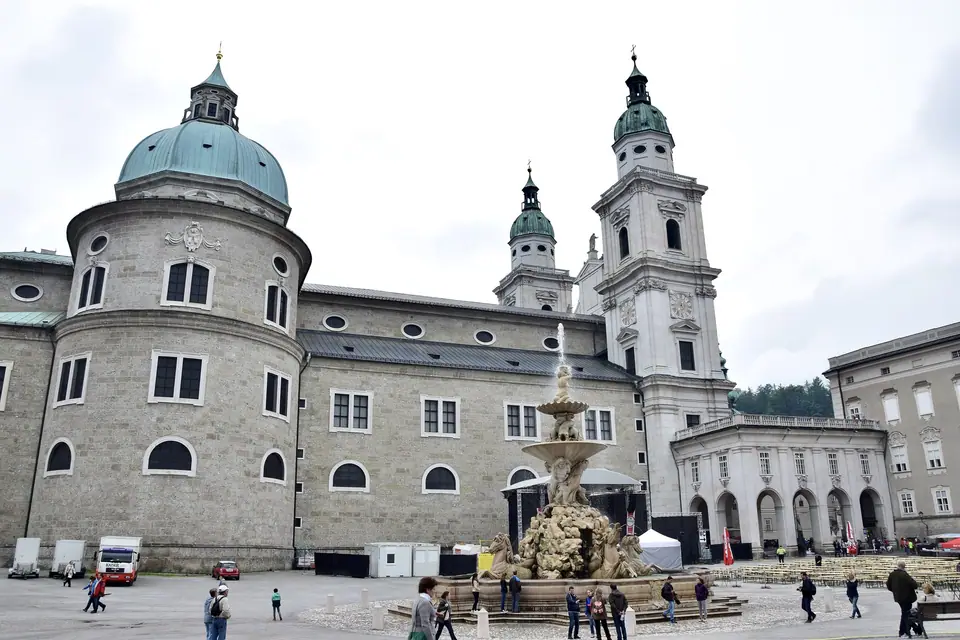
Start your walk on Residenzplatz, the ceremonial courtyard framed by the Alte Residenz, the Neue Residenz, and the north flank of the Cathedral. At the centre rises the Residenzbrunnen (1656 to 1661), the largest Baroque fountain in Central Europe outside Italy. Italian sculptor Tommaso di Garona carved the 15-metre monument from pale Untersberg limestone for Prince-Archbishop Guidobald von Thun. Four snorting rock-cut horses rise from the lower pool below three Atlas figures and a Triton blowing a conch shell.
Step around the Neue Residenz (built from 1588 by Wolf Dietrich and now housing the Salzburg Museum and the 1829 Sattler Panorama) onto Mozartplatz. At the centre stands Ludwig Schwanthaler's 1842 bronze statue of Wolfgang Amadeus Mozart. Above the Neue Residenz rises the octagonal 1702 clock tower housing the Salzburg Glockenspiel. Prince-Archbishop Johann Ernst von Thun purchased the carillon in Antwerp in 1695 from bell founder Melchior de Haze. Its 35 bronze bells play melodies by Mozart and Haydn three times a day at 07:00, 11:00, and 18:00.
2. Salzburg Cathedral (Salzburger Dom): 1628 Consecration, Mozart's Font & Five Organs
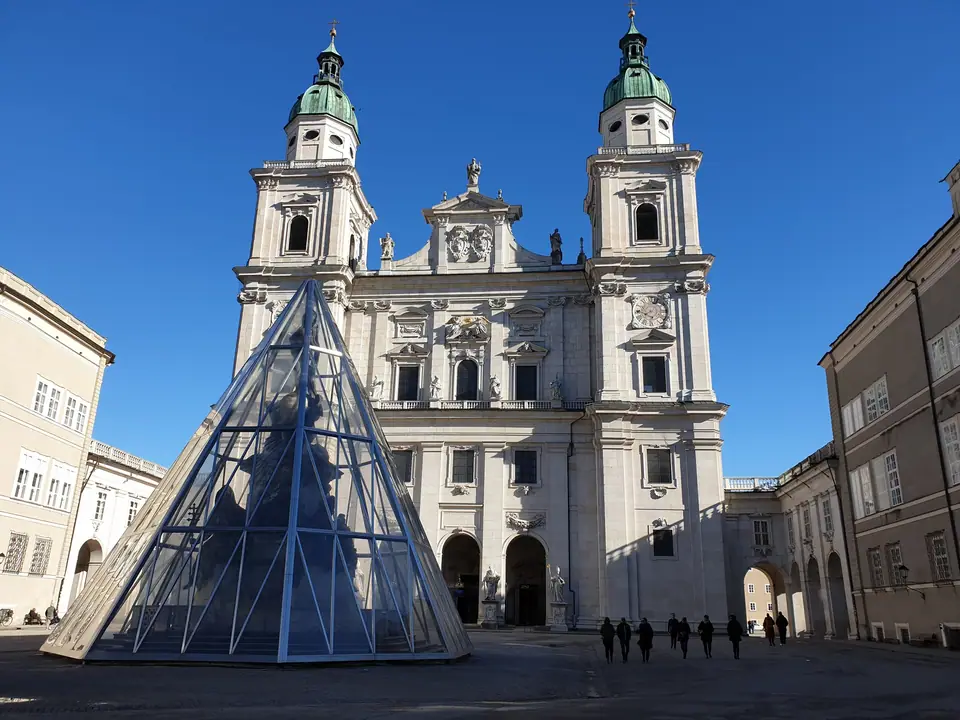
Walk under the triple stone arches from Residenzplatz into the enclosed quadrangle of Domplatz. At its centre stands the lead-and-marble Marian Column (Mariensäule) erected by Wolfgang and Johann Baptist Hagenauer in 1771. Directly ahead rises the white Untersberg marble west facade of Salzburg Cathedral (Salzburger Dom). Twin 81-metre towers flank four monumental statues of Saints Rupert, Virgil, Peter, and Paul:
- Three architectural eras (774, 1181, and 1628). Saint Virgil built the first cathedral here in 774 CE. After a fire in 1167, Archbishop Konrad III erected a five-aisled Romanesque basilica in 1181, whose foundations remain visible inside the crypt excavations. Following the 1598 fire, court architect Santino Solari built the current early-Baroque church between 1614 and 1628. Prince-Archbishop Paris Lodron consecrated the completed cathedral on 24 September 1628 during the Thirty Years' War. A single aerial bomb pierced the central 71-metre crossing dome on 16 October 1944. Restored after the war, the cathedral was reconsecrated in 1959. Look at the three dates inscribed on the wrought-iron entrance gates: 774, 1628, and 1959.
- The 1321 Bronze Baptismal Font. In the northern transept aisle stands the Romanesque bronze baptismal font cast in 1321, resting on four twelfth-century carved stone lions. Here on 28 January 1756, one day after his birth on Getreidegasse, infant Wolfgang Amadeus Mozart was baptised. Joseph Mohr, author of the 1818 carol Silent Night, was also christened at this font in 1792.
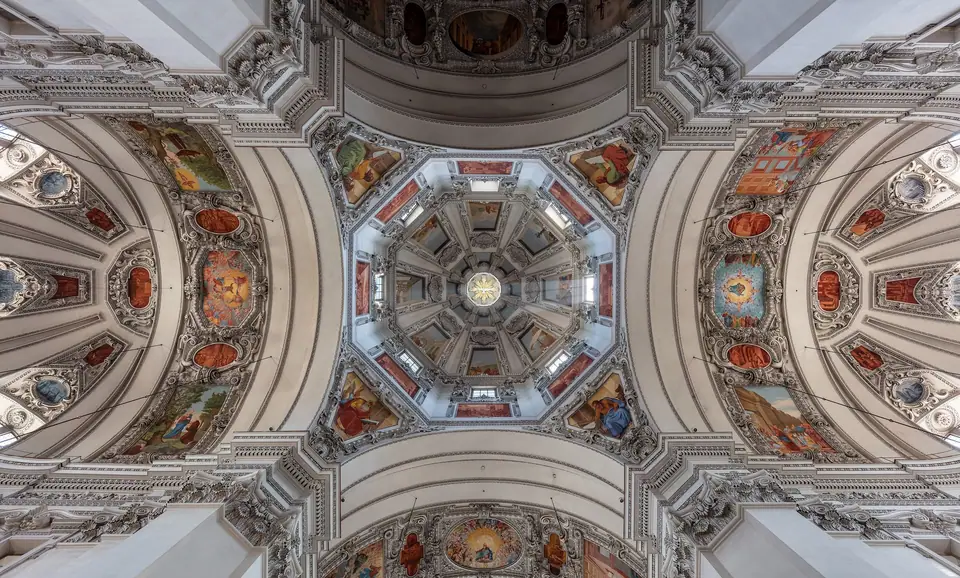
- Five organs & Mozart as Court Organist. Look up at the four crossing pillars around the dome. Each pillar carries its own seventeenth-century balcony organ in addition to the 4,000-pipe main organ on the West Gallery. From 1779 to 1781, Wolfgang Amadeus Mozart served as salaried Court Organist at the northeast pillar organ, composing his Coronation Mass (KV 317) here.
3. Walking the DomQuartier Loop (State Rooms, Residenzgalerie & Organ Loft)
The DomQuartier is included free with the Salzburg Card (check the official domquartier.at website for winter Tuesday closures). Its one-way elevated loop leads you across four historic buildings:
- State Rooms of the Alte Residenz (Prunkräume). Begin in the 66-metre-long Carabinierisaal (built circa 1600) with its 1689 ceiling frescoes by Johann Michael Rottmayr. Continue through 15 ceremonial state apartments. Highlights include the Knights' Hall (Rittersaal, where a seven-year-old Mozart performed in 1762), the Conference Room, and the Throne Room.
- The Residenzgalerie. Holds the Prince-Archbishops' picture collection of sixteenth- to nineteenth-century Dutch, Flemish, Italian, and Austrian oil paintings. Highlights include works by Rembrandt, Peter Paul Rubens, Jan Brueghel the Elder, and Salomon van Ruysdael.
- Dombogenterrasse & Cathedral West Organ Loft. Step outside onto the open-air Cathedral Archway Terrace overlooking Domplatz and Residenzplatz simultaneously. Then enter the stuccoed North Oratory and stand beside the main pipes on the Cathedral West Organ Gallery for a view down the 101-metre nave.
- St. Peter's Museum & Long Gallery (1660). Cross the southern archway into the Cabinet of Curiosities (Kunst- und Wunderkammer). Walk the 65-metre Long Gallery of St. Peter's Abbey before looking down into the Franciscan Church choir.
4. St. Peter's Abbey (696 CE), Cemetery, Catacombs, Franciscan Church & Kapitelplatz
South of the Cathedral stands St. Peter's Archabbey (Stift Sankt Peter), founded in 696 CE by Saint Rupert. It is the oldest continuously operating monastery in the German-speaking world. Step inside the 1130 to 1147 Romanesque basilica, transformed between 1760 and 1782 under Abbot Beda Seeauer into a pink-and-gold Rococo interior. Here Mozart conducted the premiere of his Great Mass in C minor (KV 427) in October 1783 with his wife Constanze singing the soprano solo. Next door inside the monastery courtyard operates the Stiftskeller St. Peter. First documented in 803 CE by Alcuin of York at the court of Charlemagne, it is the oldest documented restaurant in Central Europe.
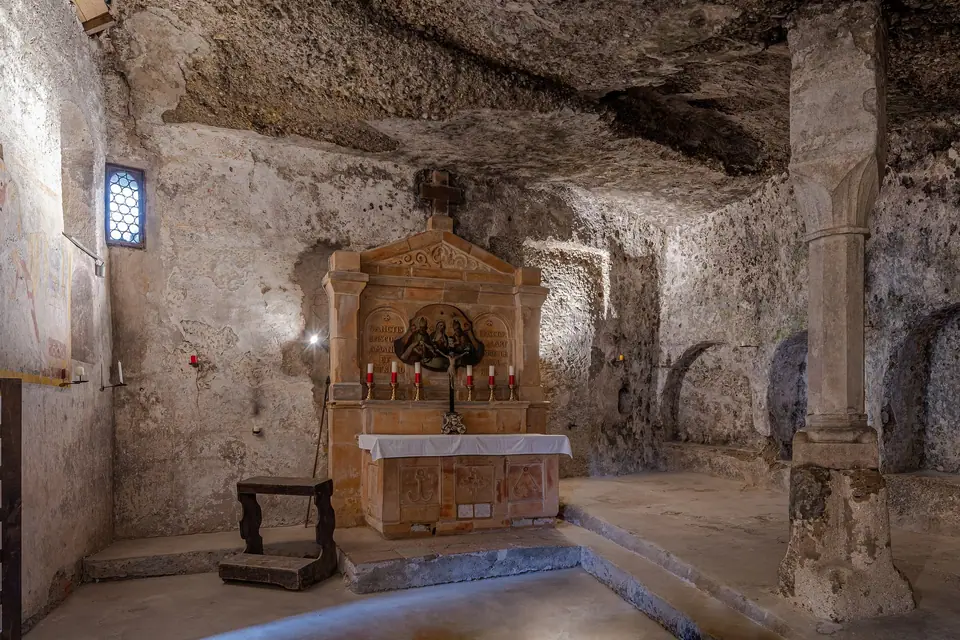
Behind the church lies St. Peter's Cemetery (Petersfriedhof), famous for its wrought-iron grave crosses and arcaded family crypts. These vaults hold the tombs of Mozart's sister Nannerl, composer Michael Haydn, and architect Santino Solari. Carved 40 metres up into the vertical conglomerate cliff face of the Mönchsberg directly above the graves are the St. Peter's Catacombs (Katakomben) (free with Salzburg Card). Climb 48 rock-hewn steps to the early Christian St. Gertrude Chapel (consecrated 1178) and Maximus Chapel. Finish inside the 1408 Gothic choir of the Franciscan Church (Franziskanerkirche) and out on Kapitelplatz. There the 1732 marble Kapitelschwemme horse pond, giant chess board, and Stephan Balkenhol's 2007 nine-metre golden sphere sculpture Sphaera stand beneath the Festungsbahn funicular.
Traveller tips
Real advice from people who have been to Salzburg. Every tip is read by our team before it goes live.
No tips yet. Been here? Yours could be the first.
Thank you! Your tip will appear here after a quick review.
More in Salzburg
Continue exploring Salzburg with related neighbourhood, food, and planning guides
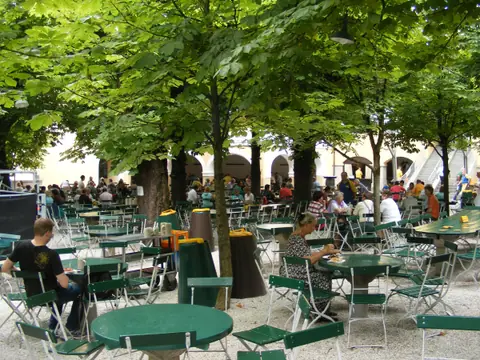
Augustiner Bräu Mülln Monastery Brewery, Stiegl-Brauwelt Museum & Salzburg Beer Culture Guide
Salzburg, Austria
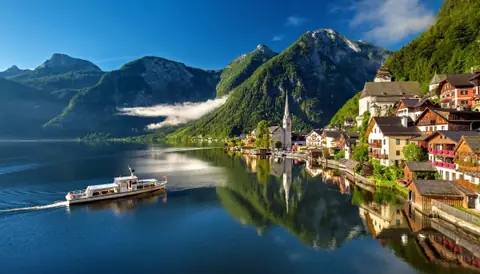
Hallstatt, St. Wolfgang & Schafbergbahn, Bad Ischl & Berchtesgaden Salt Mine Day Trips from Salzburg
Salzburg, Austria
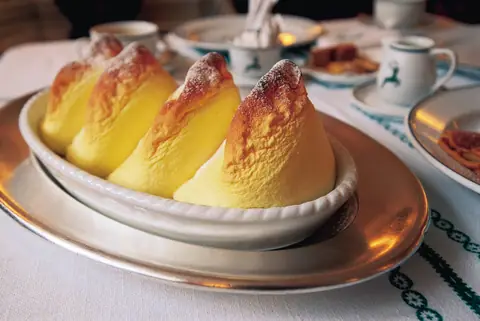
What to Eat in Salzburg: Salzburger Nockerl, Original Fürst Mozartkugel, Kasnocken, Bosna & Café Tomaselli
Salzburg, Austria
Salzburg Orientation: Salzach River Divide, Left Bank Altstadt, Right Bank Neustadt & Salzburg Card
Salzburg, Austria
