





















Getreidegasse Guild Signs, Mozart's Birthplace, Mozart Residence & Grosses Festspielhaus Walk
Walk the historic merchant lane of Getreidegasse through medieval Durchhäuser courtyards to Mozart's 1756 Birthplace, the rock-hewn Salzburg Festival Halls, and Mozart's Residence on Makartplatz.
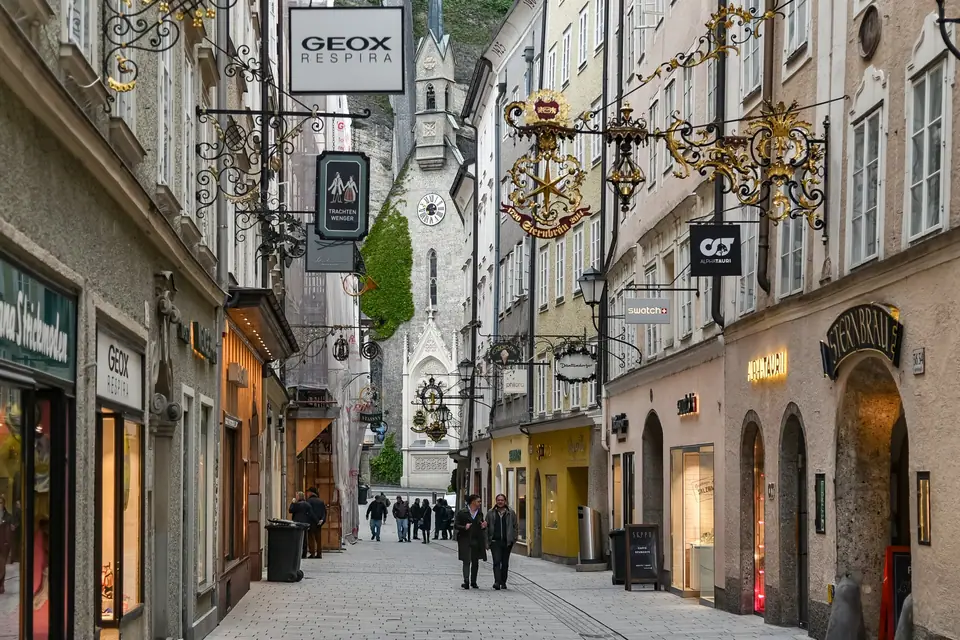
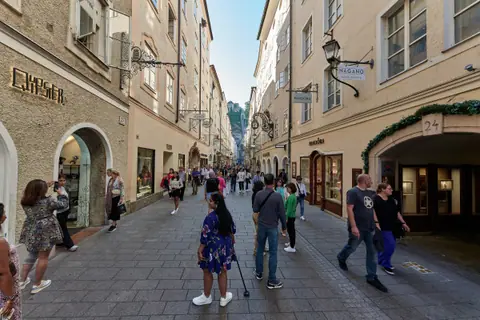
Getreidegasse (pronounced geh-TRY-deh-gah-seh, meaning "Grain Lane") runs parallel to the Salzach River on the Left Bank. It has served as Salzburg's main commercial artery since Roman times. Tall, narrow fourteenth- to eighteenth-century burgher townhouses rise five and six storeys above the cobbled lane. Because houses lacked street numbers until the late eighteenth century, wrought-iron guild brackets (Zunftzeichen) project from every second-floor facade. They advertise bakers, locksmiths, apothecaries, brewers, and tailors in gilded scrollwork. Walking this 350-metre lane and its hidden medieval courtyard passages (Durchhäuser) links Wolfgang Amadeus Mozart's 1756 Birthplace to the rock-carved opera halls of the Salzburg Festival. From there, a short bridge crossing leads to the Mozart Residence.
1. Walking Getreidegasse: Wrought-Iron Guild Signs & Medieval Durchhäuser Passages
Begin at the eastern end of Getreidegasse beside the 1407 Old Town Hall (Rathaus) at Kranzlmarkt. Its white rococo tower holds a fourteenth-century bell and astronomical clock. As you walk west, look at two distinctive features of Salzburg merchant architecture:
- Eye-Level Windows & First-Floor Dates. Notice how the windows shrink from tall Piano Nobile reception windows on the first floor to small square attic windows under the eaves. Below them, stone door lintels carry carved building dates, family coats of arms, and the protective "Eye of God" triangle.
- The Arcaded Through-Houses (Durchhäuser). Medieval Salzburg merchants built vaulted pedestrian passages straight through the ground floors of their deep townhouses. Those passages link Getreidegasse with the market square of Universitätsplatz (Grünmarkt) to the south and Griesgasse to the north. Duck inside the Schatz-Durchhaus (Getreidegasse 3) to visit the 1880 Schatz-Konditorei pastry shop and view the relief of the Virgin Mary. Step through the sixteenth-century Tuscan-columned courtyard of Getreidegasse 7 and the floral-vaulted passage of Getreidegasse 14. Continue to the Balkan Grill passage at Getreidegasse 33, where Bulgarian immigrant Zanko Todoroff invented Salzburg's famous spiced Bosna sausage roll in 1949.
2. Mozart's Birthplace (Mozarts Geburtshaus, Getreidegasse 9)
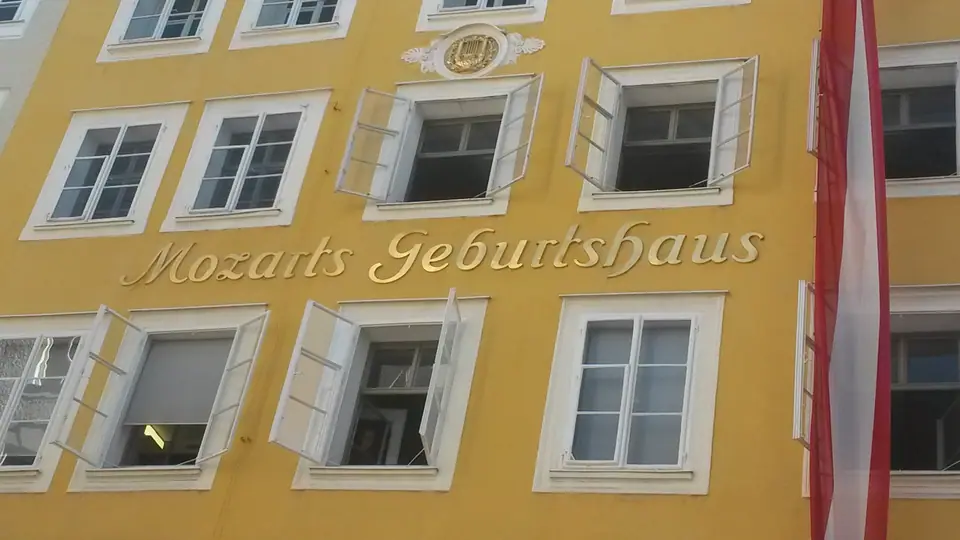
Halfway along the lane, Getreidegasse widens slightly into tiny Hagenauerplatz before the bright yellow six-storey facade of the Hagenauer Haus at Getreidegasse 9. Spice merchant and family friend Johann Lorenz Hagenauer owned the building. He rented the third-floor apartment to court violinist Leopold Mozart and his wife Anna Maria Pertl after their wedding on 21 November 1747. The family lived here for 26 years until 1773. Seven children were born in these rooms, though only two survived infancy. They were keyboard prodigy Maria Anna ("Nannerl", born 1751) and Wolfgang Amadeus Mozart, born at 20:00 on 27 January 1756.
The International Mozarteum Foundation established a museum here on 15 June 1880. Included free with the Salzburg Card, the apartment spans three exhibition floors:
- Third Floor (Original Living Quarters & Birth Room). Walk through the original back kitchen, cabinet, living room, and the Birth Room overlooking the courtyard. Glass cases display Mozart's childhood quarter-size violin, his concert violin, and his clavichord, on which he composed The Magic Flute in 1791. Another wall holds the unfinished 1782 oil portrait of Mozart at the piano by his brother-in-law Joseph Lange. Beside it rest handwritten letters from the family's 1763 to 1766 Grand Tour across Europe.
- Second & First Floors. Trace eighteenth-century opera staging history with miniature stage models and costumes on the second floor. Then explore recreated bourgeois furniture and everyday domestic life in 1756 Salzburg on the first floor.
3. Universitätsplatz, Kollegienkirche, Pferdeschwemme & the Three Festival Halls
Exiting Getreidegasse 9 through a southern Durchhaus brings you onto Universitätsplatz. On weekdays and Saturday mornings, the lively Grünmarkt farmers' market fills the square. Above the stalls rises the white limestone facade of the Collegiate Church (Kollegienkirche, built 1696 to 1707 by Johann Bernhard Fischer von Erlach). Its convex curves and soaring 50-metre white interior contain zero wall paintings so pure daylight can sculpt the baroque stucco.
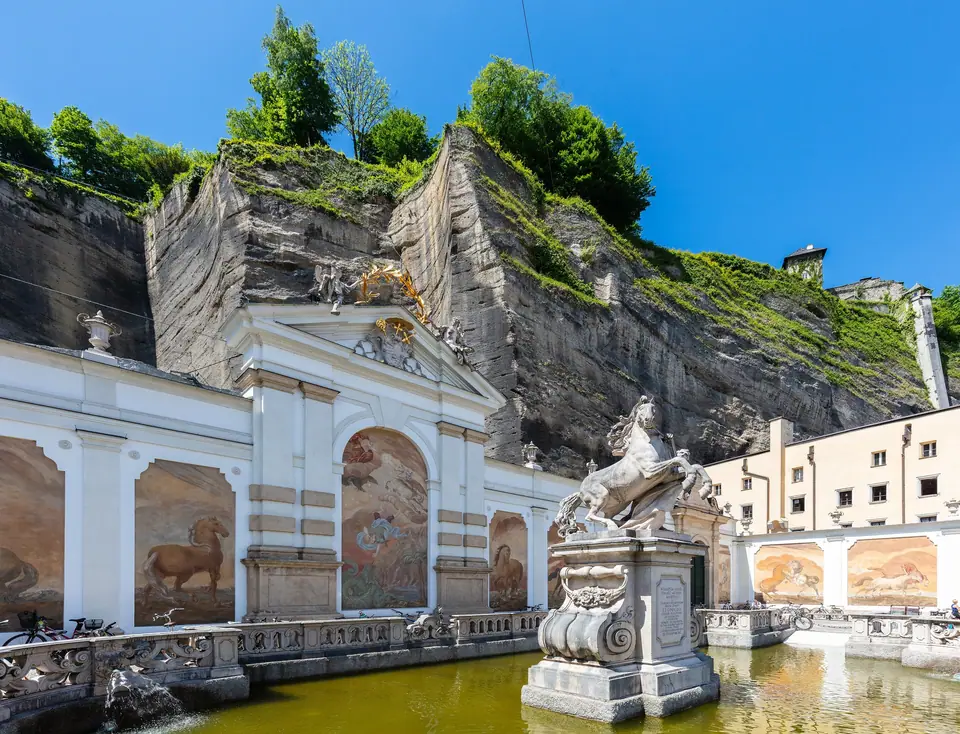
Walk west to Herbert-von-Karajan-Platz to admire Fischer von Erlach's 1695 Pferdeschwemme (Archbishops' Horse Pond). Michael Bernhard Mandl's marble statue of a rearing stallion trainer stands in front of Franz Anton Ebner's 1732 frescoes of sixty painted horses. Beside it opens the 1765 Siegmundstor (Neutor), a 131-metre-long road tunnel chiselled straight through the Mönchsberg cliff. Running south along Hofstallgasse inside the former seventeenth-century court stables and rock quarries is the 350-metre complex of the Salzburg Festival Halls (Festspielhäuser):
- The Felsenreitschule (Summer Riding School, 1693). Prince-Archbishop Johann Ernst von Thun quarried conglomerate stone from the Mönchsberg to build the Holy Trinity Church. In 1693, he instructed Fischer von Erlach to carve 96 three-tiered stone arcades directly into the vertical quarry wall as a spectator gallery for equestrian tournaments. Since Max Reinhardt staged Carlo Goldoni's Servant of Two Masters here in 1926, it has served as an open-air opera stage. It is also the venue where the von Trapp family sings at the festival in the 1965 film The Sound of Music.
- Haus für Mozart (Kleines Festspielhaus, 1925). Originally converted from the winter riding school in 1925, this hall was rebuilt by Clemens Holzmeister in 1937 and Wilhelm Holzbauer in 2006 (1,495 seats). Its foyers feature Anton Faistauer's frescoes and a golden acoustic shell.
- Grosses Festspielhaus (Large Festival Hall, 1956 to 1960). Architect Clemens Holzmeister blasted 55,000 cubic metres of rock out of the Mönchsberg cliff face. That excavation created a 2,179-seat opera auditorium with a 100-metre-wide stage. Herbert von Karajan opened the hall on 26 July 1960 conducting Richard Strauss's Der Rosenkavalier. Its marble foyer features Oskar Kokoschka tapestries and bronze doors by Toni Schneider-Manzell.
4. Crossing to the Right Bank: Mozart's Residence (Mozart-Wohnhaus) at Makartplatz 8
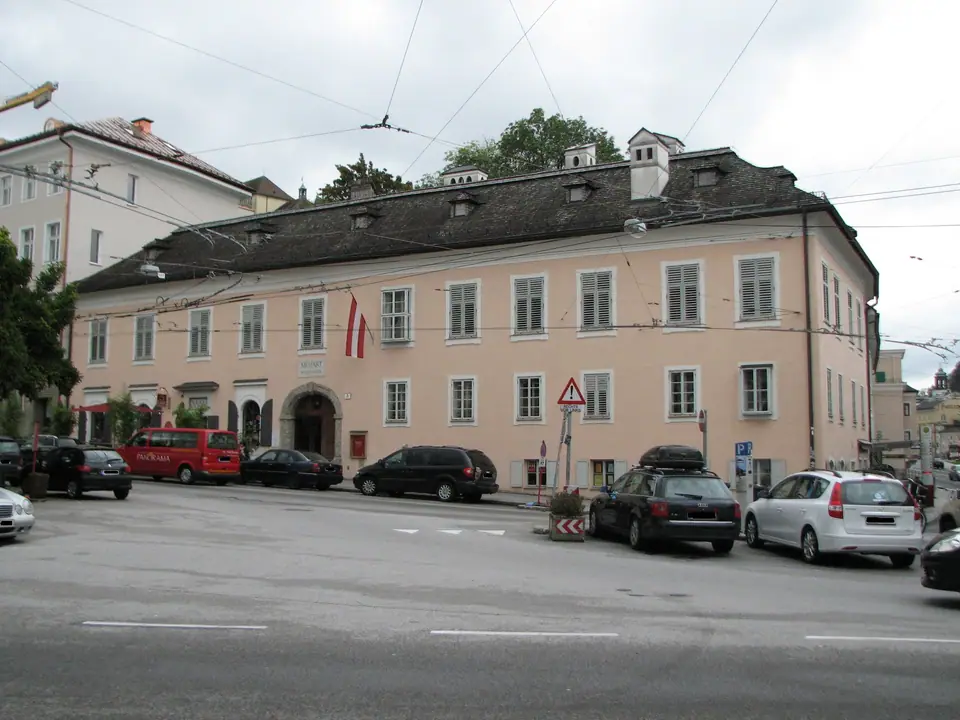
To complete the Mozart story, walk three minutes north to the Salzach River and cross the pedestrian Marko-Feingold-Steg footbridge to Makartplatz 8 on the Right Bank. By autumn 1773, the three-room Getreidegasse apartment had grown too small for the Mozart family. Leopold Mozart leased an eight-room first-floor apartment inside the Tanzmeisterhaus ("Dancing Master's House") on Makartplatz 8.
Wolfgang Amadeus Mozart lived and composed here from 1773 until he moved permanently to Vienna in 1781. He wrote over 150 works in these rooms, including his five Violin Concertos, Symphony No. 29 in A major, and the opera Idomeneo. An aerial bomb destroyed two-thirds of the building on 16 October 1944. The Mozarteum Foundation purchased the surviving wing in 1955 and reconstructed the historic facade in 1996. Included free on the Salzburg Card, the Tanzmeistersaal displays Mozart's original Hammerflügel fortepiano (built by Anton Walter) and his viola. You can also admire the 1780 to 1781 Della Croce family portrait, just two minutes' walk from Mirabell Palace and Gardens.
Traveller tips
Real advice from people who have been to Salzburg. Every tip is read by our team before it goes live.
No tips yet. Been here? Yours could be the first.
Thank you! Your tip will appear here after a quick review.
More in Salzburg
Continue exploring Salzburg with related neighbourhood, food, and planning guides
Best Time to Visit Salzburg: GeoSphere Austria Climate Normals, Salzburg Festival & Christkindlmarkt
Salzburg, Austria
What to Wear in Salzburg: Alpine Schnürlregen Rain Gear, Cobblestone Footwear & Festspielhaus Dress Code
Salzburg, Austria
Where to Stay in Salzburg: Left Bank Altstadt, Right Bank Neustadt, Mülln, Nonntal & Leopoldskron Compared
Salzburg, Austria
Salzburg 3-Day Itinerary: Old Town Domes, Hohensalzburg, Mozart & Mirabell, Hellbrunn & Salzkammergut Lakes
Salzburg, Austria
