





















Mirabell Palace & Marble Hall, Pegasus Fountain, Linzer Gasse & Kapuzinerberg Bastion Walk
Explore Salzburg's Right Bank: the 1606 Mirabell Palace, Marble Hall, and Angel Staircase, the Pegasus Fountain and Dwarf Garden, St. Sebastian's Cemetery on Linzer Gasse, and the Kapuzinerberg walk.
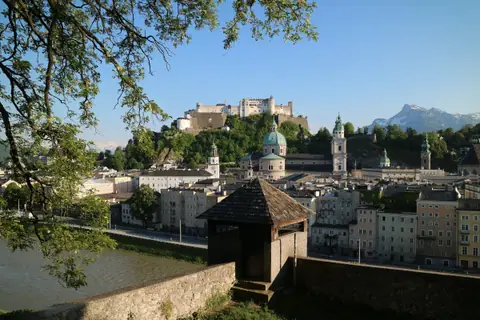
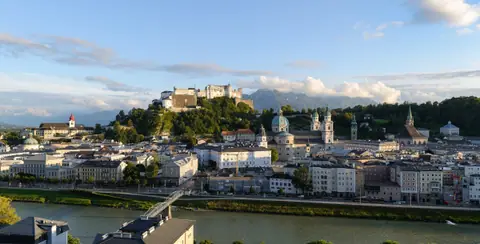
Across the Salzach River from the medieval towers of the Left Bank unfolds the sunlit Right Bank (Rechtes Salzachufer). The Left Bank was built for church ritual and military defence. By contrast, the Right Bank owes its signature landmark to a love story that defied seventeenth-century canon law. In 1606, Prince-Archbishop Wolf Dietrich von Raitenau built a country pleasure palace outside the city walls. He dedicated the estate to his beloved companion Salome Alt and their fifteen children. Paired with the artisan lane of Linzer Gasse, the Italianate arcades of St. Sebastian's Cemetery, and the wooded bastion trails of the 636-metre Kapuzinerberg, the Right Bank fills a rewarding half-day walk.
1. Mirabell Palace (Schloss Mirabell): Salome Alt, the Angel Staircase & Marble Hall
When Wolf Dietrich built the original residence in 1606, he combined his companion Salome Alt's name with his own to call it Schloss Altenau. After Wolf Dietrich was deposed and imprisoned inside Hohensalzburg Fortress in 1612, his nephew and successor Markus Sittikus von Hohenems expelled Salome Alt. He renamed the palace Mirabell, from the Italian words mirabile and bella ("admirable and beautiful"). Between 1721 and 1727, court architect Johann Lukas von Hildebrandt rebuilt the wings into a four-sided Baroque palace. After a city fire on 30 April 1818, court architect Peter de Nobile restored the exterior in clean neoclassical style.
Today Mirabell Palace houses the offices of the Mayor and Municipal Council of Salzburg. Its two finest surviving Baroque interiors escaped the 1818 fire. Both are free to enter during municipal opening hours when no wedding or concert is in progress:
- The Angel Staircase (Engelsstiege, 1723 to 1727). Lukas von Hildebrandt designed this west-wing staircase, and sculptor Georg Raphael Donner carved it from white Untersberg marble. Playful marble cherubs (Putti) tumble along the curving banister, while classical statues of Paris, Venus, and Hercules stand in arched wall niches.
- The Marble Hall (Marmorsaal). At the top of the Angel Staircase opens the gilded baroque banqueting hall of the Prince-Archbishops. Pink and grey marble pilasters frame intricate stucco work by Giuseppe Mazza. Here Leopold Mozart brought eight-year-old Wolfgang and twelve-year-old Nannerl to perform for the court. Today the hall hosts over 1,000 civil weddings a year and evening candlelit chamber concerts by the Schlosskonzerte Mirabell.
2. Walking Mirabell Gardens: Visual Axis, Pegasus Fountain, Hedge Theatre & Dwarf Garden
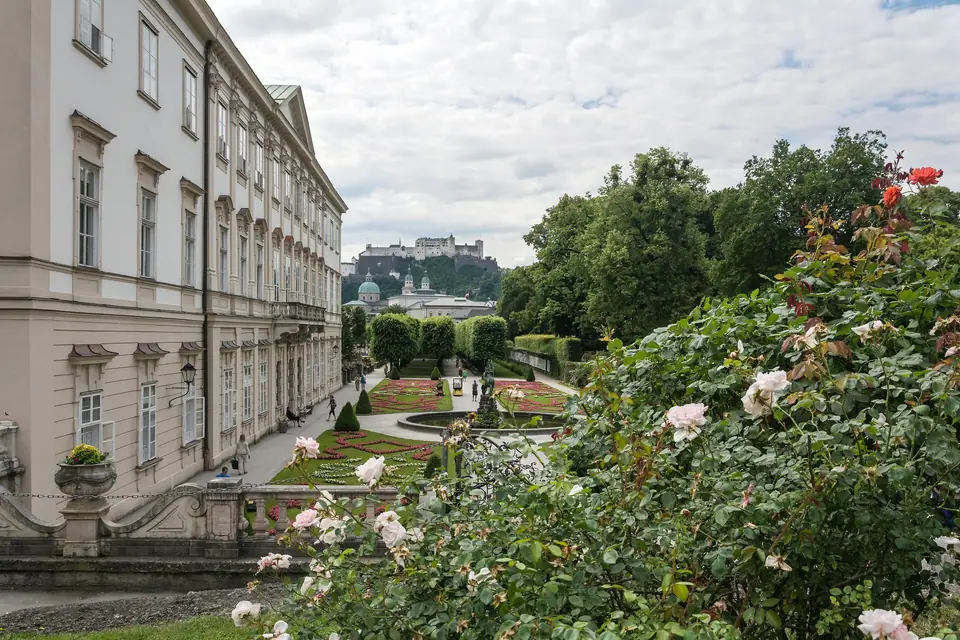
Around 1690, Prince-Archbishop Johann Ernst von Thun commissioned imperial architect Johann Bernhard Fischer von Erlach to redesign the Mirabell Gardens (Mirabellgarten). He aligned the parterres along a north-south optical axis aimed straight at the twin towers of Salzburg Cathedral and the ramparts of Hohensalzburg Fortress. Open daily free of charge from dawn to dusk, the gardens contain six classic stops:
- The Grand Parterre & Four Elements Statues (1690). Flanking the central fountain stand four marble sculpture groups carved by Ottavio Mosto in 1690. The statues depict four mythological abductions representing Fire, Air, Water, and Earth. Look for Aeneas carrying Anchises, Hercules and Antaeus, Paris and Helen, and Pluto and Persephone.
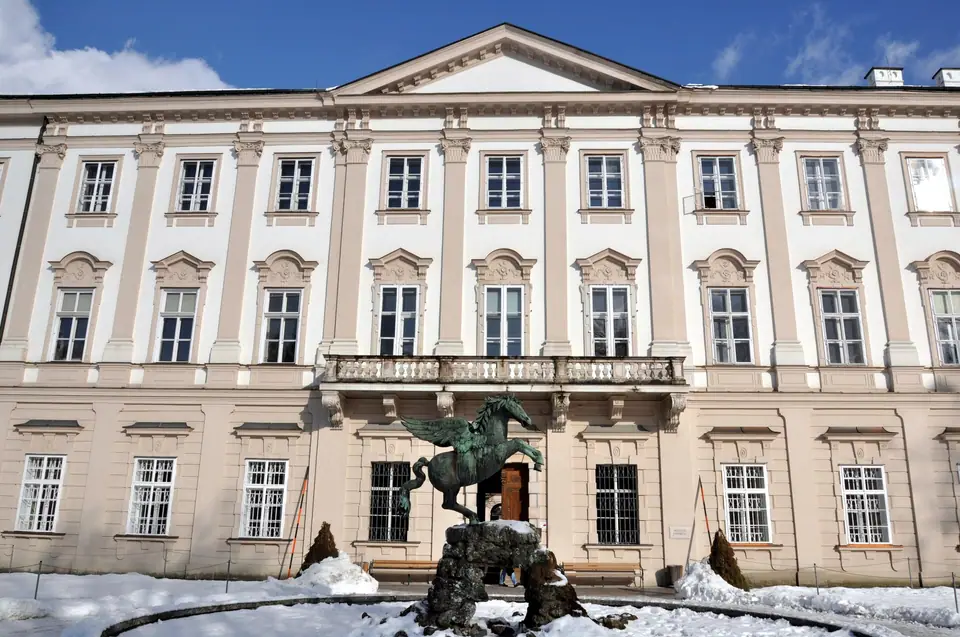
- The Pegasus Fountain (Pegasusbrunnen, 1661). In front of the western palace wing rises a bronze rearing winged horse cast in 1661 by Kaspar Gras of Innsbruck and moved here in 1913. In the 1965 film The Sound of Music, Julie Andrews and the seven children dance around the Pegasus Fountain basin. They finish "Do-Re-Mi" on the stone "Do-Re-Mi Steps" (Singtreppe) flanked by unicorn statues at the northern rose-arbour terrace.
- The Orangery (1725) & Rose Garden. South of the palace facade, delicate wrought-iron grilles enclose the geometric beds of the Rose Garden beside the glass-walled 1725 Orangery palm house.
- The Hedge Theatre (Heckentheater, 1704 to 1718). This outdoor venue sits inside the western hornwork bastion of Count Paris Lodron's seventeenth-century fortifications. It is one of the oldest preserved open-air hedge theatres north of the Alps, where trimmed hornbeam hedges form natural stage wings.
- The Dwarf Garden (Zwergelgarten, circa 1690 to 1695). Directly atop the Lodron water bastion stands Europe's oldest Baroque dwarf garden. Modelled on real members of the court retinue under Fischer von Erlach, 17 white Untersberg marble statues portray seasonal allegories and tradespeople.
- The Magic Flute Cottage at the Mozarteum. Bordering the southern edge of the gardens at Schwarzstrasse 26 stands the 1914 Art Nouveau complex of the International Mozarteum Foundation. Its bastion garden houses the wooden pavilion brought from Vienna where Mozart composed The Magic Flute in 1791.
3. Linzer Gasse, St. Sebastian's Cemetery & climbing Kapuzinerberg (636 m)
From Mirabellplatz, walk five minutes southeast through Dreifaltigkeitsgasse to pedestrianised Linzer Gasse, the old arterial trade road leading east toward Linz and Vienna. At Linzer Gasse 41, step through the rococo portal beside St. Sebastian's Church into the tranquil square arcade of St. Sebastian's Cemetery (Sebastiansfriedhof). Prince-Archbishop Wolf Dietrich von Raitenau commissioned the burial ground between 1595 and 1600. Italian architect Andrea Bergano modelled its 89 vaulted arcades after an Italian Campo Santo, sheltering three famous graves:
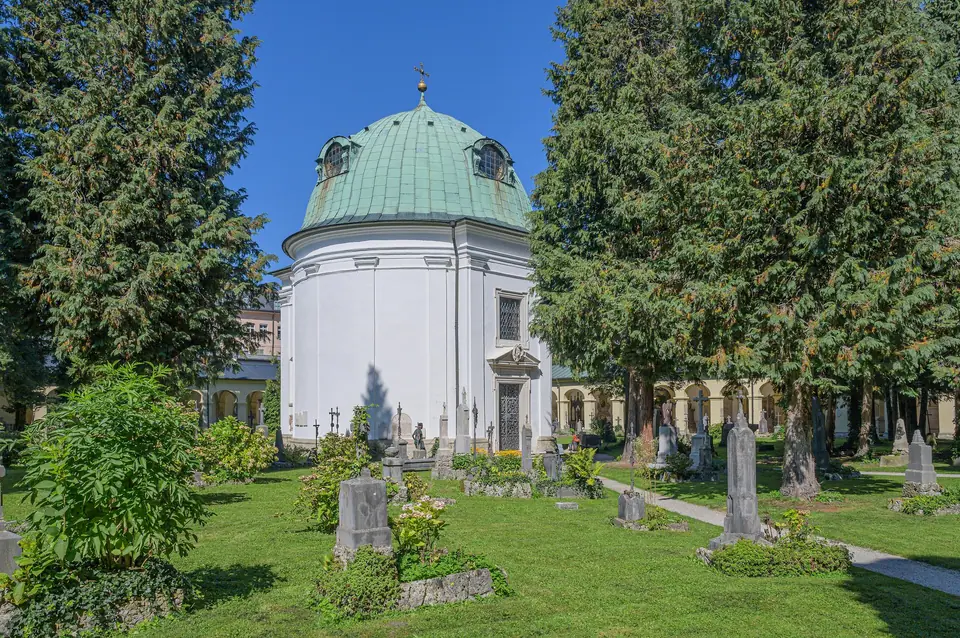
- The Mausoleum of Wolf Dietrich von Raitenau (1597 to 1603). Standing at the exact centre of the cemetery is circular St. Gabriel's Chapel. Its interior walls shine with polychrome glazed ceramic tiles (majolica), where the deposed Prince-Archbishop was buried in 1617.
- The Mozart Family Grave. Along the central path rest Mozart's father Leopold Mozart (died 1787) and Mozart's widow Constanze Weber-Nissen (died 1842). Beside them lies her second husband and Mozart biographer Georg Nikolaus von Nissen.
- The Tomb of Paracelsus (1493 to 1541). Inside the entrance vestibule stands the marble pyramid monument of Renaissance physician and philosopher Theophrastus Bombastus von Hohenheim (Paracelsus). He died in Salzburg on 24 September 1541 and left his belongings to the city's poor.
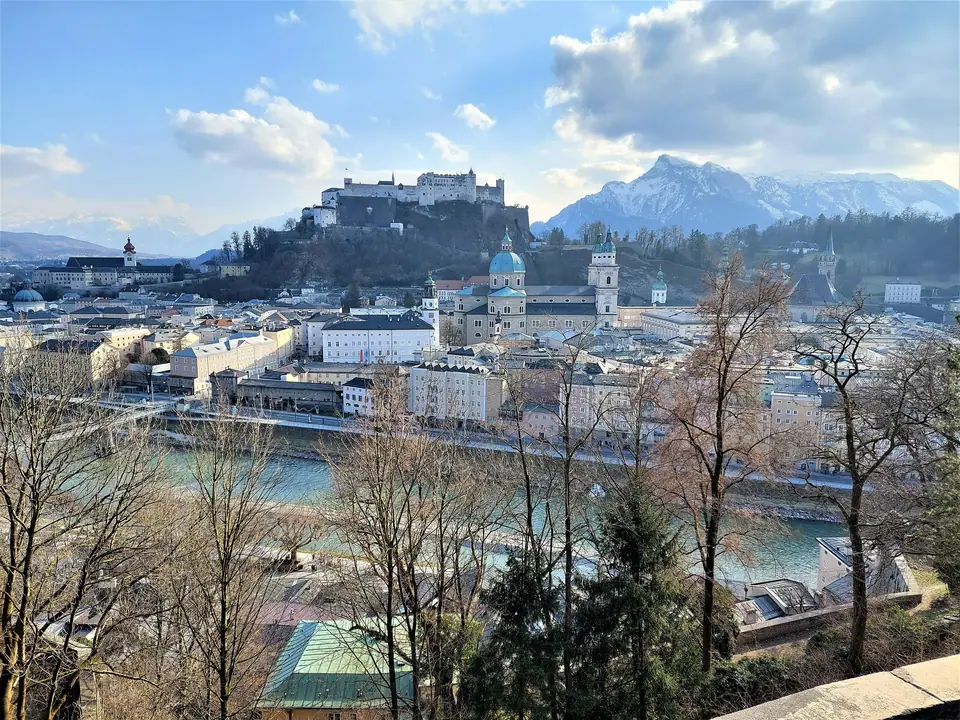
To finish with an elevated panorama of the Left Bank and Fortress, climb onto the forested dolomite massif of the Kapuzinerberg (636 metres). One option is climbing the 250 covered stone steps of the Imbergstiege rising from medieval Steingasse 9. Alternatively, pass through the arched gate at Linzer Gasse 14 and follow the Stefan-Zweig-Weg past six baroque Passion Chapels (1736 to 1744). At the top of the ramp stand the Felixpforte gate and a 1797 Mozart memorial bust. Just beyond rises the 1599 Capuchin Monastery (Kapuzinerkloster) above the Hettwer-Bastei stone parapet. If you have an extra hour, follow the quiet beech-forest trail along the 1629 Thirty Years' War city wall battlements. That path reaches the crenellated 1650 citadel of the Franziskischlössl before you descend to Linzer Gasse for coffee and strudel.
Traveller tips
Real advice from people who have been to Salzburg. Every tip is read by our team before it goes live.
No tips yet. Been here? Yours could be the first.
Thank you! Your tip will appear here after a quick review.
More in Salzburg
Continue exploring Salzburg with related neighbourhood, food, and planning guides
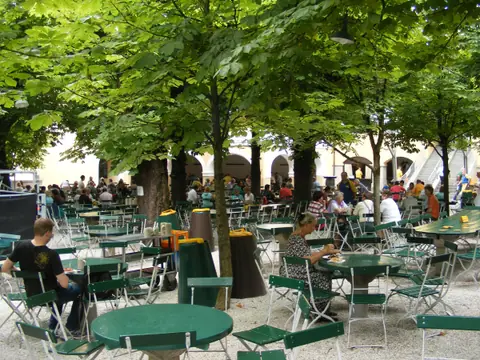
Augustiner Bräu Mülln Monastery Brewery, Stiegl-Brauwelt Museum & Salzburg Beer Culture Guide
Salzburg, Austria
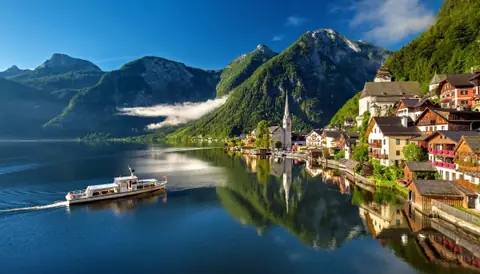
Hallstatt, St. Wolfgang & Schafbergbahn, Bad Ischl & Berchtesgaden Salt Mine Day Trips from Salzburg
Salzburg, Austria
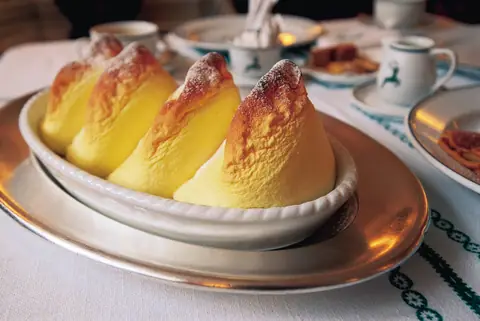
What to Eat in Salzburg: Salzburger Nockerl, Original Fürst Mozartkugel, Kasnocken, Bosna & Café Tomaselli
Salzburg, Austria
Salzburg Orientation: Salzach River Divide, Left Bank Altstadt, Right Bank Neustadt & Salzburg Card
Salzburg, Austria
