


























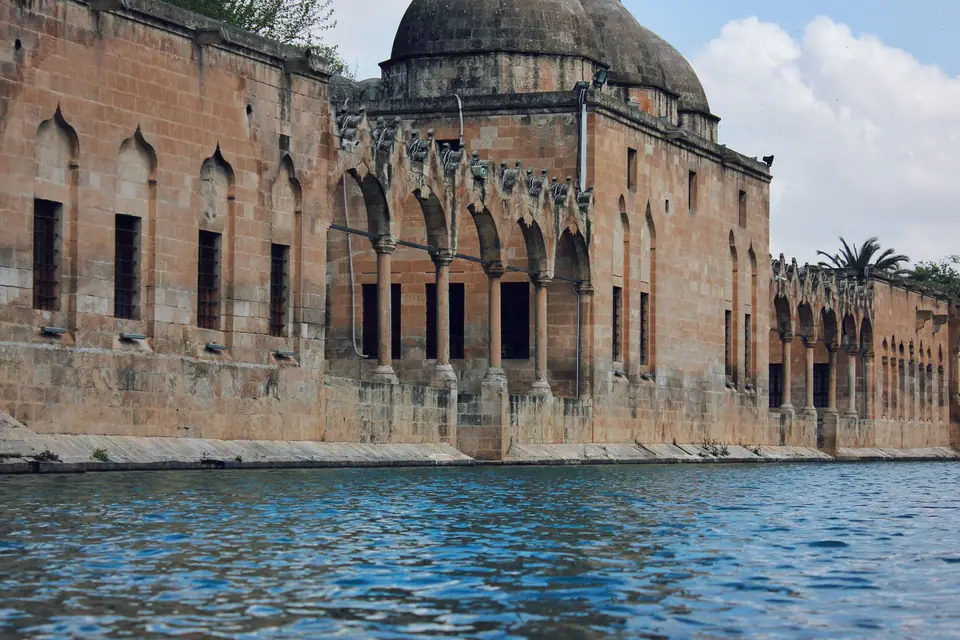
Urfa Castle (Twin Columns) and the Illuminated Kızılkoyun Rock Necropolis
Walking through sixty 2nd-century AD Roman rock-cut tombs at Kızılkoyun and viewing the Twin Columns of Urfa Castle.
Before it was Ottoman Urfa, the city was Edessa (Orhai in Syriac), founded by Seleucus I Nicator in 303 BC and ruled from 132 BC to 244 AD by the independent Abgarid Dynasty of the Kingdom of Osroene (celebrated in Christian history as the first kingdom to adopt Christianity as its official state religion under King Abgar VIII). The defensive heart and royal cemeteries of ancient Edessa are carved directly into the limestone hills between the Archaeology Museum and Balıklıgöl.
1. Kızılkoyun Roman Necropolis (Directly Opposite the Archaeology Museum, Free 24/7)
Right across the street from the entrance plaza of the Haleplibahçe Mosaic Museum rises a dramatic terraced limestone hill. For decades this slope was hidden underneath hundreds of 20th-century concrete shanty houses; when Şanlıurfa Municipality demolished the modern houses and excavated the hill between 2012 and 2020, they uncovered more than sixty intact 2nd- to 4th-century AD Roman and Edessan monumental rock-cut chamber tombs. Today it is an open-air archaeological park with wooden walkways and dramatic night lighting (completely free to walk through day and night):
- What to look for inside the tombs: step through the carved stone portals (originally sealed by heavy rolling circular millstone doors, several of which still stand in their rock tracks) to see triple arched burial niches (arcosolia), stone sarcophagi carved with garlands, peacocks, Medusa heads and Syriac/Greek inscriptions, and mosaic floors.
- Visit at Dusk: in the early evening, warm amber spotlights illuminate every single cave portal across the hillside, making it a sweeping 30-minute walk before dinner.
2. Urfa Castle (Urfa Kalesi) and the Twin Columns ("Nimrod's Throne")
Rising on the rocky ridge of Damlacık Hill directly above the southern shore of Balıklıgöl stands Urfa Castle, fortified in 814 AD under the Abbasids and expanded by the Crusaders (as the County of Edessa, 1098 to 1144), Zengids and Ottomans, protected on three sides by a colossal 400-metre-long, 15-metre-deep defensive moat chiselled entirely by hand out of the solid limestone bedrock. Rising 17 metres into the sky on the summit are the two landmark Corinthian columns known in local folklore as the catapult of King Nimrod; in reality, a Syriac (Estrangelo) inscription carved onto the shaft of the eastern column records that it was erected in 240 AD as a funerary monument in honour of Queen Shalmath, wife of King Ma'nu IX of Edessa..
Traveller tips
Real advice from people who have been to Urfa Castle (Twin Columns) and the Illuminated Kızılkoyun Rock Necropolis. Every tip is read by our team before it goes live.
No tips yet. Been here? Yours could be the first.
Thank you! Your tip will appear here after a quick review.
More in Sanliurfa
Continue exploring Sanliurfa with related neighbourhood, food, and planning guides
Walking Old Urfa: Stone Mansions (Konaklar), Kabaltı Tunnels, Ulu Cami and Reji Church
Sanliurfa
The Shrine of Prophet Job (Eyyüp Peygamber Makamı) and Germuş Armenian Church
Sanliurfa
Day Trip West to Sunken Halfeti, Rumkale and the Bald Ibis of Birecik
Sanliurfa
Getting to Şanlıurfa: GAP Airport (GNY) Havaş Coaches and Overland Connections
Sanliurfa
