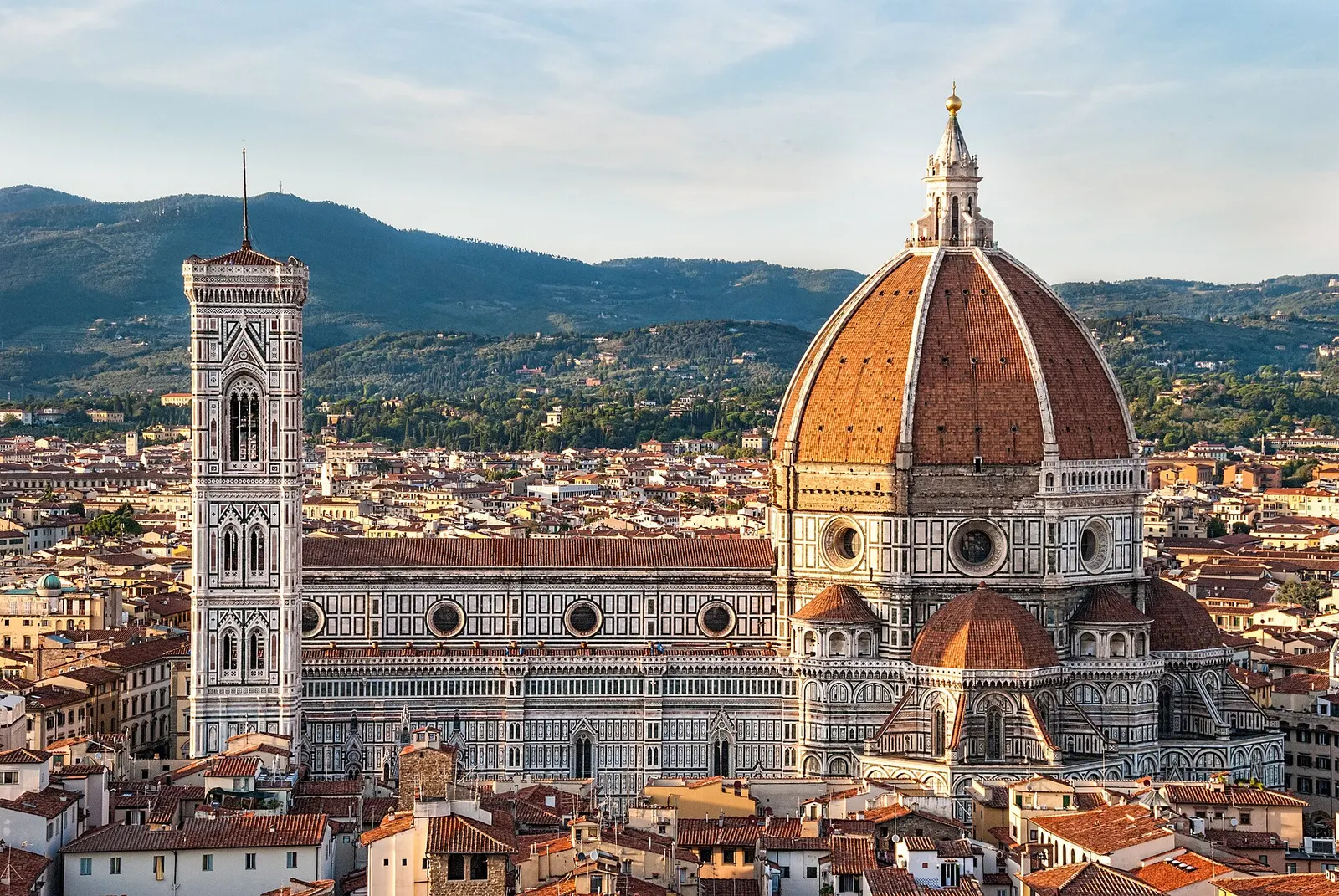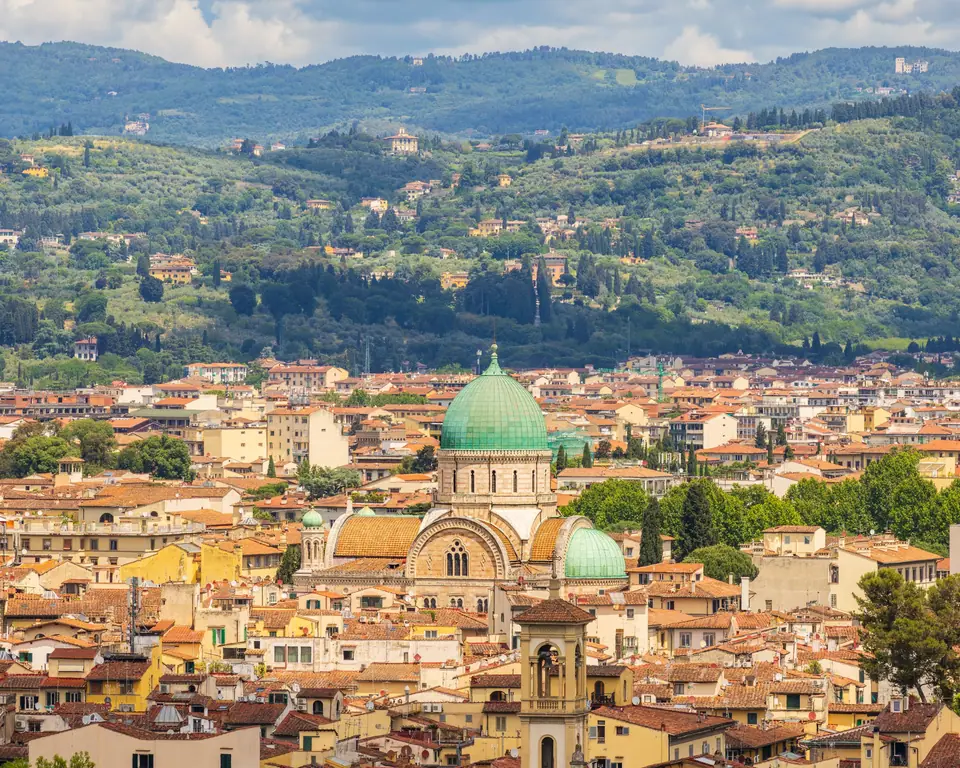
Florence is the most concentrated Renaissance city in Europe, and also one of the most compact. Between the railway platforms of Santa Maria Novella in the north-west, the Franciscan square of Santa Croce in the south-east and the hillside terraces of the Oltrarno across the Arno River, twenty minutes on foot takes you past buildings, sculptures and paintings that reshaped Western art between 1300 and 1550. The entire historic centre was inscribed as a UNESCO World Heritage Site in 1982, and almost every street inside the medieval ring boulevards still follows the geometry laid down by Roman Florentia and the merchant guilds of the wool, silk and banking boom.
This complete interactive route guide maps all 100 essential landmarks, museums, churches, palaces, cloisters, markets, bridges, gardens and viewpoints in Florence in geographical walking order across ten neighbourhood zones. Inside the article on the left we include only four section photographs so the text stays fast and easy to read; as you scroll down through all 100 stops (or click any numbered chip or map pin), the stage on the right automatically switches to that stop's photograph, summary and exact location on the live map. For hotel and transport planning, pair this 100-stop atlas with our Florence destination page and our Florence travel guide.
Roman Florentia, Wool Guilds and the Medici Renaissance
Founded in 59 BC by Julius Caesar as a settlement for veteran Roman soldiers at the narrowest crossing of the Arno River, Florentia still preserves its ancient Roman castrum grid around present-day Piazza della Repubblica. During the twelfth and thirteenth centuries, the self-governing Republic of Florence rose to become one of Europe richest mercantile and banking powers, driven by the wool guild (Arte della Lana), the silk guild (Arte della Seta) and the minting in 1252 of the gold florin, which quickly became the standard trade currency of the Mediterranean and western Europe.
Despite bitter factional struggles between Guelphs and Ghibellines and the devastation of the Black Death in 1348, guild patronage and civic rivalry ignited the Italian Renaissance at the turn of the fifteenth century. Under the de facto leadership of Cosimo il Vecchio and Lorenzo the Magnificent of the Medici banking family, architects and artists including Filippo Brunelleschi, Donatello, Masaccio, Fra Angelico, Sandro Botticelli, Leonardo da Vinci and Michelangelo transformed the walled city with the self-supporting Cathedral dome, perspective frescoes, rusticated stone palaces and public marble sculpture. Elevated to the capital of the Grand Duchy of Tuscany in 1569 and briefly serving as the capital of unified Italy from 1865 to 1871, Florence remains a remarkably compact Renaissance city whose historic core can be crossed on foot in thirty minutes.
Piazza del Duomo and the Sacred Heart
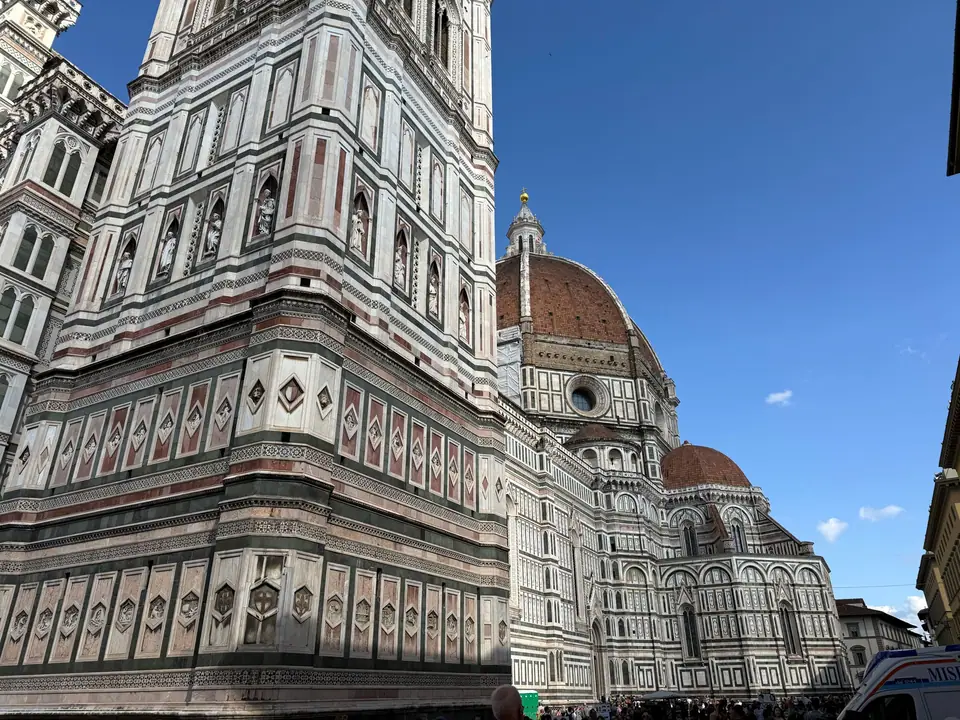
Piazza del Duomo is the sacred centre of gravity of Florence, where the cathedral, dome, bell tower, baptistery, crypt and cathedral museum operate under the unified Opera di Santa Maria del Fiore ticket passes. See our Duomo and Piazza della Signoria guide for pass comparisons.
Cathedral of Santa Maria del Fiore (Il Duomo)
Begun by Arnolfo di Cambio in 1296 over the early Christian basilica of Santa Reparata, Florence’s cathedral is the fourth-largest church in Europe, clad in white Carrara, green Prato and pink Maremma marble. Inside the austere Gothic nave, look for Paolo Uccello’s 1443 counter-clockwise liturgical clock face, Andrea del Castagno’s equestrian fresco of Niccolò da Tolentino and Domenico di Michelino’s 1465 painting of Dante holding the Divine Comedy before the walls of Florence.
Brunelleschi's Dome (Cupola del Brunelleschi)
Vaulted between 1420 and 1436 by Filippo Brunelleschi without wooden centring on the church floor, the octagonal dome uses two concentric brick shells laid in a self-supporting herringbone bond (spina di pesce). Climbing the 463 steps with the official Brunelleschi Pass takes you between the inner and outer shells, past Giorgio Vasari and Federico Zuccari’s Last Judgement frescoes, and out onto the marble lantern 91 metres above the square.
Giotto's Campanile (Bell Tower)
Begun by Giotto di Bondone in 1334, continued by Andrea Pisano with hexagonal relief panels of human crafts and completed by Francesco Talenti in 1359, the 84.7-metre bell tower is climbed via 414 steps. Its intermediate terraces and summit platform give you the single best frontal view of Brunelleschi’s red-brick dome right next door.
Baptistery of San Giovanni
Consecrated in 1059 opposite the cathedral’s west doors, the octagonal Baptistery of San Giovanni is where Dante Alighieri and generations of the Medici dynasty were baptised. Inside, its eight-sided cupola glitters with 13th-century golden mosaics of Christ in Judgement and scenes from Genesis created by Venetian and Florentine masters including Cimabue.
Gates of Paradise (Porta del Paradiso)
On the east portal of the Baptistery facing the Duomo stand the faithful replicas of Lorenzo Ghiberti’s ten gilded bronze relief panels cast between 1425 and 1452, which Michelangelo famously praised as worthy to be the Gates of Paradise (the conserved originals gleam inside the nearby Museo dell’Opera del Duomo). Compare them with Ghiberti’s earlier north doors and Andrea Pisano’s 1330s south doors.
Crypt of Santa Reparata
Reached via a staircase inside the Cathedral nave, the archaeological zone of Santa Reparata reveals the 5th-century basilica that stood here before Arnolfo di Cambio began the new cathedral in 1296. You walk across intact early Christian geometric mosaic pavements inlaid with Latin donor names, early medieval fresco fragments and the tomb slab of Filippo Brunelleschi himself.
Museo dell'Opera del Duomo (Cathedral Museum)
Founded in 1296 as the workshop of the cathedral builders, the Opera del Duomo Museum displays the original sculptures removed from the exterior monuments: Ghiberti’s original gilded Gates of Paradise facing a full-scale reconstruction of Arnolfo’s medieval facade, Donatello’s wooden Penitent Magdalene and prophet Habakkuk, Luca della Robbia’s marble Cantoria and Michelangelo’s Bandini Pietà.
Loggia del Bigallo
Built between 1352 and 1358 by Alberto Arnoldi for the Compagnia della Misericordia and the Captains of the Bigallo, this delicate two-arched Gothic marble porch at the corner of Via dei Calzaiuoli was where lost or abandoned children were displayed for three days so their parents could claim them before they were taken into care.
Museo della Misericordia
Founded in 1244 by St Peter Martyr, the Arciconfraternita della Misericordia is the oldest active volunteer ambulance and charity brotherhood in the world. Its fourth-floor museum on Piazza del Duomo displays black hooded plague robes, 16th-century hand-carried litters, works by Santi di Tito and Benedetto da Maiano, and windows looking straight across at Giotto’s Campanile.
Palazzo Arcivescovile (Archbishop's Palace)
Redesigned after a 1533 fire by Giovanni Antonio Dosio and restructured in the late 19th century when the square around the Baptistery was widened, the Archbishop’s Palace closes the western flank of Piazza San Giovanni with a balanced classical facade and an arcaded inner courtyard.
The Medici Quarter and San Lorenzo
Immediately north of the Duomo lies the district shaped by Cosimo de’ Medici the Elder and Lorenzo the Magnificent: family palaces, Brunelleschi’s parish basilica, Michelangelo’s library and tombs, and the cast-iron market hall of San Lorenzo.
Palazzo Medici Riccardi
Built by Michelozzo between 1444 and 1460 on Via Cavour for Cosimo de’ Medici the Elder, this palace defined Renaissance domestic architecture with its three-tiered stonework, rough rusticated boulders at street level, drafted stone on the piano nobile and smooth ashlar under a bold classical cornice, plus a columned courtyard and walled lemon garden.
Chapel of the Magi (Cappella dei Magi)
On the first floor of Palazzo Medici Riccardi sits the family’s tiny private chapel, painted floor to ceiling in 1459 by Benozzo Gozzoli. Its continuous fresco of the Procession of the Magi winds across rocky Tuscan hills and includes portraits of Cosimo de’ Medici, a young Lorenzo the Magnificent on a white horse, Byzantine Emperor John VIII Palaiologos and Gozzoli himself.
Basilica of San Lorenzo
Behind an unfinished brick facade for which Michelangelo carved a wooden model, Filippo Brunelleschi’s interior of San Lorenzo is a masterclass in early Renaissance mathematical proportion using grey pietra serena columns and white plaster walls. Near the crossing stand Donatello’s two late bronze pulpits, and in the floor before the high altar lies the porphyry and marble tomb marker of Cosimo Pater Patriae.
Old Sacristy of San Lorenzo (Sagrestia Vecchia)
Opening off the left transept of San Lorenzo, the Old Sacristy was designed by Filippo Brunelleschi between 1421 and 1428 as a pure cube topped by a twelve-ribbed umbrella dome, decorated with polychrome stucco roundels and bronze doors by Donatello and an astronomical fresco of the July 1442 night sky over Florence inside the altar cupola.
Laurentian Library (Biblioteca Medicea Laurenziana)
Entered from the upper cloister of San Lorenzo, the Laurentian Library was commissioned in 1524 by Pope Clement VII (Giulio de’ Medici) to house the family’s Greek and Latin manuscripts. Michelangelo broke classical rules in the high vestibule (Ricetto), setting paired columns inside wall niches above a triple stone staircase that pours down from the reading room doorway.
The Medici Chapels & Chapel of the Princes
Entered from Piazza di Madonna degli Aldobrandini behind San Lorenzo, the Medici Chapels lead from the vaulted crypt into the colossal octagonal Chapel of the Princes (Cappella dei Principi), begun in 1604 andveneered entirely in inlaid porphyry, granite, mother-of-pearl, lapis lazuli and coral (commesso fiorentino) beneath Pietro Benvenuti’s frescoed dome.
Michelangelo's New Sacristy (Sagrestia Nuova)
Conceived by Michelangelo from 1520 as a counterpart to Brunelleschi’s Old Sacristy, the New Sacristy inside the Medici Chapels unites grey stone architecture with marble sculpture. Reclining on the curved sarcophagi of Giuliano Duke of Nemours and Lorenzo Duke of Urbino are Michelangelo’s haunting figures of Night and Day and Dawn and Dusk, facing his unfinished Medici Madonna.
Mercato Centrale (San Lorenzo Market Hall)
Designed in 1874 by Giuseppe Mengoni, the architect of Milan’s Galleria Vittorio Emanuele II, the two-storey Mercato Centrale houses traditional morning butchers, tripe and lampredotto carts, fishmongers, cheese counters and schiacciata bakeries on the ground floor, with a lively all-day Tuscan food hall and wine bar upstairs.
Cenacolo di Sant'Apollonia (Castagno's Last Supper)
Inside the former refectory of the Benedictine convent of Sant’Apollonia on Via XXVII Aprile, Andrea del Castagno painted a strikingly modern Last Supper in 1447. Christ and the apostles sit inside an illusionistic pavilion of boldly veined marble panels, with Judas isolated on the near side of the white tablecloth beneath scenes of the Crucifixion, Entombment and Resurrection.
Palazzo Pucci
Stretching an entire block along Via de’ Pucci between Via Cavour and Via dei Servi, Palazzo Pucci was remodelled in the 16th century by Bartolomeo Ammannati for the Pucci family, close allies of the Medici, and later served as the historic atelier of Florentine fashion designer Emilio Pucci.
Accademia, San Marco and Santissima Annunziata
Continuing north-east from San Lorenzo brings you to Michelangelo’s original David at the Accademia (covered in our Uffizi and Accademia guide), Fra Angelico’s serene frescoes at San Marco, the 1545 Botanical Garden and the harmonious Renaissance portico of Piazza della Santissima Annunziata.
Galleria dell'Accademia & Michelangelo's David
Founded in 1784 on Via Ricasoli, the Galleria dell’Accademia centres on the 19th-century Tribune built to house Michelangelo’s 5.17-metre marble David (1501, 1504), approached through the Hall of the Prisoners lined with his four unfinished Slaves for Pope Julius II’s tomb. Do not miss the Gipsoteca Bartolini plaster hall, late Gothic gold-ground altarpieces and the Medici musical instruments collection.
Opificio delle Pietre Dure Museum
Just south of the Accademia at Via degli Alfani 78, the Opificio delle Pietre Dure was founded in 1588 by Grand Duke Ferdinando I de’ Medici to produce intricate hardstone mosaics (commesso fiorentino) for the Medici Chapels and royal courts across Europe. Its two-floor museum displays tabletops, cabinets, raw jasper and lapis lazuli samples, and historic stone-cutting workbenches.
Convent and Museum of San Marco (Fra Angelico Frescoes)
Rebuilt by Michelozzo for Cosimo de’ Medici in the 1430s, the Convent of San Marco preserves Fra Angelico’s altarpieces on the ground floor, Ghirlandaio’s Last Supper in the small refectory, and upstairs the famous Annunciation and forty-four individual contemplation frescoes painted inside the friars’ dormitory cells, ending at Savonarola’s rooms and Michelozzo’s vaulted library.
Basilica of San Marco
Adjoining the convent on Piazza San Marco, the Basilica of San Marco combines a 1780 neoclassical facade with a richly decorated single-nave interior containing a 14th-century painted crucifix on the high altar, Giambologna’s Salviati Chapel and the Renaissance wall tombs of humanist philosopher Giovanni Pico della Mirandola and poet Angelo Poliziano.
Chiostro dello Scalzo (Andrea del Sarto Frescoes)
A two-minute walk north of Piazza San Marco at Via Cavour 69, this small arcaded courtyard of the barefoot confraternity of St John the Baptist was painted between 1509 and 1526 by Andrea del Sarto and Franciabigio with sixteen monochrome (chiaroscuro) frescoes of the life of St John and the Four Virtues.
Palazzo Pandolfini (Designed by Raphael)
Further north at Via San Gallo 74 stands the only secular building in Florence built to a design by Raphael, drawn around 1516 for Bishop Giannozzo Pandolfini and executed by Giovanni Francesco and Bastiano da Sangallo with alternating triangular and segmental window pediments and a serene garden loggia.
Orto Botanico di Firenze (Giardino dei Semplici)
Laid out in 1545 by Luca Ghini and Niccolò Tribolo for Duke Cosimo I to cultivate medicinal plants (semplici), the 2.3-hectare botanical garden on Via Micheli preserves its original 16th-century geometric flowerbeds, a 19th-century taxodium tree and Victorian glasshouses filled with tropical ferns, orchids and cycads.
Museum of Geology and Paleontology
Located at Via Giorgio La Pira 4 between San Marco and the botanical garden, the University of Florence’s paleontology collection grew out of the 17th-century observations of Danish scientist Nicolas Steno at the Medici court and displays complete fossil skeletons of Valdarno mastodons, sabre-toothed cats and a Pliocene fossil whale unearthed in Tuscany.
Piazza della Santissima Annunziata
Framed on three sides by matching round-arched Corinthian porticos begun by Filippo Brunelleschi in 1419 and completed by Antonio da Sangallo the Elder and Bartolomeo Ammannati, Piazza della Santissima Annunziata is centered on Giambologna’s 1608 equestrian statue of Grand Duke Ferdinando I and Pietro Tacca’s two whimsical bronze fountains of marine creatures.
Basilica della Santissima Annunziata
Founded in 1250 by the seven Florentine founders of the Servite order, the basilica opens through a glass-roofed entrance atrium (Chiostrino dei Voti) painted with masterly High Renaissance frescoes by Andrea del Sarto, Pontormo and Rosso Fiorentino. Inside sit Michelozzo’smiraculous Annunciation tabernacle, a gilded carved ceiling and the Chiostro dei Morti containing Andrea del Sarto’s Madonna del Sacco.
Ospedale degli Innocenti (Foundling Hospital)
Designed by Filippo Brunelleschi in 1419 and funded by the Silk Guild (Arte della Seta) as Europe’s first dedicated children’s orphanage, the Ospedale degli Innocenti inaugurated Renaissance architecture with its nine semicircular arches and Andrea della Robbia’s blue-and-white glazed terracotta medallions of swaddled infants. Its museum houses Domenico Ghirlandaio’s 1488 Adoration of the Magi and a rooftop café overlooking the Duomo.
National Archaeological Museum of Florence
Housed in the 1620 Palazzo della Crocetta at the corner of Piazza della Santissima Annunziata, this museum holds the Medici and Lorraine antiquities, led by the 4th-century BC Etruscan bronze Chimera of Arezzo, the bronze Arringatore (Orator), the Greek black-figure François Vase and an extensive Egyptian collection second in Italy only to Turin.
Santa Maria Novella, Via de’ Tornabuoni and the West
The western wing of the historic centre runs from the great Dominican complex of Santa Maria Novella and its 1221 herbal pharmacy down the Renaissance palace avenue of Via de’ Tornabuoni to the Lungarno and Ognissanti.
Basilica of Santa Maria Novella
Facing the large square south of the central railway station, Santa Maria Novella unites a 14th-century Gothic lower facade with Leon Battista Alberti’s 1470 geometric white-and-green marble upper facade. Inside hang Masaccio’s ground-breaking perspective fresco of the Holy Trinity (c. 1427), Giotto’s painted crucifix, Domenico Ghirlandaio’s Tornabuoni Chapel behind the high altar and Filippino Lippi’s Strozzi Chapel.
Cloisters of Santa Maria Novella & Spanish Chapel
Adjoining the basilica, the Monumental Cloisters include the Chiostro Verde, painted in green-earth (terra verde) frescoes of Genesis and Noah’s Flood by Paolo Uccello, and the former chapter house known as the Spanish Chapel (Cappellone degli Spagnoli), covered floor to vault in 1365 by Andrea di Bonaiuto with an allegory of the Dominican order and an early depiction of Florence’s Duomo before it was even built.
Officina Profumo-Farmaceutica di Santa Maria Novella
Entered at Via della Scala 16 through a vaulted gallery, this historic apothecary was founded in 1221 by Dominican friars cultivating medicinal herbs in their monastery gardens. Entry to the neo-Gothic sales hall, frescoed 14th-century sacristy, green herbal room and pharmacy museum is free, where traditional rosewater, iris soaps and the 1533 Acqua della Regina perfume created for Catherine de’ Medici are still sold.
Museo Novecento (20th-Century Italian Art)
Directly opposite the facade of Santa Maria Novella beneath a 15th-century portico decorated with Della Robbia medallions, the former Spedale di San Paolo houses the Museo Novecento, showcasing 20th-century Italian paintings and sculptures by Giorgio de Chirico, Giorgio Morandi, Filippo de Pisis, Marino Marini and Florentine modernists.
Church of Santa Maria Maggiore
Standing along Via de’ Cerretani on 8th-century foundations and rebuilt in Gothic style in the 13th century, Santa Maria Maggiore preserves a rare polychrome relief of the Madonna by Coppo di Marcovaldo inside and, high up on its exterior north wall facing Via de’ Cerretani, the medieval marble female head known to Florentines as “Berta”.
Palazzo Antinori
Built between 1461 and 1469 by Giuliano da Maiano and purchased in 1506 by the Antinori family, vintners in Tuscany since 1385, Palazzo Antinori anchors the north end of Via de’ Tornabuoni with clean proportions, an arcaded courtyard garden and a ground-floor wine bar (Cantinetta Antinori) together with a small side-wall wine window (buchetta del vino).
Church of Santi Michele e Gaetano
Facing Palazzo Antinori, the Theatine church of San Gaetano was rebuilt between 1604 and 1648 by Matteo Nigetti and Gherardo and Pier Francesco Silvani. In a city dominated by Renaissance geometry, its theatrical stone facade of sculptural niches, scrolled pediments and marble draperies is the boldest work of Florentine Baroque architecture.
Palazzo Strozzi
Begun in 1489 by Benedetto da Maiano and Simone del Pollaiolo (Il Cronaca) for banker Filippo Strozzi after fifteen surrounding houses were demolished, Palazzo Strozzi is the grandest example of Florentine rusticated palace architecture, ringed by stone benches and wrought-iron lantern holders by Caparra. Its open courtyard is free, while the piano nobile hosts major international art exhibitions.
Palazzo Rucellai & Loggia Rucellai
Designed by humanist architect Leon Battista Alberti between 1446 and 1451 on Via della Vigna Nuova for wool merchant Giovanni Rucellai, this facade replaced fortress-like stone bosses with three classical orders of flat pilasters (Doric, Ionic and Corinthian) divided by entablatures carved with the Rucellai billowing-sail emblem, facing the three-arched Loggia Rucellai across the piazza.
Rucellai Sepulchre in San Pancrazio (Museo Marino Marini)
Around the corner from Palazzo Rucellai, the deconsecrated church of San Pancrazio now houses the Museo Marino Marini (displaying 20th-century equestrian bronzes and sculptures), and inside its side chapel sits one of the hidden wonders of the Quattrocento: Leon Battista Alberti’s 1467 inlaid green-and-white marble Tempietto del Santo Sepolcro, built as a scaled tribute to the Holy Sepulchre in Jerusalem.
Palazzo Corsini al Parione
Stretching along Lungarno Corsini between Ponte Santa Trinita and Ponte alla Carraia with a U-shaped rooftop balustrade crowned by terracotta statues, Palazzo Corsini was built between 1650 and 1737 by Pier Francesco Silvani and Antonio Ferri for the family of Pope Clement XII and houses an aristocratic private gallery with a spiral staircase and grotto.
Chiesa di Ognissanti (Botticelli & Vespucci Tombs)
Founded in 1251 by the Humiliati order of wool weavers and given Florence’s earliest Baroque travertine facade in 1637 by Matteo Nigetti, the Church of Ognissanti contains the round tomb slab of explorer Amerigo Vespucci, the tomb of Sandro Botticelli in the right transept chapels (near that of his muse Simonetta Vespucci), and opposing nave frescoes of St Augustine by Botticelli and St Jerome by Ghirlandaio.
Santa Trinita, Piazza della Repubblica and the Guild Quarter
Between the Arno and the site of the ancient Roman forum at Piazza della Repubblica stand Florence’s medieval merchant tower-houses, Renaissance palace museums and the guild shrines of Orsanmichele and Mercato Nuovo.
Cenacolo di Ognissanti (Ghirlandaio's Last Supper)
Entered through the cloister beside the Church of Ognissanti at Borgo Ognissanti 42, the former Franciscan refectory preserves Domenico Ghirlandaio’s serene 1480 fresco of the Last Supper, where the apostles dine before an open loggia of lemon trees, cypresses, peacocks and falcons that directly inspired Leonardo da Vinci’s later composition in Milan.
Basilica of Santa Trinita & Sassetti Chapel
At the southern end of Via de’ Tornabuoni, the Basilica of Santa Trinita houses two of Florence’s finest Renaissance chapels: the Bartolini Salimbeni Chapel painted by Lorenzo Monaco in the 1420s and the Sassetti Chapel in the right transept, painted between 1482 and 1485 by Domenico Ghirlandaio with scenes of St Francis set against accurate views of 15th-century Piazza Santa Trinita and Piazza della Signoria.
Piazza Santa Trinita & Column of Justice
In the centre of Piazza Santa Trinita rises a giant monolith of oriental granite taken from the Roman Baths of Caracalla and gifted by Pope Pius IV to Cosimo I de’ Medici in 1560. Dragged across Italy and erected here in 1565 to mark the defeat of Siena at Battle of Montemurlo, it is topped by Francesco Ferrucci del Tadda’s porphyry statue of Justice.
Palazzo Spini Feroni (Museo Salvatore Ferragamo)
Built in 1289 by banker Geri Spini at the corner of Piazza Santa Trinita and the Lungarno, this crenellated Gothic fortress-palace has served since 1938 as the headquarters of shoemaker Salvatore Ferragamo, whose subterranean vaulted cellars house a museum displaying more than ten thousand historic shoe designs created for Hollywood stars and royalty.
Palazzo Bartolini Salimbeni
Built between 1520 and 1523 by Baccio d’Agnolo across from the Column of Justice, Palazzo Bartolini Salimbeni shocked traditional Florentines with its Roman High Renaissance window pediments, recessed columns and deep chiaroscuro reliefs; in answer to critics, the architect carved the Latin motto “Carpere promptius quam imitari” (“Easier to criticise than to imitate”) over the portal.
Palazzo Davanzati (Museum of the Old Florentine House)
On Via Porta Rossa, Palazzo Davanzati was built in the mid-1300s by the Davizzi wool merchant family and bought in 1578 by the Davanzati. Spared 19th-century demolitions, its four storeys let you step inside an authentic medieval merchant home complete with an interior courtyard well system, 14th-century French-romance bedroom frescoes (Camera della Castellana di Vergy) and a top-floor kitchen.
Piazza della Repubblica & Column of Abundance
Located at the exact crossroads of Roman Florentia, marked by the grey granite Column of Abundance (Colonna dell’Abbondanza), Piazza della Repubblica took its current arcaded form in the 1885, 1895 urban clearance and remains home to the historic literary cafés Caffè Gilli (1733), Caffè Paszkowski and Giubbe Rosse around its vintage carousel.
Church and Museum of Orsanmichele
Rising on Via dei Calzaiuoli, Orsanmichele was built as an open grain loggia in 1337 and enclosed after 1380 as the church of Florence’s trade guilds (Arti). Its fourteen exterior Gothic niches hold replica statues by Donatello, Ghiberti, Verrocchio and Giambologna, while inside stand Andrea Orcagna’s 1359 marble-and-gold tabernacle and the upstairs museum housing the original sculptures.
Fontana del Porcellino & Loggia del Mercato Nuovo
Built between 1547 and 1551 by Giovanni Battista del Tasso for the sale of silk and gold brocades, the open arcade of the Mercato Nuovo has the bi-coloured marble Pietra dello Scandalo at its centre and Pietro Tacca’s 1633 bronze wild boar fountain (Il Porcellino) on its south side, whose shiny snout travellers rub for good fortune.
Chiesa dei Santi Apostoli
Hidden in quiet Piazza del Limbo near the Arno, the 11th-century Church of Santi Apostoli has green Prato marble columns crowned by ancient Roman composite capitals that inspired Brunelleschi. Inside a reliquary are kept the three flint stones (Pietre del Santo Sepolcro) brought back from the First Crusade by Pazzino de’ Pazzi, still used every Easter Sunday to ignite the Scoppio del Carro fireworks in front of the Duomo.
Piazza della Signoria, Palazzo Vecchio and the Uffizi Spine
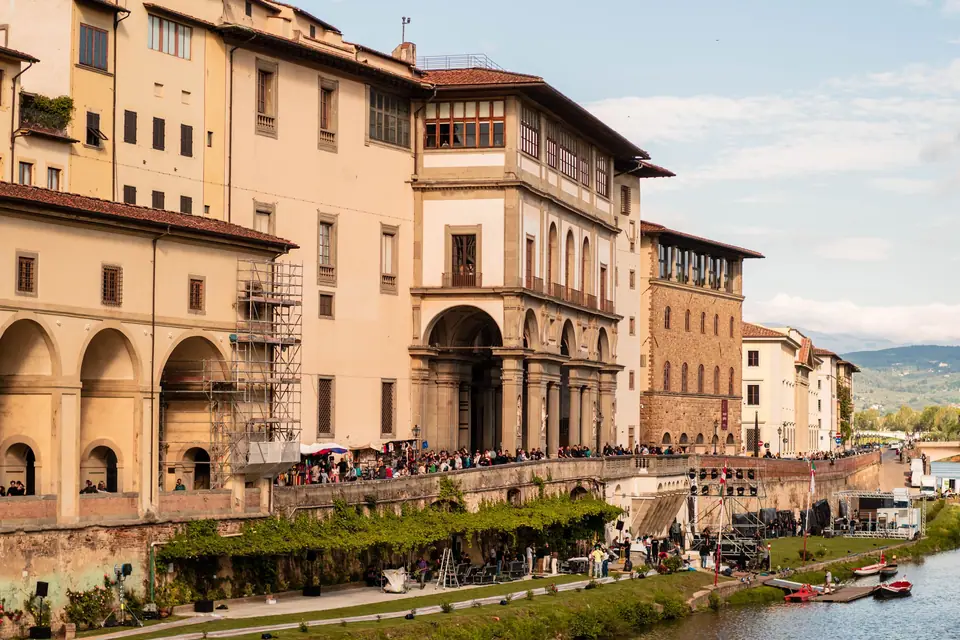
Running south from Piazza della Signoria to the river, this civic spine concentrates Florence’s Republican and Grand Ducal power across Palazzo Vecchio, the open-air sculptures of the Loggia dei Lanzi, the Uffizi Gallery and the Museo Galileo.
Piazza della Signoria
Formed in the late 13th century over the demolished houses of the exiled Ghibelline Uberti family, the L-shaped Piazza della Signoria is the civic heart of Florence, displaying Giambologna’s 1594 equestrian bronze of Cosimo I, a round porphyry pavement plaque marking where Girolamo Savonarola was burned in 1498, and copies of Donatello’s Marzocco and Michelangelo’s David flanking the palace door.
Fountain of Neptune (Fontana del Nettuno)
Commissioned for the 1565 wedding of Francesco I de’ Medici and Joanna of Austria to celebrate Florence’s new naval ambitions and first public aqueduct, Bartolomeo Ammannati’s Fountain of Neptune pairs a 4.2-metre white Carrara marble sea god (affectionately nicknamed Il Biancone by Florentines) with lively Mannerist bronze satyrs and nymphs around the octagonal basin.
Palazzo Vecchio & Salone dei Cinquecento
Begun in 1299 by Arnolfo di Cambio as the seat of the Signoria, Palazzo Vecchio leads from Michelozzo’s painted first courtyard up to the 54-metre Salone dei Cinquecento, built during Savonarola’s republic and frescoed by Giorgio Vasari. Upstairs are Francesco I’s secret Studiolo, Bronzino’s Chapel of Eleonora, Donatello’s bronze Judith and Holofernes, and the 16th-century Map Room.
Tower of Arnolfo (Torre di Arnolfo)
Rising 94 metres above Piazza della Signoria and offset onto the projecting stone gallery of Palazzo Vecchio over the older Foraboschi family tower, the Tower of Arnolfo can be climbed via 233 steps past the tiny stone cell (Alberghetto) where Cosimo the Elder (1433) and Girolamo Savonarola (1498) were imprisoned, out to a swallowtail-battlement view straight toward the Duomo.
Loggia dei Lanzi (Cellini's Perseus & Sabine Women)
Built between 1376 and 1382 by Benci di Cione and Simone Talenti for public ceremonies of the Republic and later named after Cosimo I’s German Landsknecht guards, the wide arches of the Loggia dei Lanzi shelter Benvenuto Cellini’s 1554 bronze Perseus with the Head of Medusa, Giambologna’s spiralling marble Rape of the Sabine Women and Hercules and Nessus, and ancient Roman statues.
Palazzo della Mercanzia & Gucci Garden
On the east side of Piazza della Signoria, the 1359 Palazzo del Tribunale della Mercanzia adjudicated disputes between Florence’s merchants and displays the carved stone coats of arms of all seven major and fourteen minor guilds below its parapet; inside the historic palace today sits the Gucci Garden exhibition space and Osteria.
The Uffizi Gallery (Galleria degli Uffizi)
Built by Giorgio Vasari starting in 1560 as administrative offices for Cosimo I de’ Medici, the Uffizi displays the unmatched Medici painting collection across two floors: Giotto, Cimabue and Duccio’s Maestà altarpieces, Piero della Francesca, Botticelli’s Primavera and Birth of Venus, Leonardo da Vinci’s Annunciation, Michelangelo’s Doni Tondo, Raphael, Titian and Caravaggio’s Medusa.
Corridoio Vasariano (The Vasari Corridor)
Constructed in just five months in 1565 by Giorgio Vasari so the Medici rulers could walk unseen for nearly a kilometre from Palazzo Vecchio through the Uffizi, across the top of the Ponte Vecchio, around the Mannelli Tower and through the Church of Santa Felicita into the Boboli Gardens, the newly restored corridor offers round porthole views down onto the Arno.
Museo Galileo (History of Science Museum)
Housed in the medieval Palazzo Castellani on Piazza dei Giudici immediately behind the Uffizi, the Museo Galileo preserves the scientific collection of the Medici and Habsburg-Lorraine dynasties, including Galileo Galilei’s two surviving telescopes, the objective lens with which he discovered Jupiter’s moons in 1610, Santucci’s giant armillary sphere and 18th-century obstetrical wax models.
Chiesa di Santo Stefano al Ponte
Tucked into a tiny square fifty metres north of the Ponte Vecchio, Santo Stefano al Ponte pairs a 12th-century green-and-white Romanesque marble portal with a remarkable polygonal Mannerist choir staircase inside designed by Bernardo Buontalenti in 1574, where Giovanni Boccaccio once gave the first public lectures on Dante’s Divine Comedy in 1373.
The Bargello, Badia Fiorentina and Dante’s Medieval Quarter
Just east of Via dei Calzaiuoli, narrow stone lanes lined with 11th- and 13th-century towers lead past Dante’s parish church and the Benedictine abbey of the Badia Fiorentina to the supreme Renaissance sculpture collection of the Bargello.
Torre della Pagliazza (Byzantine Round Tower)
Standing on tiny Piazza Santa Elisabetta between the Duomo and Piazza della Signoria, the semicircular stone Torre della Pagliazza dates to the 6th-century Byzantine garrison of Florence, built directly atop the circular caldarium walls of a Roman bathhouse and later used as a medieval women’s prison with straw mattresses (paglia).
Torre della Castagna
At the corner of Via Dante Alighieri and Via dei Magazzini rises one of the best-preserved 11th-century stone towers in Florence. In 1282 it served as the first meeting place of the Priors of the Guilds (including Dante Alighieri in 1300), who cast their secret ballots here using boiled chestnuts (castagne) dropped into bags.
Museo Casa di Dante & Santa Margherita de' Cerchi
Set on the documented footprint of the Alighieri family properties on Via Santa Margherita, the three-floor Museo Casa di Dante brings 13th-century Guelph-and-Ghibelline Florence and the Divine Comedy to life, directly opposite the tiny 1032 Church of Santa Margherita de’ Cerchi, the parish church of Beatrice Portinari’s family.
Badia Fiorentina (Filippino Lippi Altarpiece)
Founded in 978 by Countess Willa of Tuscany, the mother of Margrave Hugh, the Badia Fiorentina is crowned by a slender hexagonal Gothic-Romanesque campanile. Step inside off Via del Proconsolo to see Filippino Lippi’s luminous 1485 panel of the Apparition of the Virgin to St Bernard, sculpted marble tombs by Mino da Fiesole and the Upper Orange Cloister (Chiostro degli Aranci).
Museo Nazionale del Bargello
Built in 1255 as the seat of the Podestà and later used as the city prison and police headquarters, the Bargello holds the greatest collection of Italian Renaissance sculpture in the world: Donatello’s bronze David and marble St George, Michelangelo’s early Bacchus, Pitti Tondo, Brutus and David-Apollo, the 1401 Baptistery competition panels by Ghiberti and Brunelleschi, and Giambologna’s bronze Mercury.
Complesso di San Firenze & Franco Zeffirelli Museum
Closing the east side of Piazza San Firenze with one of the grandest 17th- and 18th-century Baroque facades in Tuscany (designed by Pietro da Cortona, Pier Francesco Silvani and Ferdinando Ruggieri), the former Oratorian complex and law court now houses the Franco Zeffirelli Foundation Museum of opera, theatre and cinema design.
Palazzo Gondi
Designed in 1490 by Giuliano da Sangallo at the corner of Piazza San Firenze for merchant Giuliano Gondi, Palazzo Gondi showcases graduated stonework, cross-carved window keystones and a refined arcaded courtyard staircase; Leonardo da Vinci rented rooms in one of the houses demolished to expand the palace while painting the Mona Lisa.
Palazzo Borghese
Extending along Via Ghibellina just north-east of the Bargello, this grand neoclassical palace was rebuilt in only seven months in 1821 by architect Gaetano Baccani for Prince Camillo Borghese, brother-in-law of Napoleon Bonaparte (husband of Pauline Bonaparte), featuring opulent Empire-style ballrooms and stuccoed halls.
Santa Croce, Casa Buonarroti and Sant’Ambrogio
The eastern quarter of the historic centre stretches from the Franciscan pantheon of Santa Croce and Michelangelo’s family house museum to the 1656 Teatro della Pergola, the green-domed Great Synagogue and the local morning food market of Sant’Ambrogio.
Basilica of Santa Croce
Begun in 1294 by Arnolfo di Cambio on Piazza di Santa Croce, the world’s largest Franciscan church is Italy’s artistic pantheon: inside rest the monumental tombs of Michelangelo Buonarroti, Galileo Galilei, Niccolò Machiavelli, Gioachino Rossini and Ugo Foscolo, alongside Giotto’s fresco cycles in the Bardi and Peruzzi Chapels and Donatello’s gilded stone Annunciation.
Brunelleschi's Pazzi Chapel (Cappella de' Pazzi)
Standing at the end of the first cloister of Santa Croce, the Pazzi Chapel was designed by Filippo Brunelleschi around 1429 for banker Andrea de’ Pazzi. Framed by a six-column Corinthian porch and lined inside with grey pietra serena pilasters, white plaster and blue-and-white glazed terracotta roundels of the Apostles by Luca della Robbia, it is the quietest architectural gem in Florence.
Scuola del Cuoio (Santa Croce Leather School)
Reached through the sacristy corridor of Santa Croce or from Via San Giuseppe 5r, the Scuola del Cuoio was founded after the Second World War by the Franciscan friars and the Gori and Casini families inside the Renaissance dormitory built by Michelozzo for Cosimo de’ Medici, where master leatherworkers still hand-tool and gold-stamp bags and desk accessories.
Museo Fondazione Horne (Palazzo Corsi)
At Via de’ Benci 6 between Santa Croce and the Ponte alle Grazie, English art historian Herbert Percy Horne bequeathed his 1490s palace (designed by Giuliano da Sangallo or Simone del Pollaiolo) to the Italian state in 1916 as a perfectly furnished Renaissance domestic collection, highlighted by Giotto’s gold-ground St Stephen, Masaccio panels and Giambologna bronzes.
National Central Library of Florence (Biblioteca Nazionale)
Originating in scholar Antonio Magliabechi’s 1714 bequest of 30,000 volumes and housed since 1935 in Cesare Bazzani’s monumental riverside complex on Piazza dei Cavalleggeri, Italy’s largest national library holds over six million printed volumes plus manuscripts by Galileo, Dante, Boccaccio and Machiavelli, many heroically rescued by "Mud Angels" after the 1966 Arno flood.
Casa Buonarroti (Michelangelo House Museum)
At Via Ghibellina 70, the palace acquired by Michelangelo for his nephew Lionardo and decorated in the 1610s by his grandnephew Michelangelo the Younger exhibits the sculptor’s two earliest surviving marble works, the Madonna of the Stairs (c. 1490) and the Battle of the Centaurs (c. 1492), alongside his wooden model for the San Lorenzo facade and rotating original drawings.
Teatro della Pergola (1656 Historic Opera House)
Constructed in 1656 on Via della Pergola by Ferdinando Tacca for the Accademia degli Immobili under Cardinal Giovan Carlo de’ Medici, Teatro della Pergola pioneered the classic Italian horseshoe auditorium with stacked tiers of private boxes and hosted the Florence premieres of Mozart’s operas and the 1847 world premiere of Giuseppe Verdi’s Macbeth.
Church of Santa Maria Maddalena dei Pazzi
On Borgo Pinti 58, this former Cistercian and Carmelite monastery features a graceful 1492 Ionic columned courtyard designed by Giuliano da Sangallo and, inside the chapter house beneath the church, Pietro Perugino’s tranquil three-part fresco of the Crucifixion with the Virgin, St John, St Bernard and St Mary Magdalene set against an Umbrian-Tuscan landscape.
Great Synagogue of Florence (Tempio Maggiore Israelitico)
Rising above garden trees at Via Luigi Carlo Farini 4, the Great Synagogue was built between 1874 and 1882 by Marco Treves, Mariano Falcini and Vincenzo Micheli in alternating bands of white travertine and pink granite beneath a green oxidised copper dome that is one of the unmistakable landmarks of the Florence skyline.
Sant'Ambrogio Market & Church of Sant'Ambrogio
On Piazza Lorenzo Ghiberti sits the 1873 cast-iron hall of the Mercato di Sant’Ambrogio, the city’s most authentic morning food market for local produce, butcher counters and classic lunch trattorias, two blocks south of the ancient Church of Sant’Ambrogio (housing Cosimo Rosselli’s 1486 fresco and Mino da Fiesole’s marble tabernacle).
The Arno Bridges and the Oltrarno South Bank
Crossing the Arno over the Ponte Vecchio or Ponte Santa Trinita brings you into the Oltrarno (explored with local restaurants in our Oltrarno, Ponte Vecchio and food guide), home to Palazzo Pitti, the Boboli Gardens, La Specola, Santo Spirito and Masaccio’s Brancacci Chapel.
Ponte Vecchio
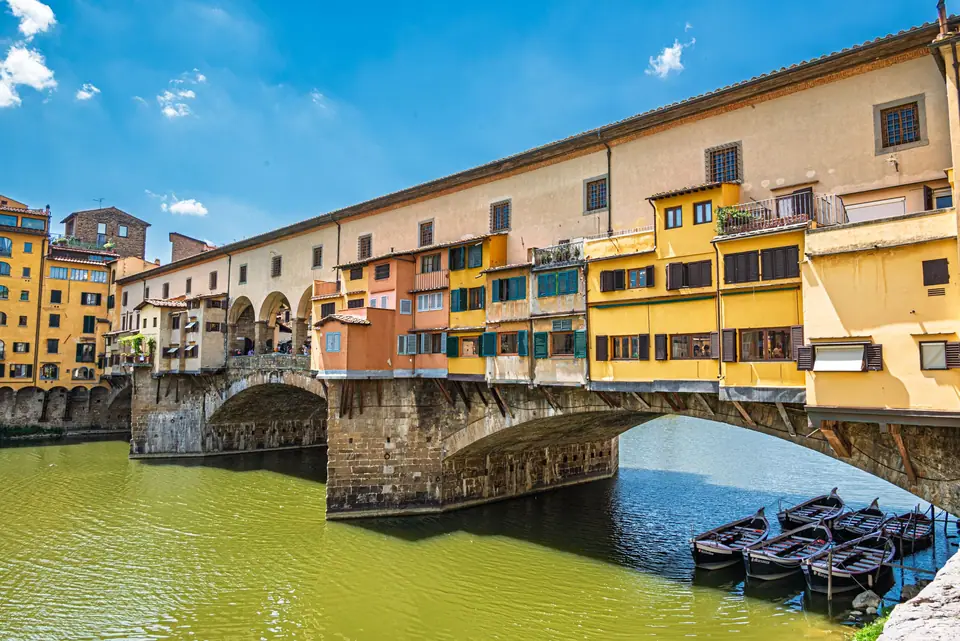
Built in 1345 by Taddeo Gaddi across the narrowest point of the Arno River, the Ponte Vecchio was the only Florentine bridge spared demolition in August 1944. Since Grand Duke Ferdinando I’s 1593 decree evicting the medieval butchers, its overhanging wooden-shuttered workshops have been occupied exclusively by goldsmiths and jewellers around the central terrace bust of Benvenuto Cellini.
Ponte Santa Trinita
Designed by Bartolomeo Ammannati between 1567 and 1569 from drawings by Michelangelo, Ponte Santa Trinita spans the Arno on three slender flattened arches adorned with rams’ heads and statues of the Four Seasons, offering the classic downstream photograph of the Ponte Vecchio reflected in the river.
Ponte alla Carraia
Originally built in wood in 1218 as the “New Bridge” after the Ponte Vecchio and reconstructed in stone by Bartolomeo Ammannati in 1559 (and rebuilt after 1944), the five-arch Ponte alla Carraia looks straight east down the Arno toward the elliptical arches of Ponte Santa Trinita and the Ponte Vecchio beyond.
Church of Santa Felicita (Pontormo's Deposition)
Just south of the Ponte Vecchio on Piazza Santa Felicita, the Vasari Corridor passes directly across the upper portico of this ancient church (where the Medici attended Mass from a private grilled balcony). Immediately to the right inside the entrance is the Capponi Chapel, designed by Brunelleschi and home to Jacopo da Pontormo’s luminous pink-and-blue 1528 Mannerist masterpiece, The Deposition from the Cross.
Palazzo Pitti & the Palatine Gallery
Begun in 1457 for banker Luca Pitti and expanded after 1549 by Bartolomeo Ammannati for Eleonora of Toledo and Cosimo I de’ Medici, Palazzo Pitti houses four museums: the sumptuous Palatine Gallery (with paintings by Raphael, Titian, Rubens and Caravaggio hung salon-style under Pietro da Cortona’s frescoed ceilings), the Royal Apartments, the Treasury of the Grand Dukes and the Gallery of Modern Art.
Boboli Gardens & Amphitheatre
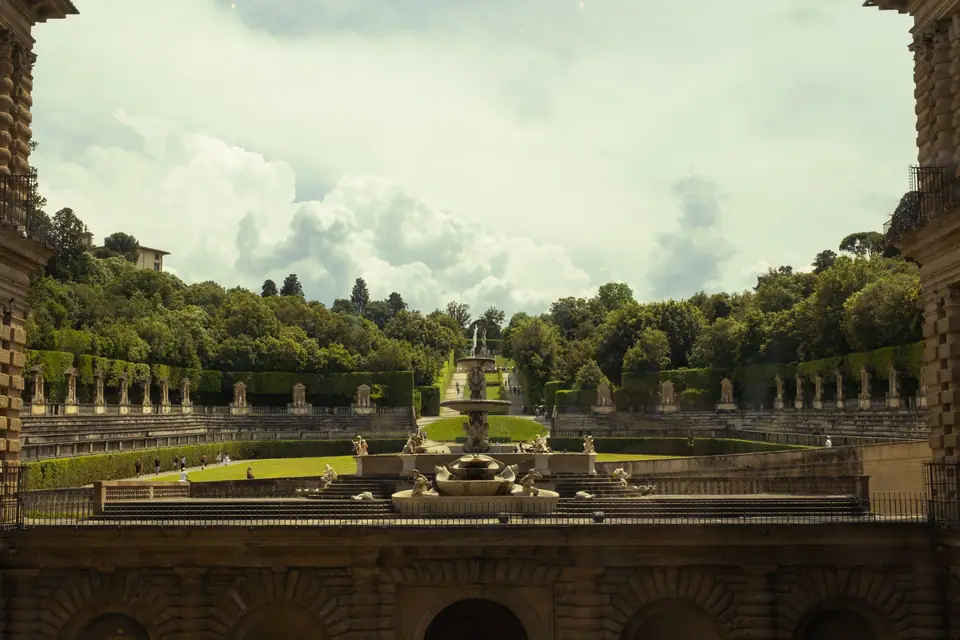
Climbing 45 hectares behind Palazzo Pitti, the Boboli Gardens were laid out from 1550 by Niccolò Tribolo, Ammannati and Buontalenti. Walk up the central axis through the 17th-century Amphitheatre centered on a Roman basin and an Egyptian obelisk from Heliopolis, past the Neptune Pond and the Kaffeehaus pavilion, and down the cypress avenue of the Viottolone to Giambologna’s Oceanus Fountain.
Buontalenti Grotto (Grotta del Buontalenti)
Located in the northern corner of the Boboli Gardens near the exit toward the Vasari Corridor, the Grotta Grande was created between 1583 and 1593 by Bernardo Buontalenti for Francesco I de’ Medici. Its three chambers encrusted with spongy calcareous stalactites, shells, frescoed shepherds and Giambologna’s marble Venus Emerging from the Bath once held Michelangelo’s original four Prisoners.
La Specola (Museum of Zoology and Anatomical Waxes)
Two minutes west of Palazzo Pitti at Via Romana 17 in Palazzo Torrigiani, the Imperial and Royal Museum of Physics and Natural History (La Specola) was opened to the public in 1775 by Grand Duke Peter Leopold and contains taxidermy galleries (including the Medici hippopotamus) alongside Clemente Susini’s famous 18th-century life-size anatomical wax models and the Galileo Tribune.
Basilica of Santo Spirito & Piazza Santo Spirito
Overlooking the tree-lined market square that serves as the living room of the Oltrarno, the Basilica of Santo Spirito was designed by Filippo Brunelleschi in 1444 with a continuous colonnade of thirty-five Corinthian columns and thirty-eight semicircular chapels holding original Renaissance altarpieces, while the octagonal sacristy preserves the wooden crucifix carved by a seventeen-year-old Michelangelo.
Santa Maria del Carmine & the Brancacci Chapel
Inside the Carmelite church on Piazza del Carmine, the Brancacci Chapel survived a devastating 1771 church fire intact. Painted between 1424 and 1428 by Masolino and the young genius Masaccio (and completed in the 1480s by Filippino Lippi), Masaccio’s Expulsion from the Garden of Eden and The Tribute Money inaugurated Early Renaissance painting with unified perspective, cast shadows and raw human grief.
Porta San Frediano & San Frediano Artisan Quarter
Anchoring the western end of Borgo San Frediano, the monumental Porta San Frediano was built between 1332 and 1334 by Andrea Pisano as part of Florence’s sixth ring of medieval walls, still retaining its giant nail-studded wooden doors and leading into the San Frediano lanes of silversmiths, gilders, wine bars and traditional trattorias.
Panoramic Hills, Fortresses and Fiesole
Finish your Florence route along the hillside ramparts, wisteria terraces and Romanesque marble churches overlooking the south bank of the Arno, or take the short hilltop bus ride up to Etruscan and Roman Fiesole.
Forte di Belvedere (Fortezza di Santa Maria in San Giorgio)
Perched on the highest point of the Boboli hill at the top of Costa San Giorgio, the star-shaped Forte di Belvedere was built between 1590 and 1595 by Bernardo Buontalenti for Grand Duke Ferdinando I both to protect the Medici palace and to house the family treasury, offering 360-degree rampart views over the Duomo and surrounding Tuscan hills.
Bardini Gardens (Giardino Bardini) & Villa Bardini
Climbing the steep slope between the Arno River at Via dei Bardi and Costa San Giorgio beside Forte di Belvedere, the four-hectare Giardino Bardini features a 17th-century baroque stone staircase, an Anglo-Chinese woodland stream and a long pergola of purple wisteria that blooms each April directly in front of the Florence skyline.
Museo Stefano Bardini
At Via dei Renai 37 near Ponte alle Grazie, the 19th-century "Prince of Antiquarians" Stefano Bardini built a neo-Renaissance palace out of medieval architectural fragments and painted its walls a signature "Bardini blue" to display Donatello’s Painted Crucifix and Madonna of the Apple, Tino di Camaino’s Charity, Della Robbia ceramics and Pietro Tacca’s original marble boar (Il Porcellino).
Porta San Niccolò & Giardino delle Rose (Rose Garden)
From the 45-metre medieval tower of Porta San Niccolò on the south-east riverbank, Giuseppe Poggi’s 1870s stone ramps and grotto waterfalls (Rampe del Poggi) climb straight up to the free Giardino delle Rose, where more than four hundred varieties of roses and bronze sculptures by Jean-Michel Folon frame a quiet view of the Duomo just below Piazzale Michelangelo.
Piazzale Michelangelo
Designed in 1869 by architect Giuseppe Poggi along the tree-lined Viali dei Colli boulevard, Piazzale Michelangelo is Florence’s classic sunset viewpoint, where a bronze monument of Michelangelo’s David and the four Medici Chapel allegories looks straight down the curve of the Arno River across every bridge, Palazzo Vecchio, Santa Croce and Brunelleschi’s Dome.
Abbey of San Miniato al Monte
Ten minutes up the stone steps above Piazzale Michelangelo stands the Benedictine basilica of San Miniato al Monte, begun in 1018 over the shrine of Florence’s first martyr. Its green-and-white geometric marble facade, 1207 inlaid zodiac pavement, Michelozzo’s Chapel of the Crucifix, Spinello Aretino’s sacristy frescoes and late-afternoon Latin vespers make it the crowning hilltop stop in Florence.
Fiesole: Roman Theatre & Monastery of San Francesco
Reached in twenty minutes from Piazza San Marco on ATAF city bus 7 up through olive groves and Renaissance villas, the Etruscan hill town of Fiesole sits 300 metres above the Arno valley. Visit the 1st-century BC Roman Theatre, thermal baths and Etruscan temple walls in the archaeological park, then climb the short steep lane to the Monastery of San Francesco for a sweeping northern panorama over all of Florence.
Plan the Rest of Your Florence Trip
Use our dedicated Florence subguides to plan your daily schedule, museum passes and neighbourhood bases:
- Florence destination overview: quick decisions, climate table and neighbourhood map.
- Florence travel guide: city passes, Monday museum closures, ZTL driving rules and daily logistics.
- Best things to do in Florence: top priorities ranked for first-time visitors.
- Duomo and Piazza della Signoria guide: comparing the Brunelleschi, Giotto and Ghiberti passes.
- Uffizi and Accademia museums guide: room-by-room highlights and timed-entry reservations.
- Oltrarno, Ponte Vecchio and Florence food guide: south-bank workshops, wine windows and trattorias.
- Florence 3-day itinerary: hour-by-hour pacing for three full days.
- Where to stay in Florence: comparing Centro Storico, Oltrarno, Santa Croce and Santa Maria Novella.
- How to get to Florence: T2 tram from Peretola Airport (FLR), Pisa Airport connections and high-speed trains to Santa Maria Novella.
- Best time to visit Florence: month-by-month weather, April wisteria, Scoppio del Carro at Easter and autumn grape harvest.
- What to wear in Florence: church dress codes, cobbled streets and seasonal layers.
- Italy travel guide and Rome Historic Centre guide: for combining Florence with Siena, Pisa, Rome and Venice.