Rome Historic Centre Guide: Pantheon, Piazza Navona, Trevi Fountain and More
How to walk Rome's historic heart in the right order: the Pantheon, the great squares, the fountains, the churches with Caravaggio, and where to eat and stay.
The historic centre of Rome is the part of the city most people picture when they think of it: the Pantheon with its portico of granite columns, Piazza Navona with its three fountains, the Trevi Fountain squeezed into a small square, the Spanish Steps climbing to a twin-towered church. It is a compact tangle of lanes between the bend of the Tiber and the long straight line of Via del Corso, and it holds two thousand years of building in an area you can cross on foot in half an hour.
That density is both the charm and the problem. The big sights are close together, so everyone ends up in the same few squares at the same time, and a first visit can dissolve into a crowded shuffle from fountain to fountain. A day here goes well when you choose the order and keep some slack for the lanes in between. This guide covers what each place is, how long it needs, what to pair it with and what you can skip. For the wider city, start with our Rome destination page and the Rome travel guide.
The short answer
- How long? One full day covers the essential squares and monuments on foot. Two days let you add the Capitoline Museums, the churches and a slow lunch.
- Where to start? The Pantheon, early, before the tour groups arrive. Then work towards Trevi and the Spanish Steps while the city is still quiet.
- The most impressive interior: the Pantheon, and it is not close.
- The best free sights: the squares, the fountains, and several churches that hold major paintings.
- The view to save for last: the terrace beside the Capitoline Museums, looking over the Roman Forum.
- The biggest mistake: arriving at Trevi in the middle of the day and expecting a quiet moment.
- When to go: spring and autumn, covered in our best time to visit Rome guide.
- Where to sleep: inside the centre for atmosphere, or just outside it for better value. More in our Rome where to stay guide.
The simplest route that works: the Pantheon, Piazza Navona, a coffee near Sant'Eustachio, the church of San Luigi dei Francesi for its Caravaggios, the Trevi Fountain, the Spanish Steps, and a slow evening in the lanes around Campo de' Fiori. We explain each step below, and our Rome 3-day itinerary shows how the centre fits into a longer stay.
How the historic centre is laid out
Rome's centro storico sits inside a bend of the Tiber, on the low ground that was the Campus Martius, the field of Mars, in ancient times. In the Roman Republic it was open land used for military training and elections. Under the emperors it filled with baths, theatres and temples, and after the fall of the empire it was gradually built over, which is why so many Roman foundations sit under the medieval and Renaissance streets above them. Whole districts follow the outline of ancient buildings, the clearest example being Piazza Navona, which keeps the oval shape of a Roman stadium.
Think of the centre as five linked pockets. The Pantheon and Piazza Navona form the heart. To the east, across Via del Corso, are Trevi and the Spanish Steps with the shopping streets around them. To the south are Campo de' Fiori and the old Jewish quarter. Further south and east rise the Capitoline Hill and the Forum edge. Along the northern side the district runs towards Piazza del Popolo. There is no metro station in the middle, so the centre is truly a walking district. The lanes are narrow, cobbled and unevenly paved, and the route between two sights is often shorter than it looks on a map.
The Pantheon
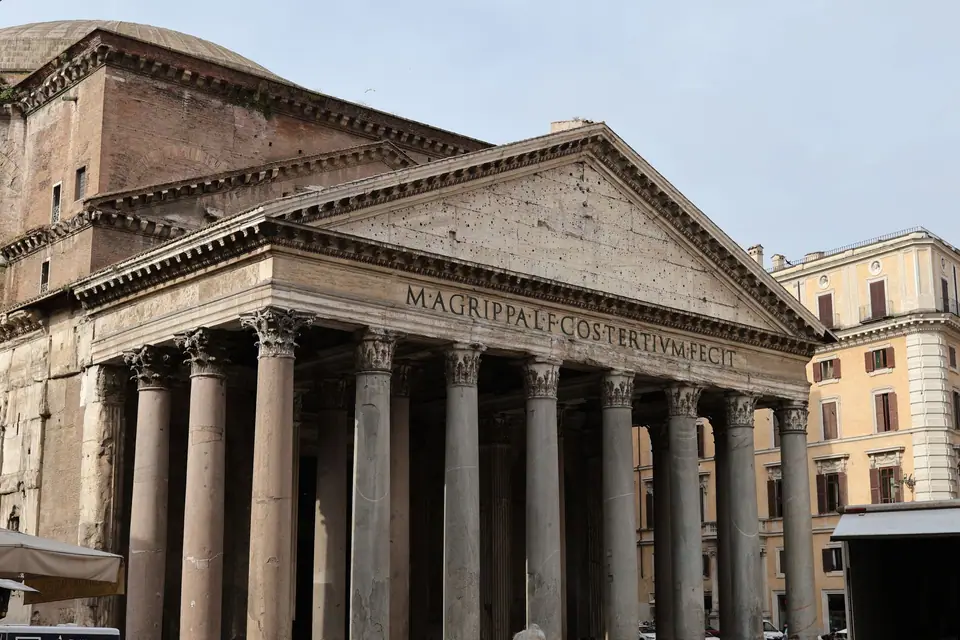
The Pantheon is the best-preserved building of ancient Rome, and it is still in use. The emperor Hadrian rebuilt it around 125 AD, replacing an earlier temple that had burned, and the Latin inscription on the front still credits Marcus Agrippa, who built the first one. Since the seventh century it has been a church, which is a large part of the reason it survived while other temples were stripped for stone.
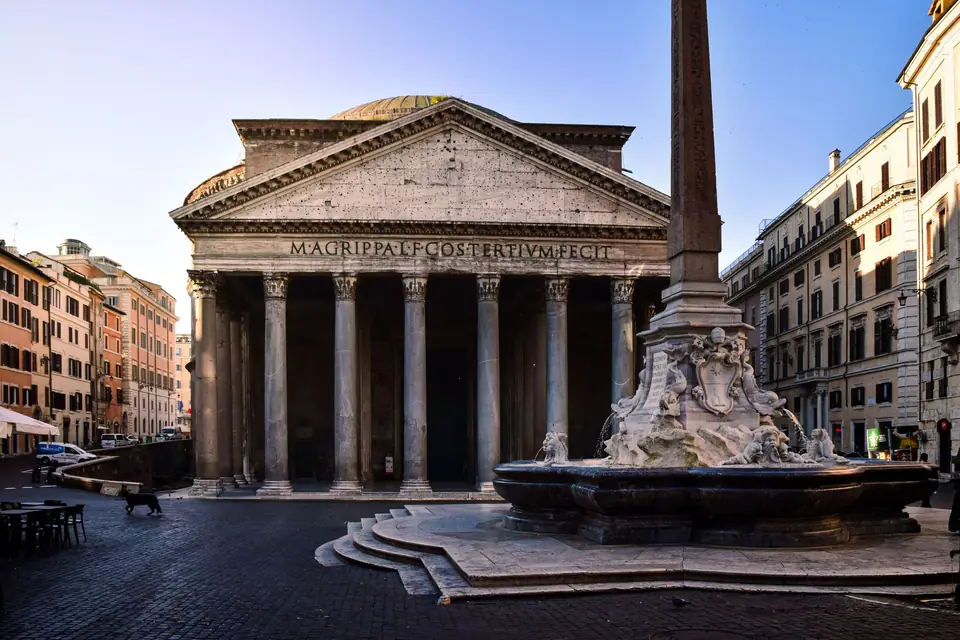
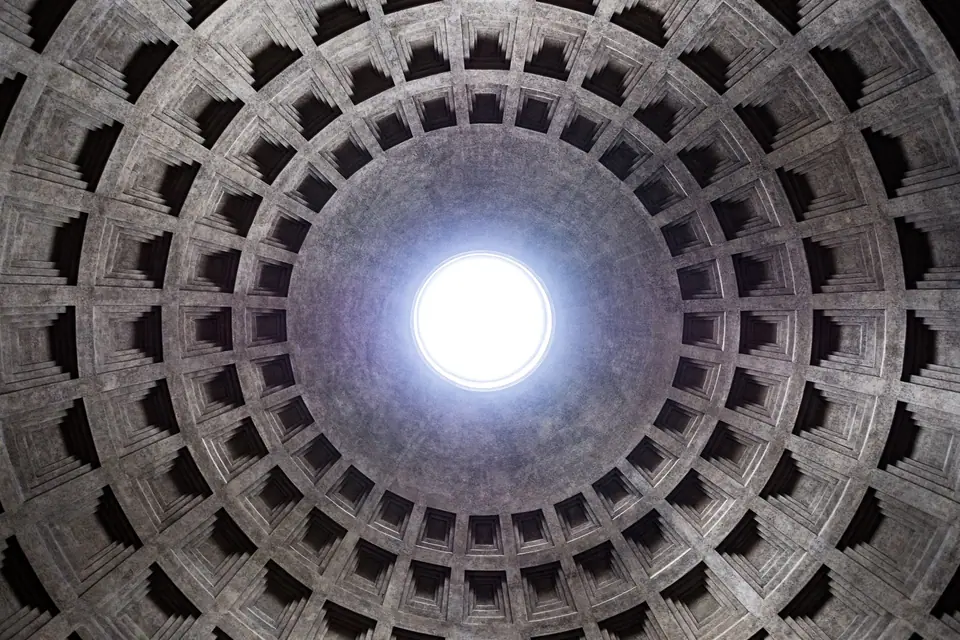
The portico looks impressive from the square, but the interior is the surprise. The dome is a perfect hemisphere of unreinforced concrete, and its diameter equals the height of the room, so a sphere would fit inside exactly. In the centre is the oculus, an open circle about eight metres wide, the only source of light. On a sunny day a bright disc of light crawls around the coffered walls, and when it rains the water falls to a drain in the floor. Raphael is buried here, along with two kings of united Italy.
Entry is now ticketed and managed by the state, so check the official site before you go, and plan to arrive early. Dress rules apply because it is an active church: covered shoulders and knees, and quiet voices during services. Sit down for ten minutes under the dome. It is one of the few places in Rome that rewards stillness. Outside, the fountain in the square carries an Egyptian obelisk, and the cafés around the edge charge for the view, so we usually drink our coffee a street away.
Piazza Navona
Piazza Navona is the most beautiful square in Rome for many visitors, and also the one with the most hawkers and overpriced tables. It was built over the stadium of Domitian, which held thousands of spectators for athletics in the first century, and the long oval shape of the square is the footprint of the old running track. In the baroque period it became a theatre of papal ambition, and the square is the best place in Rome to see the rivalry of two sculptor-architects, Gian Lorenzo Bernini and Francesco Borromini.
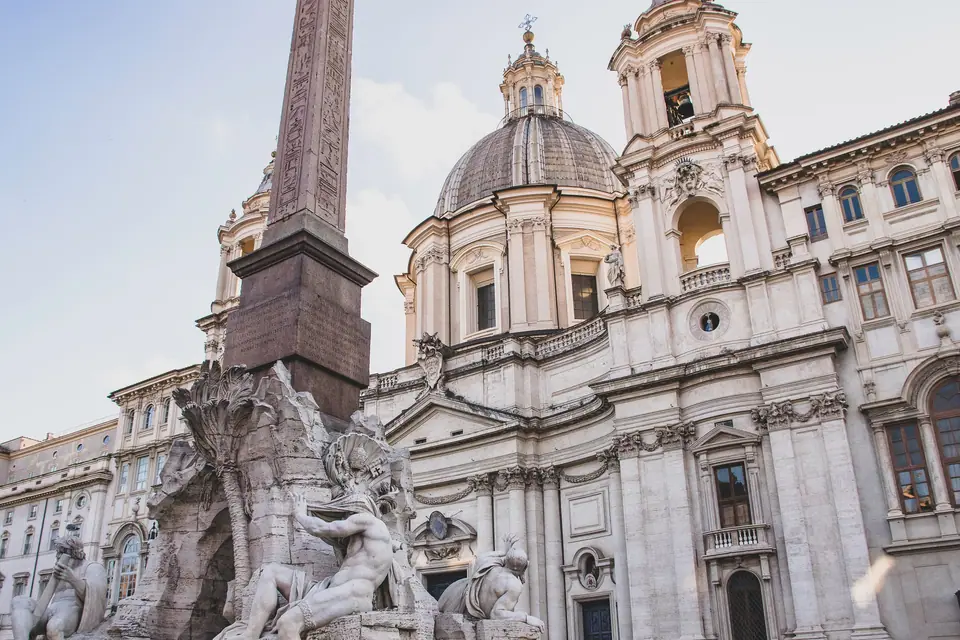
The central Fountain of the Four Rivers is by Bernini and represents the Nile, Ganges, Danube and Rio de la Plata, with an Egyptian obelisk on top. Facing it stands the church of Sant'Agnese in Agone, with a curved baroque front by Borromini. Locals enjoy the story that one of Bernini's river gods raises a hand in alarm because he fears the church will fall down. It is a legend and not a fact, but it shows how rival the two men were. At the ends of the square are two smaller fountains, the Moor and Neptune, adding to the sense of a stage set.
Come first thing in the morning for photographs and again after dinner when the crowd thins and street musicians play. In the middle of the day, the square is a place to walk through, not to sit in. The restaurants directly on the piazza are some of the least impressive meals in the city, so we eat elsewhere. Our Rome food guide explains where.
Coffee, churches and Caravaggio
Between the Pantheon and Navona lies a handful of lanes that reward a slower pace. Two long-established coffee bars stand within a few minutes of the Pantheon, Sant'Eustachio il Caffè and Tazza d'Oro, and both are the right place to try a proper Roman espresso standing at the counter. Roman coffee is short, strong and quick, and it is drunk at the bar.
Three churches repay a stop because they hold paintings and ideas you will not see anywhere else:
- San Luigi dei Francesi is the national church of France in Rome, and its side chapel holds three canvases by Caravaggio showing the life of Saint Matthew. They are dark, dramatic and full of everyday faces, and they changed the course of European painting. The light in the chapel is on a timer, so be ready for the moment it switches on.
- Sant'Ignazio has a ceiling painted so cleverly that it appears to open on the sky, and a flat ceiling disguised as a dome where money for a real one ran out. A marked disc on the floor shows the best viewing spot.
- Santa Maria sopra Minerva is Rome's rare Gothic church, built over a temple of Minerva. Outside it stands a small marble elephant by Bernini carrying an obelisk, and inside is a statue of Christ attributed to Michelangelo.
All three are free to enter, which makes them an easy reward for tired feet. Remember that churches close for services and for a long midday break, so we build them into the route and do not rely on being able to return later.
The Trevi Fountain
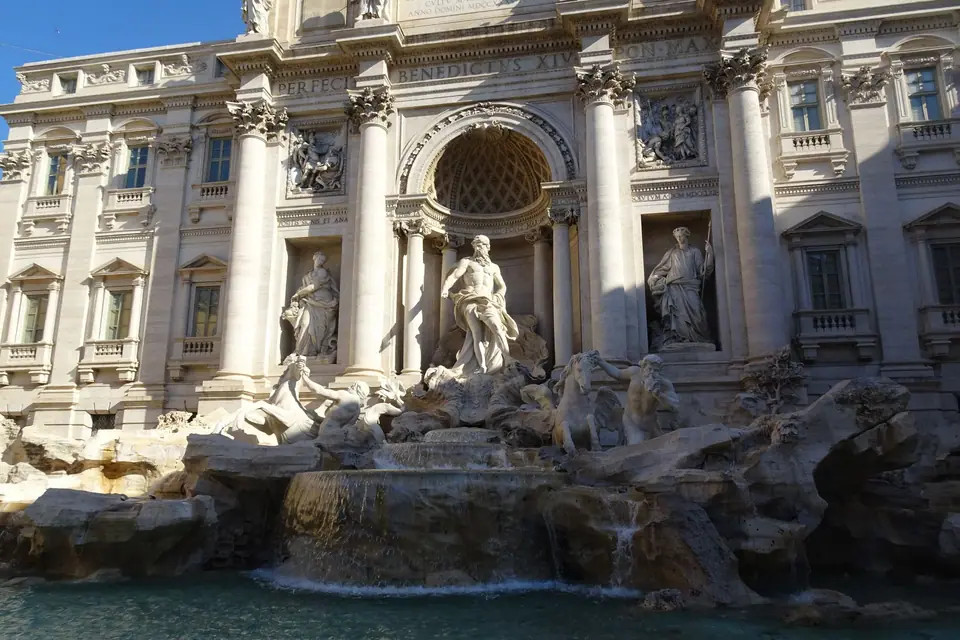
The Trevi Fountain is the largest baroque fountain in Rome, and it feels even larger because it fills almost the entire little square it stands in. Nicola Salvi designed it in the eighteenth century, and it was completed in 1762. At the centre stands Oceanus, the god of the sea, in a shell-shaped chariot pulled by sea-horses with tritons, one wild and one calm, standing for the moods of the sea. The water arrives from an aqueduct first built in 19 BC, one of the few Roman waterways that still flows, and the fountain takes its name from the three streets (tre vie) that meet at the spot.
The tradition is to stand with your back to the fountain and throw a coin over your left shoulder with your right hand, which is said to guarantee a return to Rome. The coins are collected regularly and given to charity. Many visitors know the fountain from the 1960 film La Dolce Vita, in which Anita Ekberg wades in. Wading is not allowed now, and the area is policed.
The advice that matters is about timing. By mid-morning the square is packed and the fountain is mostly seen over other people's phones. Early morning is the only time it feels like the place it was designed to be, and late evening comes second. Access arrangements for the front of the basin have been changing, so check the current rules when you plan. Keep your bag zipped, because this is a favourite spot for pickpockets. Our things to do in Rome guide lists other quiet fountains if you want a calmer alternative.
The Spanish Steps and Piazza di Spagna
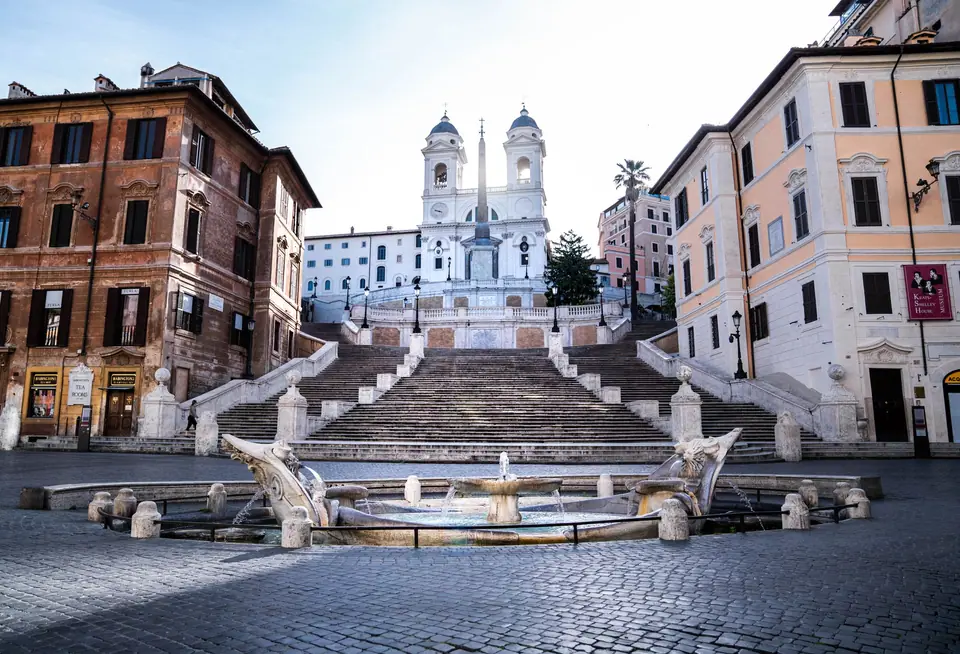
A ten-minute walk north of Trevi, the Spanish Steps descend from the church of Trinità dei Monti to Piazza di Spagna in a sweep of 135 steps, built in the 1720s. Despite the name, they were paid for by a French diplomat, and the Spanish connection comes only from the Spanish embassy that stood nearby. At the foot of the steps, the boat-shaped Barcaccia fountain is a Bernini family work, said to have been inspired by a Tiber flood that left a boat stranded in the square.
The steps are a place to look from, not to sit on, because sitting is banned and local police enforce it. Climb to the top for the view across the roofs to the dome of St Peter's, which glows at sunset. Beside the steps, in a small house at the bottom right, the poet John Keats died in 1821, and the rooms are now a museum dedicated to Keats and Shelley.
The streets that fan out from the square, Via Condotti above all, are Rome's luxury shopping district, and they are pleasant to window-shop in. For something less polished, walk a block or two east into the lanes around Via della Croce, where food shops and wine bars cater to residents. If you love to shop, our Rome things to do page covers the markets and the neighbourhoods that repay a detour.
Campo de' Fiori and the Jewish Quarter
South of Piazza Navona, Campo de' Fiori is a sloping square that hosts a food market in the morning and a loud, young drinking crowd at night. The statue in the middle is of Giordano Bruno, the philosopher and former friar who was burned here for heresy in 1600, and the hooded figure faces towards the Vatican. The market sells fruit, vegetables, spices and flowers, though the stalls cater increasingly to visitors. Better value and a more local feel come from the bakeries and delicatessens in the streets around the square.
A short walk further south, the Jewish quarter is one of the oldest in Europe. A community has lived in Rome for more than two thousand years, and the walled ghetto where the Jews were confined from 1555 to 1870 was a few streets here. Today it is a quiet, characterful district around the ruins of the Portico d'Ottavia, with a large synagogue on the riverbank and a museum of Jewish history. It is also the home of a famous dish, carciofi alla giudia, whole artichokes fried until they open like a flower, which you can try in the family restaurants of Via del Portico d'Ottavia.
Nearby, in Largo di Torre Argentina, a sunken square holds the ruins of four Republican temples. Julius Caesar was killed in a building next to the site in 44 BC. The ruins also house a well-known cat sanctuary run by volunteers. It is a free, thought-provoking stop that few people think to make.
Capitoline Hill
The Capitoline Hill was the religious and political centre of ancient Rome, and it is the smallest of the seven hills. Michelangelo redesigned the summit in the sixteenth century, creating Piazza del Campidoglio, a stately square with a geometric paving pattern that he planned but which was only completed in the twentieth century. A bronze equestrian statue of Marcus Aurelius stands in the middle (the original, now indoors, was moved for protection), and the palaces around the square house the Capitoline Museums, the oldest public museums in the world, founded in 1471.
The collections contain the Capitoline Wolf, a bronze emblem of the city, and major Roman sculpture such as the Dying Gaul and the colossal head and foot of Constantine. If you have time for only one large museum in the centre, this is the one we would pick, because it connects the ancient city to the streets outside. Allow at least two hours.
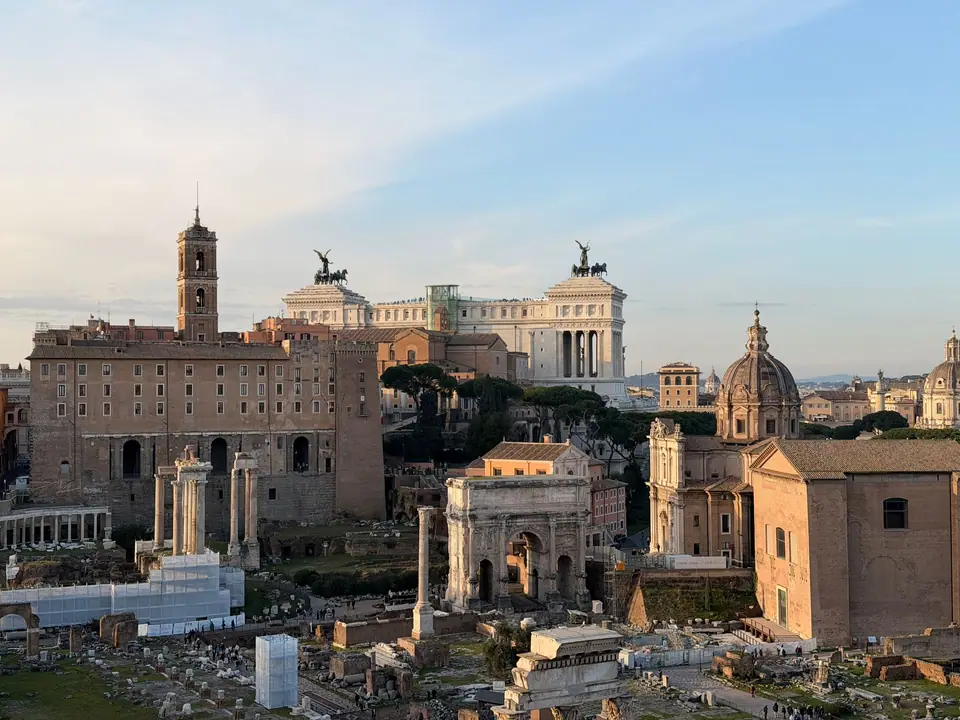
The reward is the view. Walk to the terrace beside the square and look down over the Roman Forum, with the Colosseum beyond. It is the best free view of ancient Rome, and it is usually calm. For a closer look at the monuments themselves, see our Colosseum guide. The white marble monument on the other side of the square, the Vittoriano, is a nineteenth-century memorial to the first king of united Italy. Romans have joked about it for a century, and take the glass lift to the roof for another panorama.
One day in the historic centre
This is a route we like because it moves from quiet to busy and finishes with an evening you can slow down:
- Early morning: the Pantheon, straight after arriving, then a coffee at the counter in a nearby bar.
- Mid-morning: San Luigi dei Francesi and Sant'Ignazio, then Piazza Navona while the light is still low.
- Late morning: walk to the Trevi Fountain by the lanes, not by Via del Corso, and see it while the crowds are still building. Then the Spanish Steps.
- Lunch: eat a block away from any major sight, in a trattoria where the menu is short and in Italian.
- Afternoon: Largo di Torre Argentina and the Jewish quarter, then climb to the Capitoline terrace for the view.
- Evening: an aperitivo near Campo de' Fiori, dinner in a side street, and a last walk past the floodlit Pantheon or Piazza Navona.
If it is hot, flip the plan: do the outdoor sights early and late, and use the middle of the day for the cool interiors of churches and museums.
Two days in the historic centre
A second day lets you slow down. Spend the morning at the Capitoline Museums and the Vittoriano terrace, then cross the river for Trastevere, the lively old district on the western bank, where our Trastevere food tour is a lively way to eat your way through the lanes. In the afternoon, return for the churches you skipped: the Gesù, with its overwhelming baroque ceiling, and Santa Maria in Aracoeli at the top of its long stairway on the Capitoline. If you still have energy, walk up to the Pincio terrace above Piazza del Popolo for the sunset. For the largest sights outside the centre, our Vatican guide and the Vatican Museums tour are the next steps, and the Colosseum underground tour takes you below the arena floor.
Getting to the historic centre
From Fiumicino airport, the Leonardo Express runs non-stop to Termini station, and regional trains stop at stations on the western side of the river. From Termini, the centre is about a twenty-five minute walk to Trevi, or a short bus or metro ride. Our how to get to Rome guide covers the airports, trains and transfers in detail.
Inside the centre there is no metro line, so walking is the main mode. The nearest stations are Barberini and Spagna, both on Line A, which serve Trevi and the Spanish Steps. For the Pantheon and Navona, buses and trams are an option, though a taxi or a walk is often quicker. We advise comfortable shoes with a firm grip, since the cobbles (sampietrini) are slippery when wet and rough on the ankles.
Where to stay in the historic centre
Staying inside the centre means stepping out of the door into history, and it allows an early start and a late evening walk that day-trippers do not get. The trade-offs are noise and small rooms. The area around the Pantheon, Navona and Campo de' Fiori is the most atmospheric, and the streets near the Spanish Steps are calmer and more polished. Just outside the centre, Monti and Trastevere offer a more local feel with strong restaurants, while the area near Termini gives the best transport links. Our where to stay in Rome guide compares them. In any area, book early for spring and autumn, when the best small hotels fill quickly.
Eating in the historic centre
This is where the tourist-trap warning is most useful. Restaurants with photo menus, touts at the door and tables directly facing a famous monument are rarely the best meal. A useful rule is to walk two streets away from the main sight. Look for short menus, Italian-speaking tables and dishes that follow the Roman repertoire: cacio e pepe, carbonara, amatriciana, gricia, saltimbocca, and fried artichokes in season.
Between meals, pizza bianca from a bakery near Campo de' Fiori is a simple, delicious snack, supplì (fried rice balls with a molten mozzarella centre) are the classic street food, and the gelato shops near the Pantheon include some of the city's best-known names. Choose gelato in plain metal tubs with muted colours, not piles of bright mounds. The city's fountains, called nasoni, give free drinking water, so carry a bottle. Read our Rome food guide for more.
Shopping in the historic centre
Via Condotti and the streets around it hold the major Italian fashion houses, while the lanes near Campo de' Fiori and Via dei Coronari are better for antiques, small galleries and craft studios. For gifts, look for local food: olive oil, pasta shapes, and bottled artichokes from a delicatessen. Sales usually run in winter and summer, and shops often close for part of August.
When to visit the historic centre
April, May, late September and October are the best months. The light is soft, the days are long and the heat is manageable. July and August are hot and crowded, and a large number of Romans leave the city around mid-August, so some small restaurants and shops close. Winter is cool, damp and much quieter, and a sunny December morning at the Pantheon is one of the best bargains in European travel. Around Easter, the Christmas period and any major religious event, expect long queues. See our best time to visit Rome and what to wear in Rome guides for details.
Beyond the historic centre
If you have more time, Rome rewards a second look from other angles. The ruins of the Roman Forum and Palatine Hill lie just beyond the Capitoline, and the ancient port of Ostia Antica is a short train ride away. Tivoli, with its villas and fountains, makes a classic day trip, and the rest of the country is covered in our Italy guide.
Plan the rest of your Rome trip
The historic centre is a day or two of a longer stay. Our Rome 3-day itinerary shows how to combine it with the Colosseum and the Vatican, and the things to do in Rome page lists the rest of the city.
Frequently asked questions
Is one day enough for the historic centre?
For the main sights, yes, if you start early and follow a sensible order. If you also want the Capitoline Museums, the churches and a long lunch, take two days.
Do I need to book the Pantheon in advance?
Entry is ticketed now, and queues build by mid-morning. The simplest plan is an early visit, with the official site checked before you go for the current rules.
Should we visit the Trevi Fountain?
Yes, but at the right time. Go early in the morning or late in the evening. In the middle of the day it is a crowd more than a fountain.
Can I sit on the Spanish Steps?
No. Sitting is banned and the rule is enforced. Climb them and enjoy the view from the top instead.
Do I need to dress modestly?
In churches, yes: shoulders and knees covered. In the streets, normal summer clothes are fine. See our what to wear in Rome guide.
Is the centre safe?
Yes. Pickpockets work the crowds at Trevi, on buses and around the Spanish Steps, so keep valuables in a front pocket or a zipped bag. Politely ignore people offering free bracelets, roses or a photo with a costumed gladiator.
For everything else about planning your stay, our Rome travel guide covers money, transport, etiquette and how many days to give the city.