Île de la Cité and the Latin Quarter Guide: Notre-Dame, Sainte-Chapelle and More
How to see the island where Paris began and the student quarter beside it in the right order: cathedrals, stained glass, bridges, bookshops and where to eat.
Every road distance in France is measured from a small bronze plaque on the pavement in front of Notre-Dame. That plaque stands on the Île de la Cité, the island in the Seine where Paris began. A Celtic tribe, the Parisii, settled here more than two thousand years ago, the Romans built their town of Lutetia on the banks around it, and for centuries afterwards the island held the cathedral, the royal palace and the law courts. Walk across it today and you cross eight hundred years of French history in a few hundred metres.
Next door, on the Left Bank, the Latin Quarter has been the city's university district since the Middle Ages. Students once spoke Latin in its lanes, which is how it got its name, and the Sorbonne, the Panthéon, old bookshops and narrow medieval streets still give it a scholarly, slightly shabby charm. The two areas make one compact day: monuments and stained glass in the morning, books and cafés in the afternoon. This guide covers what each place is, how long it needs, what to pair it with and what to skip. For the rest of the city, start with our Paris destination page and the Paris travel guide.
Paris's historic core at a glance
- How long? One full day covers the island and the heart of the Latin Quarter. Two days let you add the Cluny museum, the Panthéon and the quieter streets.
- Where to start? Sainte-Chapelle, in the first entry slot you can book, then Notre-Dame while the queues are still short.
- The most beautiful interior: the upper chapel of Sainte-Chapelle on a sunny day.
- The best free sights: the cathedral square, the bridges, the quays, the flower market and the squares of the Latin Quarter.
- The classic evening: a river cruise from the foot of the Pont Neuf, with the island lit up behind you.
- The biggest mistake: arriving at the cathedral at midday with no plan and spending the day in queues.
- When to go: spring and autumn, covered in our best time to visit Paris guide.
- Where to sleep: the Latin Quarter for atmosphere, or the Marais and Saint-Germain for a calmer stay. More in our Paris where to stay guide.
The simplest route that works: Sainte-Chapelle, the Conciergerie or the flower market, Notre-Dame, the tip of the island and the Pont Neuf, lunch on the Île Saint-Louis, and then the Latin Quarter on foot. We explain each step below, and our Paris 3-day itinerary shows how it fits into a longer stay.
Reading the map of the island and the quarter
The Île de la Cité is a boat-shaped island about a kilometre long, joined to both banks by bridges. Notre-Dame stands at the eastern end, the Palais de la Cité, with Sainte-Chapelle and the Conciergerie, fills the western half, and between them runs a tight knot of streets. At the western tip, a small park called the Square du Vert-Galant points downstream like the prow of a ship. A second, smaller island, the Île Saint-Louis, lies just east, joined to the first by a footbridge.
The Latin Quarter begins at the Petit-Pont, the bridge leading south from Notre-Dame, and climbs gently up the hill towards the Panthéon. The main artery is Boulevard Saint-Michel, with the Sorbonne and the Cluny museum to the west and the Rue Mouffetard market street to the south-east. The whole area sits inside the 4th and 5th arrondissements, and everything described here can be reached on foot. Metro Line 4 stops at Cité, right on the island, and the RER B stops at Saint-Michel Notre-Dame, which is the most direct rail link from Charles de Gaulle airport.
Notre-Dame
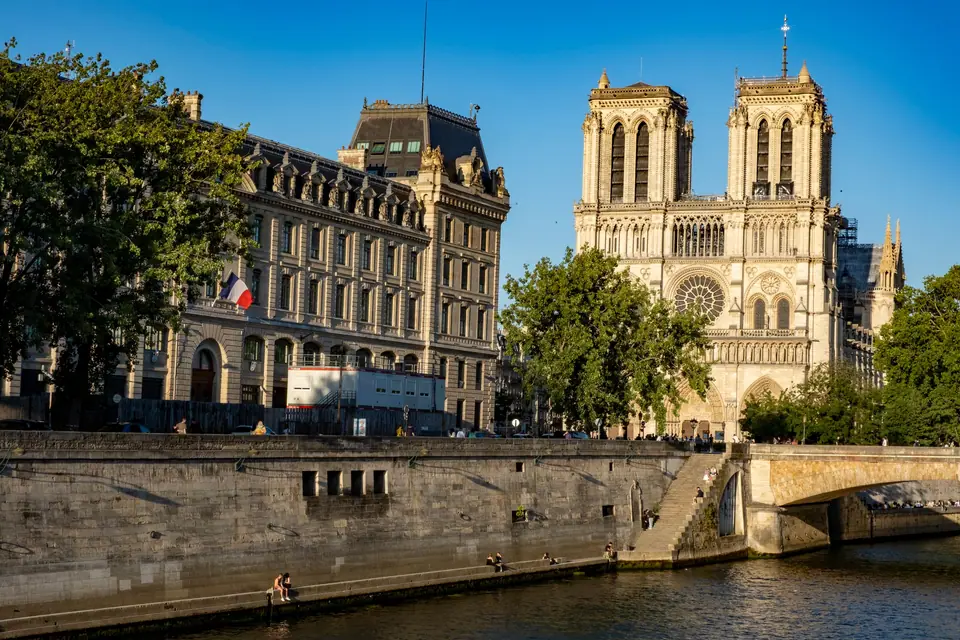
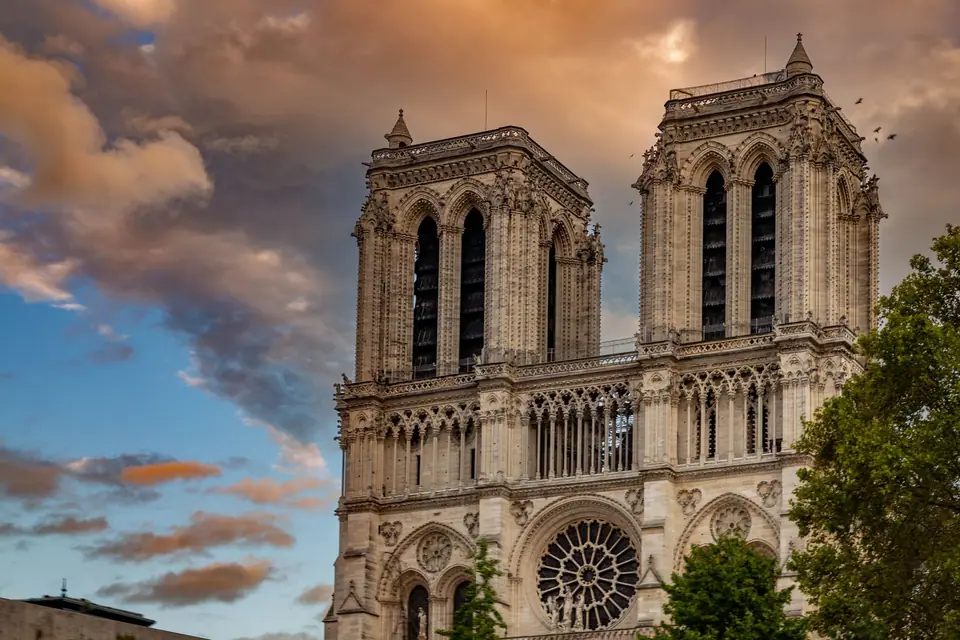
Notre-Dame de Paris is the great Gothic cathedral of France. Bishop Maurice de Sully laid the foundation in the 1160s, and the building took almost two centuries to finish. Its facade, with the twin towers, the three portals and the carved Gallery of Kings above, is the model of what a Gothic cathedral looks like. The flying buttresses at the east end were among the first built, and they let the walls rise high and fill with windows.
In April 2019 a fire destroyed the roof and the spire, and the world watched as the towers held. Five years of restoration followed, and the cathedral reopened in December 2024. The oak roof frame and the spire, which was a nineteenth-century addition by the architect Viollet-le-Duc, were rebuilt, and the stonework inside was cleaned until the vaults looked almost white. Many visitors now say the interior is lighter and more beautiful than it has been for centuries.
Look for the three rose windows, the carved choir screen, the treasury and the statues of the Virgin and Child. Outside, the gargoyles and chimeras on the towers are mostly Viollet-le-Duc's work, and the carved portals tell Bible stories in stone. Visiting arrangements, including how entry is managed and whether the towers are open, have been changing since the reopening, so check the official site before you plan. Dress is modest and voices are low, because it is an active church.
Do not miss what lies under the square. The archaeological crypt beneath the cathedral forecourt shows Roman streets, medieval foundations and the layers of the city's growth, and it is usually calm when the cathedral is not.
Sainte-Chapelle
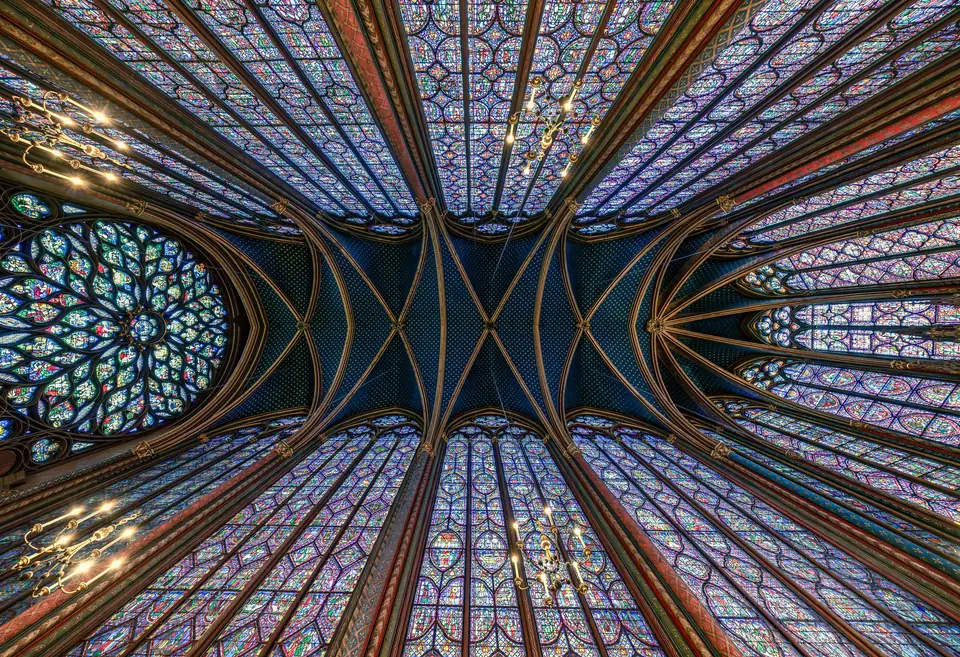
Sainte-Chapelle is the reason many people come to the island, and most are surprised by how small the building is. King Louis IX, later Saint Louis, built it in the 1240s to house relics of the Passion that he had bought at great expense, including what was believed to be the Crown of Thorns. The chapel was consecrated in 1248, and the Gothic architects designed it as a jewel box in stone and glass.
There are two levels. The lower chapel, low and painted in deep blues and reds, was for the household servants. A narrow spiral stair leads up to the upper chapel, where the walls seem to disappear: fifteen tall stained-glass windows, filled with more than a thousand small scenes from the Old and New Testaments, rise to a star-spangled vault. The glass is largely medieval and is among the finest in the world. The colours are strongest on a bright day, when the whole room glows red and blue.
Book a timed entry in advance, because it is one of the busiest sights in Paris and the security check at the entrance can be slow. Go first thing in the morning where possible, and give it at least half an hour inside. Sit on the benches along the wall and look up slowly, from the biblical scenes at eye level to the images at the top. The same palace site holds the law courts, so you pass through a courtyard where lawyers in black robes hurry to their hearings.
The Conciergerie and the palace
Next to Sainte-Chapelle stands the Conciergerie, the surviving part of the medieval royal palace. The French kings moved out in the fourteenth century, and the building then became the city's prison. During the Revolution it held thousands of prisoners on their way to the guillotine, among them Queen Marie Antoinette, whose reconstructed cell is on view. Before that, it was a royal showpiece, and the huge vaulted Hall of the Men-at-Arms, with its forest of Gothic columns, is one of the grandest medieval rooms in Europe.
The visit is quieter than the chapel and works well as a second stop, especially on a day when the weather turns. The riverside facade, with its round towers and the first public clock in Paris, is best seen from the Quai de l'Horloge or from the Pont au Change.
The flower market and the tip of the island
A short walk from the cathedral, the Flower Market is the last of its kind on the island. It occupies a row of green pavilions on the Place Louis-Lépine, and it fills with plants and cut flowers during the week. On Sundays it turns into a bird market, which children tend to enjoy.
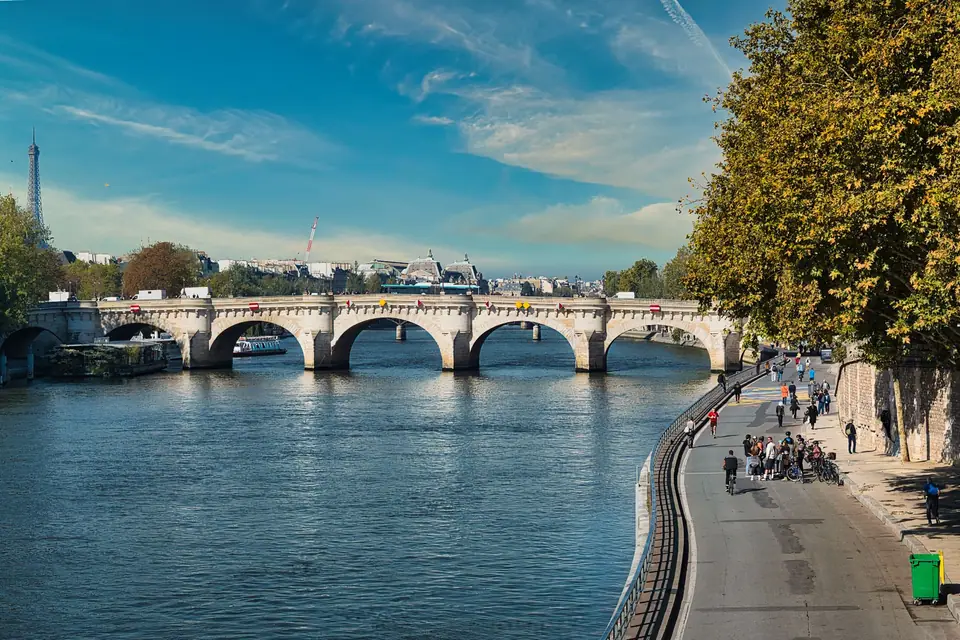
At the western end of the island, the Pont Neuf, the New Bridge, is in fact the oldest standing bridge in Paris. It was finished in 1607 under Henri IV, whose equestrian statue stands at its centre, and it was the first Paris bridge without houses built along it, so people could see the river for the first time. Steps near the statue lead down to the Square du Vert-Galant, a triangle of lawn, willow trees and benches with the water on both sides. In the evening it is one of the best places in the city to sit with a sandwich and watch the river boats pass.
The cruise boats leave from just beside the park. Our Seine river cruise page explains how to choose one, and the island looks best from the water at dusk when the monuments are lit.
Île Saint-Louis
The smaller island east of the cathedral feels like a village. Its straight streets were laid out in the seventeenth century and lined with elegant stone town houses, and there is hardly a shop that sells anything but food, books or antiques. It is a favourite place for a slow lunch, a riverside walk on the Quai de Bourbon, and an ice cream from the famous Berthillon shop, whose fruit sorbets have been served here for generations.
The Île Saint-Louis also has the church of Saint-Louis-en-l'Île, a quiet baroque interior, and the best views back towards the cathedral from the tip at the Square Barye. It is a calm contrast to the crowds on the larger island, and you can reach it on a footbridge from behind Notre-Dame in two minutes.
The Latin Quarter
Cross the Petit-Pont and the mood changes at once. The Latin Quarter is a maze of narrow streets, small squares and old stones. Its centre is the Sorbonne, the university founded in the thirteenth century, and its rhythm still follows the students, who fill the cafés and the bookshops.
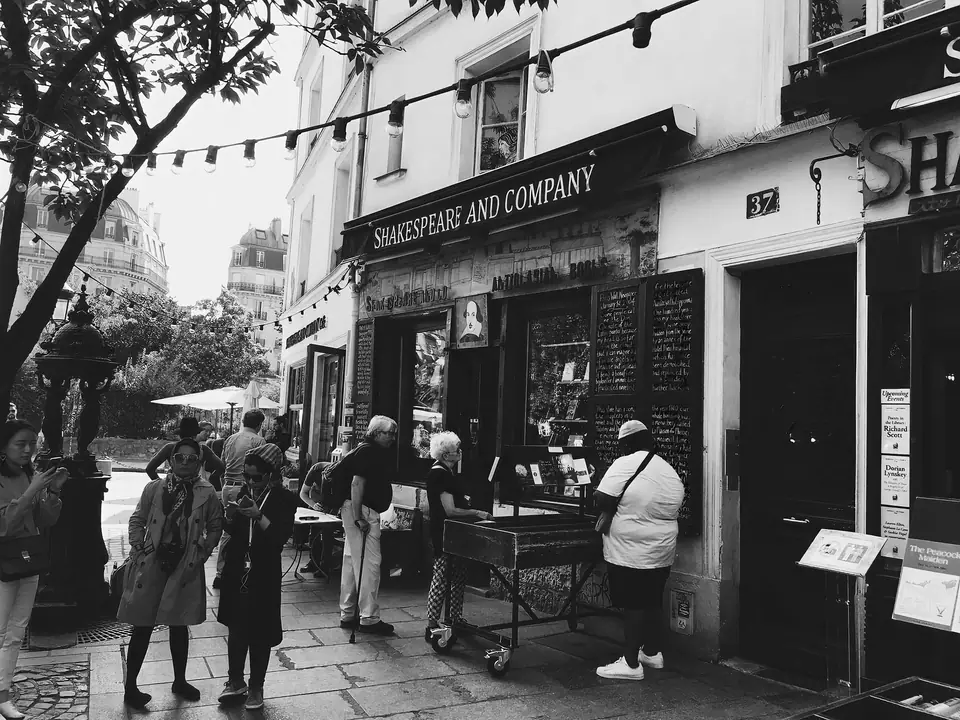
Start on the Rue de la Bûcherie, where the bookshop Shakespeare and Company faces Notre-Dame across the river. It was opened by an American, George Whitman, in the 1950s, and it carries on the tradition of the earlier shop of the same name that was a home to Hemingway and Joyce. A tiny medieval church, Saint-Julien-le-Pauvre, stands beside it, and Saint-Séverin, a Gothic church with spiral pillars and modern stained glass, is a short walk away.
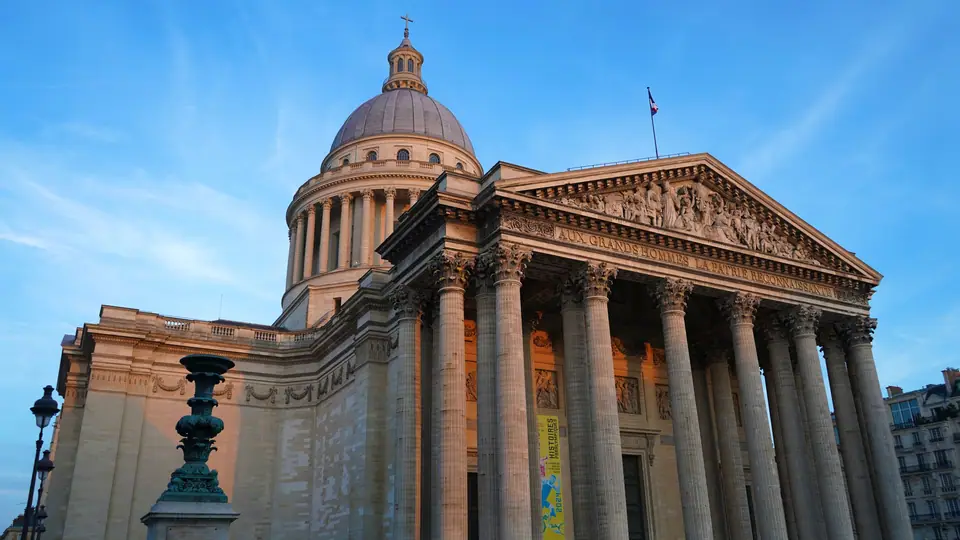
Further on, the Musée de Cluny, the national museum of the Middle Ages, is housed in a medieval abbot's mansion built on top of Roman baths. Its masterpiece is the set of tapestries called The Lady and the Unicorn, made around 1500, and the museum also keeps a collection of medieval sculpture and jewellery. Higher up the hill, the Panthéon, a neoclassical temple built as a church and now a national mausoleum, holds the tombs of Voltaire, Rousseau, Victor Hugo and Marie Curie. Right beside it stands Saint-Étienne-du-Mont, a church with a rare carved rood screen.
For a change of pace, the Rue Mouffetard is a lively old market street on the south side of the hill, lined with food shops, cafés and small restaurants. The Roman amphitheatre called the Arènes de Lutèce is hidden behind an unassuming gate nearby, and local people play boules and football in what was once a Roman arena.
A one-day route through the island and the Latin Quarter
This is the route we like because it begins with the busiest sights and ends in the quiet:
- Early morning: Sainte-Chapelle in the first entry slot, then the Conciergerie if you want the palace as well.
- Mid-morning: Notre-Dame and the forecourt, with the crypt underneath, then a stroll to the flower market.
- Late morning: the Pont Neuf and the Square du Vert-Galant, then back along the quay.
- Lunch: a bistro on the Île Saint-Louis, followed by a sorbet from the famous ice-cream shop.
- Afternoon: Shakespeare and Company, Saint-Séverin, the Cluny museum, and the Sorbonne square.
- Late afternoon: climb to the Panthéon and Saint-Étienne-du-Mont, then walk down the Rue Mouffetard.
- Evening: dinner in a side street, and if the light is right, a final walk on the quay to see the cathedral lit.
If it rains, swap the open-air stops for the Conciergerie and the Cluny museum, both of which are easy to enjoy under cover.
Adding a second day
A second day allows you to slow down. Spend the morning in the Cluny museum and the Panthéon, climb the stairs to the dome if it is open, and spend the afternoon in the Jardin des Plantes or the Luxembourg Gardens, where Parisians sit with a book and a paper cup of coffee. The rooftop terrace of the Institut du Monde Arabe gives a different view of Notre-Dame. In the evening, the cafés of Saint-Germain, a short walk west, are the right place for dinner. For art, the Louvre guide explains how to visit the great museum across the river, and the Louvre guided tour is a good way to see its highlights in a morning.
Metro, bus and walking routes to the island
The area is in the middle of the city, so it is easy to reach. Metro Line 4 stops at Cité, which is on the island itself, and at Saint-Michel, at the foot of the Latin Quarter. Lines 10 and 7 serve the south side of the hill, and Châtelet, a short walk across the Pont au Change, is the city's biggest interchange. From Charles de Gaulle airport, the RER B runs directly to Saint-Michel Notre-Dame, which makes the area a convenient first stop on arrival. Our how to get to Paris guide explains the airports and trains in detail.
Within the area, you will walk. Distances are short, but the cobbles are uneven and the streets climb steadily up to the Panthéon, so wear comfortable shoes.
Sleeping near the island and the Latin Quarter
The Latin Quarter has plenty of small hotels in old buildings, with rooms that are often compact and charming. It is lively until late near the Boulevard Saint-Michel and much calmer on the side streets towards the Panthéon. The Île Saint-Louis has a few elegant hotels, and a stay there feels like living in a village in the middle of Paris. If you prefer a more polished area, the Marais on the Right Bank and Saint-Germain on the Left Bank are both a ten-minute walk away. Our where to stay in Paris guide compares them. Book early for spring and autumn, when the best small hotels fill quickly.
Where we eat on the island and in the Latin Quarter
The tourist-trap warning applies here more than anywhere. Streets such as the Rue de la Huchette, with their neon signs, photo menus and touts at the door, are best avoided. Walk a couple of streets away, towards the Rue Mouffetard, the Place de la Contrescarpe or the Île Saint-Louis, and the restaurants are better and the menus shorter.
Look for classic French dishes done simply: steak frites, onion soup, a croque monsieur, roast chicken, duck confit, and a tarte tatin to finish. For a light meal, a crêpe from a street stall or a baguette sandwich from a bakery is a classic, and the bakeries of the Latin Quarter are among the best in the city. Coffee is drunk standing at the counter or sitting on a café terrace, and the price changes with the choice, so decide before you order. Do not feel obliged to eat in a café with a view of the cathedral, because the best bite is usually a few steps away.
Bookshops, quays and souvenirs
The Latin Quarter is the best part of Paris for books. Beside Shakespeare and Company, the green boxes of the booksellers along the quays, called bouquinistes, sell old prints, posters and second-hand books, and they are part of the Seine's UNESCO-listed riverbanks. On the Rue Saint-Jacques and around the Sorbonne, antiquarian and student bookshops line the streets. For food gifts, look at the cheese shops and chocolate makers on the Rue Mouffetard and the Rue Saint-Louis-en-l'Île.
Queues, bags and other practical matters
A few habits make the day easier. Carry a refillable bottle, because Paris has many public drinking fountains, including green Wallace fountains along the quays. Buy timed entries for the chapel and the Conciergerie before you leave home, and keep the confirmations on your phone. Be ready for bag checks at the entrance to the cathedral and the palace, and travel light so that they move quickly. Many shops in the Latin Quarter close on Sunday afternoon and Monday, and some museums close on Monday or Tuesday, so we check the day of the week before fixing the order of the route. If you are visiting in a busy season, walk the quays in the evening: the crowds thin out, the light turns gold, and the cathedral glows against the sky.
Seasons on the Seine
April, May, late September and October are the best months. The weather is mild, the light is soft and the trees along the quays are green or golden. July and August bring heat and crowds, although Parisians leave in August and the Latin Quarter feels slightly emptier. Winter is cold and grey, but the cathedral, the chapel and the museums are quieter, and a frosty evening on the quays can be lovely. Christmas, Easter and any major holiday mean long queues, so book timed entries early. See our what to wear in Paris guide for the seasons.
Further afield from Notre-Dame
If you have more time, the rest of the city opens up from here. The Louvre is a short walk along the river, the Eiffel Tower is covered in our Eiffel Tower guide, and the hilltop village of Montmartre has its own Montmartre guide. A day trip to Versailles is described in our Versailles day trip page, and the wider country is covered in the France guide.
Building a longer Paris stay around the island
The island and the Latin Quarter are a day or two of a longer stay. Our Paris 3-day itinerary shows how to combine them with the Louvre and the Eiffel Tower, and the things to do in Paris page lists the rest of the city.
Questions we hear most about the island
Is one day enough for the island and the Latin Quarter?
For the main sights, yes, if you start early and follow a sensible order. If you also want the Cluny museum, the Panthéon and a long lunch, take two days.
Do I need to book Sainte-Chapelle in advance?
Yes. It is small and very popular, and timed entry is the norm. Book online for the first slot of the day.
Can I visit Notre-Dame again after the fire?
Yes. It reopened in December 2024 after the restoration. The arrangements for entry and for the towers have been changing, so use the official site for the current system.
Is the Conciergerie an extra stop we should add?
If you like history, yes. It is quieter than the chapel and shows the medieval palace and the Revolution side by side.
Do I need to dress modestly?
In churches, yes: shoulders covered and respectful behaviour. In the streets, normal clothes are fine. See our what to wear in Paris guide.
Is the area safe?
Yes. Pickpockets work the crowds around the cathedral and on the metro, so keep valuables in a front pocket or a zipped bag. Politely ignore clipboard petitions and anyone who offers a friendship bracelet or claims to have found a gold ring on the pavement.
For everything else about planning your stay, our Paris travel guide covers money, transport, etiquette and how many days to give the city.