Quick Field Data
- UNESCO Inscription: 1993 (Ref. 546); Criteria (ii) and (iv)
- Scale & Footprint: 72.45 hectares encompassing the walled monastic precinct on the edge of Maulbronn plus linear reservoirs, canals and drainage works across the Salzach river valley
- Access & Ticketing: The western outer courtyard and town-hall square open freely to pedestrians; entering the abbey church, Paradise narthex, cloister, fountain house and museum rooms requires a site admission ticket
- Arrival Logistics: Stuttgart Airport (STR) sits 46 kilometres southeast and Frankfurt Main Airport (FRA) lies 115 kilometres north, serving the hilly Stromberg valley just north of Mühlacker near the historic Speyer to Cannstatt corridor
From Eckenweiher Exile to an Imperial Cistercian Abbey
Maulbronn Monastery owes its intact medieval survival to an abrupt relocation in 1147. Nine years earlier, in 1138, a free knight named Walter von Lomersheim donated an estate at Eckenweiher (now Mühlacker) to the Cistercian Order, prompting Neubourg Abbey to dispatch a party of twelve monks. Eckenweiher proved too dry and cramped in pasture for Cistercian self-sufficiency. In 1147, Günther von Henneberg, Bishop of Speyer, moved the small community roughly 8 kilometres into a sheltered valley near the source of the Salzach river called Mulenbrunnen, situated inside the hilly Stromberg countryside close to the ancient Roman road linking Speyer and Cannstatt.
Rapid imperial and papal backing transformed the valley clearing into a major ecclesiastical lordship. In 1148, Bishop Henneberg waived Maulbronn's levies on extensive forest clearances and Pope Eugene III granted patronage rights. Supported by the ruling Hohenstaufen dynasty, Emperor Frederick I, in a 1156 charter, exempted Maulbronn from tithes and raised it to an Imperial Abbey holding eleven farmsteads, shares of eight villages and multiple vineyards. By 1151 the monks had established Bronnbach Abbey, acquired the Füllmenbacher and Elfinger farmsteads in 1152 and 1153, and founded Schöntal Abbey in 1157. When Pope Alexander III confirmed the abbey's holdings in 1177, Maulbronn owned seventeen farmsteads. Arnold I, Archbishop of Trier, consecrated the abbey church in 1178, and the core monastic complex stood largely finished by 1200.
Economic success did not spare Maulbronn from fourteenth-century disputes. Under Cistercian regulations, lay brothers rather than choir monks were required to farm the abbey's estates. Friction between the two groups steadily shrank lay-brother numbers during the thirteenth century, forcing the monastery to hire external labourers. Around 1236, the House of Enzberg became Maulbronn's secular protectors (vögte), sparking chronic conflict that briefly suppressed the abbey in 1270 even after Pope Alexander IV granted legal jurisdiction over its lands. Emperor Charles IV transferred protective authority to the Electoral Palatinate in 1372, dragging Maulbronn into regional rivalry against the expanding County of Württemberg. Prosperity surged again in the fifteenth century. In 1450 Maulbronn sent the largest financial contribution of any Cistercian house to Cîteaux Abbey, and in 1464 it absorbed the debts and priory status of Pairis Abbey in Alsace. The abbey oversaw five convents: Mariental, Rechtenshofen, Lichtenstern, Heilsbruck and Koenigsbruck. It reached a peak of one hundred thirty-five monks in the 1460s before Emperor Maximilian I, in 1492, withdrew the Palatinate vogtei and barred new abbey fortifications.
Reformation Seminary, Fortified Sieges and Secularisation
Maulbronn's long medieval autonomy ended in 1504 during the War of the Succession of Landshut, when Duke Ulrich of Württemberg captured the walled complex after a seven-day siege and annexed its lands into the Duchy of Württemberg. Peasants occupied the monastery and expelled the monks during the German Peasants' War of 1525. When Duke Ulrich adopted Lutheranism in 1534 and dissolved Württemberg's monasteries, Maulbronn alone was initially spared in order to house monks displaced from neighbouring houses, though its abbot departed for Pairis in 1536 to litigate for restoration. Briefly reinstated under the 1548 Augsburg Interim following the Schmalkaldic War, the Cistercians surrendered the complex permanently after the 1555 Peace of Augsburg.
In 1556, Duke Christoph of Württemberg followed a reform plan drafted by advisor Johannes Brenz, converting thirteen former monasteries into Protestant seminaries and turning Maulbronn's holdings into an administrative district. Former Maulbronn monk Valentin Vannius assumed office as Protestant abbot and seminary head in 1558, hosting two Lutheran colloquys in 1564 and 1576. Armed conflict repeatedly touched the precinct: the Thirty Years' War forced the seminary school to close until 1656, and during the Nine Years' War Maulbronn formed part of the Eppingen defensive lines constructed from 1695 to 1697 by Margrave Louis William of Baden-Baden. Around the late seventeenth century, Duke Louis III (Ludwig) engaged court architect Georg Beer to adapt the monastic rooms for school use and erect a Renaissance hunting lodge on the grounds, representing one of the rare Renaissance accents within a predominantly medieval precinct.
King Frederick I, in 1806, formally secularised the complex, yet preservation of its medieval architecture began unusually early in 1840. Taken over by the Nazi Party in 1941, the seminary school reopened after the war in 1945 and operates to this day as an Evangelical seminary and boarding school, sharing the outer enclosure with Maulbronn's town hall, municipal offices and police station.
Today some 90 percent of the monument rests in public hands under the Federal State of Baden-Württemberg and the Town of Maulbronn. Preservation follows Sections 28 and 12 of the Baden-Württemberg Monument Protection Act and the federal Town and Country Planning Code, supported by a standing Monastery Advisory Committee (Klosterbeirat) working under annual conservation action plans. Legal protection extends across the buffer zone under Sections 2(3) and 15(3) of the Monument Protection Act, guided by the 2012 Kloster-landschaft landscape plan. The outer hydraulic network falls under Sections 2(1) and 2(2) together with the Baden-Württemberg Water Protection Act, Forest Act and Nature Protection Act under regional supervision of the Stuttgart Regional Commissioner's Office. Even private property owners inside the historic hydraulic zone must seek formal approval before altering land or water features. Receiving an annual average of 235,000 visitors as of 2019, the precinct demonstrates how continuous educational, civic and legal stewardship prevented the demolition that stripped bare so many secularised European abbeys.
Transitional Gothic Stonework and Salzach Valley Waterworks
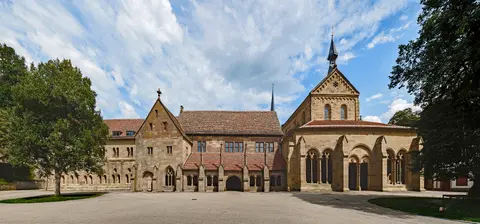
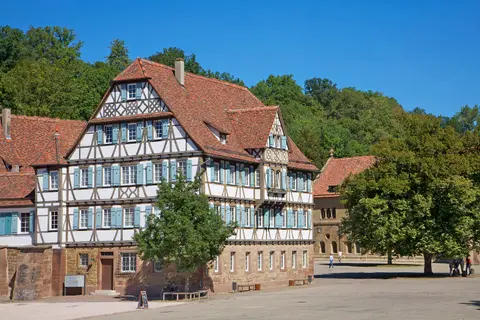
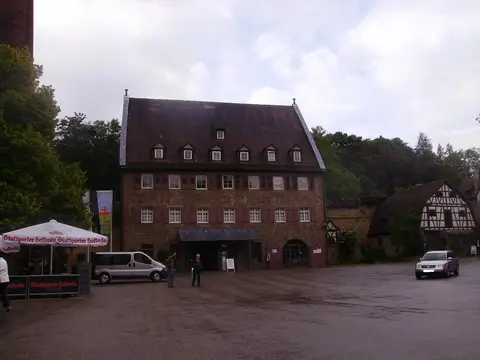
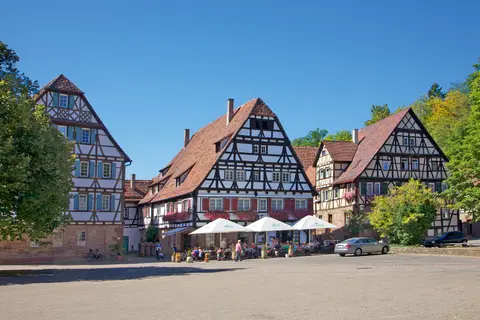
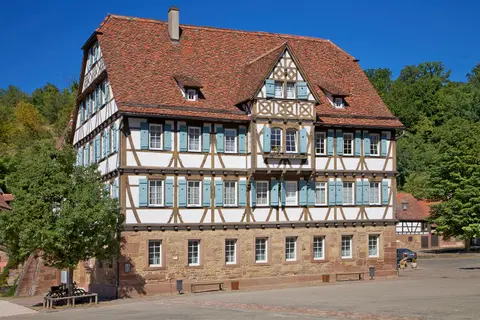
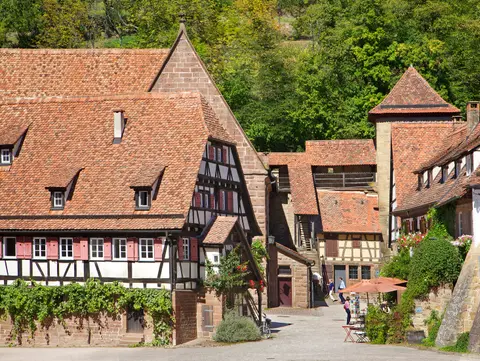
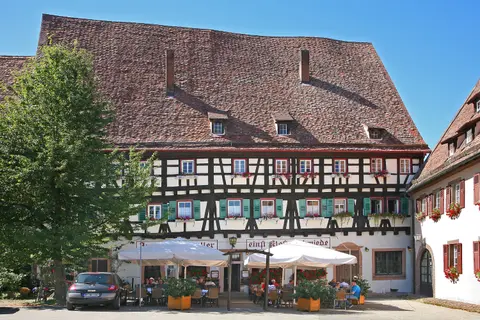
Stepping through the fortified perimeter reveals one of the clearest transitions from Swabian Romanesque to French Gothic architecture in central Europe. Surrounding thirteenth-century stone walls, five defensive towers and a drawbridge gatehouse (backed around 1600 by a half-timbered rear wing with a fireplace hall and roofed in 1751) enclose an extraordinary outer workshop yard. Behind the gatehouse stand the former guest inn and pharmacy, where a resident monk once said early morning mass for travellers. Adjacent stands a nineteenth-century carriage house museum built atop a circa 1480 chapel whose choir foundations remain visible outside. Nearby lie buried remains of a Romanesque gate demolished in 1813 together with an associated lead water pipe hinting at a medieval courtyard well. East of the gate rises the Fruchtkasten, a thirteenth-century storehouse totally rebuilt and enlarged in 1580 for wine-making equipment and used today as a concert hall. Northward along the western defensive wall run former blacksmith and wheelwright workshops, the Haberkasten granary, the chief baker's workplace and residence, and a cooperage (Küferei). Beside them stands the former mews converted in 1600 from Gothic into Maulbronn's Renaissance town hall. Three half-timbered buildings complete the line: the Speisemeisterei next to the sawmill, the 1550 servants' quarters, and the 1742 Bursarium built as a cemetery office and functioning in 2019 as a police station and notary.
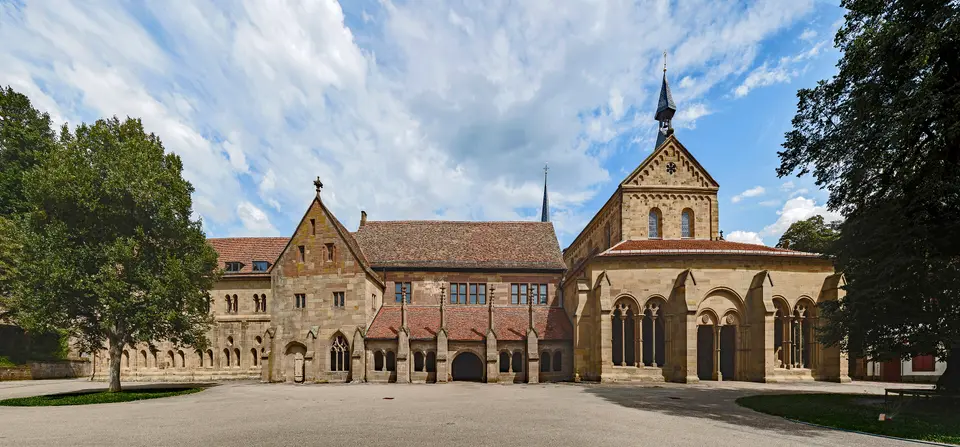
At the heart of the precinct stands the abbey church, originally built in the twelfth-century Swabian Hirsau style marked by uniform columns and rectangular stone frames enclosing round Romanesque arches. While the two-storey Romanesque nave, low chevet and transept (opening into three rectangular chapels per arm) preserve first-generation Cistercian austerity, including the original twelfth-century west portal and timber doors, an anonymous Paris-trained master transformed the complex between 1210 and 1220. Working in transitional Romanesque-Gothic forms, this master raised the Paradise entrance narthex, the southern cloister walk and the monks' refectory, creating the earliest examples of French Gothic architecture on German soil, followed later by Late Gothic additions from the late thirteenth to mid-fourteenth centuries.
Inside the church, a monumental stone choir wall rigidly divided choir monks from lay brothers. Two carved ciboriums adorned with toads, lizards and skulls flank this partition, fronted on the lay brothers' side by a single-block stone Crucifixion carved around 1473 and a 2013 pipe organ by Gerhard Grenzing. Beyond the partition sit the circa 1307 to 1317 Maulbronner Madonna, the abbot's seat, and oak choir stalls crafted around 1450 for 92 monks (possibly by Hans Multscher) filled with biblical reliefs and mythical beasts. Wall frescoes depict the Adoration of the Magi, Walter von Lomersheim entering as a lay brother and noble donor coats of arms. Outside the stone walls, Cistercian hydraulic engineers harnessed the Salzach valley and adjacent hillsides with a multi-kilometre network of reservoirs, sluice drains and irrigation canals. That system powered fishponds, mills and farm pastures, leaving one of Europe's best-preserved medieval water-management landscapes despite nineteenth-century pond drainage.
Access Zones Across the Maulbronn Monastery Enclosure
| Complex Zone | Key Highlights | Access & Ticket Rule |
|---|---|---|
| Western Outer Courtyard | Drawbridge gatehouse, Fruchtkasten concert hall, Haberkasten granary, cooperage, town hall and half-timbered workshops | Open pedestrian precinct without admission charge; municipal offices and seminary school rooms remain closed to casual entry |
| Abbey Church & Paradise Narthex | Hirsau-style Romanesque nave, 1210 to 1220 Gothic narthex, choir screen, 1473 Crucifixion and 1450 oak choir stalls | Ticketed heritage entry operated through the monastery visitor centre; quiet conduct required during services |
| Cloister, Lavatorium & Refectory | Southern Gothic cloister arcade, fountain house (lavatorium) and early Gothic monks' refectory | Included with abbey site admission; select upper rooms and seasonal thematic walks require guided tours |
| Salzach Valley Water System | Surviving reservoirs, irrigation ditches and historic drainage channels across surrounding meadows and woodland | Open countryside footpaths traverse public and forest sectors; observe protection markers around private land |
Dividing a visit between the free outer yard and the ticketed monastic core makes the spatial hierarchy of a Cistercian abbey legible at a glance. Commercial crafts, grain storage, wine pressing and guest hospitality hugged the western gatehouse yard, isolating the enclosed church and cloister for uninterrupted monastic prayer and labour.
Three Monastic Masonry and Engineering Details to Inspect
- Choir Screen Ciboriums and Monolithic Crucifixion: Examine the carved stone canopies flanking the church partition for miniature medieval beasts including toads, lizards and skulls, set directly in front of the 1473 single-stone Christ figure facing the lay brothers' nave.
- Transitional Vaulting in the Paradise and Southern Cloister: Compare the square-framed twelfth-century Hirsau Romanesque arches of the west portal and original doors against the 1210 to 1220 pointed Gothic ribs launched by the Paris-trained architect.
- Salzach Valley Reservoir Earthworks and Gatehouse Lead Pipe traces: Walk beyond the fortified perimeter into the surrounding Stromberg slopes to trace how Cistercian earth dams, canals and buried conduits brought spring water directly into the lavatorium fountain house and outer workshops.
Seasonal Timing and Pairing With Stuttgart
Arrive on weekday mornings to explore the cloister and church choir stalls before school groups and coach tours reach the gatehouse courtyard, and budget an extra hour to follow the footpaths tracing the Salzach reservoirs outside the fortified walls. Winter frosts crisp the half-timber facades, whereas spring and autumn bring mild walking conditions across the Stromberg woods. Located just 37 kilometres northwest of Stuttgart, Maulbronn pairs easily with southwest German itineraries before browsing further monastic landmarks across the UNESCO World Heritage Atlas.