Quick Field Data
- UNESCO Inscription: Reference 1155, inscribed in 2006 as a Cultural site under Criteria (ii), (iii), and (iv) in Bavaria, Germany.
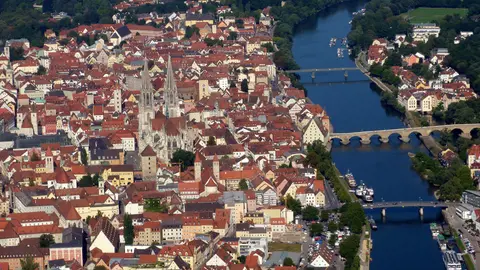
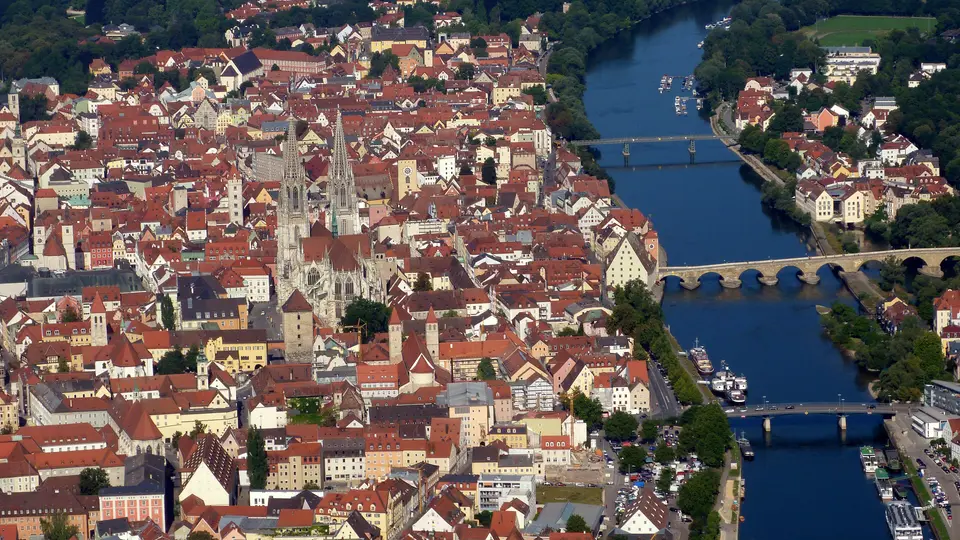
- Scale & Footprint: Covers 182.8 hectares uniting the medieval Altstadt south of the Danube, two elongated Danube river islands known as the Wöhrde, and the former St Katharina hospital precinct in Stadtamhof bounded on the north by the Rhine-Main-Danube canal.
- Access & Ticketing: Old Town lanes, the Stone Bridge, Rathausplatz, Porta Praetoria ruins, and Stadtamhof remain open for free pedestrian exploration, while St Peter's Cathedral treasury, the Old Town Hall Imperial Diet rooms, Schloss Thurn und Taxis, and diocesan museums operate ticketed entry.
- Arrival Logistics: Munich Airport (MUC) lies 78 kilometres south-west, with Nuremberg Airport (NUE) 91 kilometres north-west; direct regional rail links deliver travellers to Regensburg central station on the southern edge of the listed Altstadt, 1 kilometre from the medieval centre.
From Castra Regina to the Twelfth-Century Danube Stone Bridge
Standing at the northernmost bend of the Danube where the Naab and Regen tributaries converge, Regensburg marks a geological crossroads between four distinct Bavarian landscapes. The granite and gneiss mountains of the Bavarian Forest lie to the north and northeast, while the fertile Gäuboden loess plain stretches downstream to the east and southeast. To the south lies the Tertiary Hill Country of the Alpine Foreland, balanced by the Franconian Jura to the west. Settlement dates back to the Stone Age and the Celtic Radasbona, before Roman engineers placed a fort here around AD 90. In 179 AD, Emperor Marcus Aurelius raised Castra Regina, a major legionary fortress for Legio III Italica. Its perimeter still defines the eastern core of the Old Town between Obere and Untere Bachgasse and Schwanenplatz, anchored on the river side by the limestone arches of the Porta Praetoria.
After Roman administration faded, the Agilolfings established Regensburg as the ducal capital of Bavaria from about 530 until the first half of the thirteenth century. Saint Boniface re-established the Bishopric of Regensburg in 739, and Charlemagne hosted his 792 ecclesiastical assembly here to condemn Spanish adoptionism. Following the 843 partition of the Carolingian Empire, Eastern Frankish ruler Louis the German made Regensburg his principal seat. Two years later, 14 Bohemian princes came here for baptism, turning Regensburg into the mother diocese of Prague and anchoring Czech lands in the Roman Catholic orbit. Arnulf of Carinthia later died here on 8 December 899, and between 800 and 1000 the town's population climbed from 23,000 to 40,000.
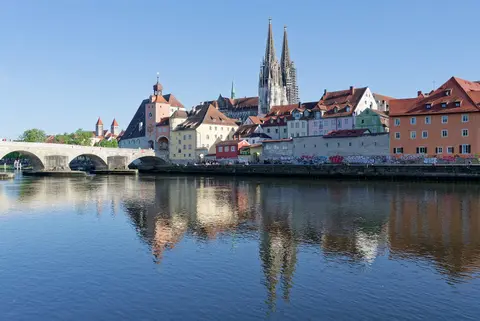
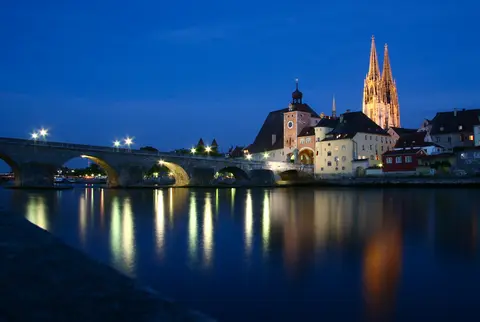
Regensburg's commercial ascent peaked when builders raised the Stone Bridge across the Danube between 1135 and 1146, shortly after Gottschalk's 1096 crusading mob attacked the local Jewish quarter. Bypassing slow river ferries, the stone span connected northern Europe directly to Venice and transcontinental Silk Road commodities via Bohemia, Russia, and Byzantium. Knights of the Second and Third Crusades marched across its arches on their way to the Holy Land, while the bridge builders' original riverside headquarters survived beside the south approach as the historic Regensburg Sausage Kitchen, linking twelfth-century engineering directly to living street life.
Patrician Towers, Five Political Jurisdictions, and the Perpetual Diet
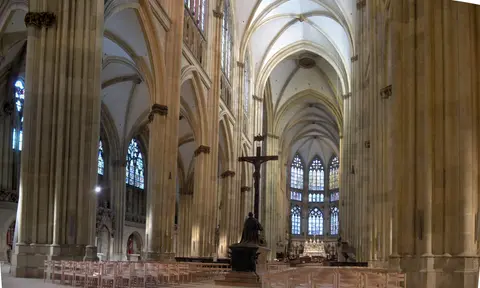
In 1245 Regensburg won Free Imperial City status, sparking intense architectural competition among merchant dynasties whose wealth rested on long-distance trade in gold work and fine textiles. Rather than building in timber, wealthy patrician families erected tall defensive stone houses and status towers that still punctuate the skyline, exemplified by the 1260 Goldener Turm on Wahlenstrasse and the historic Baumburger Turm. Meanwhile, major ecclesiastical foundations transformed the urban fabric around St Peter's Cathedral, begun in 1275 in pure German Gothic and completed in 1634 before its twin towers were finished in 1869. The cathedral houses Peter Vischer monuments, the celebrated Regensburger Domspatzen choir, and an adjoining cloister chapel dating back possibly to the eighth century. Other medieval foundations include the twelfth-century Scottish Benedictine abbey church of St James near Jakobstor and St Emmeram's Abbey with its rare detached bell tower. The 1010 church of Obermünster and the thirteenth-century St Ulrich diocesan museum further enrich this monastic landscape.
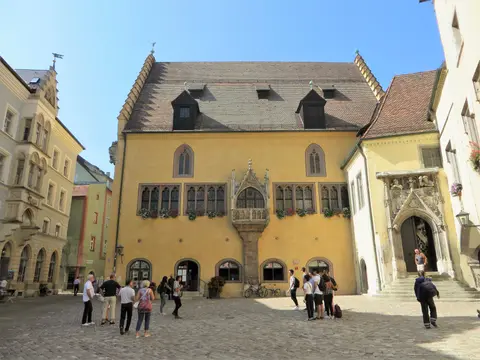
Confessional politics turned early modern Regensburg into one of the strangest constitutional arrangements in Europe. Following an imperial meeting in 1471 and brief Bavarian annexation in 1486 reversed ten years later, the city council expelled around 500 Jews in 1519 after Emperor Maximilian the First died, demolishing the medieval synagogue and cemetery and scattering gravestones into town construction. After hosting the first Diet of Regensburg in 1541, the city adopted the Protestant Reformation in 1542, barring Roman Catholics from civic citizenship rights. Yet the town simultaneously retained its Catholic bishopric and three imperial-estate abbeys holding independent Reichstag votes: St Emmeram, Niedermünster, and Obermünster. Until 1803, five separate political entities operated side by side inside the medieval walls. Between 1663 and 1806, the fourteenth-century Old Town Hall hosted the Perpetual Imperial Diet of the Holy Roman Empire, making Regensburg a functional co-capital together with Vienna and establishing the Prince of Thurn and Taxis as the Emperor's resident Commissary-Principal.
Imperial fragmentation ended in 1803 when Archchancellor Carl von Dalberg united town, bishopric, and monasteries into the Principality of Regensburg and granted Protestants and Catholics equal civic rights. Six years later, between 19 and 23 April 1809, Napoleon's forces clashed with retreating Austrian troops in the Battle of Ratisbon. Roughly 150 houses burned before Dalberg ceded the city to the Kingdom of Bavaria in 1810. By that time, St Emmeram's monastic buildings had been converted in 1809 into Schloss Thurn und Taxis. Secular monuments such as the 1610 Adler-Apotheke and the Gasthof zum Goldenen Kreuz added intimate Renaissance texture to the medieval streets. At the Gasthof zum Goldenen Kreuz, Charles V met Barbara Blomberg, mother of Don John of Austria born in 1547.
Preservation Across Stone Architecture and Wartime Survival
Few medieval cities north of the Alps retain Regensburg's structural continuity, largely because nearly 1,500 listed buildings were erected in stone and escaped sweeping twentieth-century demolition. Even during the Nazi period and Second World War, destruction struck unevenly. Following persecution after 1933, Kristallnacht on 9 November 1938 destroyed the Regensburg synagogue and saw roughly 220 Jews arrested and sent to Dachau. In 1942, over 200 Jews were deported to Piaski and Theresienstadt, and in March and April 1945 a Flossenbürg concentration camp subcamp operated here. Inside that subcamp, 40 of 460 forced labourers died, commemorated today by a memorial stone in Stadtamhof. Allied bombers targeted the Messerschmitt Bf 109 aircraft factory and oil refinery on 17 August 1943 and 5 February 1945. The medieval streets remained mostly intact, apart from a March 1945 raid that destroyed Obermünster church while sparing its belfry.
Between 1945 and 1949, Regensburg hosted Germany's largest displaced persons camp in the Ganghofersiedlung district, sheltering nearly 5,000 Ukrainian and 1,000 non-Ukrainian residents with a camp postal service launched on 11 December 1946. Slow early post-war economic recovery spared the old stone centre from modern redevelopment until Siemens arrived in the 1960s, followed by the University of Regensburg in 1965, the University of Applied Sciences in 1971, BMW in 1986, and high-tech firms such as Infineon and OSRAM. By the 1970s, conservation sentiment governed municipal planning under the 1975 Bavarian Heritage Preservation Law, the 1982 Old Town Statutes, and the 1986 Federal Building Code. Even northern Stadtamhof, annexed into Regensburg only in 1924, preserved its historical continuity around the former St Katharina charity hospital across the Stone Bridge, helping earn Regensburg the 1997 Europe Prize for European integration.
Civic institutions and noble estates inside the historic loop continue reinforcing that preservation ethos today. St Emmeram's legacy extends across town to Schloss Höfling, while municipal cultural life centres on the public library, picture gallery, and botanical gardens on campus and inside Herzogspark. An episcopal clerical seminary, a dedicated church music school, and Regensburg's traditional stained-glass making institute keep specialist craft traditions rooted inside the Bavarian Upper Palatinate capital. Complemented by Steering Committee integrative monitoring and local by-laws, the historic urban fabric remains an inhabited living town rather than a depopulated monument zone.
Access Zones Across Regensburg Altstadt, Danube Islands, and Stadtamhof
Regensburg's 182.8-hectare World Heritage site functions as a walkable living town split by two channels of the Danube, making exterior exploration straightforward while concentrating paid admissions in select historical halls.
| Complex Zone | Key Highlights | Access & Ticket Rule |
|---|---|---|
| Altstadt & Roman Castra Core | Porta Praetoria wall remains, St Peter's Cathedral, St Ulrich diocesan museum, Adler-Apotheke (1610) | Streets and Roman archway exteriors free to inspect; cathedral treasury and museum galleries charge entry |
| Civic & Patrician Quarter | Old Town Hall Imperial Diet rooms, Goldener Turm (1260), Gasthof zum Goldenen Kreuz, Schottenkirche | Rathausplatz, patrician tower exteriors, and parish churches open freely; guided Diet Hall tours require tickets |
| Stone Bridge & Danube Islands | Twelfth-century Steinerne Brücke, historic Sausage Kitchen, Upper and Lower Wöhrd island walks | Free pedestrian crossing over the Danube bridge and open parkland footpaths across both islands |
| Stadtamhof & Southern Abbeys | St Katharina precinct, Rhine-Main-Danube canal edge, Schloss Thurn und Taxis (St Emmeram) | Stadtamhof lanes and Flossenbürg memorial open publicly; Schloss Thurn und Taxis state rooms require paid tour entry |
Three Masonry and Engineering Details to Inspect Around Regensburg
Close ground inspection across the Altstadt and riverfront reveals how medieval builders adapted Roman stonework and river hydraulics into lasting civic landmarks.
- Bridge Foundations and Flood Pier Cuts on the Stone Bridge: Built between 1135 and 1146, the Stone Bridge stands on deep timber oak piles braced by stone cutwaters designed to deflect winter Danube ice and fast current. Stepping onto the south bank near the historic Sausage Kitchen lets visitors examine how the former bridge construction office tucked directly under the medieval defensive ramparts.
- Romanesque Portal Carvings on the Schottenkirche: Outside the twelfth-century Irish Benedictine church of St James near Jakobstor, examine the dense stone reliefs framing the main north doorway. Unusual grotesque figures, mythological beasts, and symbolic carvings wrap around the stepped round-arched portal, illustrating how continental monastic workshops blended insular traditions with Bavarian stonecraft.
- Roman Porta Praetoria Arches Embedded in Medieval Walls: Near the Danube north of St Peter's Cathedral, look at the weathered limestone blocks of the northern gateway of Castra Regina built in 179 AD for Legio III Italica. Medieval houses and the bishop's complex incorporated the surviving twin archway and flanking defensive tower directly into later masonry rather than quarrying the stone away.
Danube Climate Patterns and Regional Planning from Regensburg
Regensburg sits in a transitional humid continental and oceanic climate zone that remains cooler than most major German cities. Between 1981 and 2010, temperatures averaged 8.9 degrees Celsius with 658 millimetres of annual rainfall and 1,670 sunshine hours a year. July brings the warmest conditions for walking the Wöhrd river islands, City Park, Herzogspark, and VillaPark. Danube excursions also head upstream toward Weltenburg Abbey (founded around 620) and King Ludwig the First's circular Befreiungshalle at Kelheim, 25 kilometres away. Downstream along the river sits the Parthenon-inspired Walhalla temple at Donaustauf, 10 kilometres east. January is the coldest month, when frost and river mist sharpen the silhouettes of patrician towers and make warm stops inside the Old Town Hall or traditional bakeries especially rewarding.
Reaching Regensburg requires minimal transit effort from Munich Airport (78 kilometres) or Nuremberg Airport (91 kilometres), and every historic monument sits within easy walking reach of the central rail station 1 kilometre from the Old Town core. For local restaurant recommendations, riverfront green spaces, and structured walking itineraries across Bavaria's medieval river capital, consult our dedicated Regensburg city guide. Travellers combining medieval German river ports with Central European trading capitals can compare related sites across our full UNESCO World Heritage Atlas.