Quick Field Data
- UNESCO Inscription: Reference 624, inscribed in 1993 as a Cultural World Heritage Site under criteria (ii) and (iv).
- Scale & Footprint: Covers 142 hectares across three distinct historic districts spanning seven hills, two arms of the River Regnitz, and cultivated inner-city vegetable plots containing around 2,400 historic timber houses.
- Access & Ticketing: Streets, bridges, Klein-Venedig riverbanks, the Market Gardeners' lanes, and Cathedral nave are open-access public terrain; museum interiors inside the Neue Residenz, Old Town Hall, Diocesan Treasury, and Franconian Brewery Museum operate via standard admission tickets. Check official Bamberg heritage portals before visiting.
- Arrival Logistics: Nuremberg Airport (NUE) sits 46 km south, connected cleanly to Bamberg by regional rail (63 km by railway from Nuremberg and 101 km east of Würzburg). Our closest destination guide covers Regensburg (130 km southeast).
Emperor Henry II and the Eleventh-Century Franconian Diocese
Bamberg sits in Upper Franconia along the River Regnitz, 3 km before it joins the Main. Written records first mention the settlement beneath Babenberch castle in 902. Earlier missionary activity by Fulda monks in Slavic-settled eastern Franconia fell under Würzburg's spiritual jurisdiction before the Babenberg line died out. In 1007, King Henry II, Duke of Bavaria and future Holy Roman Emperor, carved out an independent bishopric from parts of the Würzburg and Eichstätt dioceses. This foundation strengthened Christian governance east of the Main. After Pope John XVIII confirmed the boundaries in 1008, Henry II commissioned a monumental cathedral consecrated on 6 May 1012. He also founded Michaelsberg Benedictine Abbey in 1017 to train clergy. In 1020, Pope Benedict VIII visited Bamberg to confer directly under the Holy See and consecrate churches. Briefly serving as a working political centre of the Holy Roman Empire, this northern "second Rome" became the burial place for Henry II and his wife Kunigunde. From the tenth century onward, Bamberg also served as a vital cultural link with Western Slavic peoples in Poland and Pomerania.
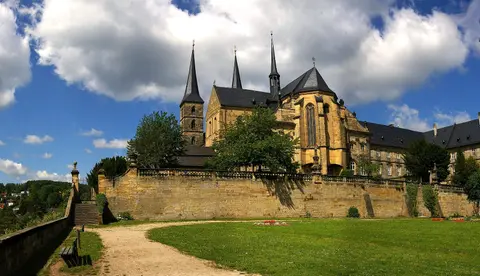
Although fire partially damaged the first cathedral in 1081, Saint Otto of Bamberg consecrated a successor in 1111, and by 1237 builders completed the present four-towered late-Romanesque Cathedral, measuring 94 metres long, 28 metres wide, and 26 metres high beneath four 81-metre towers. That twelfth- and thirteenth-century prosperity carried Bamberg's architectural forms outward into northern Germany, Poland, Pomerania, and Hungary. From the mid-thirteenth century onward, Bamberg's bishops ruled as sovereign princes of the Empire, acquiring territories of the Counts of Meran in 1248 and 1260 and registering the municipal coat-of-arms seal by 1279.
Early modern turmoil struck Bamberg harshly before Enlightenment learning arrived. Under Prince-Bishop Johann Georg II Fuchs von Dornheim, seventeenth-century witch trials peaked between 1626 and 1631. Centred on the 1627 Drudenhaus witch prison and documented in surviving letters such as that of Johannes Junius, those trials claimed roughly one thousand victims before easing. Shortly thereafter, in 1647, Bamberg founded its university, the Academia Bambergensis. By the late eighteenth century, thinkers including Georg Wilhelm Friedrich Hegel and writer E. T. A. Hoffmann lived in town, turning Bamberg into an Enlightenment intellectual centre in southern Germany. That era ended in 1802 when Napoleonic secularisation abolished episcopal independence and folded Bamberg into Bavaria in 1803. At secularisation, the bishopric covered 3,305 square kilometres and 207,000 inhabitants, having earlier sold Austrian properties in 1759 after losing nearly half its territory in the Reformation. Across its medieval territory, the old Bishopric of Bamberg stretched unbroken from Schlüsselfeld northeastward toward the Franconian Forest. It also administered estates in Carinthia, Salzburg, the Upper Palatinate, Thuringia, and along the Danube.
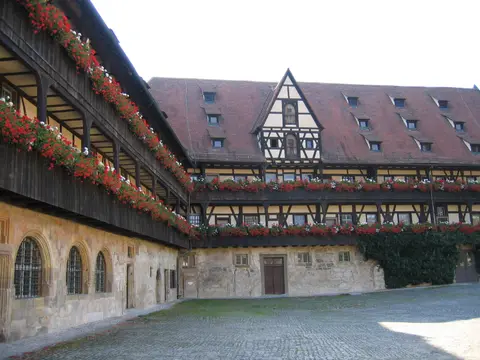
Three Urban Quarters: Hill Town, Island Town, and Market Gardeners
Unlike compact single-core medieval towns, Bamberg's 142-hectare World Heritage plan expresses social and ecological order across three distinct zones descending northeast to southwest from the Steigerwald foothills across the Regnitz plain.
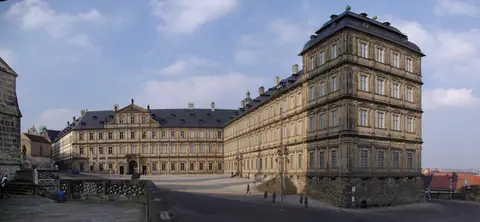
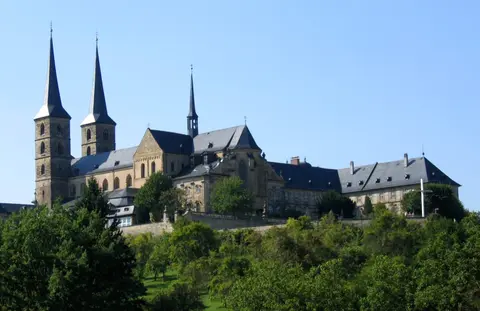
Highest stands the Bergstadt ("Hill Town"), crowned by seven church-topped hills: Cathedral Hill, Michaelsberg, Kaulberg/Obere Pfarre, Stefansberg, Jakobsberg, Altenburger Hill, and Abtsberg. This skyline earned Bamberg the nickname "Franconian Rome", prompting local guides to joke that Rome is the "Italian Bamberg". Here sit the monumental seats of episcopal government, led by the four-towered Cathedral. Inside lie tombs of Emperor Henry II, Empress Kunigunde, and Pope Clement II, the only papal grave north of the Alps outside France. Beside the Cathedral stand the sixteenth- and seventeenth-century half-timbered Alte Hofhaltung residence and the Baroque Neue Residenz, built between 1698 and 1704. The Neue Residenz includes a 4,500-rose terrace garden and the Bamberg State Library, and later housed deposed King Otto of Greece from 1864 to 1867. Elsewhere stand Michaelsberg Abbey, housing the Franconian Brewery Museum, and Altenburg castle. Documented in 1109, Altenburg served as an episcopal seat from 1251 until its 1553 destruction by Albert Alcibiades of Brandenburg-Kulmbach.
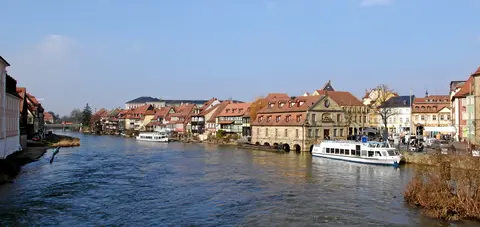
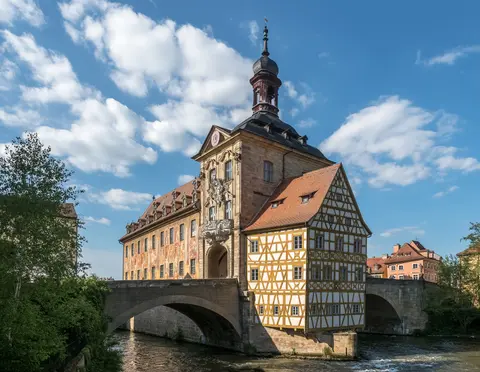
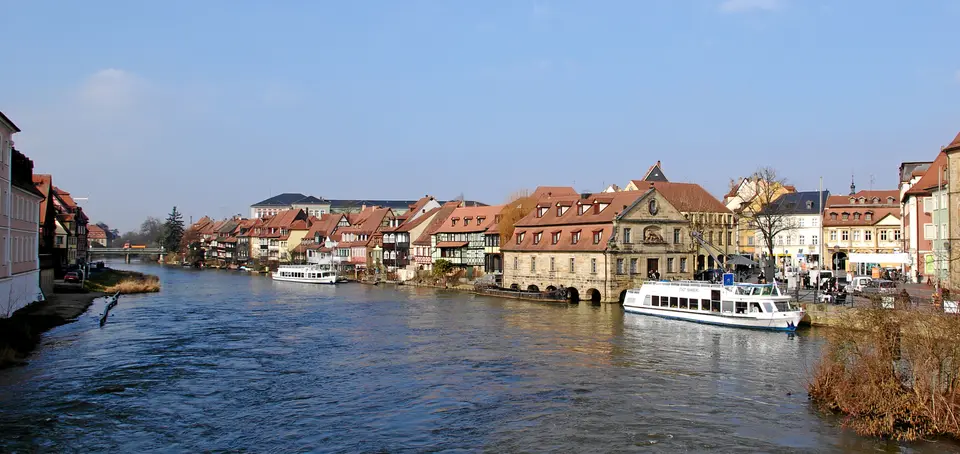
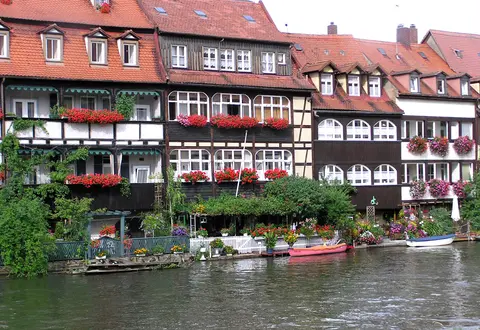
Between two arms of the River Regnitz lies the Inselstadt ("Island Town"), Bamberg's secular mercantile core. Its centrepiece is Grüner Markt, ranked Germany's top shopping street for smaller cities in 2018 and drawing almost 8.5 million passers-by in 2023. Narrow craft lanes link this square to the celebrated 1386 Old Town Hall (Altes Rathaus). Erected on an artificial island midstream and linked to both banks by twin bridges, the hall faces the nineteenth-century fishermen's cottages of Klein-Venedig ("Little Venice"). To the northeast across the Regnitz plain spreads the Gärtnerstadt ("Market Gardeners' District"), where medieval urban horticulture persists inside city streets. This quarter unites urban distribution markets with uninterrupted cultivated inner-city vegetable plots and hillside vineyards.
Romanesque Cathedral Sculpture, Timber Houses, and Enlightenment Press
Connected to Germany's railway network in 1844, Bamberg entered modern history unscathed by wholesale industrial clearing yet marked by dramatic political turns. In 1815, Napoleon's chief of staff Louis Alexandre Berthier died in the town. After First World War unrest toppled Munich's government into the Bavarian Soviet Republic, the displaced Bavarian state government sheltered in Bamberg for nearly two years. Freikorps units later retook Munich, and Bavaria's first republican constitution (Bamberger Verfassung) was enacted. In February 1926, Adolf Hitler convened the Bamberg Conference here to curb northern party dissent. During the Second World War, nine Allied air raids between 1944 and 1945 struck 4.4 percent of the town and killed 378 civilians. The heaviest raid on 22 February 1945 hit the station, Obstmarkt, Grüner Markt, Lange Straße, Keßlerstraße, the Church of the Redeemer (Erlöserkirche), the Grüner Markt Altane, and the Alte Maut. A planned follow-up raid on 23 February was cancelled for weather. German troops blew the bridges before US forces entered on 14 April 1945, later maintaining Warner Barracks until 2014.
Because roughly 95 percent of historic buildings survived wartime bombing, Bamberg preserved some 2,400 timber-framed houses. Rather than sweeping redevelopment, post-1950s preservation adopted the celebrated "Bamberg model" of thousands of small-scale, owner-coordinated craft restorations. Work is supervised under the Bavarian Preservation of Monuments Act and Germany's Town and Country Planning Code. Since 2005, a dedicated municipal heritage unit, the Centre of World Heritage Bamberg, has coordinated conservation alongside the 2019 World Heritage Visitor and Interpretation Centre. Visual axis studies also protect surrounding skylines across the Town Ensemble and its buffer zone.
Today's town of 79,000 inhabitants (2022) generates roughly 56,500 jobs across 2,624 businesses, including 969 craft enterprises and 87 firms employing over 100 workers. Heritage tourism recorded 807,294 overnight stays in 2023, split between 85 percent domestic guests and 15 percent international visitors led by the United States, the Netherlands, Poland, and Austria. Industry blends automotive and electrical manufacturing led by Bosch, operating since 1939 with over 6,000 workers pivoting toward fuel cells. Major employers also include Brose on Berliner Ring and in neighbouring Hallstadt, Wieland Electric (founded 1910), and RZB lighting. Nearby, the 100-hectare port handled 416,000 tons of cargo and over 700 river cruise vessels in 2023. Traditional workshops persist through organ and woodwind builders such as master organ maker Thomas Eichfelder. Cultural links also connect the town to descendants of eighteenth-century Bamberg settlers (1719 to 1753) still known around Poznań as the Bambrzy.
Bamberg's Three Historic Districts and Entry Matrix
Exploring Bamberg requires no transit passes inside the core because Hill Town, Island Town, and the Market Gardeners' quarter link directly on foot across short Regnitz bridges.
| Complex Zone | Key Highlights | Access & Ticket Rule |
|---|---|---|
| Bergstadt (Cathedral Hill & Altenburg) | 1237 Cathedral, Alte Hofhaltung, Neue Residenz Rose Garden, Michaelsberg Abbey, Altenburg ridge | Courtyards, Cathedral nave, and Rosengarten are open public spaces; state rooms, library exhibits, and Brewery Museum require tickets. |
| Inselstadt (Island Town & Old Town Hall) | 1386 Altes Rathaus bridge hall, Grüner Markt, Klein-Venedig fishermen's row, half-timbered lanes | Streets, bridges, and riverbanks are permanently open-access; Ludwig porcelain collection inside Old Town Hall charges entry. |
| Gärtnerstadt (Market Gardeners' District) | Cultivated inner-city garden plots, timber farmsteads, and medieval urban-agricultural strips | Public streets and market lanes allow open pedestrian walking; respect working private market-garden boundaries. |
| World Heritage Visitor Centre | Interpretation exhibits explaining the three districts and the post-1950s Bamberg preservation model | Operates as an indoor municipal visitor facility near the centre; check official town portal for seasonal entry conditions. |
| Regnitz Riverfronts & Footbridges | Obere and Untere bridges, fishermen's row reflections, and riverside footpaths linking hills to gardens | Public walkways and embankments stay freely open; verify local boat and river-cruise mooring access along the canal. |
Reading the River Town Hall, Riemenschneider Marble, and Garden Plots
Three physical stops bring Bamberg's political division, late-Gothic carving, and urban food ecology directly into focus.
- The Midstream Island of the Old Town Hall: Stand on the Obere Brücke facing the 1386 Altes Rathaus perched directly in the current between episcopal Hill Town and mercantile Island Town. According to civic tradition, the bishop refused burghers land on the hill, prompting townspeople to drive wooden piles into the Regnitz stream to build their council house on neutral river ground.
- Riemenschneider's Tomb and the Bamberg Horseman: Inside the four-towered Cathedral, examine Tilman Riemenschneider's marble tomb of Emperor Henry II and Empress Kunigunde, carved between 1499 and 1513. Nearby stands the thirteenth-century equestrian stone sculpture known as the Bamberg Horseman (Der Bamberger Reiter), possibly depicting Emperor Conrad III.
- Striped Market-Garden Beds Behind Street Fronts: Walk east across the island into the Gärtnerstadt, where narrow street-facing timber houses conceal unusually deep open soil plots still worked commercially inside the historic town boundary, illustrating medieval links between urban growers and central markets. Look for courtyard gates wide enough for wooden carts and cold-frame glass beds tucked behind century-old facades, confirming that traditional cultivation persists inside modern Upper Franconia rather than surviving solely as museum exhibits.
Seasonal Pacing and Linking Bamberg with Regensburg
Bamberg's oceanic-influenced climate brings mild seasonal swings, year-round rainfall, and crisp winter nights often dropping below zero. Late spring through early autumn suits climbing between the seven hills and viewing 4,500 blooming roses at the Neue Residenz terrace. Early hours are best for photographing reflections along Klein-Venedig before midday river-cruise passengers arrive. Arriving by regional train from Nuremberg (63 km south, near NUE airport 46 km away) or Würzburg (101 km west) removes parking pressure. The station puts you a short walk from the Gärtnerstadt, Island Town bridges, and unhurried walks from the episcopal Hill Town down into market-garden lanes. Between Cathedral Hill and the Regnitz bridges, keep time for the Franconian Brewery Museum inside Michaelsberg Abbey. At the 2019 World Heritage Visitor Centre, scale models show how seven church hills, twin island channels, and flat market gardens interlock across 142 hectares.
Combine Bamberg's episcopal hill town and timbered islands with our Danube-side Regensburg travel guide (130 km southeast), or trace other medieval European heritage towns inside our UNESCO World Heritage Atlas.