





















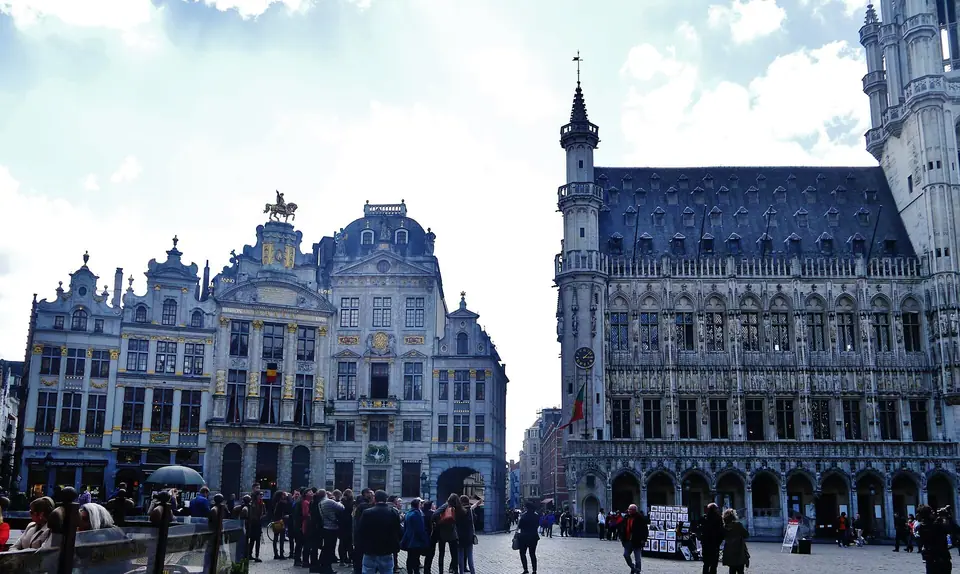
Grand-Place Walking Guide: Gothic Town Hall, 1695 Baroque Guildhalls, King's House & Manneken Pis
Walk the UNESCO-listed Grand-Place house by house, decoding the 1401 Gothic Town Hall, the 1695 French bombardment and guildhall symbols, the King's House, and Manneken Pis.
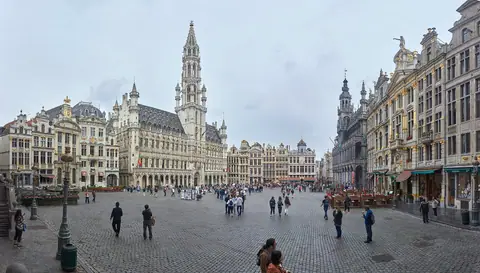
Approached through any of the seven narrow medieval alleys that feed into it, the Grand-Place (Grote Markt) delivers a dramatic architectural reveal. Low brick lanes named after medieval cheese, herb, coal, and poultry stalls open suddenly onto the square. Before you stretches a 110-by-68-metre rectangle of grey porphyry cobblestones enclosed by Gothic spires and Baroque gables blazing with gold leaf. Inscribed as a UNESCO World Heritage Site in 1998, the square owes its unified appearance to a seventeenth-century catastrophe. Over 36 hours in August 1695, French artillery levelled almost everything here except the fifteenth-century Town Hall. Brussels' wealthy trade guilds then rebuilt the entire marketplace in carved stone within five years.
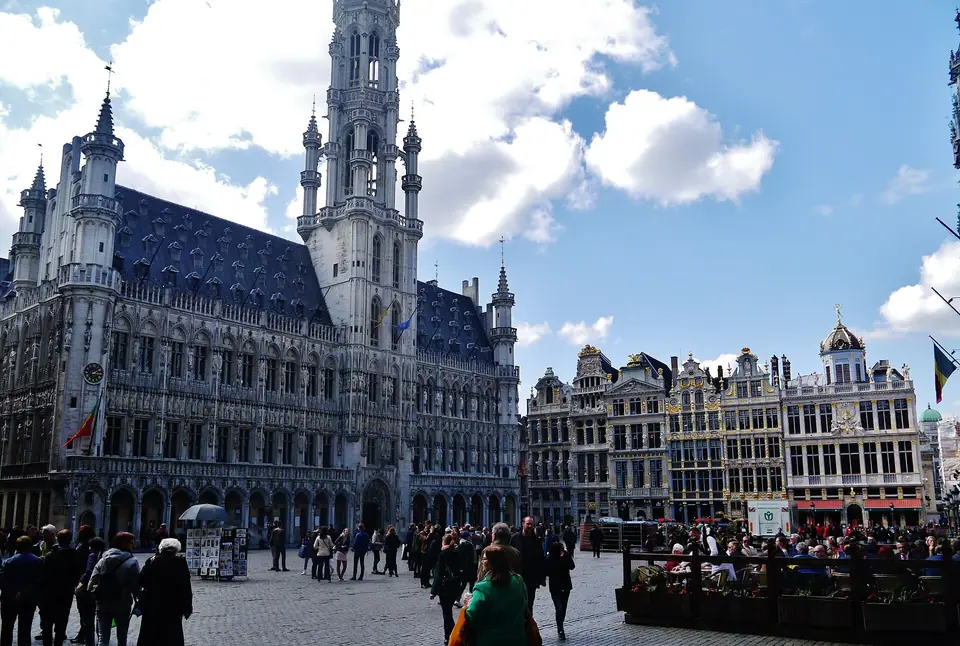
The 1401 to 1455 Gothic Town Hall (Hôtel de Ville / Stadhuis) and its asymmetric legend
The Gothic Town Hall (Hôtel de Ville) occupies almost the entire southern flank of the square. It is the oldest and only medieval building on the Grand-Place to survive the 1695 bombardment structurally intact. Its construction unfolded in three fifteenth-century campaigns under the Dukes of Burgundy:
- The two unequal wings (1401 to 1449). Architect Jacob van Thienen built the longer eastern wing and the lower belfry base between 1401 and 1421. When the city outgrew those chambers, a young Charles the Bold laid the foundation stone for the shorter western wing in 1444, completed in 1449. Look closely at the main portal beneath the tower and you will see that the arched doorway sits off-centre. The left wing counts 12 bays while the right wing has 7 bays. Local folklore claims the architect leaped from the spire upon noticing the error. In reality, the medieval cloth hall and Rue de la Tête d'Or dictated the layout.
- Jan van Ruysbroeck's 96-metre belfry (1449 to 1455). Between 1449 and 1455, court architect Jan van Ruysbroeck raised the square lower tower into an octagonal Brabantine Gothic spire. The openwork stone belfry reaches 96 metres (315 feet) above the cobbles. At its summit turns a 5-metre gilt-copper statue of Archangel Michael (Saint Michel) trampling the devil, hammered in 1454 by Martin van Rode. The 1454 original is conserved inside the Brussels City Museum opposite, while a gilded replica crowns the spire.
- Council halls and the 1902 Everard 't Serclaes plaque. Nearly 300 nineteenth-century statues of Dukes of Brabant, saints, and civic figures fill the facade niches. Guided tours visit the sixteenth- to eighteenth-century woven wall-hanging halls and the 1712 courtyard. Under the arcade of L'Étoile (No. 8, the smallest house on the square) shines Julien Dillens' 1902 bronze bas-relief of alderman Everard 't Serclaes. He scaled the walls in 1356 to liberate Brussels and died in 1388.
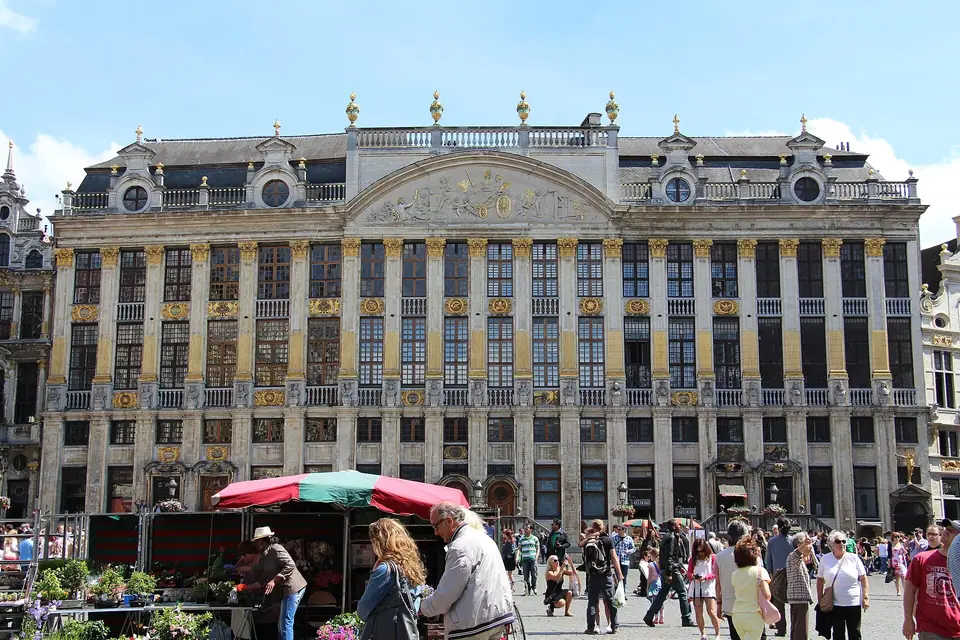
The August 1695 bombardment and how to read the Baroque guildhalls
On 13, 14, and 15 August 1695, during the Nine Years' War, 70,000 French troops under Marshal de Villeroy bombarded Brussels. Acting on orders of King Louis XIV, French batteries on the heights of Anderlecht fired red-hot iron balls into the centre. Roughly 4,000 to 5,000 buildings, one-third of the city, burned to ashes. French gunners used the 96-metre Town Hall spire as their target marker and incinerated the wooden guildhalls around the square. The magistrates and trade guilds rebuilt their headquarters in stone and gold leaf between 1695 and 1700. Because houses lacked street numbers in the seventeenth century, each guildhall proclaims its identity through sculptural emblems:
- Western Side (Nos. 1 to 7). At the corner of Rue au Beurre stands Le Roy d'Espagne (No. 1, Corporation of Bakers, 1697), crowned by an octagonal dome and a bust of King Charles II of Spain. Next stand La Brouette (Nos. 2 to 3, Tallow Merchants, 1697) with patron Saint Giles, and Le Sac (No. 4, Carpenters and Coopers, 1644 and 1697). Beside them rises La Louve (No. 5, Archers' Guild, 1690 to 1696 by Pierre Herbosch). It displays Romulus and Remus nursing from the She-Wolf and a gilded Phoenix above the motto Combusta 1695 Restaurata 1696. Next come Le Cornet (No. 6, Boatmen's Guild, 1697 by Antoine Pastorana), shaped like a seventeenth-century Spanish frigate stern, and Le Renard (No. 7, Haberdashers' Guild, 1699) with a golden fox.
- Southern Side (Nos. 8 to 12). Next to L'Étoile (No. 8) stands Le Cygne (No. 9, Butchers' Guild, 1698) with a white swan over the portal. Inside this tavern, Karl Marx and Friedrich Engels celebrated New Year's Eve 1847 while drafting The Communist Manifesto (published in February 1848). In April 1885, the Belgian Workers' Party was founded upstairs. Beside it rises L'Arbre d'Or (No. 10, Brewers' Guild, 1698). A gilded equestrian statue of Governor Maximilian II Emanuel of Bavaria tops the gable above the Belgian Brewers Museum.
- Eastern Side (Nos. 13 to 19) and Northern Side. Designed in 1697 to 1698 by city architect Guillaume de Bruyn, the Maison des Ducs de Brabant unites 7 separate guildhalls behind one monumental facade. Nineteen portrait busts of the Dukes of Brabant line the pilasters. Along the northern side stand Le Pigeon (Nos. 26 to 27, Painters' Guild), where exiled French author Victor Hugo lived in 1852, and La Chaloupe d'Or (Nos. 24 to 25, Tailors' Guild).
The King's House (Maison du Roi / Broodhuis) and the 1619 Manneken Pis
Directly facing the Town Hall across the northern side stands the neo-Gothic Maison du Roi (King's House), known in Dutch as Broodhuis (Bread Hall). Thirteenth-century bakers sold loaves here before stone ducal courts replaced the market under Emperor Charles V between 1515 and 1536. Counts Egmont and Hornes spent their final night inside before their execution on the square on 5 June 1568. Reconstructed by city architect Victor Jamaer between 1873 and 1895, it houses the Brussels City Museum. The top floor exhibits the original 1619 bronze statue of Manneken Pis, broken into 11 pieces in 1817, welded together, and moved indoors in 1965.
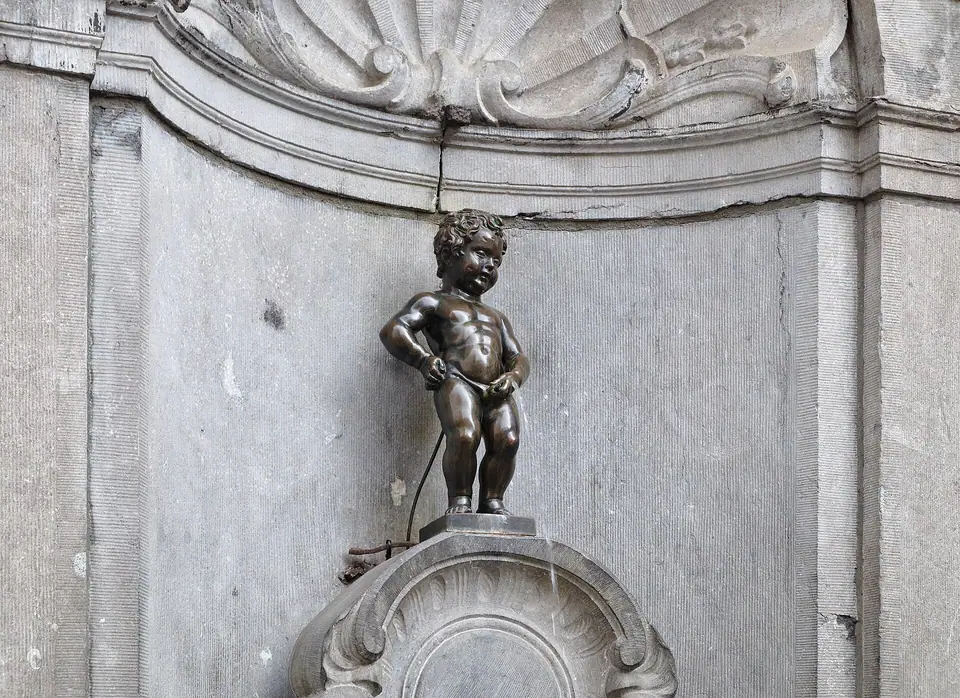
From the museum exit, walk southwest past the Everard 't Serclaes relief. Follow Rue de l'Étuve (Stoofstraat) for 250 metres to the corner of Rue du Chêne (Eikstraat). Set into a 1770 rococo stone niche stands the 61-centimetre bronze replica of Manneken Pis. Hiëronymus Duquesnoy the Elder cast the 1619 model on the site of a 1451 public fountain. Over 130 days a year, he wears miniature outfits from a wardrobe of more than 1,100 costumes. King Louis XV started the tradition by gifting an embroidered suit in 1747. Inspect the outfits 60 metres uphill at the GardeRobe MannekenPis Museum (Rue du Chêne 19). Afterwards, continue onto our Galeries Royales Saint-Hubert walk, Mont des Arts guide, or Brussels food guide.
Traveller tips
Real advice from people who have been to Brussels. Every tip is read by our team before it goes live.
No tips yet. Been here? Yours could be the first.
Thank you! Your tip will appear here after a quick review.
More in Brussels
Continue exploring Brussels with related neighbourhood, food, and planning guides
What to Eat in Brussels: Double-Fried Frites, Moules-Frites, Carbonnade, Waffles, Pralines & Lambic Beer
Brussels, Belgium
Brussels Orientation: The Pentagon, Lower vs Upper Town, 19 Communes & Bilingual Street Signs
Brussels, Belgium
Best Things to Do in Brussels: Grand-Place, Magritte, Horta Art Nouveau, Atomium & Beer Culture
Brussels, Belgium
Arriving in Brussels: Zaventem Airport (BRU), Midi Eurostar Terminal, Central Station & STIB-MIVB
Brussels, Belgium
