





















Mont des Arts, Royal Museums, Magritte Museum, MIM, Sablon & Marolles Guide
Explore Brussels' Upper Town ridge: the Mont des Arts gardens, Coudenberg Palace ruins, the Magritte and Old Masters museums, the 1899 Old England MIM, the Sablon, and the Marolles.
The eastern ridge of Brussels rises 40 metres above the merchant guildhalls of the Senne valley. For nine centuries, this hillcrest has served as the seat of dukes, Habsburg emperors, Austrian governors, and Belgian kings. Start on the formal garden terraces of the Mont des Arts (Kunstberg) and cross Place Royale. Walking south down Rue de la Régence to the Sablon and the Palais de Justice links Belgium's finest fine-art museums, palaces, and antique squares.
The Mont des Arts (Kunstberg) gardens and the 24-bell Jacquemart carillon
The Mont des Arts connects Place de l'Albertine near Brussels-Central Station to Place Royale on the crest of the hill. Architects Maurice Houyoux and Hugo Van Kuyck built this cultural acropolis between 1954 and 1958 for Expo 58. Landscape architect René Pechère laid out the central garden parterre with geometric boxwood hedges, fountains, and flowerbeds. Along the flanks rise the Royal Library of Belgium (KBR), the State Archives, and Square Brussels. Inside KBR, the KBR Museum displays fifteenth-century illuminated manuscripts of the Dukes of Burgundy. On the archway spanning Rue Montagne de la Cour hangs a 1964 star-shaped carillon of 24 bronze bells. Twelve historical figurines surround the clock below a gilded Jacquemart automaton. Climb to the upper balustrade beside the Old England building at sunset. From there, you look straight down the vista to the 96-metre spire of the Grand-Place Town Hall.
Place Royale, the subterranean Coudenberg Palace, and the Royal Palace
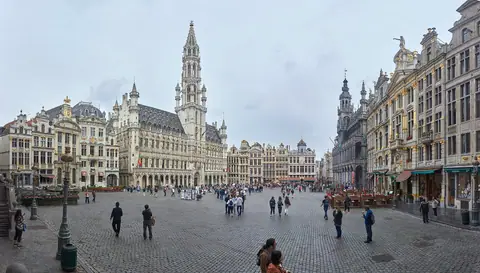
At the top of the Mont des Arts opens the neoclassical quadrangle of Place Royale (Koningsplein). French architects Barnabé Guimard and Jean-Benoît-Vincent Barré laid out the square between 1775 and 1782 under Governor Charles Alexander of Lorraine. At its centre stands Eugène Simonis's 1848 bronze statue of Godfrey of Bouillon before the Church of Saint Jacques-sur-Coudenberg. On those church steps, King Leopold I swore the constitutional oath as first King of the Belgians on 21 July 1831.
Directly underneath the cobblestones of Place Royale and Rue Royale lies the Coudenberg Palace Archaeological Site, entered through the BELvue Museum at Place Royale 7. Before burning down on the night of 3 to 4 February 1731, this complex was the principal residence of Philip the Good, Duke of Burgundy. Habsburg Emperor Charles V also ruled from the palace and abdicated his crown inside its ceremonial hall (Aula Magna, built 1452 to 1460) in October 1555. Today you can walk underground along the medieval stone paving of buried Rue Isabelle and beneath the vast masonry foundations of the Aula Magna.
Immediately east of Place Royale stretches the Royal Palace of Brussels (Palais Royal / Koninklijk Paleis). Architect Henri Maquet completed its Louis XVI-style stone facade and curved garden wings between 1904 and 1909 for King Leopold II. Across the street lies the 13-hectare Brussels Park (Parc de Bruxelles / Warandepark, laid out 1776 to 1783) facing the Federal Parliament. Although the King and Queen live in Laeken, the Royal Palace serves as the working chancellery. Every summer from late July to late August, it opens free of charge to the public. Visitors admire Alphonse Balat's white marble Grand Staircase and Jan Fabre's 2002 ceiling installation Heaven of Delight in the Mirror Room. Fabre inlaid the ceiling with 1.4 to 1.6 million green jewel-beetle wing cases.
The Magritte Museum, Old Masters (Bruegel & Rubens), and the 1899 Musical Instruments Museum
Three world-class museums cluster around the southern edge of Place Royale, all closed on Mondays with free ground-floor cloakrooms for backpacks:
- The Magritte Museum (Place Royale 1). Opened on 2 June 2009 inside the neoclassical Hôtel Altenloh, this museum holds the world's largest collection of Belgian surrealist René Magritte (1898 to 1967). Across three chronological levels hang more than 200 original oil canvases, gouaches, drawings, painted bottles, vintage photographs, and short surrealist films. Start on Level 3 in the 1920s and descend to Level 2 for the wartime Renoir and vache periods. Finish on Level 1 before the 1954 oil painting The Empire of Light (L'Empire des lumières).
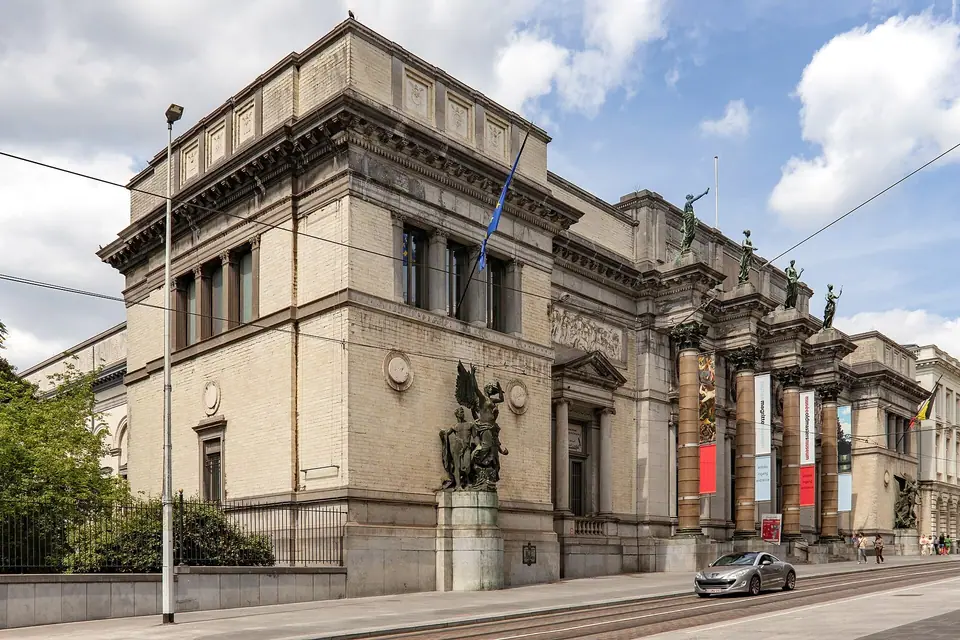
- The Old Masters Museum (Musée Old Masters, Rue de la Régence 3). Founded in 1801 and housed in Alphonse Balat's 1880 palace, the Royal Museums of Fine Arts showcase fifteenth- to eighteenth-century Netherlandish painting. The dedicated Bruegel Room holds the world's second-largest collection of Pieter Bruegel the Elder after Vienna. Highlights include The Fall of the Rebel Angels (1562) and Winter Landscape with Ice Skaters and a Bird Trap (1565). You also see The Census at Bethlehem (1566) and Landscape with the Fall of Icarus. Adjacent galleries display panels by Rogier van der Weyden, Petrus Christus, Hans Memling, and Hieronymus Bosch. Nearby hang altarpieces by Peter Paul Rubens, Anthony van Dyck, and Jacob Jordaens, plus Jacques-Louis David's 1793 The Death of Marat.
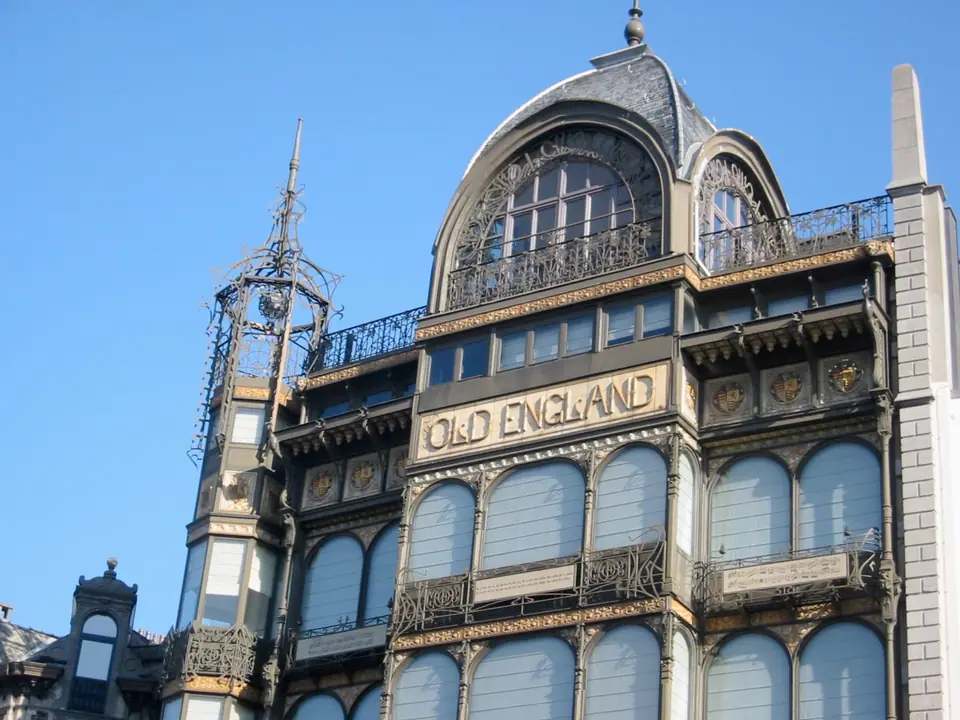
- The Musical Instruments Museum (MIM, Montagne de la Cour 2). Architect Paul Saintenoy built the Old England department store in 1899 from bolted wrought iron and plate glass. Since 2000, the building has housed the Musical Instruments Museum. Four floors display 1,200 instruments from a collection of over 8,000. An interactive audio headset plays seventeenth-century Antwerp Ruckers harpsichords. You also hear the workshop instruments of Belgian maker Adolphe Sax (1814 to 1894), who patented the saxophone in 1846.
Petit Sablon, Notre-Dame du Sablon, Grand Sablon, Palais de Justice & the Marolles
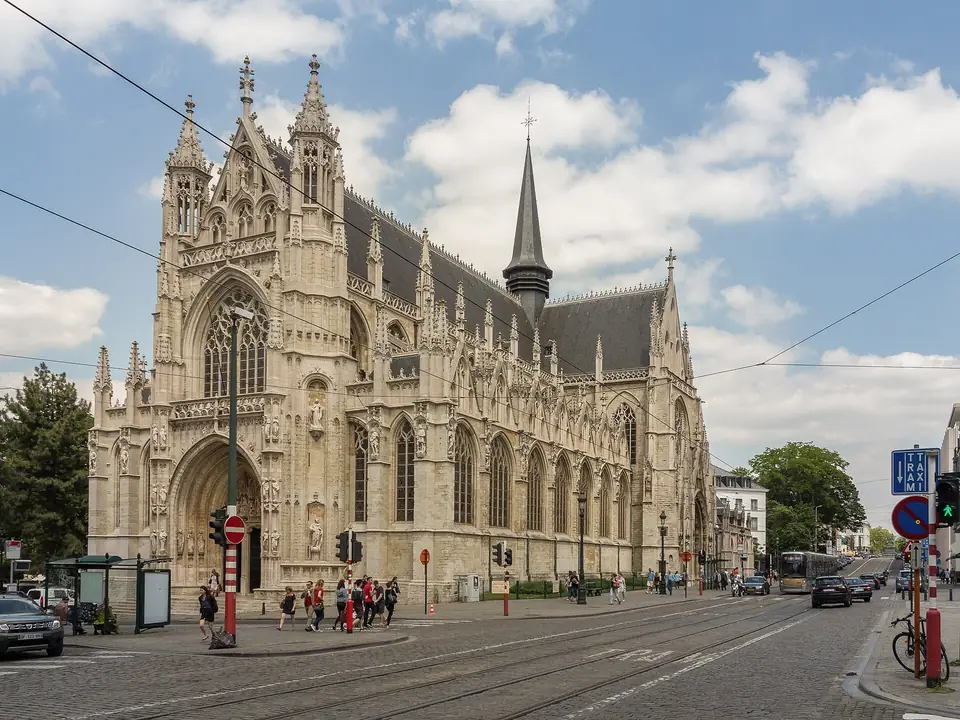
Walk 300 metres south down Rue de la Régence to the twin squares of the Sablon (Zavel). Between them rises the fifteenth-century Brabantine Gothic Church of Our Lady of the Sablon (Église Notre-Dame des Victoires au Sablon). Built by the Crossbowmen's Guild, its choir has 11 stained-glass windows reaching 14 metres high. Inside stand the marble Baroque chapels built between 1651 and 1676 for the Thurn und Taxis postal dynasty. Uphill sits Place du Petit Sablon, an 1890 garden by Henri Beyaert. Its railings support 48 bronze statuettes of the medieval craft guilds around the monument to Counts Egmont and Hornes. Downhill slopes Place du Grand Sablon, known for its weekend antique market and chocolatiers Pierre Marcolini, Wittamer (1910), and Neuhaus.
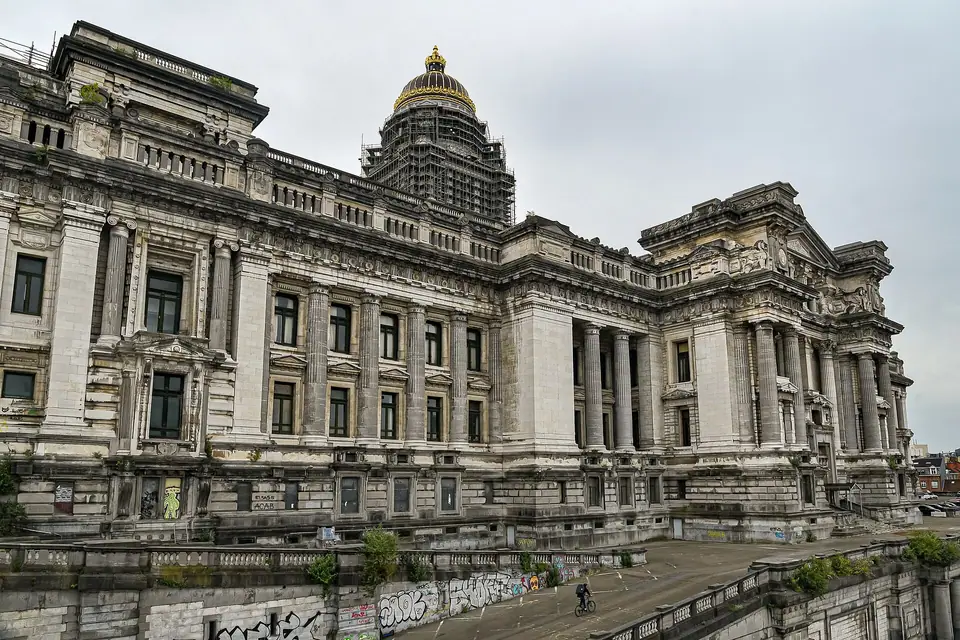
At the end of Rue de la Régence towers Joseph Poelaert's Palais de Justice (Justitiepaleis). Built between 1866 and 1883, it covers 26,000 square metres beneath a 104-metre dome. From Place Poelaert, ride the free glass Poelaert Elevator (Ascenseur des Marolles) 30 metres down into the Marolles quarter. Every morning since 1873, the vintage flea market (Vieux Marché) has filled Place du Jeu de Balle (Vossenplein). From Place Poelaert, you can also board Tram 92 south to start our Victor Horta and Art Nouveau walk.
Traveller tips
Real advice from people who have been to Brussels. Every tip is read by our team before it goes live.
No tips yet. Been here? Yours could be the first.
Thank you! Your tip will appear here after a quick review.
More in Brussels
Continue exploring Brussels with related neighbourhood, food, and planning guides
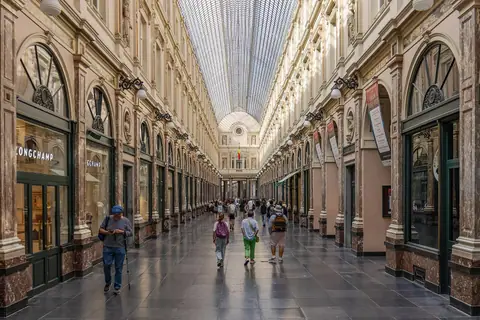
Galeries Royales Saint-Hubert, Comic Strip Route, Bourse & Sainte-Catherine Walk
Brussels, Belgium
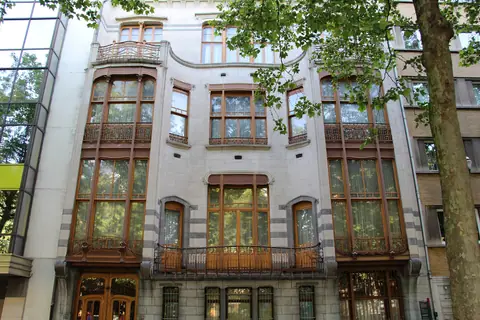
Victor Horta & Art Nouveau Walk: Horta Museum, Hôtel Tassel, Hôtel Solvay, Maison Hannon & Ixelles
Brussels, Belgium
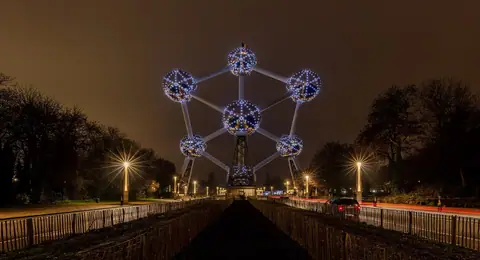
Atomium, Royal Greenhouses of Laeken, Parc du Cinquantenaire & Train World Guide
Brussels, Belgium
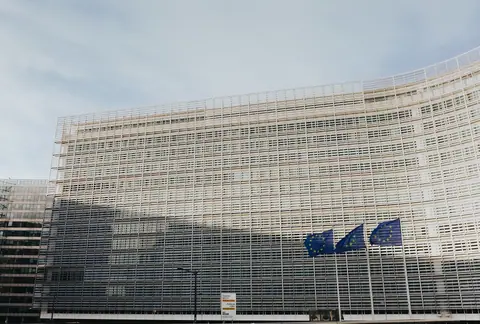
European Quarter Guide: Parlamentarium, Hemicycle, House of European History, Berlaymont & Leopold Park
Brussels, Belgium
