





















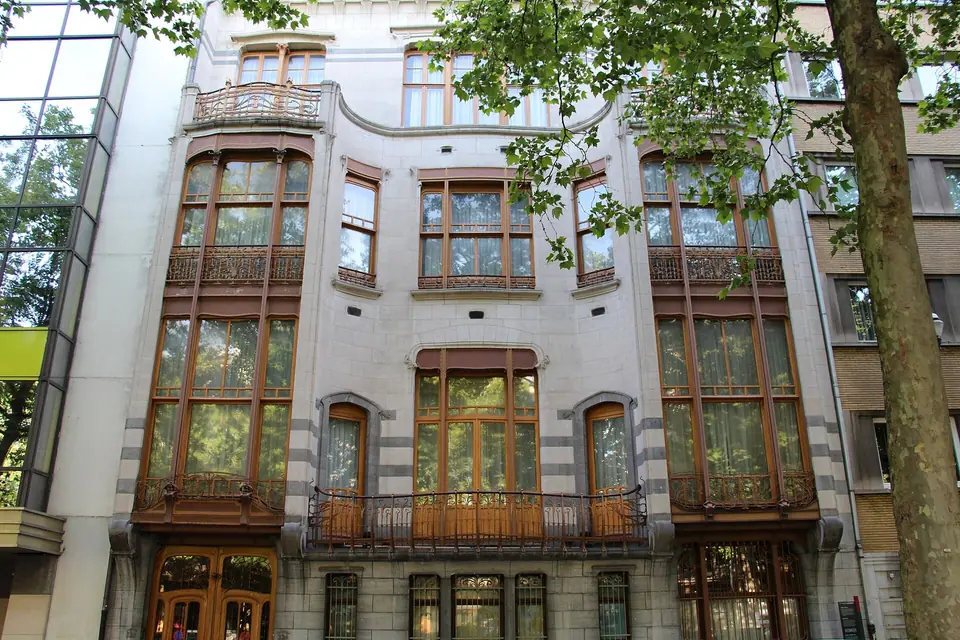
Victor Horta & Art Nouveau Walk: Horta Museum, Hôtel Tassel, Hôtel Solvay, Maison Hannon & Ixelles
Follow our self-guided Art Nouveau walking route through Saint-Gilles and Ixelles across Victor Horta's UNESCO townhouses, Maison Hannon, the Ixelles Ponds, and Maison Cauchie.
In 1893, along the residential avenues south of the Brussels Pentagon, architectural history changed course. Tired of dark nineteenth-century row houses imitating old palaces, two young Belgian architects in Saint-Gilles and Ixelles pioneered architectural Art Nouveau. Victor Horta (1861 to 1947) completed Hôtel Tassel while Paul Hankar (1859 to 1901) built Maison Hankar a few blocks away. Horta brought structural riveted iron and glass into the domestic living space. He carved out central skylight winter gardens to flood narrow 7-to-10-metre Brussels building plots with daylight. Ironwork, stained glass, mosaic floors, wall frescoes, and custom cabinetry flowed together in his signature "whiplash" curve (coup de fouet). In 2000, UNESCO inscribed four of Victor Horta's Brussels townhouses on the World Heritage List. Today they anchor a great architectural walk across Saint-Gilles and Ixelles.
1. Horta Museum (Maison & Atelier Horta, Rue Américaine 23 to 25, Saint-Gilles)
Begin your walk by riding STIB-MIVB Tram 92 south from Place Royale or Place Poelaert. Get off at the Ma Campagne stop in Saint-Gilles (1060). Three minutes west at Rue Américaine 23 to 25 stand the twin townhouses that Victor Horta designed between 1898 and 1901. Number 25 served as his family residence, while Number 23 housed his architectural studio and sculpting workshop. Preserved as the Horta Museum since 1969 and inscribed by UNESCO in 2000, this is the top Art Nouveau interior open year-round in Brussels.
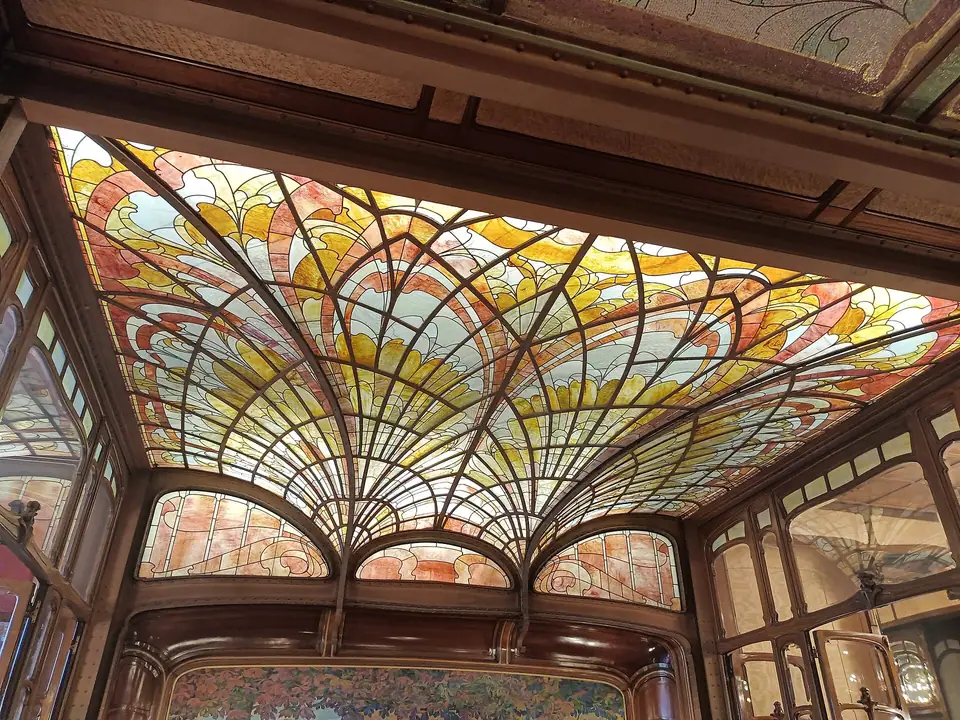
Stepping inside reveals how Horta dissolved conventional walls between rooms. A white Carrara marble staircase spirals upward through the heart of the house toward a double curved amber-and-gold stained-glass skylight. Large wall mirrors at either end reflect the glass vault into an endless golden canopy. Horta drew every radiator grille, brass door handle, mosaic floor border, white enamelled-brick dining wall, and sycamore and Cuban mahogany cabinet himself. Because the fragile domestic rooms hold few visitors at once, advance online timed tickets are compulsory. Note that the museum closes on Mondays.
2. Maison Hannon (1902), Maison Hankar (1893) & Ciamberlani House on Rue Defacqz
Walk 350 metres east of the Horta Museum to Avenue de la Jonction 1 and Rue Africaine. Here rises Maison Hannon, which reopened as a museum in June 2023. Architect Jules Brunfaut built it between 1902 and 1904 for Solvay engineer and art collector Édouard Hannon and his French wife Marie Debard. Sculptor Victor Rousseau carved the exterior corner relief of The Spinner. Inside, Belgian spatial flow meets the French École de Nancy. Sunlit rooms glow with opalescent stained-glass windows by Tiffany disciple Raphaël Évaldre. You also see botanic marquetry furniture and inlaid glass by Émile Gallé and Louis Majorelle, plus stairwell frescoes by Paul Baudouin.
From Maison Hannon, walk five minutes north along Rue Defacqz to see how Horta's contemporaries interpreted the style outdoors. At Rue Defacqz 71 stands Paul Hankar's 1893 Maison Hankar. Adolphe Crespin decorated its facade with polychrome sgraffito murals of morning, day, evening, and night beneath wrought-iron eaves. Down the street at Rue Defacqz 48 stands Hankar's 1897 Hôtel Ciamberlani. It features horseshoe-arched windows and a restored golden symbolist sgraffito frieze depicting the stages of human life.
3. Hôtel Tassel (1893) & Hôtel Solvay (1894 to 1903) along Avenue Louise
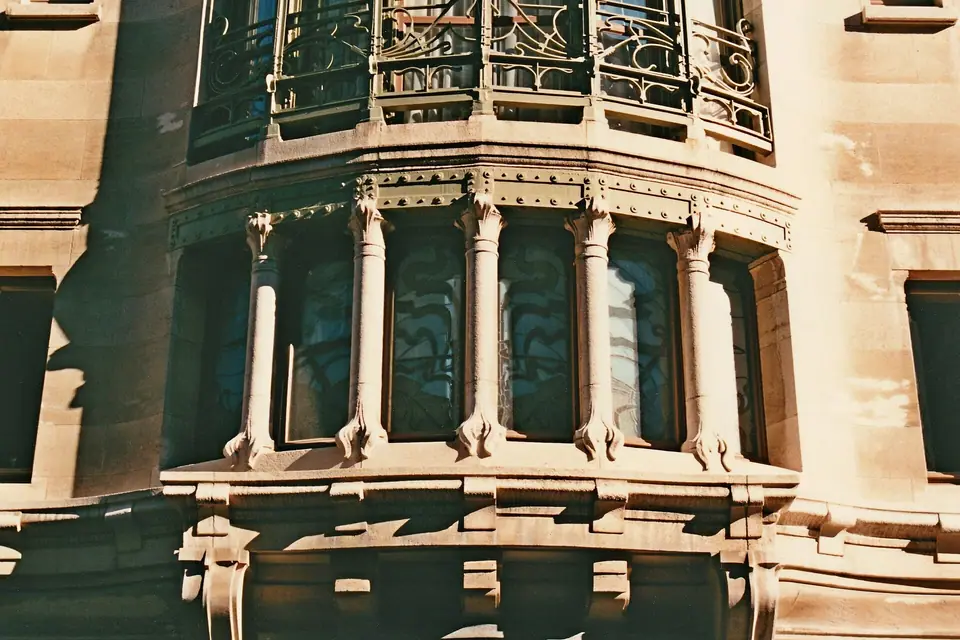
Continue northeast across Rue du Bailli near Place du Châtelain to reach Rue Paul Émile Janson 6. Here Victor Horta completed Hôtel Tassel in 1893 to 1894 for geometry professor Émile Tassel on a narrow 7.8-metre-wide plot. UNESCO recognised it as the world's first complete architectural work of Art Nouveau. Its sandstone facade integrates a central iron-and-glass bow window on slender stone corbels. Hôtel Tassel houses private offices today and opens its winter garden only during events like the March BANAD Festival. Even from the pavement, its facade shows Horta's break with academic symmetry.
Walk two minutes around the corner onto chestnut-lined Avenue Louise 224 to stand before the UNESCO-listed Hôtel Solvay. Horta built this mansion between 1894 and 1903 for chemical industrialist Armand Solvay across a 15-metre-wide double plot. Given an open budget, Horta combined 23 varieties of Italian and North African marble and onyx with 17 exotic tropical woods. These woods include red mahogany, ebony, amaranth, and orangewood. Gilded bronze floral chandeliers and a double stained-glass skylight illuminate the main salon. They frame Belgian Neo-Impressionist painter Théo van Rysselberghe's pointillist canvas La Lecture dans le Parc. Now an independent museum open on Thursdays and Saturdays, Hôtel Solvay requires a pre-booked timed reservation on its official website.
4. The Ixelles Ponds, Place Flagey, Hôtel van Eetvelde & Maison Cauchie
From Hôtel Solvay, stroll downhill past the thirteenth-century Cistercian gardens of the Abbey of La Cambre (founded in 1201). Just beyond lie the twin Ixelles Ponds (Étangs d'Ixelles). Along the western bank on Rue Belle-Vue and Rue Ernest Solvay, architect Ernest Blérot built a row of Art Nouveau houses between 1900 and 1904. The bank leads directly to Place Eugène Flagey. There Joseph Diongre's 1938 Art Deco former National Radio Building (Le Flagey) rises opposite the Frit Flagey fry shack.
Ride Metro Line 1 or 5 or Bus 60 north to the European Quarter for two final stops:
- Hôtel van Eetvelde (Avenue Palmerston 2 to 4, 1895 to 1898). Victor Horta built this residence for diplomat Edmond van Eetvelde just north of Schuman at Square Marie-Louise. Nearby at Square Ambiorix 11 stands Gustave Strauven's 4-metre-wide 1900 Maison Saint-Cyr. The Brussels-Capital Region purchased part of Hôtel van Eetvelde in 2023 to house the LAB·AN Art Nouveau centre. Its octagonal winter-garden rotunda and stained-glass dome open on weekends.
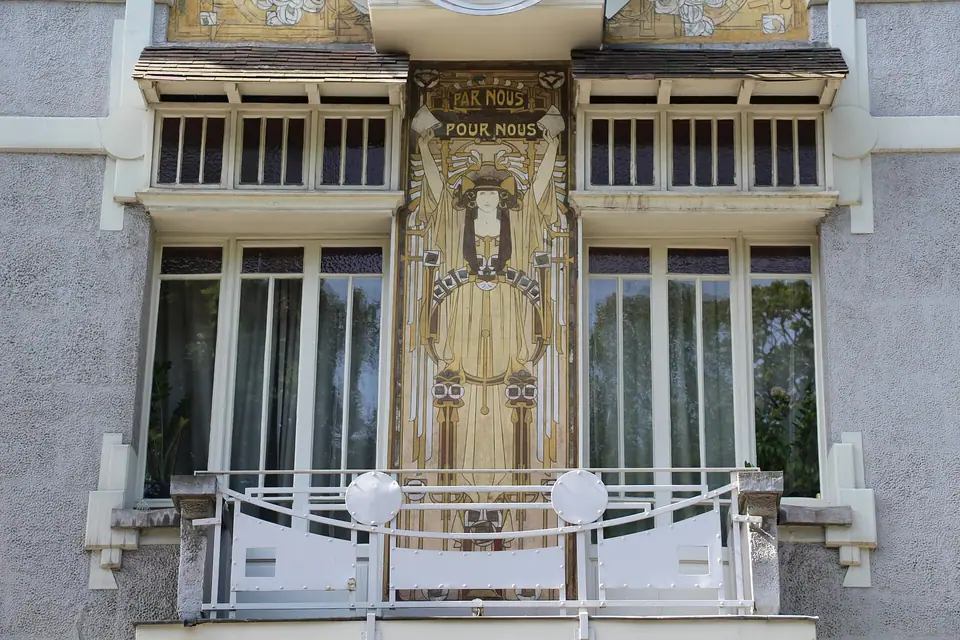
- Maison Cauchie (Rue des Francs 5, Etterbeek, 1905). Beside the southern edge of Parc du Cinquantenaire near Merode station stands this 1905 home. Architect-decorator Paul Cauchie and his painter wife Caroline Voet (Lina) covered the facade in geometric Glasgow-inspired sgraffito murals of the Muses and female allegories of craftsmanship.
Traveller tips
Real advice from people who have been to Brussels. Every tip is read by our team before it goes live.
No tips yet. Been here? Yours could be the first.
Thank you! Your tip will appear here after a quick review.
More in Brussels
Continue exploring Brussels with related neighbourhood, food, and planning guides
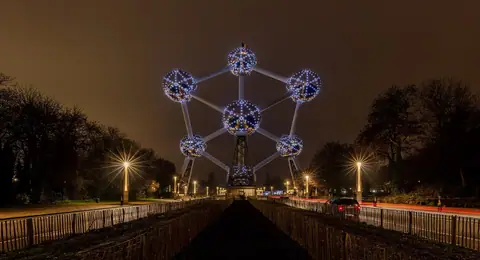
Atomium, Royal Greenhouses of Laeken, Parc du Cinquantenaire & Train World Guide
Brussels, Belgium
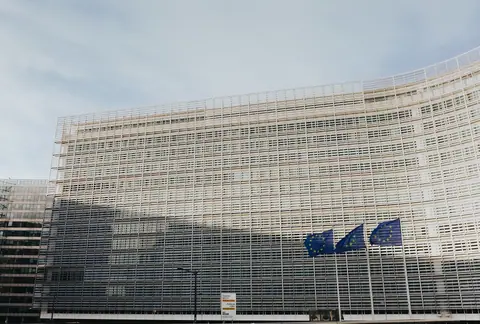
European Quarter Guide: Parlamentarium, Hemicycle, House of European History, Berlaymont & Leopold Park
Brussels, Belgium
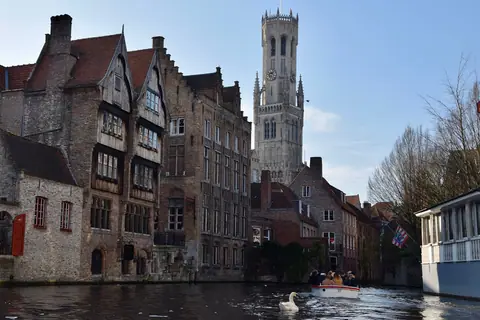
Flanders Day Trips from Brussels by Train: Bruges Canals, Ghent Gravensteen & Antwerp Guide
Brussels, Belgium
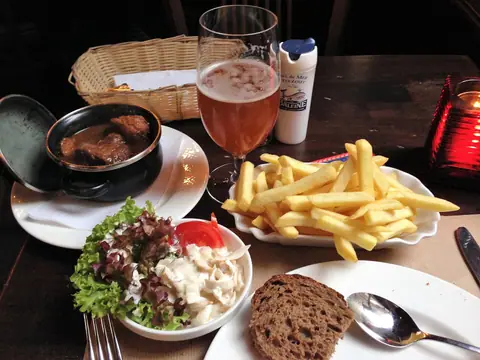
What to Eat in Brussels: Double-Fried Frites, Moules-Frites, Carbonnade, Waffles, Pralines & Lambic Beer
Brussels, Belgium
