


























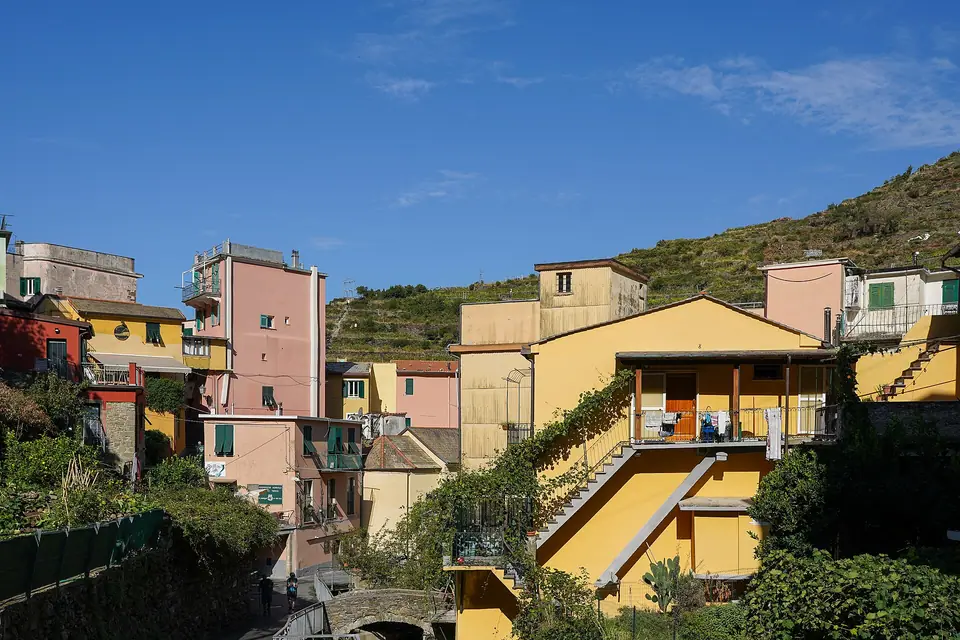
Photo: Wikimedia Commons · CC BY-SA 4.0
Cinque Terre Dry-Stone Walls, Heroic Viticulture & Sciacchetrà Wine Guide
How generation after generation of Ligurian farmers carved dry-stone terraces above the sea to produce crisp white wines and rare Sciacchetrà.
UNESCO inscribed Portovenere, Cinque Terre, and the Islands on the World Heritage List. It classified the coast as an evolutionary cultural landscape shaped by human labour. Across the precipitous coastline between Monterosso al Mare and Riomaggiore, medieval farmers transformed steep mountain slopes into fertile agricultural steps. They supported those narrow terraces with hand-stacked dry-stone walls (muretti a secco). Discover how these unmortared stone walls hold up the mountainside and why tiny rack-and-pinion monorails snake through the vines. Learning how winemakers press amber DOC Sciacchetrà gives every coastal walk deeper meaning.
The engineering of dry-stone walls (Muretti a Secco)
Once Saracen coastal raids subsided in the eleventh and twelfth centuries, villagers moved down from the inland ridge sanctuaries. Families cleared the dense Mediterranean holm-oak scrub (macchia) on the slopes above the sea. Using heavy iron picks, they broke up the native sandstone and shale (arenaria and galestro). Farmers crushed the smaller rock shards into stony soil (ciàn) for planting. They then stacked the larger sandstone blocks into retaining walls without a single drop of mortar.
UNESCO inscribed the Art of Dry-Stone Wall Construction on the international register of living heritage traditions. The absence of mortar is an intentional hydrogeological feature. During heavy autumn rainstorms, water drains freely through the small gaps between the unmortared stones. That natural drainage prevents the hydrostatic pressure that would burst a solid concrete wall. Placed end to end, the park's walls support extensive terraced slopes across the coastal hills. Each wall requires careful layering of foundation base stones, interlocking facing blocks, and internal drainage gravel (scaglie). Today, the National Park's Stone Bank (Banca della Pietra) works with master stonewallers across the villages. Together they train younger farmers and rebuild terraces damaged by wild boar or winter landslides.
Centuries of dedicated manual work created a landscape engineered entirely for viticulture and olive cultivation. Without constant maintenance, abandoned terraces rapidly degrade as winter storms dislodge individual face stones. Rebuilding a single collapsed section requires dismantling the surrounding rubble by hand before relaying the foundational stones. Skilled local wallers select stones by size, placing long binding stones deep into the terrace fill to anchor the wall structure securely against earth movements.
| Cinque Terre DOC Wine | Grape Blend Rules | Winemaking Method | Tasting Profile & Classic Pairing |
|---|---|---|---|
| Cinque Terre Bianco DOC | Bosco, Albarola & Vermentino | Fresh stainless-steel fermentation | Dry, saline, lemon peel & wild herbs; pairs with anchovies |
| Costa de Sera / Costa de Campu / Costa da Posa | Same DOC blend from specific historic crus | Single-subzone hillside selection | Structured mineral dry white; pairs with baked sea bream |
| Cinque Terre Sciacchetrà DOC | Bosco, Albarola & Vermentino | Grapes air-dried on racks; aged before release | Amber sweet passito; dried apricot, honey, almond & sea salt |
| Sciacchetrà Riserva DOC | Hand-selected top clusters | Extended ageing before release | Deep mahogany nectar; pairs with aged cheese or pandolce |
Heroic viticulture: Pergola Bassa vines and the vineyard monorails
Viticulture in the Cinque Terre meets every formal criterion of heroic viticulture (viticoltura eroica) established by CERVIM. Vineyards here cling to steep slopes on narrow stone terraces (fasce). Such steep geometry rules out tractors or wheeled machinery completely. Historically, growers trained their vines extremely low to the ground on chest-high wooden frames called pergola bassa. Farmers had to work bent double on their knees beneath the leafy trellis. This low canopy sheltered the grape clusters from salt-laden Libeccio sea gales while trapping the radiant nighttime heat stored inside the stone walls behind them.
As you hike the amphitheatre trail between Manarola, Volastra, and Corniglia, you will cross dozens of narrow galvanized steel rails bolted to the stone steps. Installed by the agricultural cooperative, these rack-and-pinion vineyard monorails (trenini a cremagliera) rescued local winegrowing from abandonment. A small two-stroke petrol engine pulls flatbed carts at walking pace up steep inclines and hairpin cliff turns. Each monorail spares winegrowers from carrying heavy crates of harvested grapes up thousands of stone steps on their shoulders during the September vendemmia. Remember that the monorails are agricultural machinery and are strictly forbidden for tourists to touch or ride.
The three native grapes and the making of DOC Sciacchetrà
Cinque Terre wine holds official Denominazione di Origine Controllata (DOC) status. Every bottle relies on three white grape varieties adapted to stony, salt-breezed coastal terraces:
- Bosco. A rugged variety native to the Spezzino coast with thick skins that resist sea spray and retain structure during air-drying.
- Albarola. Adds crisp floral aromatics, green apple notes, and bright acidity to balance the richness of Bosco.
- Vermentino. Brings Mediterranean citrus, white peach, and wild rosemary notes.
Much of the harvest goes into crisp, saline Cinque Terre Bianco DOC. Connoisseurs seek out bottles from three officially recognized historic subzones (sottozone). These are Costa de Sera in Riomaggiore, Costa de Campu in Manarola, and Costa da Posa below Volastra. The crown jewel of the coast is Cinque Terre Sciacchetrà DOC, a sweet amber passito wine. Nineteenth-century writers Giosuè Carducci and Gabriele D'Annunzio both praised its rich aroma. Its name derives from the Ligurian dialect verb sciaccaà ("to crush" or "to press"). During the September harvest, pickers select loose, sun-ripened grape clusters by hand. They lay them out on shaded reed mats or ventilated racks (graticci) until late autumn. Once the berries shrivel into raisins and lose water weight, winemakers destem and crush them by hand. They ferment the must on the skins and age it before release, with extended cellar ageing for Riserva.
Where to taste Cinque Terre wines and visit the Cantina Cooperativa
Production of Sciacchetrà remains limited across the park. Consequently, you rarely find genuine bottles outside Liguria. Visit the Cantina Cinque Terre (Cooperativa Agricoltura Cinque Terre) to taste authentic Cinque Terre Bianco and Sciacchetrà. Pair your glass with the regional dishes covered in our Cinque Terre food guide. Founded by smallholder winegrowers, the cooperative winery sits at Groppo just above Manarola. You can reach the cellar door easily on the ATC minibus toward Volastra. You can also sample single-vineyard bottles from independent artisanal producers at the village wine bars (enoteche) in Riomaggiore, Manarola, Corniglia, Vernazza, and Monterosso. Check the cooperative's official website to book guided cellar tours and vineyard tastings in advance.
Tasting flights pair dry coastal whites with salted Monterosso anchovies and aged sheep's cheese. Hosts then pour amber Sciacchetrà beside almond cantucci or Ligurian pandolce cake. In Manarola, the municipal Fondazione Manarola works together with local winegrowers to clear abandoned terraces and rebuild fallen stone walls above the village amphitheatre. Visitors who purchase DOC bottles directly from the Groppo cooperative or village wine cellars help fund the preservation of these historic agricultural slopes for future generations. Walking slowly along the mid-slope paths between Manarola, Volastra, and Corniglia lets you admire the tight stonework and low timber pergolas up close. Please stay strictly on the marked stone footpaths and never step onto the dry-stone wall crests or touch ripening grape clusters. Respecting the working terraces ensures that local winegrowers can continue cultivating these coastal cliffs by hand. Every glass of coastal white or amber passito reflects generations of patient stonework above the Ligurian waves. Visiting the local wine cooperative tasting counter gives you a direct appreciation for the labour behind every bottle. Walking quietly along the upper vineyard lanes lets you observe masons repairing dry-stone terraces by hand.
Where it is
- 1Cinque Terre Dry-Stone Walls, Heroic Viticulture & Sciacchetrà Wine
- Pisa International Airport (PSA) · about 71 km from here in a straight line
- Directions in Google Maps
Stations and taxi ranks: OpenStreetMap. Airports: OurAirports. Distances are in a straight line.
Traveller tips
Real advice from people who have been to Cinque Terre. Every tip is read by our team before it goes live.
No tips yet. Been here? Yours could be the first.
Thank you! Your tip will appear here after a quick review.
More in Cinque Terre
Continue exploring Cinque Terre with related neighbourhood, food, and planning guides
La Spezia, Castello San Giorgio, Naval Museum & Lerici Guide: Gulf of Poets
Cinque Terre, Italy
What to Eat in Cinque Terre: Trofie al Pesto, Monterosso Anchovies, Focaccia & Farinata
Cinque Terre, Italy
Cinque Terre: Coastal Villages, Trains & Park Rules
Cinque Terre, Italy
Things to Do in Cinque Terre: Villages, Cliff Trails & Boat Trips
Cinque Terre, Italy
