


























Photo: Sjaak Kempe from Groningen, The Netherlands · CC BY 2.0
Riomaggiore Guide: Marina Slipway, Via dell'Amore & Hilltop Castle
Navigating the southernmost Cinque Terre village, from its steep ravine tower-houses and rocky boat slipway to the hilltop castle and timed Via dell'Amore cliff walk.
Travelling north from La Spezia Centrale on the coastal railway, the train exits the long Monte Grosso rock tunnel. Riomaggiore immediately bursts into view as the southernmost village. According to local tradition, early Greek settlers fleeing Byzantine iconoclasm established the hillside hamlet of Montenero before moving down to the sea. The village takes its name from the Rivus Maior (the Rio Maggiore stream). In modern times, engineers vaulted over the lower bed of the rushing stream. That stone culvert created the stepped main street of Via Colombo. That engineering left tall medieval tower-houses clinging to both walls of the V-shaped gorge.
Orientation: Station tunnel, Via Colombo, and the medieval tower-houses
Railway tracks slice across a narrow rock shelf just west of the valley mouth. Pedestrian tunnels bored through the sandstone headland link Riomaggiore's three connected zones:
- The Station Plaza and Via dell'Amore Terrace. Stepping off the train at Riomaggiore puts you on a breezy cliffside terrace. Just above sit the Cinque Terre Card office and the Via dell'Amore checkpoint. To reach the village itself, turn into the barrel-vaulted pedestrian tunnel decorated with colourful ceramic mosaics. The passage runs parallel to the tracks straight into the main ravine.
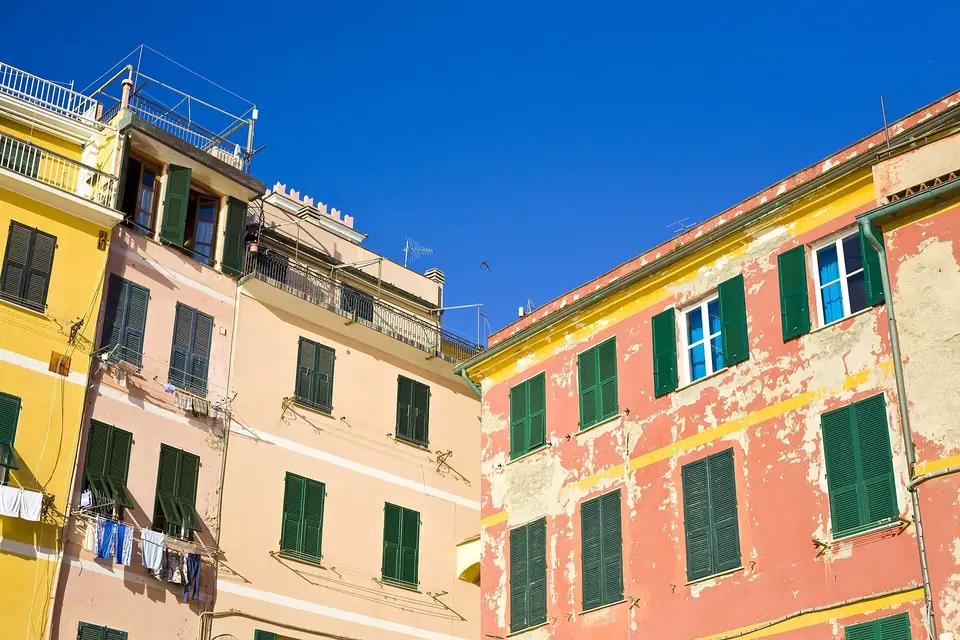
- Via Cristoforo Colombo (The Culverted Valley Spine). Emerging from the station tunnel, turn left (inland) to walk uphill along Via Colombo. Multi-storey houses painted in Ligurian ochre, rose pink, and terracotta flank this lively pedestrian spine. Along the street sit focaccia bakeries, paper-cone fish fryers (friggitorie), wine cellars, and diving shops.
- Why Ligurian Tower-Houses (Case-Torri) Were Built So Narrow. As you climb Via Colombo, look closely at the medieval facades. Houses measure few rooms wide yet rise several storeys high. Space inside the defensive ravine was scarce in past centuries. Families stacked their wine press and boat store on the ground floor, bedrooms in the middle, and kitchen under the slate roof. Interior staircases took up precious living space inside these narrow towers. Consequently, parallel stone alleys (caruggi) higher up the cliff often open directly into the upper floors.
| Riomaggiore Landmark | Location / Sector | Historical Era | Access & Visiting Notes |
|---|---|---|---|
| Marina di Riomaggiore & Fossola Cove | Seafront below station tunnel | Medieval slipway | Free open access; seasonal ferry jetty on west rock |
| Via Cristoforo Colombo | Central ravine floor | Culverted stream bed | Main pedestrian street with bakeries and wine bars |
| Church of San Giovanni Battista | Upper eastern valley terrace | Gothic foundation | Free admission; white Carrara marble rose window |
| Castello di Riomaggiore | Cemeterial hill crest | Medieval fortification | Panoramic sea terrace; check municipal opening hours |
| Via dell'Amore Cliff Walkway | Riomaggiore to Manarola cliff | Rock-cut coastal path | One-way northbound; requires card and timed reservation |
The Marina boat slipway, ferry pier, and Fossola pebble beach
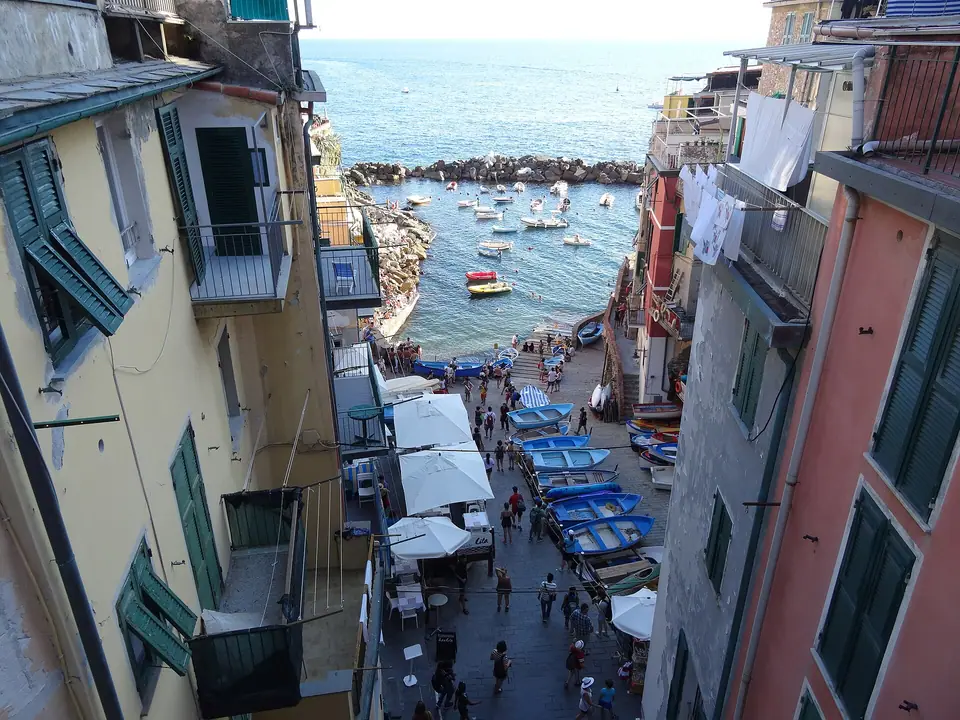
When you exit the station tunnel, look for the short stone staircase curving down to your right. Those steps descend straight to the waterfront cove of Marina di Riomaggiore. Unlike Vernazza, Riomaggiore has no wide harbour basin. Instead, a steep concrete ramp wedged between high red and ochre buildings drops directly into a narrow V-shaped rock inlet. Local fishermen line the stone ramp with brightly painted wooden rowing boats (gozzi). Whenever swells roll in from the Ligurian Sea, they haul the boats up the slipway using winches.
Follow the rocky walkway along the western breakwater to the small stone terrace above the waves. That viewpoint frames the classic postcard angle looking back at Riomaggiore's stacked houses. On the eastern side of the Marina cove, a short path cut into the cliff passes the ferry landing stage. The path curves around the headland to Spiaggia del Paese (Fossola Beach). We detail this deep-water cove of smooth dark pebbles in our Cinque Terre beaches and swimming guide.
Church of San Giovanni Battista and Castello di Riomaggiore
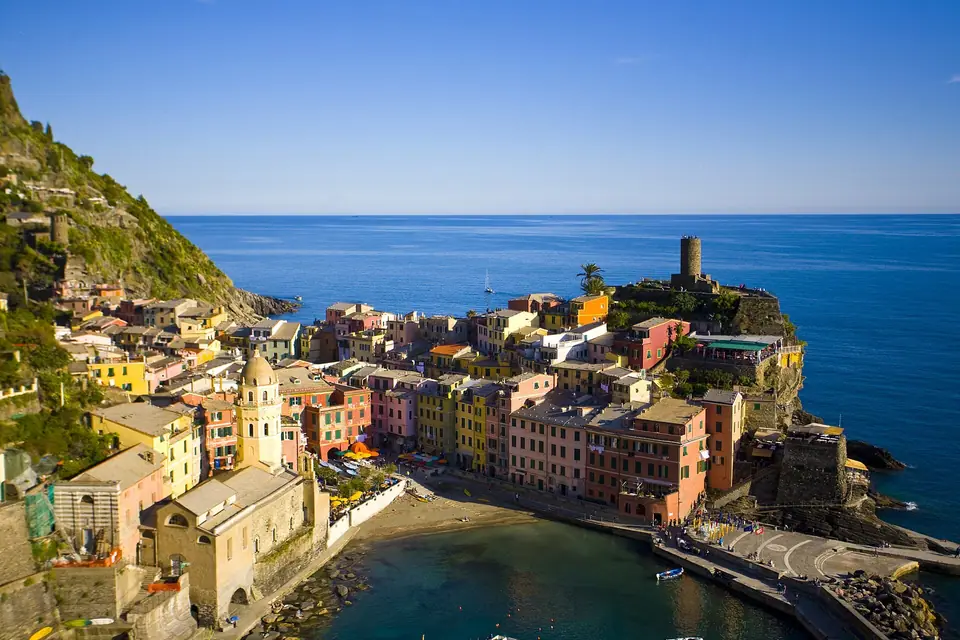
Climb halfway up Via Colombo and take the stone stairs of Via Signorini on your right. The steps lead onto the quiet upper terrace of the Church of San Giovanni Battista. Founded by Bishop Antonio Fieschi of Luni, the three-aisled basilica had its western facade rebuilt in neo-Gothic style after structural settling. Even so, it preserves its original Gothic white Carrara marble rose window and pointed side portals carved with bas-reliefs. Step inside the nave to see the wooden crucifix by Genoese sculptor Anton Maria Maragliano. The church also preserves historic marble carvings and a mechanical pipe organ.
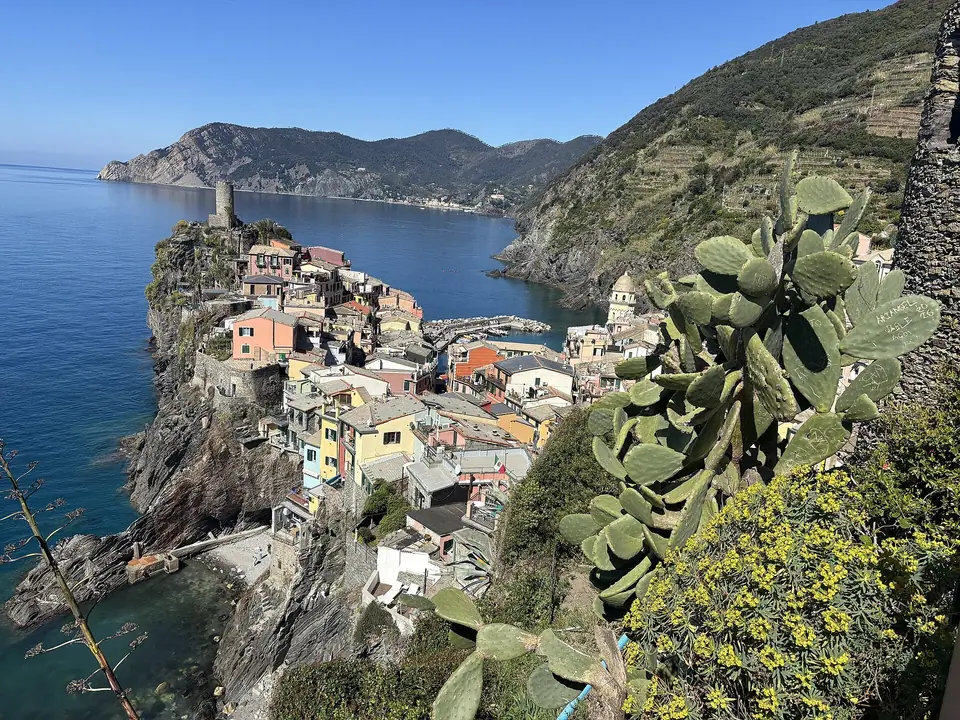
From the church square, continue climbing the stepped mule path westward toward the crest of the promontory separating the town from the railway station. High on the ridge stands the Castello di Riomaggiore (Castello di Cerricò). Marquis Niccolò Fieschi began the quadrangular fortress, and Genoa completed it after purchasing the territory. Its cylindrical stone watchtowers sheltered villagers during Barbary corsair raids. Its outer stone esplanade beside the Oratory of San Rocco commands an unobstructed panoramic view northwest toward Manarola and Corniglia.
Walking the reopened Via dell'Amore: Reservation rules and engineering
Starting directly above Riomaggiore's railway platforms, the Via dell'Amore ("Lovers' Lane") is the flattest section of the coastal Sentiero Verde-Azzurro. Railway engineers began blasting a tunnel between Riomaggiore and Manarola during past expansion works. To reach the central gunpowder depot, they carved twin service paths into the sheer sea cliff. Once tunnel construction finished, young couples from the two parishes began meeting halfway along the cliff ledge. Local journalist Paolo Monelli noted the custom, inspiring the path's romantic name.
Following a major rockfall, the path underwent extensive geotechnical reconstruction before reopening to the public. Specialist alpine rope teams anchored vast protective stainless-steel rockfall mesh across the vertical shale cliff. Crews also extended the protective gallery roof and replanted indigenous coastal shrubs. Keep key visitor rules in mind: walking operates one-way from Riomaggiore toward Manarola, and you must book a timed entry window. Entry requires the Via dell'Amore supplement added to a valid Cinque Terre Card.
Hiking the historic ridge route to Manarola and path to Montenero
If Via dell'Amore time slots sell out, lace up the gripped boots from our packing guide. Two alternative historical stone paths climb directly out of Riomaggiore. Walking up to the upper castle terrace before sunset rewards you with sweeping views across the rugged coastline. Pausing along the stepped side alleys reveals how medieval builders fitted tall stone houses into the narrow gorge. Checking your timed reservation slot before walking down to the station platform keeps your coastal stroll relaxed. Early mornings down at the stone slipway let you watch fishermen prepare their wooden boats in peace.
- The Historic Via Beccara to Manarola. Before workers blasted the coastal cliff path, villagers walked over the high ridge of Costa di Corniolo (Via Beccara). The trail climbs hundreds of steep stone steps through terraced vineyards over an energetic hike. Steep stone stairs then descend straight into upper Manarola.
- The Pilgrim Path to the Sanctuary of Nostra Signora di Montenero. Start from the stone bridge along the Rio Maggiore stream. This pilgrim staircase ascends high onto the ridge towards the shrine of Montenero. From the sanctuary parvis, you enjoy sweeping views south across Capo di Montenero toward Portovenere and Palmaria Island. Returning down the stone stairs in late afternoon brings warm sunset light across the pastel tower-houses and the rocky boat slipway below. Pause at a wine bar along Via Colombo afterward to sample crisp local white wine grown on these steep coastal cliffs.
Where it is
- 1Riomaggiore
- Pisa International Airport (PSA) · about 70 km from here in a straight line
- Directions in Google Maps
Stations and taxi ranks: OpenStreetMap. Airports: OurAirports. Distances are in a straight line.
Traveller tips
Real advice from people who have been to Cinque Terre. Every tip is read by our team before it goes live.
No tips yet. Been here? Yours could be the first.
Thank you! Your tip will appear here after a quick review.
More in Cinque Terre
Continue exploring Cinque Terre with related neighbourhood, food, and planning guides
What to Wear in Cinque Terre: Trail Footwear Rules & Packing Tips
Cinque Terre, Italy
Where to Stay in Cinque Terre: Comparing Villages, La Spezia & Levanto
Cinque Terre, Italy
Cinque Terre 3-Day Itinerary: Villages, Blue Trail & Portovenere
Cinque Terre, Italy
Manarola Guide: Punta Bonfiglio Viewpoint, Vineyards & San Lorenzo
Cinque Terre, Italy
