


























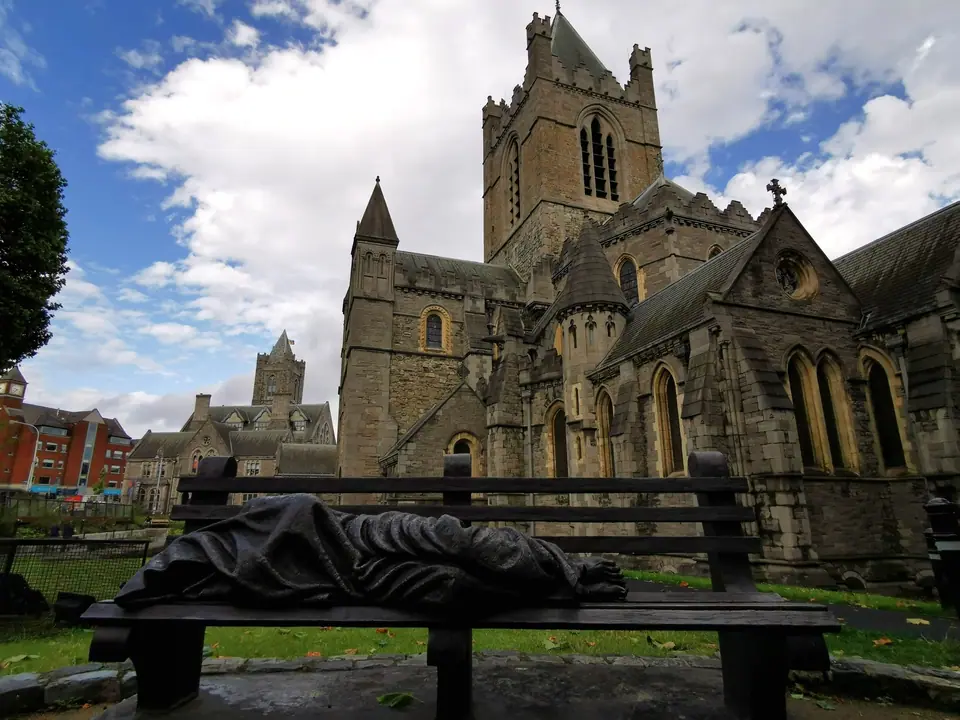
Dublin Castle, Chester Beatty and Christ Church Cathedral: Viking and Medieval Core
A historical walking route along Dublin's medieval ridge covering Dublin Castle, the Dubh Linn Garden, Chester Beatty, Christ Church, and St Patrick's.
Long before eighteenth-century Georgian squares expanded Dublin eastward, the entire walled city stood on a limestone ridge overlooking the southern bank of the River Liffey where its tributary, the River Poddle (now channelled underground), formed a dark tidal pool called Dubh Linn. Walking west along Dame Street and Lord Edward Street from Trinity College takes you through a thousand years of Viking, Anglo-Norman, and British vice-regal rule in a single compact kilometre.
Dublin Castle: State Apartments, Record Tower and Viking Undercroft
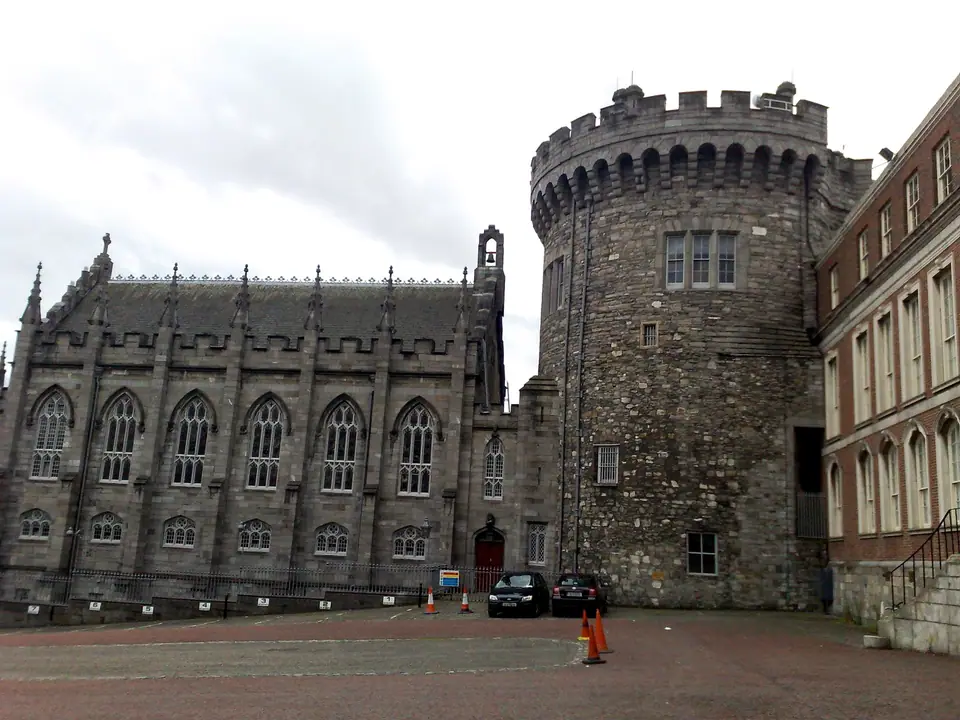
Built on the highest point of the medieval ridge, Dublin Castle was ordered in 1204 by King John of England to serve as a fortified treasury, fortress, and seat of English and later British administration in Ireland until 16 January 1922, when the castle was formally handed over to the Provisional Government of the Irish Free State led by Michael Collins. A devastating fire in April 1684 destroyed most of the medieval four-towered fortress, leaving a striking contrast between two courtyards:
- Upper Castle Yard: A Georgian red-brick quadrangle entered from Cork Hill past the 1761 Bedford Tower (from which the Irish Crown Jewels were mysteriously stolen in July 1907 and never recovered). The south range houses the State Apartments, former residence of the Lord Lieutenant (Viceroy), including the gilded Throne Room, St Patrick's Hall (used today for the inauguration of every President of Ireland), and the James Connolly Room, where the wounded 1916 Rising leader was held before being taken to Kilmainham Gaol.
- Lower Castle Yard and the Record Tower (circa 1228): Dominated by the massive circular limestone keep of the medieval Record Tower, standing alongside Francis Johnston's 1814 Gothic Revival Chapel Royal with over ninety carved stone heads around its exterior windows.
- The Viking Undercroft: Accessed on the guided tour beneath the Powder Tower, an underground archaeological chamber where the subterranean River Poddle still meets the thirteenth-century moat wall and tenth-century Viking earthen bank defenses.
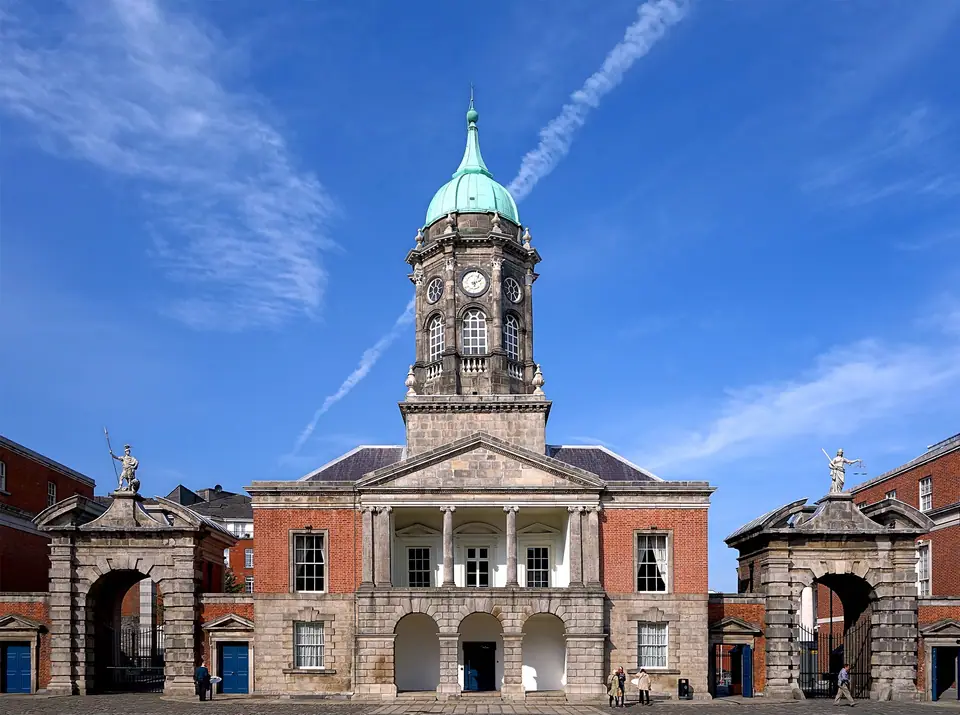
While the castle courtyards are free to walk through daily, entering the State Apartments passes by standard self-guided ticket, and seeing the Viking Undercroft and Chapel Royal requires the 60-minute OPW guided tour.
The Dubh Linn Garden and the Chester Beatty Museum
Directly behind the Chapel Royal lies the circular lawn of the Dubh Linn Garden, marking the exact site of the original Viking "Black Pool" where ninth-century longships moored. Facing the garden is the Chester Beatty Museum (admission free), housing the extraordinary library bequeathed to the Irish nation by American-born mining engineer Sir Alfred Chester Beatty, who moved to Dublin in 1950. Its two floors display second- and third-century Egyptian papyrus manuscripts of the Gospels and Pauline Epistles, illuminated Qur'ans from the ninth to nineteenth centuries, Ottoman miniatures, Japanese Edo-period woodblock prints, and Chinese jade books.
Christ Church Cathedral and the medieval crypt
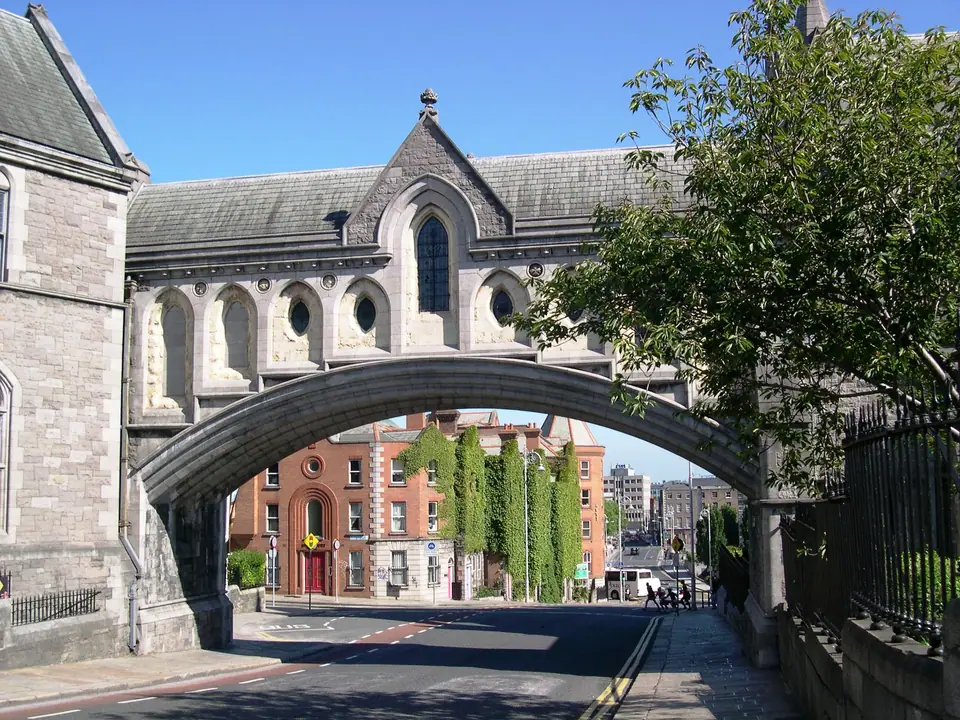
Five minutes west of the castle along Lord Edward Street rises Christ Church Cathedral (officially the Cathedral of the Holy Trinity), founded around 1030 by Viking King Sitric Silkenbeard and Dunan, first Bishop of Dublin, and rebuilt in stone after 1172 by Anglo-Norman conqueror Richard de Clare (known as Strongbow) and Archbishop Laurence O'Toole. Inside the nave, look for the effigy monument associated with Strongbow and the pronounced outward lean of the north wall (caused when the medieval roof collapsed in 1562), then descend into the twelfth-century stone crypt, the largest and oldest surviving structure in Dublin, which holds the cathedral treasury and the famous mummified remains of a cat and a rat found trapped inside an organ pipe in the 1850s. Spanning Winetavern Street via George Edmund Street's 1870s Neo-Gothic covered stone bridge is the former Synod Hall, home to the Dublinia Viking and medieval history exhibition.
St Patrick's Cathedral and Marsh's Library
Because medieval Dublin possessed two competing Anglican diocesan institutions, a second great Gothic church stands just five minutes south down Nicholas Street: St Patrick's Cathedral, Ireland's National Cathedral, built between 1220 and 1260 beside the ancient well where tradition holds St Patrick baptised converts. Topped by a 43-metre spire added in 1749, the cathedral is forever linked with Jonathan Swift, author of Gulliver's Travels, who served as Dean of St Patrick's from 1713 until 1745 and is buried beside Esther Johnson ("Stella") beneath the south nave near the 1632 Boyle Monument and the oak Door of Reconciliation (1492), which gave English the phrase "chancing your arm". Next door, stop into 1707 Marsh's Library before continuing west into The Liberties.
Traveller tips
Real advice from people who have been to Dublin Castle, Chester Beatty and Christ Church Cathedral: Viking and Medieval Core. Every tip is read by our team before it goes live.
No tips yet. Been here? Yours could be the first.
Thank you! Your tip will appear here after a quick review.
More in Dublin
Continue exploring Dublin with related neighbourhood, food, and planning guides

Dublin: River Liffey Layout, Postcodes, Leap Transit and First-Time Planning
Dublin, Ireland
Things to Do in Dublin: Libraries, Historic Gaols, Georgian Squares and Coastal Trails
Dublin, Ireland

How to Get to Dublin: Airport Buses, Holyhead Ferries and Intercity Rail Stations
Dublin, Ireland
Best Time to Visit Dublin: Month-by-Month Weather, Daylight Hours and Festivals
Dublin, Ireland
