


























Temple Bar and the River Liffey Bridges: Ha'penny Bridge, Cultural Quarter and Quays
How to experience Temple Bar's daytime arts institutions and Saturday markets alongside the historic and modern bridges spanning the River Liffey.
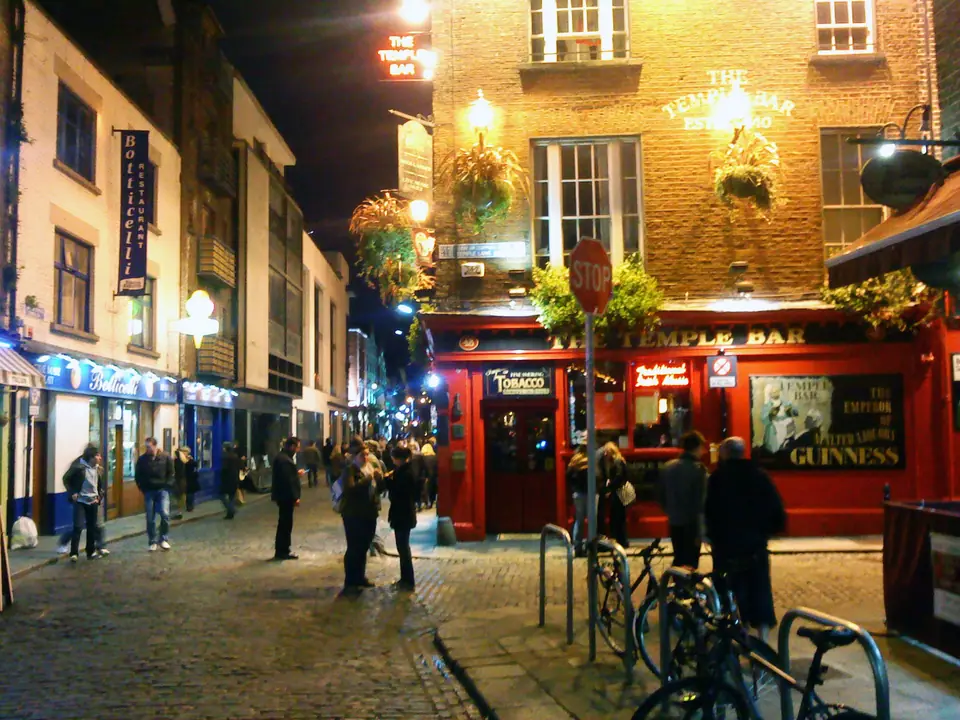
Bounded by the south bank of the River Liffey to the north, Dame Street to the south, Westmoreland Street to the east, and Fishamble Street to the west, Temple Bar is Dublin's best-known riverside enclave. Named after Sir William Temple, who served as Provost of Trinity College in 1609 and built his family house and riverside walk ("bar") on reclaimed land east of the city walls, the neighbourhood survived plans in the 1970s and 1980s by state transport company CIÉ to demolish its eighteenth-century merchant lanes for a central bus terminal. While low rents in the 1980s attracted artists, recording studios, and independent galleries before the quarter was designated Dublin's Cultural Quarter in 1991, visitors today find two distinct versions of Temple Bar depending on the time of day.
Daytime cultural venues, markets and Fishamble Street
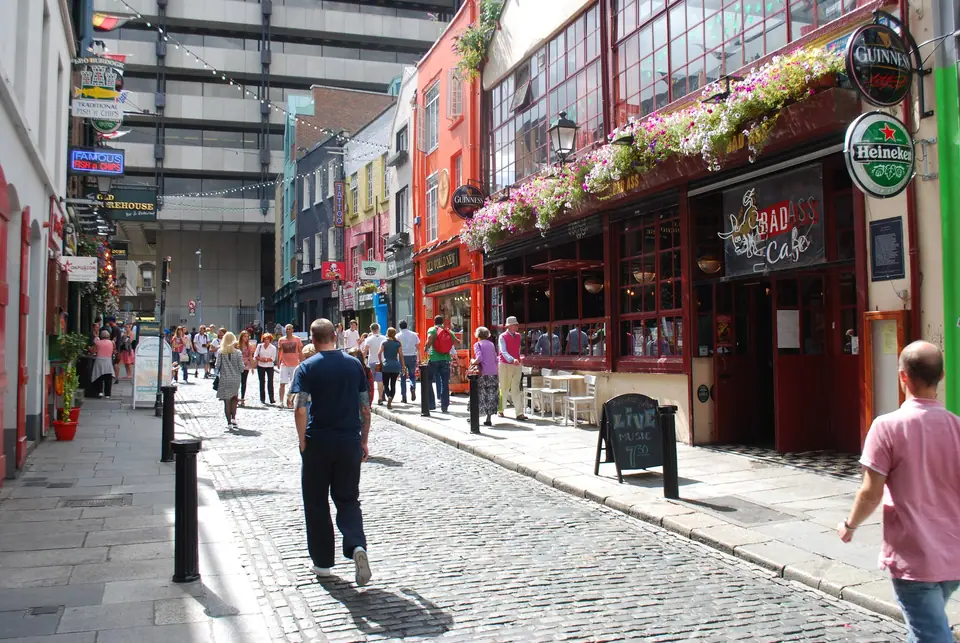
Walking through Temple Bar during the morning or early afternoon reveals the arts institutions and historic streets that predated the late-night stag-party bars:
- Meeting House Square and the Irish Film Institute (IFI): An open-air cobbled courtyard sheltered by retractable rain canopies that hosts the Saturday Temple Bar Food Market alongside the Gallery of Photography (Photo Museum Ireland), the National Photographic Archive, the Ark Children's Cultural Centre, and the Irish Film Institute on Eustace Street.
- Project Arts Centre and Temple Bar Gallery + Studios: Contemporary theatre, visual art, and working studio spaces on East Essex Street and Temple Bar street, plus the Saturday Designer Mart on Cow's Lane and book stalls on Temple Bar Square.
- Fishamble Street and Handel's Messiah: At the western edge of Temple Bar running down from Christ Church Cathedral, Fishamble Street follows a tenth-century Viking street line. A stone archway and bust mark the site of Neal's Music Hall, where George Frideric Handel conducted the world premiere of his oratorio Messiah on 13 April 1742.
After dark, Fleet Street and Temple Bar street become densely crowded and significantly more expensive per pint than the rest of the city; take your evening photographs of the red-painted corner pubs, then walk ten minutes south toward Exchequer Street, Camden Street, or The Liberties for quieter local pubs.
The 1816 Ha'penny Bridge and O'Connell Bridge
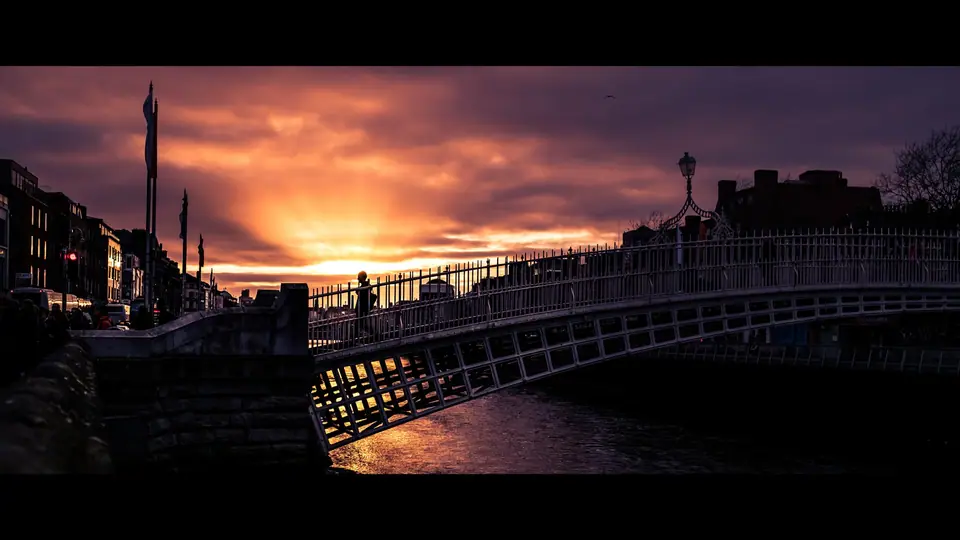
More than twenty road, rail, and pedestrian bridges span the tidal waters of the River Liffey through central Dublin. Linking Merchant's Arch at the foot of Temple Bar with Bachelor's Walk on the north bank is the Ha'penny Bridge (officially the Liffey Bridge). Opened in May 1816 as Ireland's first cast-iron bridge and cast at Coalbrookdale in Shropshire for alderman William Walsh, it replaced seven leaky passenger ferries. Until 1919, pedestrians paid a toll of one halfpenny at turnstiles on either bank to cross its single elliptical arch beneath three wrought-iron lantern hoops.
Two hundred metres east stands O'Connell Bridge, originally constructed by James Gandon in 1794 as Carlisle Bridge and widened in 1880 so that its roadway width (50 metres across) matches its length across the river, making it one of the only traffic bridges in Europe that is as wide as it is long.
Calatrava's harp bridges and the River Liffey Quays
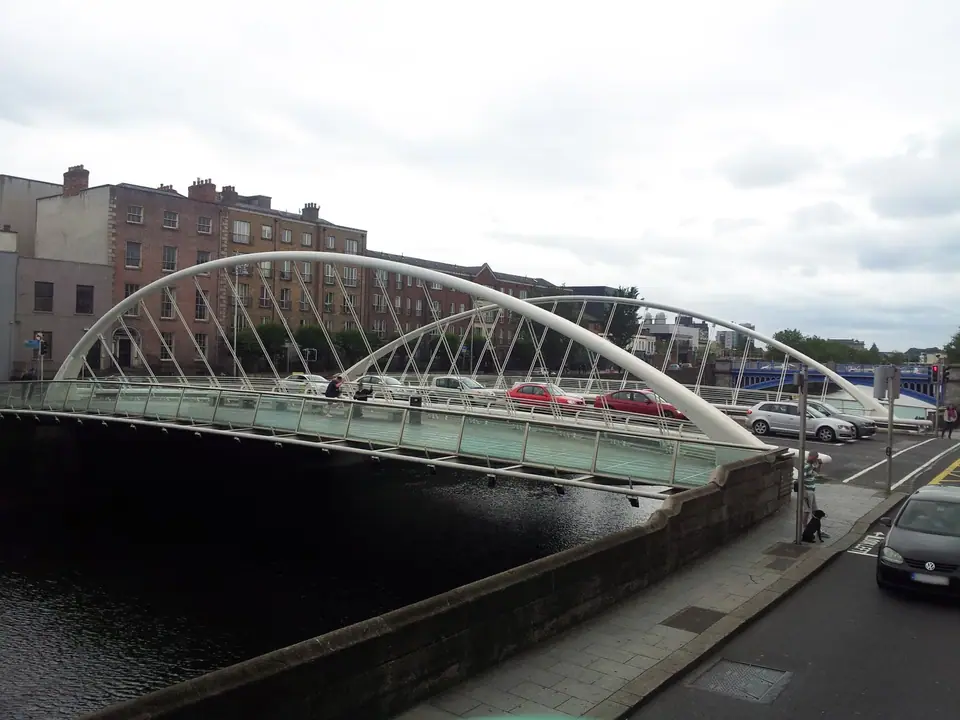
Following the riverside boardwalks west and east of O'Connell Bridge showcases three centuries of Irish engineering, including two white steel spans designed by Spanish architect and engineer Santiago Calatrava:
- Father Mathew Bridge and Grattan Bridge: Upstream beside the Four Courts and Dublin Castle, Father Mathew Bridge marks the site of the original ancient ford of hurdles (Áth Cliath) and Dublin's earliest medieval stone bridge of 1214.
- James Joyce Bridge (2003): Located further west between Usher's Island (the setting for Joyce's short story The Dead at No. 15 Usher's Quay) and Blackhall Place, supported by two outward-tilted steel arches.
- Samuel Beckett Bridge (2009): Downstream in the Docklands linking Sir John Rogerson's Quay with Guild Street, a 120-metre cable-stayed swing bridge whose inclined 48-metre pylon and 31 steel cables form the silhouette of an Irish harp lying on its edge, capable of rotating 90 degrees to let tall ships pass into the city.
Traveller tips
Real advice from people who have been to Temple Bar and the River Liffey Bridges: Ha'penny Bridge, Cultural Quarter and Quays. Every tip is read by our team before it goes live.
No tips yet. Been here? Yours could be the first.
Thank you! Your tip will appear here after a quick review.
More in Dublin
Continue exploring Dublin with related neighbourhood, food, and planning guides
Howth Cliff Walk and Dún Laoghaire Day Trip: DART Coastal Villages and Pier Walks
Dublin, Ireland
Dublin: River Liffey Layout, Postcodes, Leap Transit and First-Time Planning
Dublin, Ireland
Things to Do in Dublin: Libraries, Historic Gaols, Georgian Squares and Coastal Trails
Dublin, Ireland
How to Get to Dublin: Airport Buses, Holyhead Ferries and Intercity Rail Stations
Dublin, Ireland
