


























St Stephen's Green, Merrion Square and the Free National Museums of Georgian Dublin
A southside walking route through St Stephen's Green, Kildare Street, Merrion Square, and Fitzwilliam Square with Dublin's free national museums.
During the eighteenth century, under the reigns of Kings George I through George IV and the planning authority of the Wide Streets Commissioners (established in 1757), Dublin transformed from a cramped medieval port into the second city of the British Empire. Aristocrats and members of the Irish Parliament abandoned the old ridge around Dublin Castle to build uniform red-brick townhouse terraces around landscaped garden squares south-east of Trinity College. Today, this southside quarter (postcode D02) preserves the finest Georgian streetscapes in Ireland alongside the country's free national museums and gallery.
St Stephen's Green: Victorian park and 1916 battleground
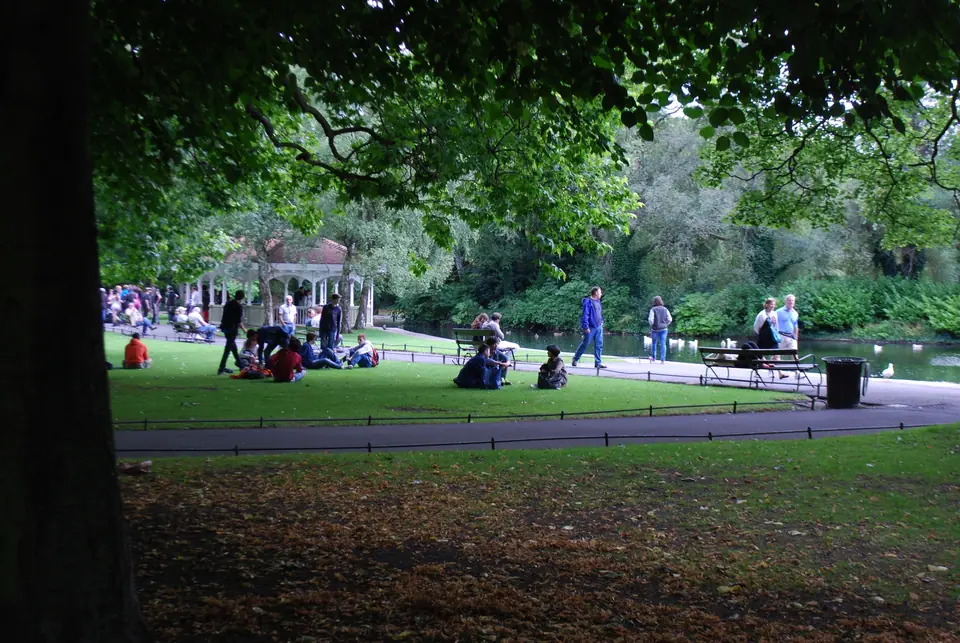
At the top of pedestrian Grafton Street sits St Stephen's Green (Faiche Stiabhna), a 9-hectare (22-acre) public park originally enclosed from marshy common land in 1664. For over two centuries the green was a private square reserved for key-holding residents of the surrounding townhouses until brewer and philanthropist Sir Arthur Edward Guinness (later Lord Ardilaun) funded an Act of Parliament in 1877 to redesign the grounds with ornamental lakes, waterfalls, a Victorian cast-iron bandstand (1887), and shaded paths, opening it free to all citizens in July 1880.
Enter through Fusiliers' Arch at the Grafton Street corner, erected in 1907 to commemorate the Royal Dublin Fusiliers who died in the Second Boer War. During the Easter Rising of April 1916, members of the Irish Citizen Army commanded by Michael Mallin and Countess Constance Markievicz dug trenches around the park ponds before retreating under heavy machine-gun fire from the roof of the Shelbourne Hotel into the adjacent Royal College of Surgeons (bullet scars are still visible on the granite columns of both the arch and the college). According to contemporaneous accounts, shooting was halted twice each day so park superintendent James Kearney could feed the waterfowl on the lake. Elsewhere in the park, look for the busts and statues of James Joyce, W. B. Yeats (by Henry Moore), Wolfe Tone, and the Three Fates fountain.
Kildare Street: Leinster House and the free National Museum (Archaeology)
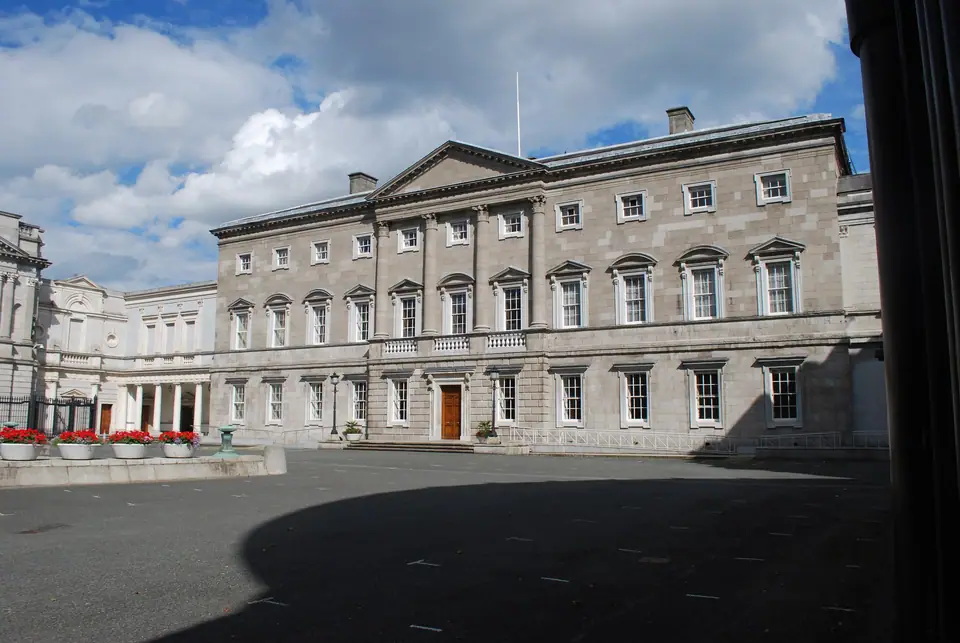
Walking two minutes north from St Stephen's Green along Kildare Street brings you to the symmetrical trio of cultural buildings framing Leinster House, built in 1745 by Richard Cassels as the town palace of the Duke of Leinster and serving since 1922 as the seat of the Oireachtas (the Irish Parliament). Flanking its courtyard on Kildare Street are two buildings designed by Sir Thomas Newenham Deane and Sir Thomas Manly Deane and opened in 1890:
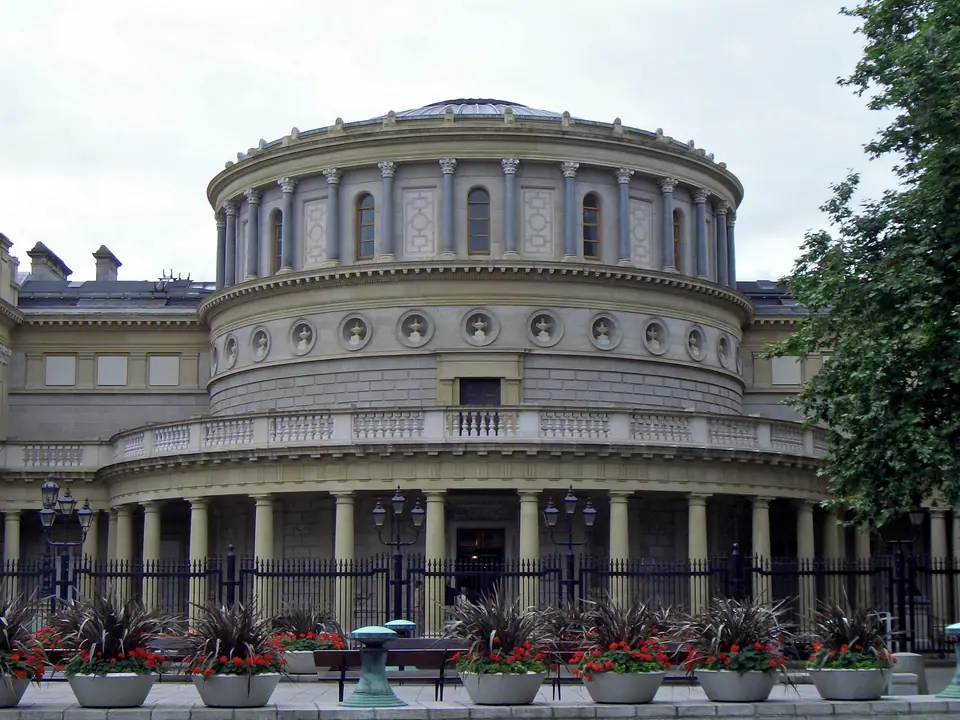
- National Museum of Ireland Archaeology (Free): Enter through the classical rotunda patterned with Irish marbles to view the Treasury exhibition, which holds the eighth-century Ardagh Chalice, the Tara Brooch, the eleventh-century Shrine of St Patrick's Bell, and the twelfth-century Cross of Cong. The ground floor also displays the Ór: Ireland's Gold gallery (the largest collection of prehistoric Bronze Age goldwork in western Europe, dating from 2200 to 500 BC) and the Kingship and Sacrifice exhibition of Iron Age bog bodies preserved in Irish peatlands.
- National Library of Ireland (Free): Directly across the forecourt, famous for its domed green-lamp Reading Room (which features in the "Scylla and Charybdis" episode of James Joyce's Ulysses) and its ground-floor exhibition on the life and manuscripts of W. B. Yeats.
Merrion Square, the National Gallery and the Georgian Doors of Dublin
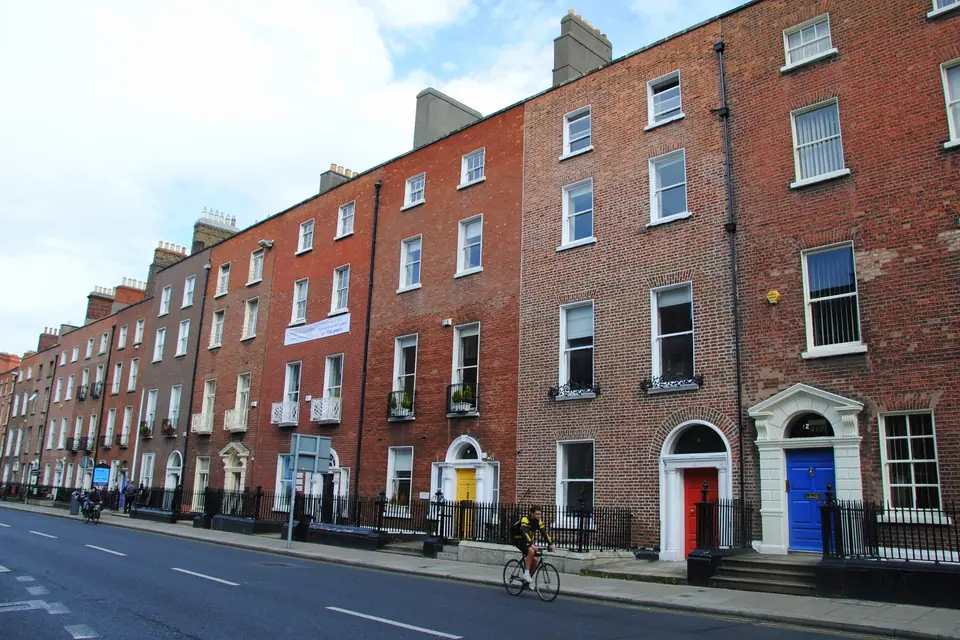
Walk around the back of Leinster House to emerge onto Merrion Square, laid out in 1762 and framed on three sides by intact Georgian red-brick terraces. Notice how eighteenth-century Dublin architecture follows strict proportion: tall ground- and first-floor reception windows diminish in height toward the upper attic storeys, wrought-iron balconies and boot scrapers flank the steps, and no two front doors are alike. Residents personalised the uniform facades with brightly painted timber doors, brass lion-head knockers, and intricate semicircular glass fanlights over the transoms to let daylight into the entrance halls.
On Merrion Square West, the National Gallery of Ireland (opened in 1864; permanent collection free) spans four wings holding Caravaggio's The Taking of Christ (rediscovered in a Jesuit dining room on Leeson Street in 1990), Johannes Vermeer's Woman Writing a Letter, with her Maid, and the Yeats Room featuring Jack B. Yeats's The Liffey Swim. Next door stands the 1857 Natural History Museum ("the Dead Zoo"). Cross into Merrion Square Park to see Danny Osborne's polychrome stone sculpture of Oscar Wilde lounging on a quartz boulder directly opposite his childhood home at No. 1 Merrion Square North; further south along Upper Fitzwilliam Street and Fitzwilliam Square, No. 29 Fitzwilliam Street Lower houses a restored Georgian townhouse museum run by the ESB and the National Museum.
Traveller tips
Real advice from people who have been to St Stephen's Green, Merrion Square and the Free National Museums of Georgian Dublin. Every tip is read by our team before it goes live.
No tips yet. Been here? Yours could be the first.
Thank you! Your tip will appear here after a quick review.
More in Dublin
Continue exploring Dublin with related neighbourhood, food, and planning guides
Trinity College Dublin and the Book of Kells: Old Library Long Room and Campus Squares
Dublin, Ireland
Guinness Storehouse and The Liberties: St James's Gate, Gravity Bar and Distilleries
Dublin, Ireland
Kilmainham Gaol and Phoenix Park: 1916 Rising History, IMMA and Fallow Deer Herds
Dublin, Ireland
Temple Bar and the River Liffey Bridges: Ha'penny Bridge, Cultural Quarter and Quays
Dublin, Ireland
