


























Trinity College Dublin and the Book of Kells: Old Library Long Room and Campus Squares
How to visit Ireland's oldest university, the ninth-century Book of Kells, the 65-metre Long Room, the Brian Boru harp, and the campus quadrangles.
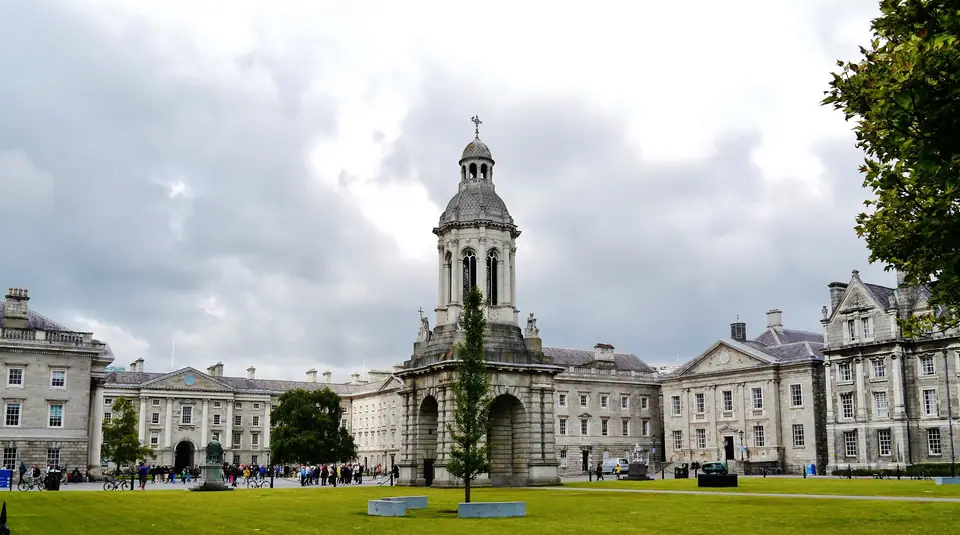
Founded by royal charter of Queen Elizabeth I on 3 March 1592 on the dissolved medieval priory lands of All Hallows, Trinity College Dublin (officially the College of the Holy and Undivided Trinity of Queen Elizabeth near Dublin) is Ireland's oldest university. Once standing outside the eastern walls of medieval Dublin, its 19-hectare walled campus now forms a tranquil enclave of cobblestone squares, neoclassical porticoes, and manicured lawns right at the meeting point of College Green, Dame Street, and Grafton Street.
Walking the historic squares and the 1853 Campanile
Pedestrians can walk freely through the main College Green entrance gate beneath the eighteenth-century Regent House facade during daytime hours at no cost. Stepping through the vaulted wooden archway brings you immediately into Parliament Square and Front Square, where traffic noise drops away behind granite ranges designed in the eighteenth century by Sir William Chambers:
- The Chapel (1798) and Public Theatre / Examination Hall (1791): Twin Corinthian-porticoed buildings facing each other across Parliament Square with plasterwork interiors by Michael Stapleton.
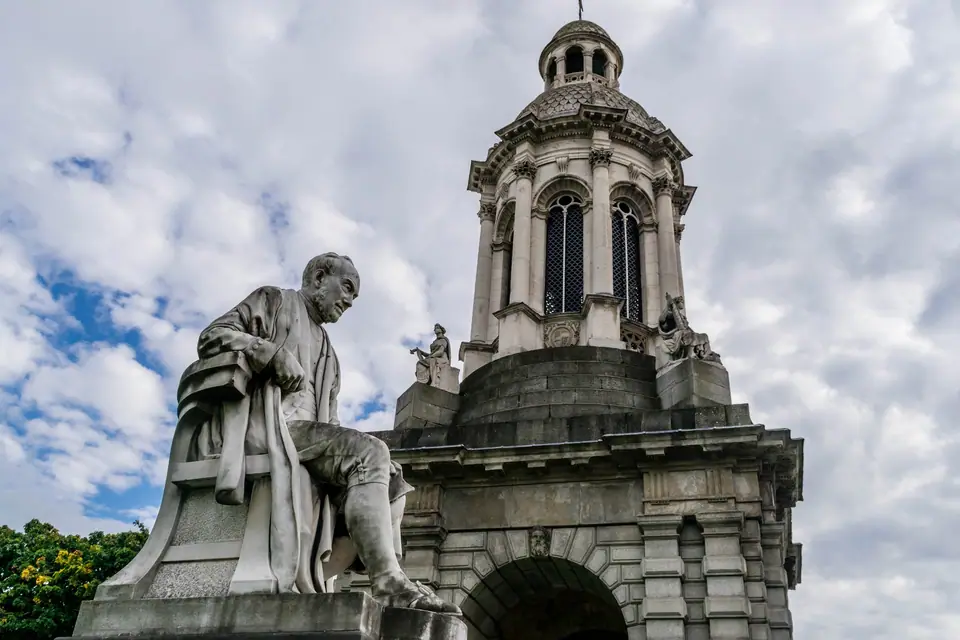
- The Campanile (1853): Rising 30 metres (100 feet) at the junction of Parliament Square and Library Square, this domed limestone bell tower was erected by Lord John George Beresford, Archbishop of Armagh, and designed by Sir Charles Lanyon on the traditional site of the medieval monastery's bell house. Beneath it sit statues of provost George Salmon and historian William Edward Hartpole Lecky (college superstition holds that undergraduates who walk beneath the bell tower while it tolls will fail their annual examinations).
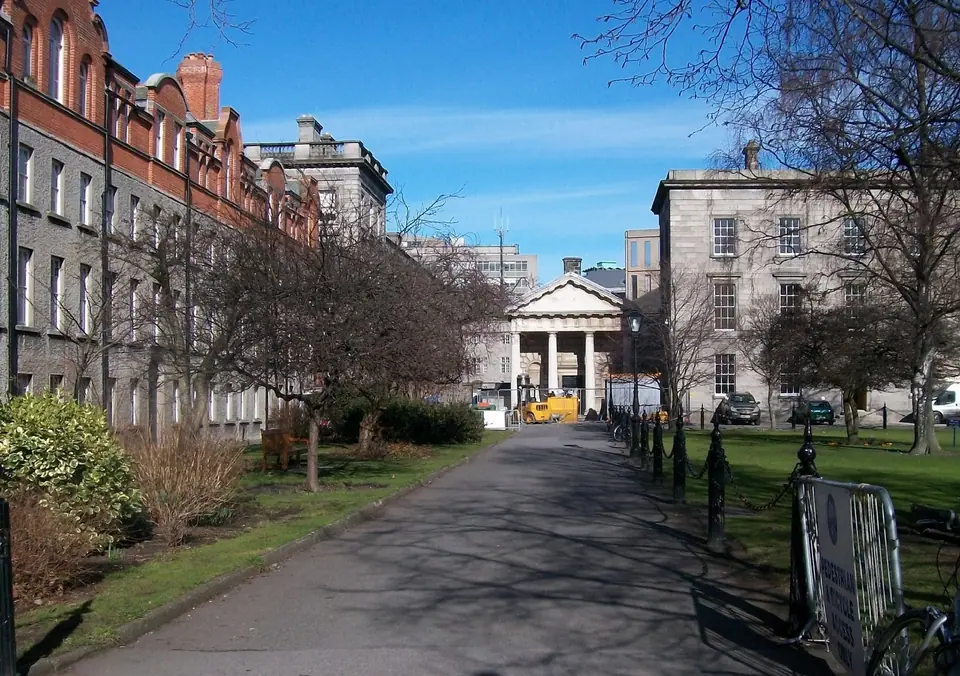
- The Rubrics (circa 1700) and the Museum Building (1857): Immediately east of the Campanile stands the red-brick residential range of the Rubrics, the oldest surviving building on campus. Behind the Old Library, the Ruskinian Venetian-Gothic Museum Building by Thomas Deane and Benjamin Woodward features naturalistic stone carvings of Irish flora and fauna by the O'Shea brothers and the vaulted entrance hall housing skeletons of the extinct giant Irish elk.
The Book of Kells Experience
While the outdoor quadrangles are free to wander, entering the Old Library to see the Book of Kells requires a timed-entry ticket booked online in advance. Created around 800 AD by Columban monks at the island monastery of Iona off the coast of Scotland and brought to the Abbey of Kells in County Meath after Viking raids, this insular illuminated manuscript contains the four Gospels of the New Testament in Latin, written on prepared calfskin vellum across 340 surviving folios (680 pages). Presented to Trinity College in 1661 by Henry Jones, Bishop of Meath, the manuscript is celebrated for its intricate knotwork, zoomorphic initials, and mineral pigments drawn from lapis lazuli, orpiment, and verdigris. After viewing the original manuscript pages in the climate-controlled Treasury, the Book of Kells Experience continues into the Red Pavilion behind the library for large-scale digital projections of the manuscript's illuminations.
The Old Library, the Long Room and the Brian Boru Harp
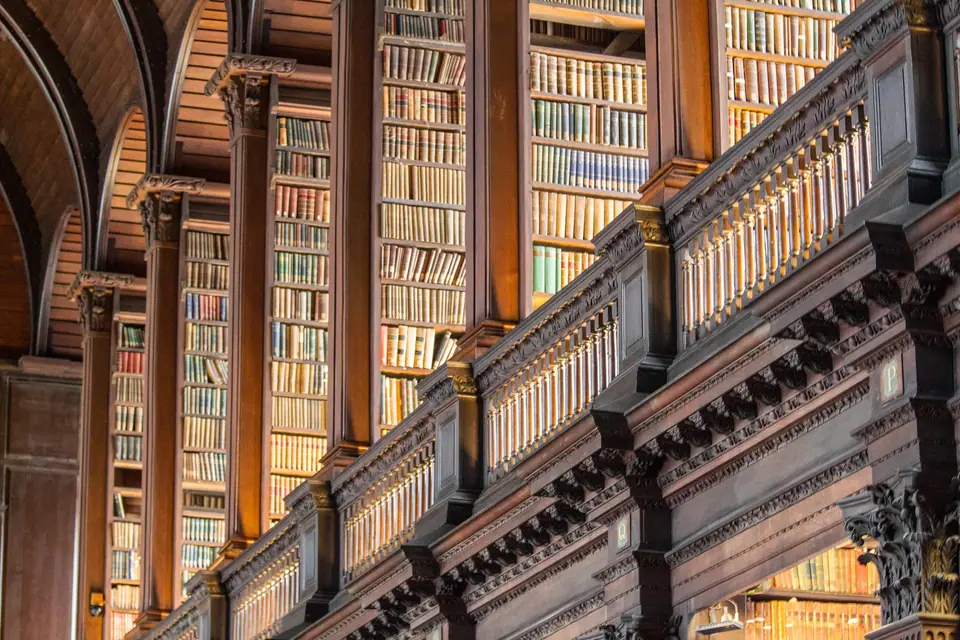
Upstairs in the Old Library (designed by Colonel Thomas Burgh and completed between 1712 and 1732) stretches the Long Room, a 65-metre (213-foot) chamber that originally had a flat plaster ceiling until roof architects Deane and Woodward raised the timber barrel vault in 1860 to create a second gallery tier for the expanding legal-deposit collection. Note that the Old Library is currently undergoing a major multi-year conservation project (the Old Library Redevelopment Project); while most historic volumes have been carefully decanted to climate-controlled storage during restoration works, visitors still walk the full length of the barrel-vaulted oak hall past its collection of marble busts (carved by Peter Scheemakers and Louis François Roubiliac, including Jonathan Swift and recently added busts of Rosalind Franklin, Ada Lovelace, Mary Wollstonecraft, and Augusta, Lady Gregory).
In the centre of the Long Room stand two national treasures of Ireland: an original printed copy of the 1916 Proclamation of the Irish Republic read by Patrick Pearse outside the GPO, and the Trinity College Harp (also called the Brian Boru Harp), dating to the fourteenth or fifteenth century. Carved from willow and oak with 29 brass wire strings, it is the oldest surviving medieval Gaelic harp in Ireland and the direct model for the state emblem found on Irish passports, presidential seals, and Irish euro coins. From the Nassau Street gate of Trinity College, you are less than five minutes on foot from the free National Museums on Kildare Street and ten minutes from Dublin Castle.
Traveller tips
Real advice from people who have been to Trinity College Dublin and the Book of Kells: Old Library Long Room and Campus Squares. Every tip is read by our team before it goes live.
No tips yet. Been here? Yours could be the first.
Thank you! Your tip will appear here after a quick review.
More in Dublin
Continue exploring Dublin with related neighbourhood, food, and planning guides
Kilmainham Gaol and Phoenix Park: 1916 Rising History, IMMA and Fallow Deer Herds
Dublin, Ireland
Temple Bar and the River Liffey Bridges: Ha'penny Bridge, Cultural Quarter and Quays
Dublin, Ireland
Dublin Castle, Chester Beatty and Christ Church Cathedral: Viking and Medieval Core
Dublin, Ireland
St Stephen's Green, Merrion Square and the Free National Museums of Georgian Dublin
Dublin, Ireland
