





















Block Arcade, Royal Arcade, Bourke Street Mall, Chinatown & State Library Walk
Trace Melbourne's 19th-century gold-rush wealth from the 1892 Block Arcade and 1870 Royal Arcade across Bourke Street Mall and 1851 Chinatown to the octagonal dome of State Library Victoria.
In the 1880s, three decades after the discovery of gold in regional Victoria, Melbourne had become the richest city of the Southern Hemisphere. Visiting English journalist George Augustus Sala famously coined the phrase "Marvellous Melbourne" to describe the city's grand avenues. Nowhere is that late-Victorian architectural confidence more tangible than on the half-mile walk connecting Collins Street to La Trobe Street. This route passes through the city's covered shopping arcades, Bourke Street Mall, Little Bourke Street's Chinatown, and the octagonal dome of State Library Victoria. Every block sits inside the Free Tram Zone and connects directly onto our Flinders Street Station and Degraves Street walk.
1. The 1892 Block Arcade and Hopetoun Tearooms
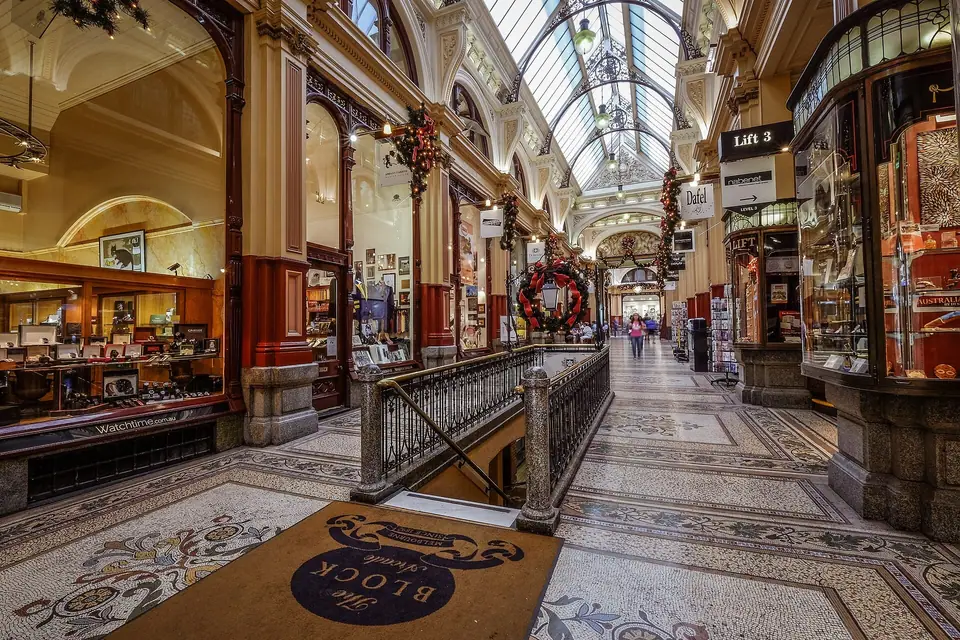
Start at 282 to 284 Collins Street, where the six-storey Victorian Mannerist facade of The Block Arcade opens beneath a curved pediment. Architect David C. Askew of Twentyman and Askew designed the building at the height of the land boom. It was constructed between 1891 and 1893, with the main gallery opening in 1892. The L-shaped arcade links Collins Street north to Little Collins Street and west to Elizabeth Street. Its name comes from the nineteenth-century social ritual of "doing the Block". Back then, fashionable Melburnians paraded in top hats and silk gowns along the northern pavement of Collins Street between Swanston and Elizabeth streets.
Askew modelled the interior directly on the Galleria Vittorio Emanuele II in Milan. Overhead arches a high glass-and-wrought-iron barrel vault that meets at a central glass dome. Underfoot stretches one of the largest hand-laid mosaic tile floors in Australia. Craftsmen assembled the floor from tens of thousands of imported porcelain tesserae made by Craven, Dunnill and Company in Shropshire, England. Halfway along the gallery sits the heritage Hopetoun Tearooms, established in 1892 by the Victorian Ladies' Work Association. The tearoom was named after Lady Hopetoun, wife of the Earl of Hopetoun, who served as Governor of Victoria and later Australia's first Governor-General. Check the official arcade directory for current tearoom booking policies.
2. The 1870 Royal Arcade and the statues of Gog and Magog
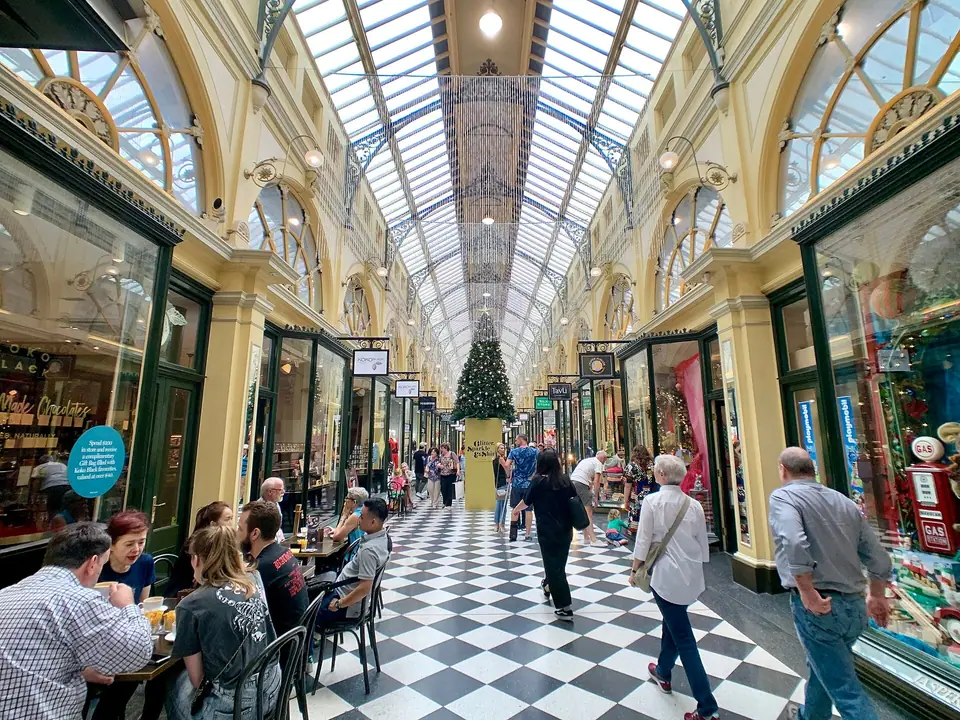
Step out of the Block Arcade onto Little Collins Street and walk fifty metres north across the tram lines. Here you enter the southern portal of the Royal Arcade, which runs through to 335 Bourke Street Mall with a western arm to Elizabeth Street. Architect Charles Webb designed the passage after winning an 1869 competition, and Mayor Samuel Amess formally opened it on 2 May 1870. The Royal Arcade is the oldest surviving shopping arcade in Australia. Its symmetric Italianate nave is paved in black-and-white chequered marble tiles under a clerestory glass roof and cast-iron lanterns.
Look up inside the southern arch above the intersection of the T-shaped corridors to see a famous Melbourne curiosity. Gaunt's Clock was installed in 1892 by royal watchmaker Thomas Gaunt. Flanking the clock stand two 7-foot (2.1-metre) carved pinewood statues of the mythical ancient British giant guardians Gog and Magog, carved by Mortimer Godfrey. Every hour on the hour, the hinged arms of Gog and Magog strike the chimes with their maces. At the northern Bourke Street archway presides a matching carved figure of Father Time.
3. Bourke Street Mall and Hardware Lane
Exiting the Royal Arcade onto Bourke Street Mall places you in Melbourne's central retail promenade. The city converted this block between Swanston and Elizabeth streets into a pedestrian-and-tram mall in 1978 and completed it in 1983. Shoppers, buskers, and low-floor trams on Routes 86 and 96 share the paved strip. Either side stand the heritage flagship department stores of Myer (founded in 1911, with its Beaux-Arts facade completed in 1914) and David Jones. For lunch away from the retail crowds, walk two blocks west down Bourke Street and turn north into Hardware Lane. This red-brick pedestrian lane is flanked by nineteenth-century saddlery and ironmongery warehouses.
4. Little Bourke Street (1851 Chinatown) and Coop's Shot Tower
Walk one block north of Bourke Street Mall to Little Bourke Street, where crimson archways mark Melbourne's historic Chinatown between Swanston and Spring streets. Cantonese prospectors settled here in 1851 after arriving in Port Phillip Bay on their way to the goldfields at Ballarat and Bendigo. This five-block corridor is the oldest continuous Chinatown in the Western world and the longest continuous Chinese settlement in the Southern Hemisphere. Duck into Cohen Place to visit the Museum of Chinese Australian History (Chinese Museum). Inside rests the 63-metre-long Millennium Dragon carried through the streets each Lunar New Year, while nearby lanes serve soup dumplings and Cantonese roast duck.
Continue one block north up Swanston Street to the corner of La Trobe Street and step inside Melbourne Central. Opened in 1991 to a design by Japanese architect Kisho Kurokawa, the complex is crowned by a 20-storey, 84-metre-high glass cone. Directly beneath that glass cone stands the preserved 1889 Coop's Shot Tower, a 50-metre-tall, 9-storey red-brick chimney. Here, the Coop family manufactured lead shot until 1961 by dropping molten lead from the top floor into a water basin.
5. State Library Victoria: The 1913 La Trobe Reading Room and Ned Kelly's Armour
Directly across Swanston Street at 328 Swanston Street rises the Corinthian sandstone portico of State Library Victoria. The library sits at the heart of Melbourne's 2008 designation as a UNESCO City of Literature. Founded in 1854 under Supreme Court judge Sir Redmond Barry, it opened on 11 February 1856 with 3,800 volumes. It was one of the first free public libraries in the world, admitting anyone aged fourteen and over with clean hands. Entry to the entire building and its permanent exhibitions remains free today; check the official State Library Victoria website before your visit.
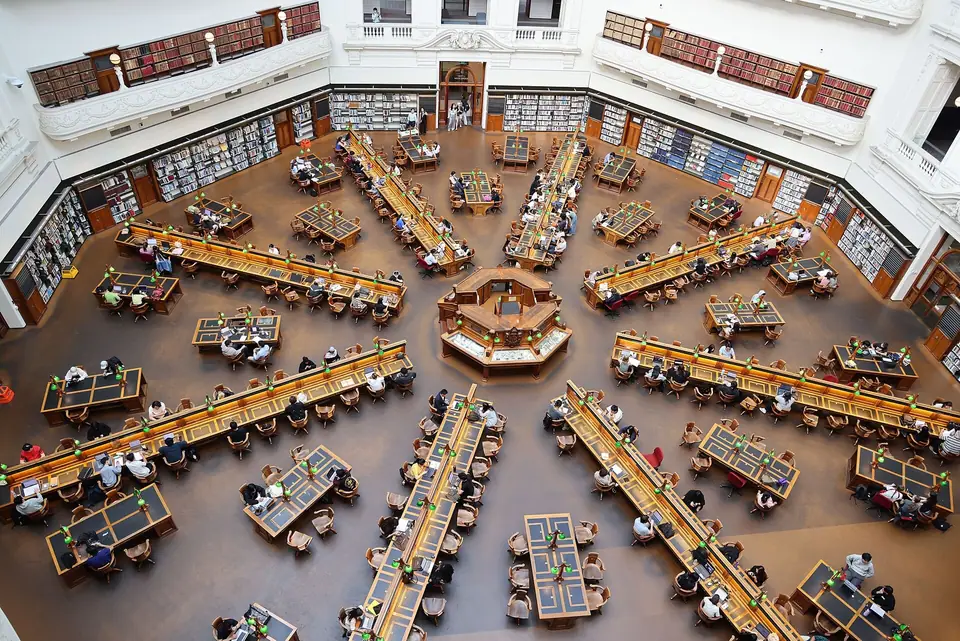
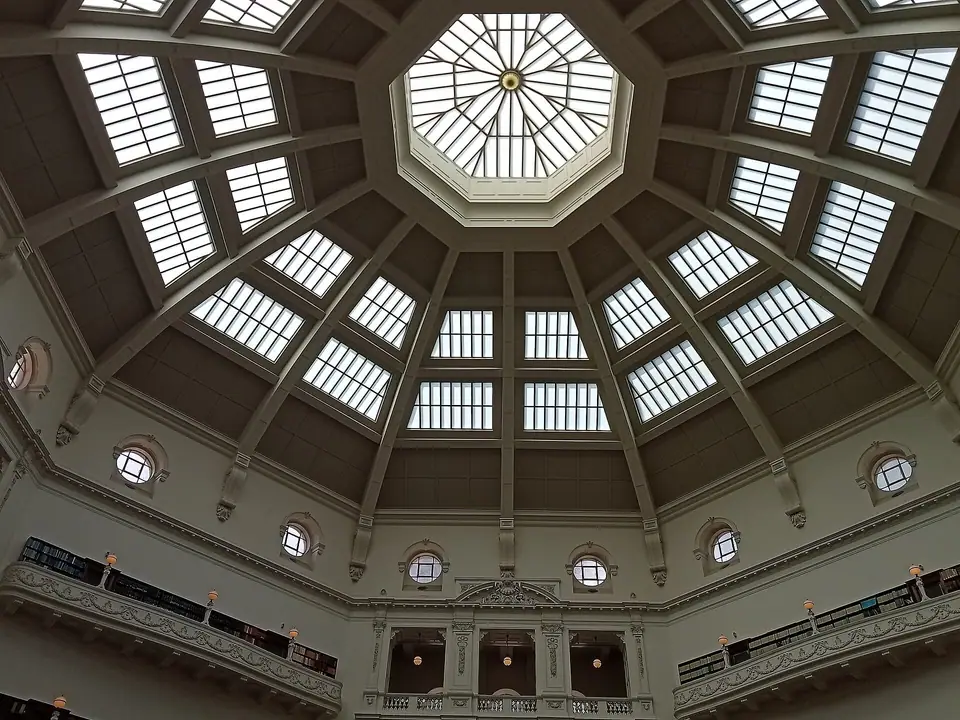
Walk straight to the centre of the library to enter the octagonal La Trobe Reading Room. Designed by Bates, Peebles and Smart and opened in 1913, its dome spans 34.75 metres (114 feet) in both diameter and height. Upon completion in 1913, it was the largest reinforced concrete dome in the world. You can walk quietly across the ground floor past radial timber desks equipped with green-shaded lamps that seat 320 readers. Afterwards, ride the lift to the Dome Galleries on Levels 4, 5, and 6 to look down from the perimeter balconies. On Levels 4 and 5, visit the World of the Book exhibition and the restored 1856 Ian Potter Queen's Hall. The gallery also displays the original 44-kilogram handmade iron helmet and bullet-dented breastplate worn by bushranger Ned Kelly at the Siege of Glenrowan in June 1880, plus his 56-page Jerilderie Letter. Outside on the Swanston Street lawns, you are a five-minute walk from the UNESCO Royal Exhibition Building and Carlton Gardens.
Traveller tips
Real advice from people who have been to Melbourne. Every tip is read by our team before it goes live.
No tips yet. Been here? Yours could be the first.
Thank you! Your tip will appear here after a quick review.
More in Melbourne
Continue exploring Melbourne with related neighbourhood, food, and planning guides
Great Ocean Road, Twelve Apostles, Phillip Island Penguins & Yarra Valley Day Trips
Melbourne, Australia
What to Eat in Melbourne: Laneway Coffee, Queen Victoria Market & Eight Iconic Dishes
Melbourne, Australia
Melbourne Orientation: The 1837 Hoddle Grid, Laneways, Trams & Six Core Precincts
Melbourne, Australia
Best Things to Do in Melbourne: Laneways, Arcades, Galleries, MCG & Coastal Day Trips
Melbourne, Australia
