





















Federation Square, Flinders Street Station, St Paul's Cathedral & Hosier Lane Walk
Walk Melbourne's busiest intersection from the 9 clocks of the 1910 Flinders Street Station dome and 1891 St Paul's Cathedral through Federation Square (NGV Australia and ACMI) to Hosier Lane and Degraves Street.
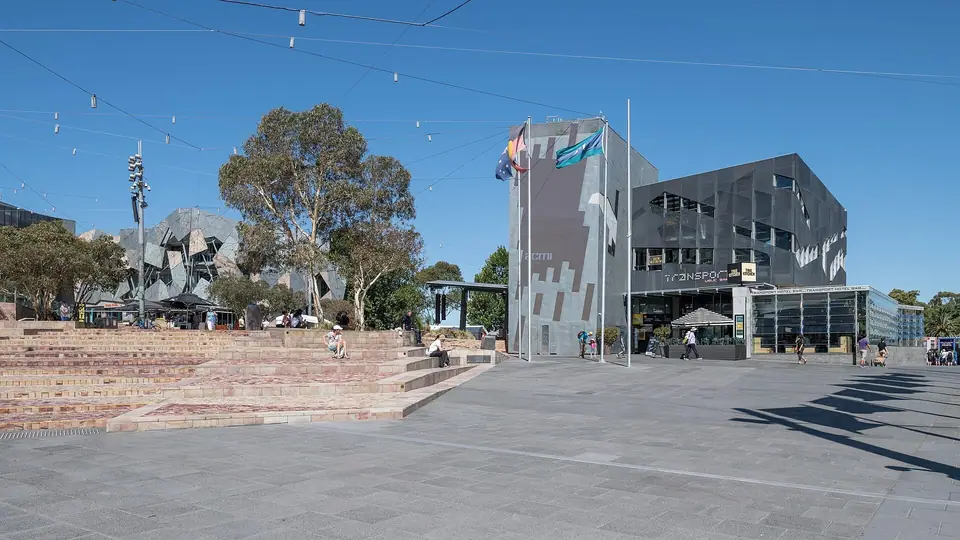
Melbourne's centre of gravity is the crossroads where Swanston Street meets Flinders Street on the northern bank of the Yarra River. Stand on this intersection and the four corners tell the story of the city across three centuries. To the southwest rises the 1910 Edwardian dome of Flinders Street Station. To the northeast soar the three Gothic Revival spires of St Paul's Cathedral, while to the northwest stands the 1861 Young and Jackson Hotel. Across the road to the southeast unfolds the sandstone plaza of Federation Square, directly opposite the aerosol-painted bluestone cobbles of Hosier Lane. Every stop on this compact walking route sits inside the Free Tram Zone and takes three to four hours.
Stop 1: "Under the Clocks" at Flinders Street Station and Campbell Arcade
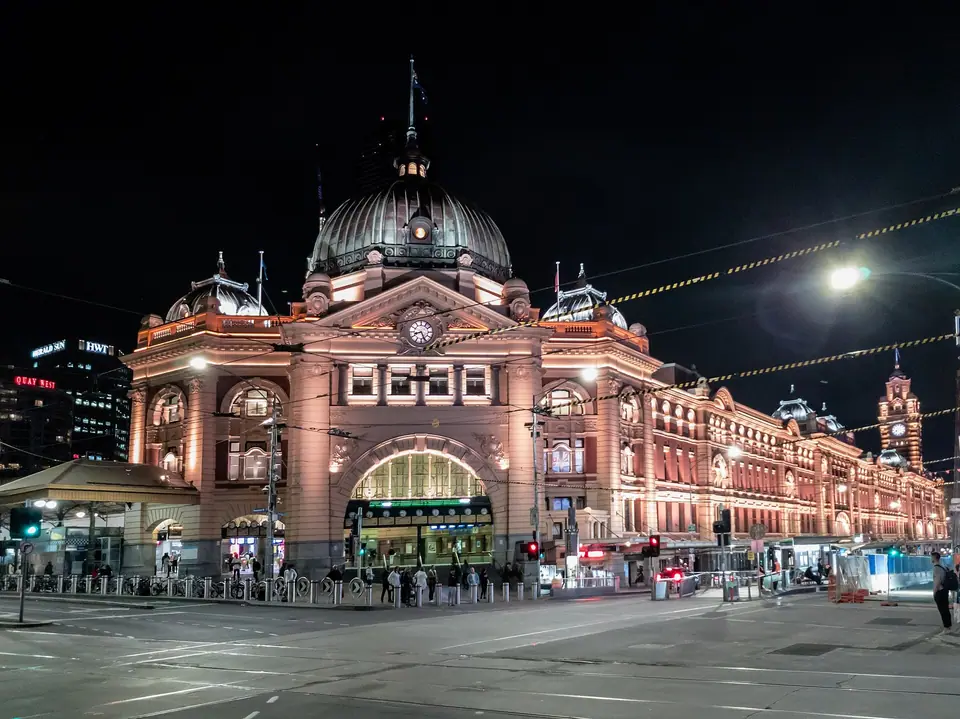
Begin on the arched corner steps of Flinders Street Railway Station. Here, Australia's first steam railway terminal opened on 12 September 1854 with a line running from Melbourne to Sandridge (now Port Melbourne). By the end of the nineteenth century, the original timber sheds could no longer handle the commuter surge. In 1899, railway architects James Fawcett and H.P.C. Ashworth won a design competition with their French Renaissance and Edwardian Baroque entry codenamed "Green Light". Built between 1905 and 1910, the yellow-and-red facade stretches an entire block from Swanston Street to Elizabeth Street. A copper-sheathed entrance dome anchors the Swanston Street corner, while a square clock tower rises at Elizabeth Street. Along the river side runs Platform 1 (connecting into Platform 14), which measures 708 metres from end to end as the longest railway platform in Australia.
Look up beneath the main corner arch to see the row of 9 analogue indicator clocks. Those clocks have inspired the universal Melbourne meeting phrase, "I'll meet you under the clocks", for more than a century. Originally operated manually by a guard using a central rod mechanism to show the next departure time on each suburban line, the clocks are now computer-driven. Before crossing Flinders Street, descend the steps on the Swanston Street concourse into Campbell Arcade, also known as the Degraves Street Subway. Built for the 1956 Melbourne Summer Olympics, this underground passage preserves salmon-pink Victorian wall tiles, black granite columns, and glass vitrine cases.
Stop 2: Degraves Street, Centre Place, St Paul's Cathedral, and Chloe
Climb the northern stairs out of Campbell Arcade and you emerge directly into Degraves Street. This pedestrian laneway pioneered Melbourne's outdoor espresso culture. Nineteenth-century brick warehouses, striped canvas awnings, and plane trees shelter outdoor tables serving flat whites, long blacks, and toasted panini. Walk one block north across Flinders Lane and the pedestrian path continues through a narrow brick canyon called Centre Place. Tiny hole-in-the-wall espresso windows, stencil art, and soup bars line the alley before it opens onto Collins Street opposite the 1892 Block Arcade.
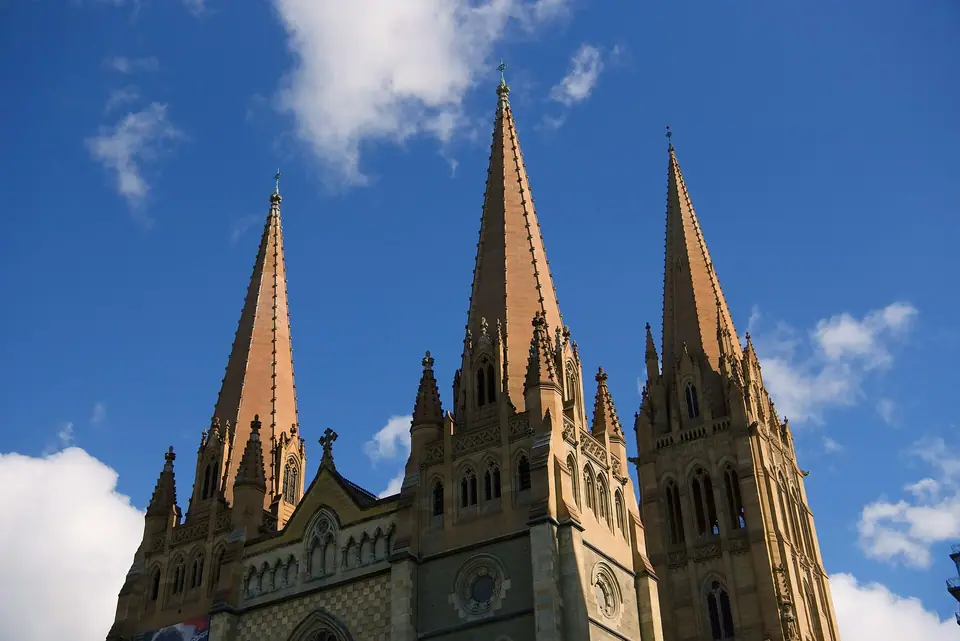
Loop back down Swanston Street to the northeast corner of the intersection to enter St Paul's Cathedral. Entry is free; check the official cathedral portal for daily service times. The Anglican cathedral occupies the site where the earliest public Christian service in Melbourne was conducted in 1836. English architect William Butterfield designed the building in the Gothic Revival style. Its foundation stone was laid in 1880 and the nave was consecrated on 22 January 1891. Sydney architect John Barr later designed the 3 spires, which were completed in 1932. The 96-metre central Moorhouse Tower spire is the second-tallest Anglican spire in the world after Salisbury Cathedral in England. Inside, English Devonshire marble columns, geometric dado tiles, and a stencilled timber ceiling frame the high altar. Directly across Swanston Street on the northwest corner stands the 1861 Young and Jackson Hotel. Upstairs in Chloe's Bar hangs Jules Joseph Lefebvre's 1875 Parisian Salon gold-medal oil painting Chloé. The painting was exhibited at the 1880 Melbourne International Exhibition in Carlton Gardens and has hung in the pub since 1909.
Stop 3: Federation Square, NGV Australia, ACMI, and the Koorie Heritage Trust
Cross Swanston Street onto the undulating ochre cobblestones of Federation Square (Fed Square). Opened in October 2002 to mark the centenary of Australian Federation, the 3.2-hectare civic plaza was designed by Lab Architecture Studio. Engineers built it atop a concrete and steel deck suspended directly over the active Jolimont railway lines. Its faceted buildings are clad in 470,000 Kimberley sandstone tiles from Western Australia, perforated zinc, and glass arranged in a mathematical pinwheel fractal pattern. Matching Western Australian sandstone cobbles pave the main open-air plaza floor. Three flagship cultural institutions inside Federation Square offer free general admission (check their official sites for special ticketed exhibitions):
- The Ian Potter Centre: NGV Australia. Occupying the eastern wing of the square, this is the world's first major public gallery dedicated exclusively to Australian art. Galleries display historic Aboriginal and Torres Strait Islander bark paintings, Hermannsburg watercolours, and desert dot paintings. You can also see nineteenth-century Heidelberg School landscapes by Tom Roberts, Arthur Streeton, and Frederick McCubbin, plus twentieth-century modernists Sidney Nolan, Albert Tucker, and Joy Hester. Pair it later with the international collection across the river at NGV International.
- ACMI (Australian Centre for the Moving Image). Reopened in 2021 after a major transformation, ACMI features the permanent underground exhibition The Story of the Moving Image. It traces shadow puppets, magic lanterns, Australian cinema, television, video art, and playable videogames. Every visitor receives a free circular "Lens" disc to tap and save favourite exhibits.
- Koorie Heritage Trust. Located inside the Yarra Building on Fed Square's riverfront terrace, the Koorie Heritage Trust celebrates the living art of the First Peoples of southeastern Australia. Visitors can browse multi-floor exhibitions, a retail design shop, and guided Birrarung Wilam Aboriginal river walks.
Stop 4: Hosier Lane, Rutledge Lane, and AC/DC Lane
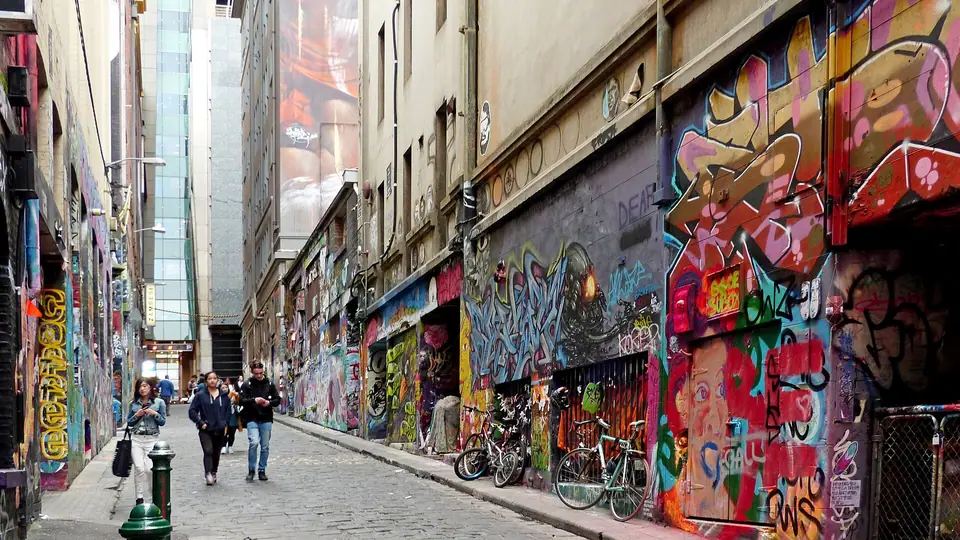
Exit Federation Square through the glass-roofed Atrium onto Flinders Street and cross at the pedestrian lights directly into Hosier Lane. Officially supported as a living urban art space since the 1998 City Lights Initiative, this steep bluestone-cobbled lane is Melbourne's most photographed street art gallery. Horseshoe-shaped Rutledge Lane branches off its western flank with painted wheelie bins and brick walls. Because aerosol artists, stencil makers, and paste-up collectives paint here daily, the murals change every week. Pause to watch artists at work, and always ask before photographing an artist's face. To finish your walk, stroll two blocks east along Flinders Lane past Exhibition Street and turn into AC/DC Lane. Renamed from Corporation Lane on 1 October 2004, it honours the Australian rock band who filmed their 1976 "It's a Long Way to the Top" video on Swanston Street. Next door in Duckboard Place, basement restaurants and wine bars sit beneath rock-and-roll murals.
Traveller tips
Real advice from people who have been to Melbourne. Every tip is read by our team before it goes live.
No tips yet. Been here? Yours could be the first.
Thank you! Your tip will appear here after a quick review.
More in Melbourne
Continue exploring Melbourne with related neighbourhood, food, and planning guides
Melbourne 3-Day Itinerary: Hoddle Grid Laneways, Southbank Arts, MCG & Great Ocean Road
Melbourne, Australia
Block Arcade, Royal Arcade, Bourke Street Mall, Chinatown & State Library Walk
Melbourne, Australia
Royal Exhibition Building, UNESCO Carlton Gardens, Melbourne Museum & Lygon Street
Melbourne, Australia
NGV International, Southbank Arts Precinct, Shrine of Remembrance & Botanic Gardens
Melbourne, Australia
