


























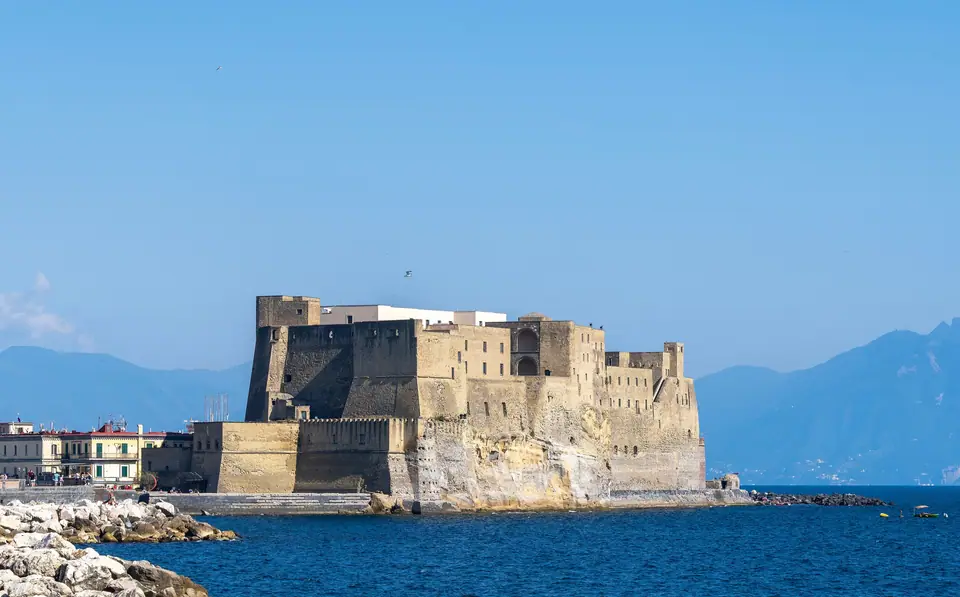
Castel dell'Ovo and the Lungomare: Megaride islet, Borgo Marinari and Via Partenope
Stroll the traffic-free seaside promenade of Via Partenope and Via Caracciolo past the Fountain of the Giant to the medieval ramparts of Castel dell'Ovo and the harbour village of Borgo Marinari.
After hours spent inside the shaded stone canyons of the Centro Storico, stepping out onto the Lungomare reveals the wide horizontal sweep of the Bay of Naples. Stretching for roughly three kilometres from the headland of Santa Lucia past the tuff islet of Castel dell'Ovo and the palm gardens of the Villa Comunale to the yacht basin of Mergellina, this waterfront promenade offers uninterrupted views of Mount Vesuvius, the Sorrentine Peninsula, the island of Capri, and the volcanic headland of Posillipo.
The islet of Megaride and the history of Castel dell'Ovo
Connected to the mainland promenade of Via Partenope by a 100-metre stone causeway, the small yellow-tufa islet of Megaride is the oldest inhabited spot in Naples. Greek sailors from Cumae established their earliest trading post here in the eighth century BC before founding Parthenope on the facing bluff of Monte Echia (Pizzofalcone), and classical myth identified the rocky shore as the spot where the siren Parthenope washed ashore after failing to enchant Odysseus with her song. In the first century BC, the wealthy Roman general and gourmet Lucius Licinius Lucullus built a vast seaside villa (the Castrum Lucullanum) stretching across the islet and Monte Echia, complete with saltwater fishponds and libraries. Wait five centuries and this same fortified villa became the scene of the end of the Western Roman Empire in AD 476, when the Germanic ruler Odoacer exiled the teenage last Western Emperor, Romulus Augustulus, to the Castrum Lucullanum.
In the twelfth century, the Normans under King Roger II fortified the islet as their royal seat (Castellum Salvatoris ad Mare), and Emperor Frederick II of Swabia expanded its towers in 1222 as a royal treasury and state prison before King Charles I of Anjou shifted the court to Castel Nuovo. The castle's popular name, Castel dell'Ovo ("Egg Castle"), comes from a fourteenth-century Neapolitan legend surrounding the Roman poet Virgil, whom medieval folklore revered as a benevolent magician: Virgil was said to have placed a magical egg inside a glass carafe protected by an iron cage in the castle's subterranean vaults, decreeing that as long as the egg remained unbroken, both the fortress and the city of Naples would be spared catastrophe.
Borgo Marinari and the Fountain of the Giant
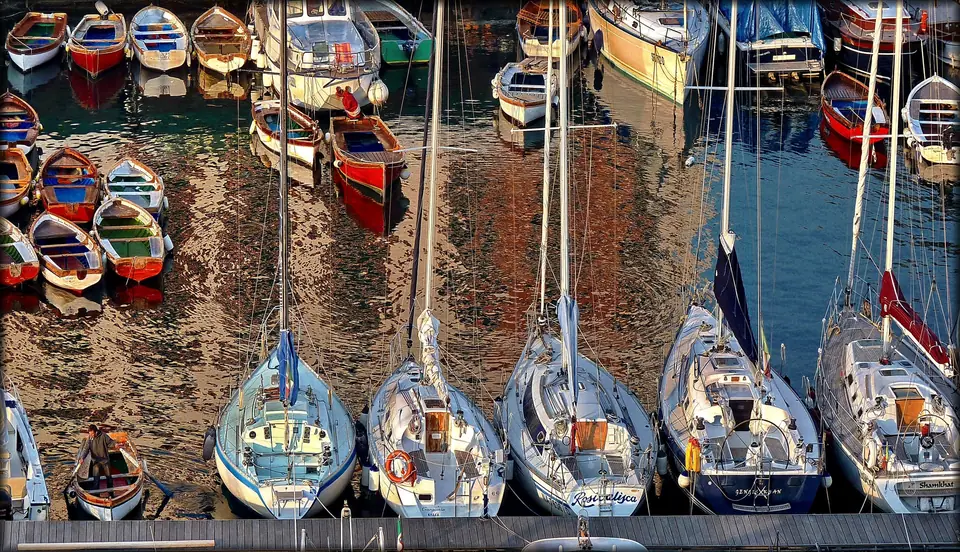
At the base of Castel dell'Ovo's eastern bastion lies Borgo Marinari, a compact two-block maritime hamlet constructed on reclaimed land in the late nineteenth century around a sheltered harbour basin. Once a smuggling cove and fishermen's settlement, its low two-storey houses now surround the historic yacht clubs of the Reale Yacht Club Canottieri Savoia and the Circolo del Remo e della Vela Italia, alongside open-air seafood trattorias serving spaghetti with clams (spaghetti alle vongole) and fried Gulf anchovies.
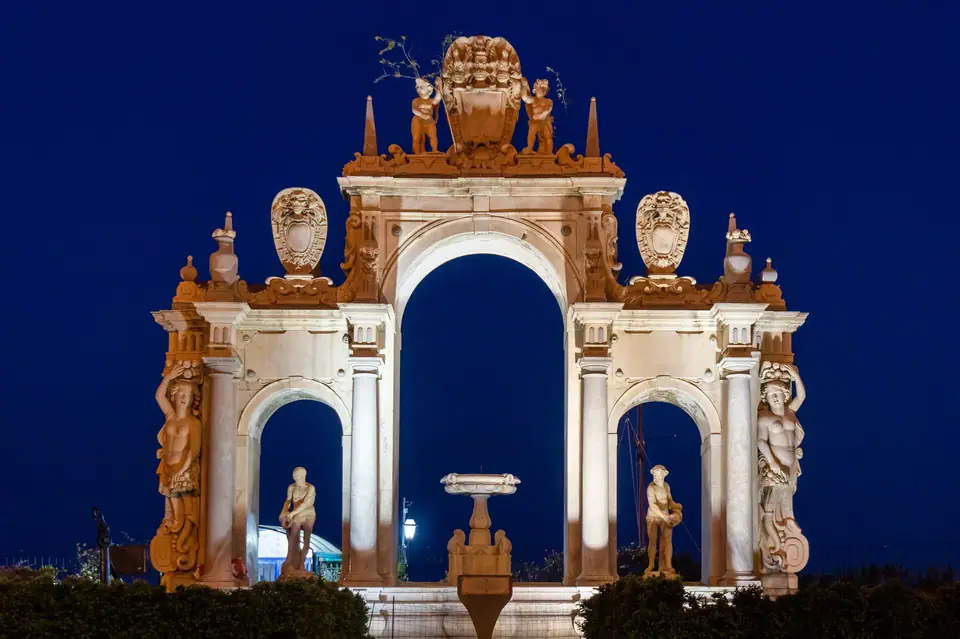
Where the castle causeway meets the mainland at the corner of Via Nazario Sauro and Via Partenope stands the Fontana del Gigante (also called the Fontana dell'Immacolatella). Commissioned in the early seventeenth century by the Duke of Alba from sculptors Michelangelo Naccherino and Pietro Bernini (father of Gian Lorenzo Bernini), the tripartite white marble arch featuring river gods and sea monsters originally stood outside the Royal Palace of Naples beside a colossal ancient statue of Jupiter (the "Giant"), before being moved several times and finally installed beside the sea in 1905.
Walking from Via Partenope to the Villa Comunale and Mergellina
Walking west from Castel dell'Ovo along pedestrianised Via Partenope brings you to Piazza Vittoria and the eastern gates of the Villa Comunale. Laid out in the 1780s by Carlo Vanvitelli for King Ferdinand IV as a royal promenade along the beach (Real Passeggio di Chiaia) and widened in the late nineteenth century when the wide seaside carriageway of Via Francesco Caracciolo was reclaimed from the sea, the park shelters the nineteenth-century Stazione Zoologica Anton Dohrn (founded in 1872 by German Darwinist biologist Anton Dohrn, housing Europe's oldest continuously operating public research aquarium) and the neoclassical Casina Pompeiana. Follow the curving stone sea wall further west to Mergellina, where locals gather at evening chalets for taralli and coffee before riding the Mergellina Funicular or Metro Line 2 back toward the centre.
Traveller tips
Real advice from people who have been to Castel dell'Ovo and the Lungomare: Megaride islet, Borgo Marinari and Via Partenope. Every tip is read by our team before it goes live.
No tips yet. Been here? Yours could be the first.
Thank you! Your tip will appear here after a quick review.
More in Naples
Continue exploring Naples with related neighbourhood, food, and planning guides

Spaccanapoli and the Centro Storico: walking the ancient Greek-Roman grid
Naples, Italy
Cappella Sansevero and Duomo di Napoli: the Veiled Christ and San Gennaro
Naples, Italy

National Archaeological Museum (MANN) and Capodimonte: Farnese and Roman treasures
Naples, Italy
Piazza del Plebiscito and Royal Palace: San Carlo, Galleria Umberto and Castel Nuovo
Naples, Italy
