


























Piazza del Plebiscito and Royal Palace: San Carlo, Galleria Umberto and Castel Nuovo
Explore the monumental civic heart of Naples around Piazza del Plebiscito: the Royal Palace of Naples, the neoclassical Basilica of San Francesco di Paola, Teatro di San Carlo, Galleria Umberto I, and medieval Castel Nuovo.
Where the narrow medieval lanes of the Centro Storico and the Quartieri Spagnoli meet the southern end of Via Toledo, the urban fabric of Naples suddenly opens into grand royal squares, sweeping Doric colonnades, glass-vaulted shopping arcades, and fortified harbour castles. This is the Monumental Centre, shaped sequentially by Angevin kings, Aragonese humanists, Spanish viceroys, and Bourbon monarchs.
Piazza del Plebiscito and the Basilica of San Francesco di Paola
Covering roughly 25,000 square metres, pedestrianised Piazza del Plebiscito takes its name from the plebiscite of 21 October 1860 that unified the Kingdom of the Two Sicilies with the Kingdom of Italy under the House of Savoy. Originally an irregular open space known as the Largo di Palazzo used for Spanish viceregal tournaments and festivals, it was reshaped in the early nineteenth century when Napoleonic King Joachim Murat commissioned Leopoldo Laperuta to erect a semicircular Doric colonnade. After the Bourbon restoration in 1815, King Ferdinand I commissioned Ticinese architect Pietro Bianchi (between 1816 and 1846) to crown the centre of the colonnade with the neoclassical Basilica of San Francesco di Paola, whose circular Pantheon-inspired dome rises 53 metres high behind an Ionic portico. In front of the church stand two bronze equestrian statues cast by Antonio Canova and his workshop depicting Charles III of Bourbon and Ferdinand I.
The Royal Palace of Naples (Palazzo Reale)
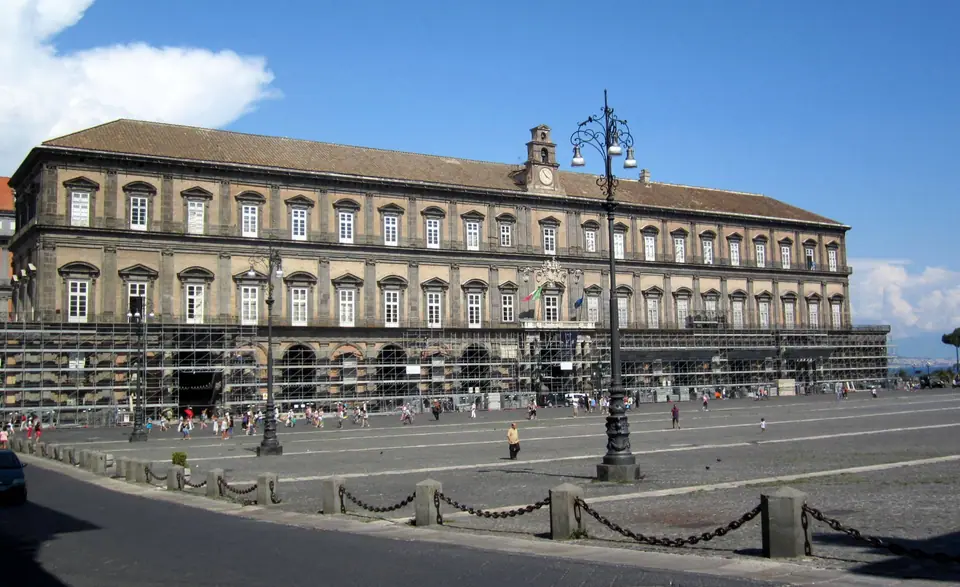
Framing the entire eastern side of Piazza del Plebiscito with a 169-metre-long facade, the Royal Palace of Naples was commissioned in 1600 by Spanish Viceroy Fernando Ruiz de Castro, Count of Lemos, from architect Domenico Fontana in anticipation of a state visit by King Philip III of Spain. Transformed in 1734 into the principal seat of the Bourbon kings of Naples and remodelled in the 1830s and 1840s by Gaetano Genovese after a fire, the palace is famous for two exterior and interior highlights:
- The Eight Kings on the Facade: In 1888, King Umberto I of Savoy ordered eight monumental marble statues placed inside the ground-floor niches of the facade (originally bricked up to strengthen the structure) to represent the eight dynasties that had ruled Naples since the twelfth century: Roger the Norman, Frederick II of Swabia, Charles I of Anjou, Alfonso V of Aragon, Emperor Charles V, Charles III of Bourbon, Joachim Murat, and Victor Emmanuel II of Savoy.
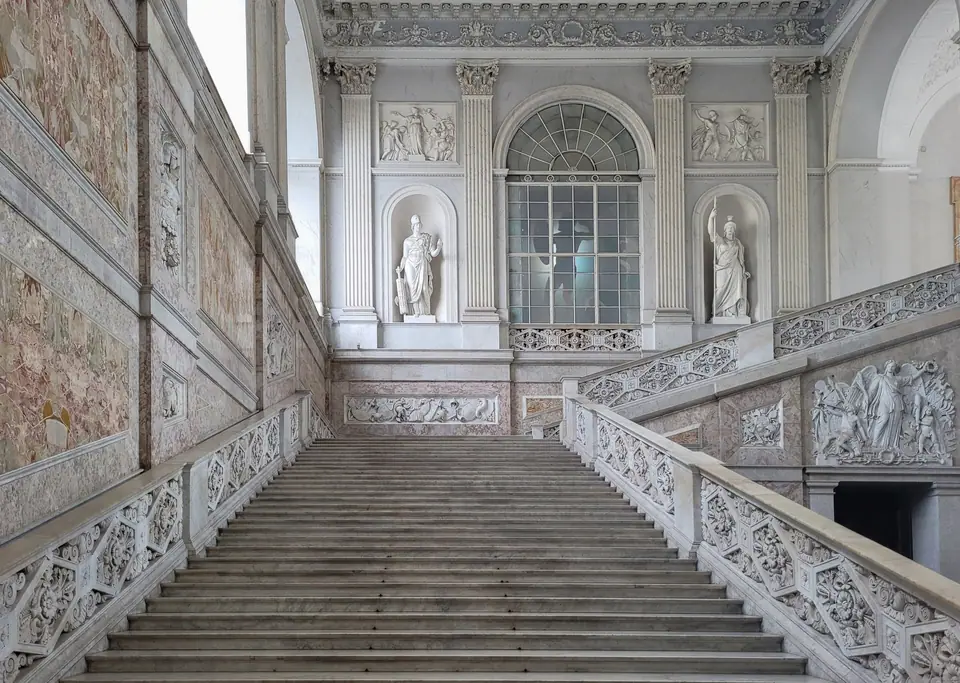
- The Grand Staircase of Honour and Historic Apartments: Ascending Francesco Antonio Picchiatti's 1651 double-ramp marble staircase (Scalone d'Onore, praised by Montesquieu as the finest in Europe), visitors tour thirty state rooms including the Court Theatre (built in 1768 by Ferdinando Fuga for the wedding of Ferdinand IV and Maria Carolina of Austria), the neoclassical Throne Room, the Hall of Hercules, and the Hanging Garden overlooking the Bay of Naples and Mount Vesuvius.
Teatro di San Carlo, Galleria Umberto I, and Caffè Gambrinus
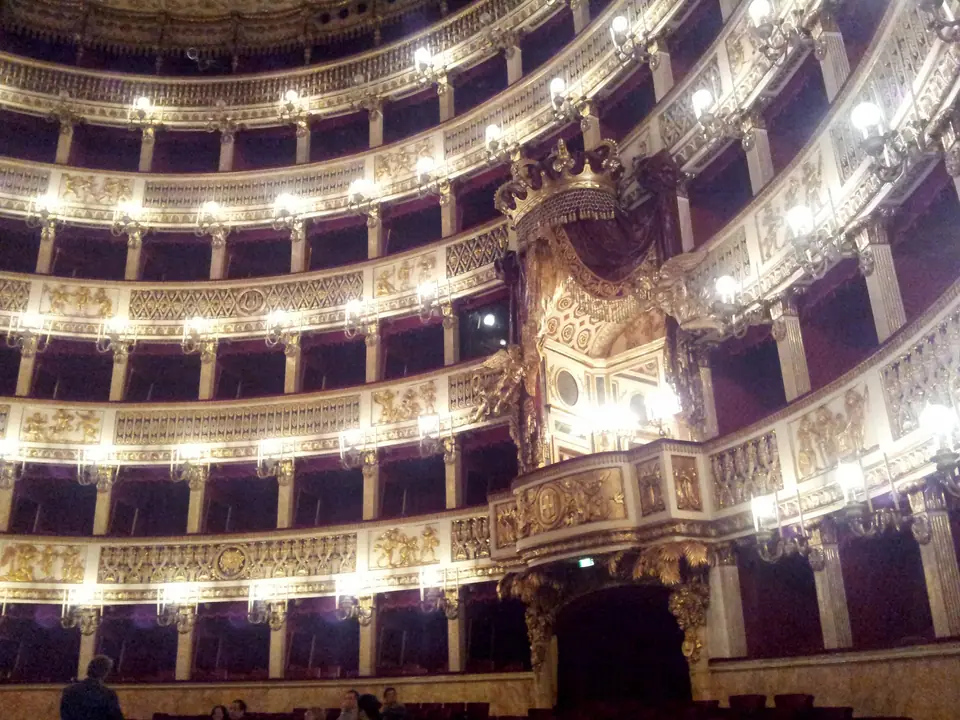
Adjoining the northern wing of the Royal Palace on Via San Carlo stands the Real Teatro di San Carlo. Commissioned by King Charles VII of Bourbon to replace the dilapidated Teatro San Bartolomeo and designed by Giovanni Antonio Medrano and Angelo Carasale, the opera house was inaugurated on 4 November 1737 (the king's name day) with Domenico Sarro's Achille in Sciro, making it the oldest continuously active venue for public opera in the world (predating Milan's La Scala by forty-one years and Venice's La Fenice by fifty-five years). Rebuilt in just nine months by Antonio Niccolini after a fire in February 1816, its six-tier gilded horseshoe auditorium and Giuseppe Cammarano's ceiling canvas of Apollo Presenting Minerva to the Poets can be visited on official guided tours.
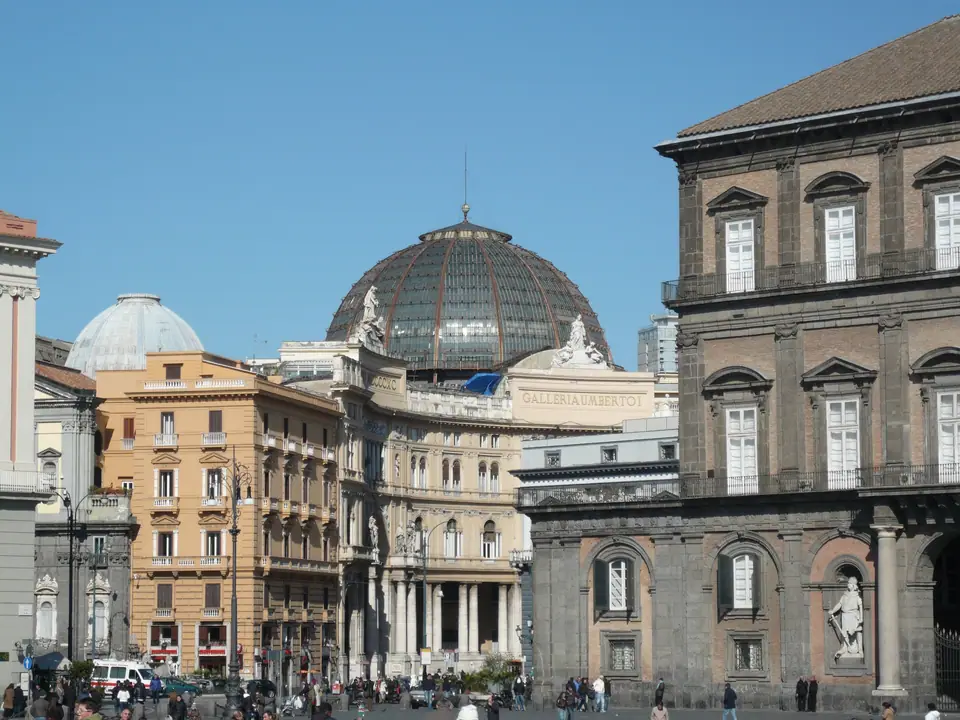
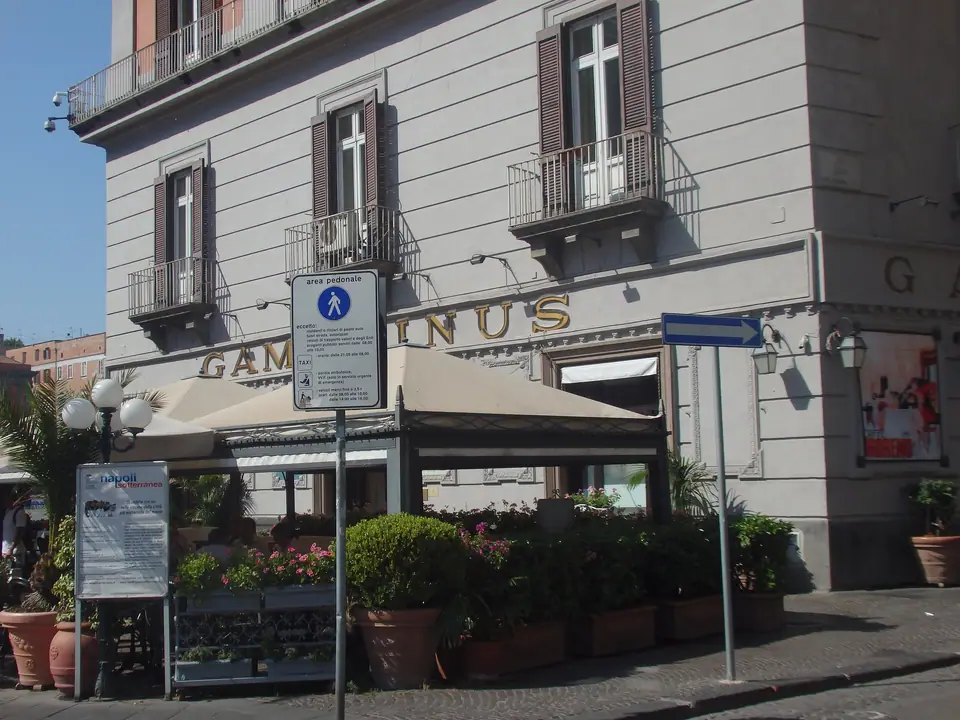
Directly across Via San Carlo rises the monumental glass-and-iron cross vault of Galleria Umberto I, built between 1887 and 1890 to designs by Emanuele Rocco, Antonio Curri, and Ernesto di Mauro as the cornerstone of the post-unification Risanamento urban renewal project; beneath its 56-metre-high central glass dome, a marble mosaic compass rose inlaid with the twelve signs of the zodiac marks the floor. At the corner where Via Chiaia meets Piazza Trieste e Trento, historic Gran Caffè Gambrinus (founded in 1860 and decorated in the 1890s with Belle Époque stuccoes and canvases by Neapolitan painters) remains a classic stop for standing at the marble counter with an espresso and sfogliatella, where locals still practice the tradition of caffè sospeso (paying in advance for a second cup of coffee for someone in need).
Castel Nuovo (Maschio Angioino)
Completing the monumental precinct toward the Molo Beverello ferry port, the moated five-towered fortress of Castel Nuovo (popularly known as the Maschio Angioino) was begun in 1279 by King Charles I of Anjou after he moved the royal capital from Palermo to Naples. After Alfonso V of Aragon conquered Naples in 1442, he rebuilt the dark volcanic piperno towers with round rusticated bastions and commissioned Francesco Laurana and a team of sculptors between 1452 and 1471 to wedge a two-storey white marble Renaissance Triumphal Arch between the western entrance towers, celebrating Alfonso's entry on 26 February 1443. Inside the courtyard, the Gothic Palatine Chapel of Santa Barbara stands beside the vaulted Barons' Hall (Sala dei Baroni), designed by Guillem Sagrera with an octagonal star-ribbed vault where King Ferrante I arrested rebellious barons in 1486.
Traveller tips
Real advice from people who have been to Piazza del Plebiscito and Royal Palace: San Carlo, Galleria Umberto and Castel Nuovo. Every tip is read by our team before it goes live.
No tips yet. Been here? Yours could be the first.
Thank you! Your tip will appear here after a quick review.
More in Naples
Continue exploring Naples with related neighbourhood, food, and planning guides
Getting around Naples: Metro Line 1 Art Stations, funiculars and Circumvesuviana
Naples, Italy
Spaccanapoli and the Centro Storico: walking the ancient Greek-Roman grid
Naples, Italy
Cappella Sansevero and Duomo di Napoli: the Veiled Christ and San Gennaro
Naples, Italy
National Archaeological Museum (MANN) and Capodimonte: Farnese and Roman treasures
Naples, Italy
