





















City of Arts and Sciences Guide: Calatrava's Palau de les Arts, Hemisfèric, Science Museum & Oceanogràfic
Explore Valencia's two-kilometre City of Arts and Sciences: Santiago Calatrava's Palau de les Arts, Hemisfèric, Science Museum, Umbracle, CaixaForum, and Félix Candela's Oceanogràfic.
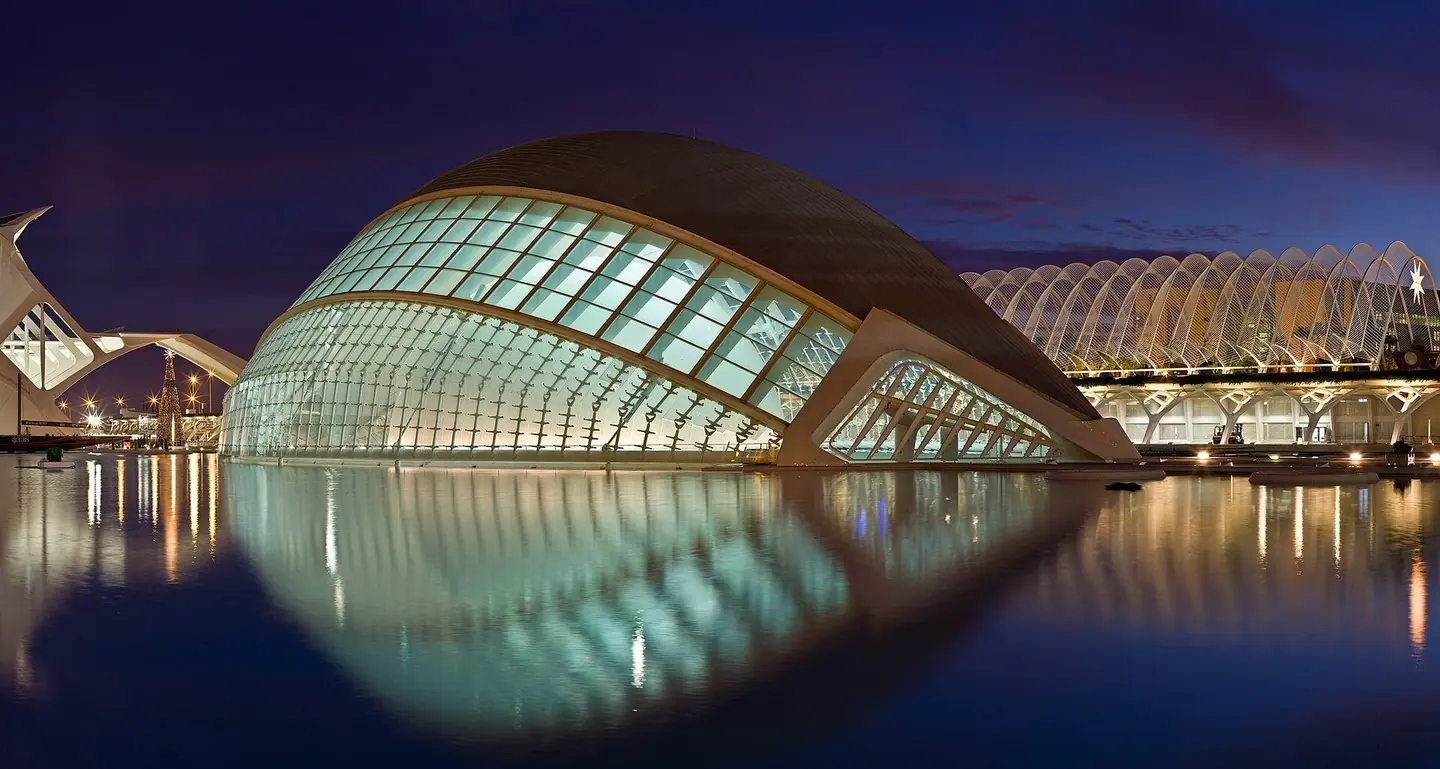
The City of Arts and Sciences (Ciutat de les Arts i les Ciències) stretches two kilometres across the former mouth of the Turia riverbed. It stands today as a landmark of contemporary European civic architecture. Valencian architect and structural engineer Santiago Calatrava (born in nearby Benimàmet in 1951) designed the complex. Thin-shell concrete pioneer Félix Candela (1910 to 1997) created the parabolic roofs at the Oceanogràfic. The 350,000-square-metre ensemble opened in stages between April 1998 and 2009. Across the sunken park, organic white concrete skeletons inspired by whale ribcages, human eyes, and water lilies rise out of shallow turquoise reflecting pools. Millions of broken white and cobalt trencadís ceramic mosaic shards catch the Mediterranean sun across every facade.
Walking the complex west to east: the six Calatrava structures
Even before buying an interior museum ticket, visitors can explore the entire exterior promenade free of charge 24 hours a day. The palm-shaded elevated gardens of the Umbracle and the surrounding reflecting pools also require no ticket. Walking from northwest to southeast along the dry riverbed reveals six structures in sequence:
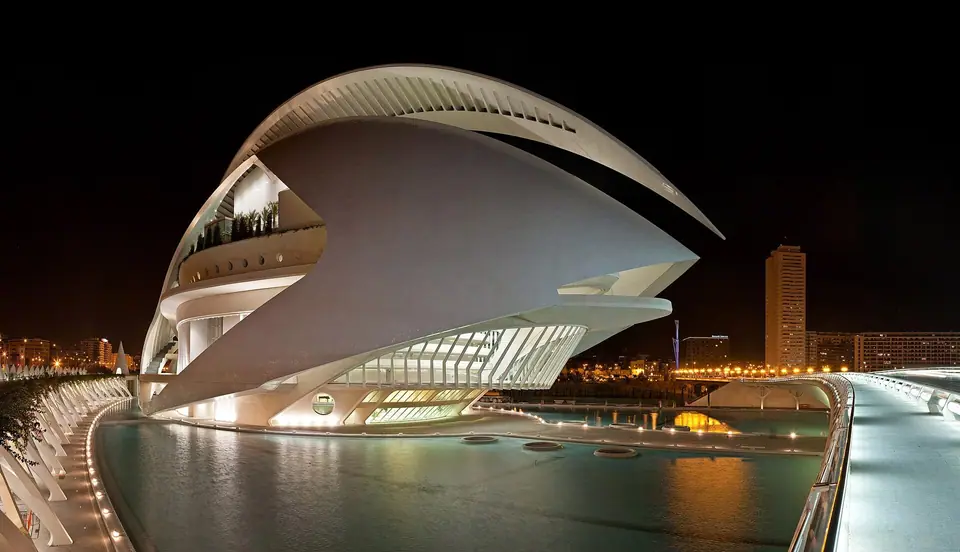
- Palau de les Arts Reina Sofía (Inaugurated October 2005). Anchoring the western head of the complex, Valencia's opera house and performing-arts centre rises 75 metres high across 14 levels (three underground) and 40,000 square metres. Two curved white concrete shells wrap the building beneath a 230-metre-long metallic feather plume cantilevered from a single western support point. Four performance halls sit inside the shell. The 1,412-seat Sala Principal opera auditorium is clad in blue ceramic mosaic, while the 400-seat Aula Magistral hosts chamber recitals. Above and below sit the 1,420-seat acoustic Auditori and the 400-seat underground Teatre Martín i Soler. Panoramic lifts and suspended walkways connect the planting terraces inside the shell. Guided architectural tours enter the auditoria on non-rehearsal days; check the official Les Arts website for schedules.
- L'Hemisfèric (Inaugurated 16 April 1998). The first building of the complex to open represents a colossal human eye of wisdom reflected into a full sphere inside its 24,000-square-metre pool. Beneath a 100-metre ovoid roof with moving aluminium brise-soleil eyelids sits a 24-metre-diameter inner sphere. It houses a 900-square-metre concave screen for 3D IMAX cinema, digital planetarium projections, and Fulldome astronomical shows. Every seat includes multi-language audio headsets.
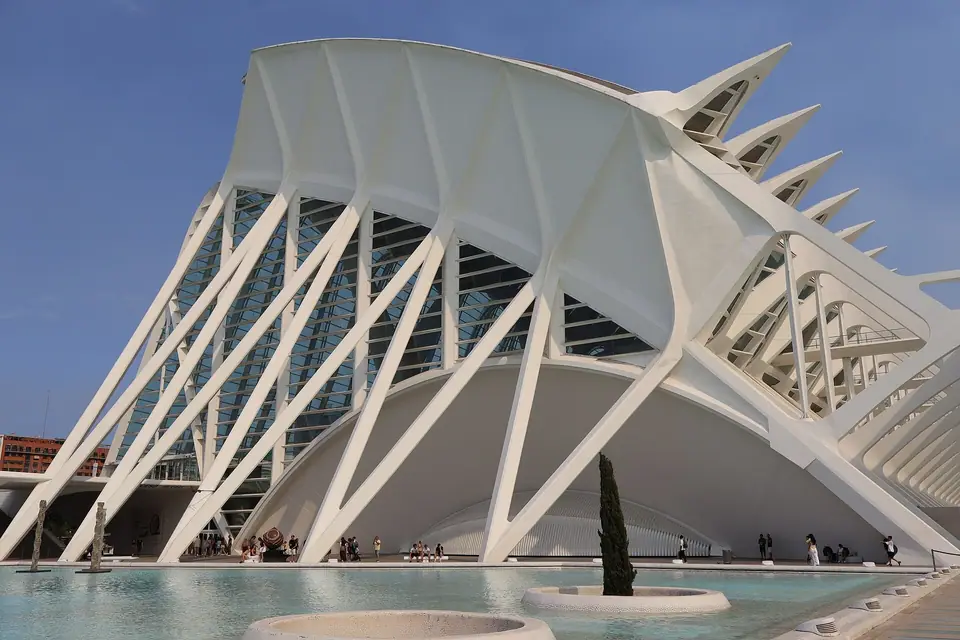
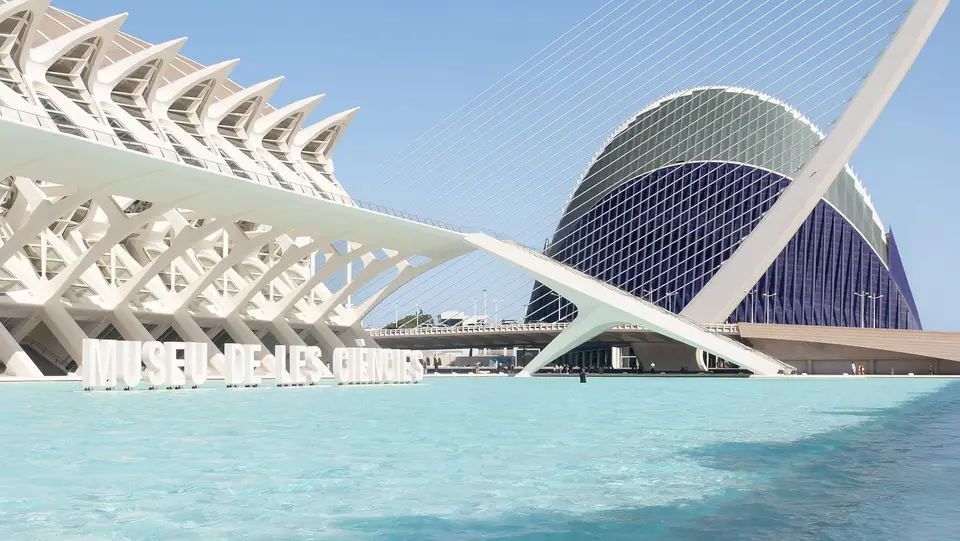
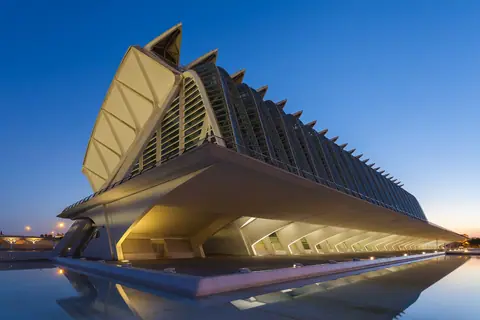
- Museu de les Ciències Príncipe Felipe (Inaugurated November 2000). Modelled on the repeating ribs of a prehistoric whale skeleton, this three-floor interactive science museum covers 42,000 square metres. The concrete-and-glass hall stretches 220 metres long, 80 metres wide, and 55 metres high. Its northern facade uses 4,000 glass panes while the southern wall filters strong Mediterranean sunlight. Outside in the north colonnade, visitors test the 30-metre acoustic echo arches. Standing at opposite columns 30 metres apart lets two people whisper clearly along the concrete curve. Inside hang the 34-metre Foucault Pendulum and a 15-metre DNA double-helix sculpture beside interactive space, zero-gravity, and human biology galleries. On the ground floor, the free Calle Menor promenade displays temporary scientific installations, restrooms, and café terraces.
- L'Umbracle (2001). Running parallel to the Science Museum along the southern rim rises a 320-metre-long, 60-metre-wide elevated botanical promenade. Fifty-five fixed and 54 floating white parabolic arches reach 18 metres high above indigenous Valencian palms, rosemary, lavender, bougainvillea, and bitter orange trees. It incorporates the open-air Paseo del Arte sculpture walk and the interactive Astronomy Garden. The upper terrace delivers the finest elevated photography angle over the entire complex at sunset and stays open free of charge during the day.
- Pont de l'Assut de l'Or (2008). Immediately east of the Science Museum soars Calatrava's white single-pylon cable-stayed bridge. Its curved 125-metre-tall lightning-rod mast is the highest structural point in the city of Valencia, supporting a 180-metre deck with 29 front cables. Pedestrians and cyclists cross dedicated lanes between the museum pools and the Ágora plaza.
- L'Àgora / CaixaForum València (2009 / June 2022). Beneath a 70-metre-tall metallic blue rib structure clad in ceramic trencadís tiles, architect Enric Ruiz-Geli designed the organic interior of CaixaForum València. Opened in June 2022 across 6,500 square metres, it holds two major fine-art exhibition halls and a vertical garden auditorium. Visitors can also browse the design bookshop and walk the ground-floor architectural plaza without a ticket.
L'Oceanogràfic (2003): Europe's largest marine complex and Félix Candela's roofs
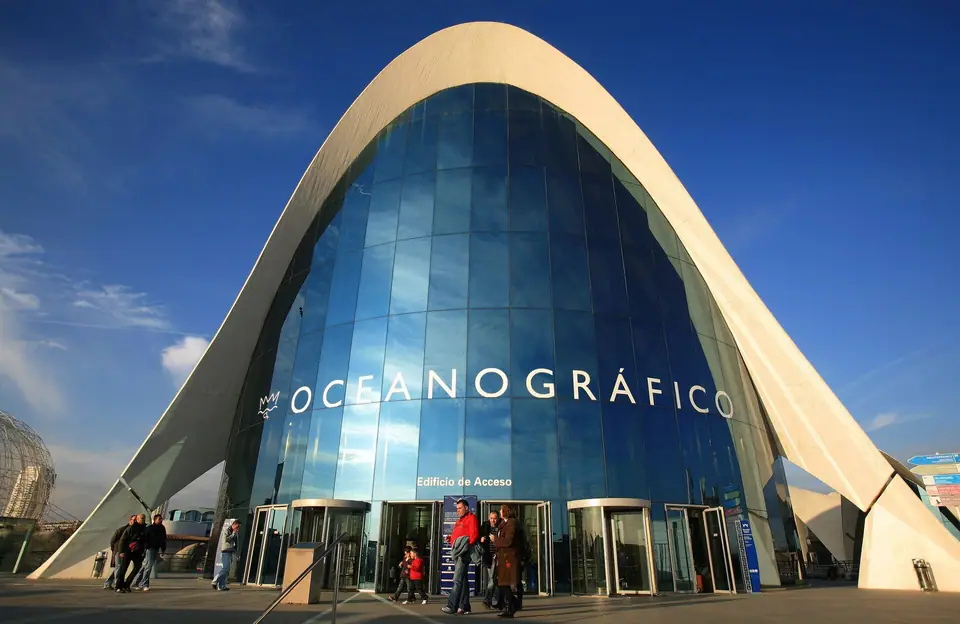
At the eastern end of the site stands L'Oceanogràfic, inaugurated on 14 February 2003 as the largest aquarium and marine park in Europe. The park spans 110,000 square metres and holds 42 million litres of salt water pumped from the coast of La Malvarrosa. It represents the final architectural work of Félix Candela. He designed its two thin-shell concrete hyperbolic paraboloid (hypar) roofs shaped like giant white water lilies (nenúfares) over the entrance lobby and restaurant.
Allow at least three to four hours to explore its nine marine ecosystems, which shelter 45,000 animals across 500 species. Highlights include the 70-metre-long underwater acrylic tunnel inside the Oceans tank. Sand tiger sharks, nurse sharks, and eagle rays swim overhead across 7 million litres of water. Nearby stand the igloo-domed Arctic pavilion (home to resident beluga whales) and the Antarctic gentoo penguin colony. A 26-metre spherical aviary holds scarlet ibises and roseate spoonbills beside Mediterranean mangrove wetlands and the 1,500-seat Dolphinarium focused on marine conservation. Combined tickets pairing the Oceanogràfic, Science Museum, and a timed Hemisfèric projection can be booked online via the official CAC portal. Return after sunset to see the white concrete arches illuminated in gold and blue across the mirror-calm pools. Arrive on Metrovalencia Tram Line 10 at the Ciutat Arts i Ciències or Oceanogràfic stops. You can also ride EMT Buses 35 and 95 or cycle through the Turia Gardens.
Traveller tips
Real advice from people who have been to Valencia. Every tip is read by our team before it goes live.
No tips yet. Been here? Yours could be the first.
Thank you! Your tip will appear here after a quick review.
More in Valencia
Continue exploring Valencia with related neighbourhood, food, and planning guides

What to Eat in Valencia: Wood-Fired Paella Valenciana, Arroz a Banda, Horchata de Chufa, Fartons & Agua de Valencia
Valencia, Spain
Valencia Orientation: Ciutat Vella, the 9 km Turia Gardens, City of Arts and Sciences & Bilingual Valencian Signs
Valencia, Spain
Best Things to Do in Valencia: City of Arts and Sciences, UNESCO Silk Exchange, Central Market, Turia & Paella
Valencia, Spain
Arriving in Valencia: Manises Airport (VLC) Metro Lines 3 & 5, Joaquín Sorolla AVE High-Speed Rail & Valenbisi
Valencia, Spain
