The Prater, Giant Ferris Wheel and the Danube Island
The 1897 Giant Ferris Wheel, the former imperial hunting grounds and how Vienna's three waterways fit together.
Two things surprise first-time visitors looking for the river in Vienna: first, that the famous "Prater" is both a vintage funfair and six square kilometres of peaceful woodland, and second, that the Danube does not actually run through the historic centre. Understanding both gives you the best outdoor escapes in the city.
The Riesenrad and the Wurstelprater
Directly outside the Praterstern station (U1, U2 and S-Bahn) in the 2nd district sits the Wurstelprater amusement park. Entry to the grounds is free; you pay individually at each ride. Its landmark is the Wiener Riesenrad, the 65-metre Giant Ferris Wheel built in 1897 by British engineer Walter Bassett to mark Emperor Franz Joseph's Golden Jubilee and immortalised in Carol Reed's 1949 postwar noir The Third Man, when Orson Welles's Harry Lime delivers his cuckoo-clock speech from one of the red wooden cabins.
Only 15 of the original 30 cabins were rehung after the wheel burned in 1945, giving it its distinctive spaced-out silhouette. One slow rotation takes about 15 minutes and gives a clear view north-east toward the Danube and south-west to St Stephen's Cathedral. Book a ticket online if you come on a sunny weekend afternoon, or go in the evening when the park lights come on.
The green Prater and its beer gardens
Walk past the roller coasters and you enter the Grüner Prater, a floodplain forest that served as the private hunting reserve of the Habsburgs until Emperor Joseph II opened it to the public in 1766. Through its middle runs the Hauptallee, a dead-straight, four-kilometre chestnut avenue closed to cars (and the flat course where Eliud Kipchoge ran the first sub-two-hour marathon in 2019). Just off the funfair edge sits the Schweizerhaus beer garden, open from mid-March to the end of October, where waiters carry trays of cold Czech Budvar and huge crispy roast pork knuckles (Stelze) enough for two or three people to share.
Three waterways: Donaukanal, Alte Donau and Donauinsel
To prevent catastrophic floods, engineers re-channelled the Danube in the 1870s and again in the 1970s, leaving Vienna with three distinct bodies of water:
- The Donaukanal (Danube Canal): the narrow branch that borders the northern edge of the Innere Stadt at Schwedenplatz. Its concrete walls are legal graffiti galleries, and in summer its banks fill with deckchair bars and the Badeschiff pool boat.
- The Donauinsel (Danube Island): a 21-kilometre artificial island between the main river and the New Danube flood channel (U1 to Donauinsel), lined with cycle paths, swimming ladders and free bathing coves.
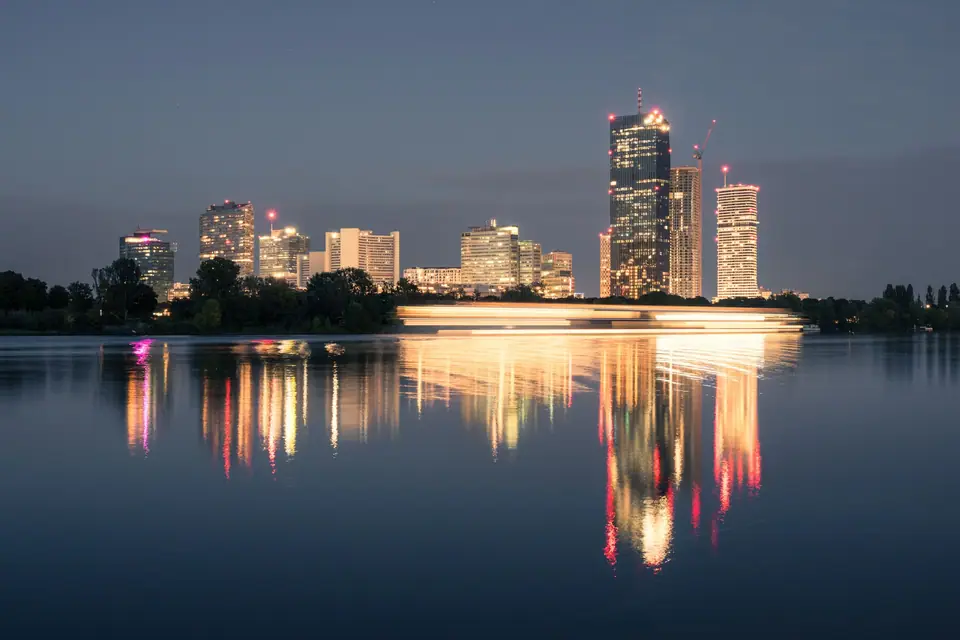
- The Alte Donau (Old Danube): a calm, cut-off oxbow lake one stop further on U1 (Alte Donau station), with clear water, wooden lidos (Strandbäder), rowing and electric boat hire, and waterside restaurants looking across to the modern towers of Donau City.
Traveller tips
Real advice from people who have been to The Prater, Giant Ferris Wheel and the Danube Island. Every tip is read by our team before it goes live.
No tips yet. Been here? Yours could be the first.
Thank you! Your tip will appear here after a quick review.
More in Vienna
Continue exploring Vienna with related neighbourhood, food, and planning guides