The Spanish Riding School: Lipizzaner Performances and Morning Exercise
How to see the white Lipizzaner stallions in the Baroque Winter Riding School hall, with or without a performance ticket.
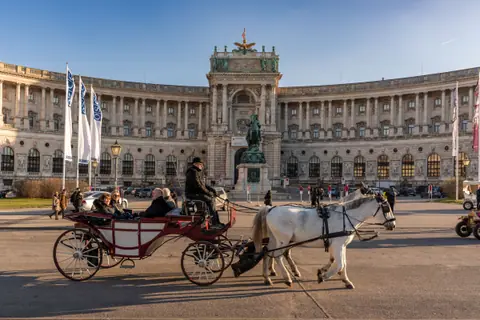
Founded in 1565 and named after the Spanish horses imported by the Habsburgs to establish their stud at Lipica (in modern Slovenia), the Spanish Riding School (Spanische Hofreitschule) is the only institution in the world that has practised classical haute école dressage continuously since the Renaissance. It sits inside the Hofburg complex between Michaelerplatz and Josefsplatz, and there are three very different ways to visit.
Full performance or morning exercise?
- The Gala Performances: held mostly on Saturday and Sunday mornings (plus selected Friday evenings), lasting 70 to 90 minutes. Riders wear the traditional brown tailcoat, bicorne hat and white buckskin breeches, and the fully trained white stallions perform the choreographed Pas de Deux, the Eight-Horse Quadrille and the airborne jumps above the ground known as the capriole, courbette and levade.
- Morning Exercise (Morgenarbeit): held on most weekday mornings from Tuesday to Friday. For an hour, riders exercise groups of young grey stallions and older white stallions to recorded classical music, working on relaxation and everyday movements rather than the high jumps (to protect the horses' joints). It costs a fraction of a gala ticket and lets you admire the hall without booking months in advance.
- Guided Tours: afternoon architectural and backstage tours take you into the Winter Riding School hall and across Reitschulgasse to the 16th-century Renaissance courtyard of the Stallburg, where the stallions live in their stables.
The Winter Riding School hall
Even visitors with little interest in equestrian sport are struck by the room itself. Built between 1729 and 1735 by Joseph Emanuel Fischer von Erlach, the Winter Riding School is a high white Baroque hall ringed by 46 Corinthian columns supporting two levels of viewing galleries, lit by crystal chandeliers. Because the floor is deep sand and sawdust, the room is quiet except for the music and the soft thud of hooves. At the end of the hall hangs a portrait of Emperor Charles VI, who commissioned the building; riders still salute the portrait by raising their bicorne hats whenever they enter the arena.
Booking and seating tips
Performance tickets sell out weeks or months ahead; book directly on the official Spanish Riding School website (srs.at). The hall offers seated places in the first and second galleries and along the short end, plus cheaper standing room in the side galleries. In the standing sections, only the front row at the balustrade has a clear view of the arena floor directly below, so arrive when the doors open if you hold a standing ticket. Photography and filming are strictly forbidden during both performances and morning exercise, as camera flashes startle the stallions. In July and August the horses leave Vienna for their summer holiday in the hills, so check the calendar in our seasonal guide before planning a summer visit.
Traveller tips
Real advice from people who have been to The Spanish Riding School: Lipizzaner Performances and Morning Exercise. Every tip is read by our team before it goes live.
No tips yet. Been here? Yours could be the first.
Thank you! Your tip will appear here after a quick review.
More in Vienna
Continue exploring Vienna with related neighbourhood, food, and planning guides