The Ringstrasse and Otto Wagner's Vienna
A route around the grand 19th-century boulevard and the Art Nouveau buildings that rebelled against it.
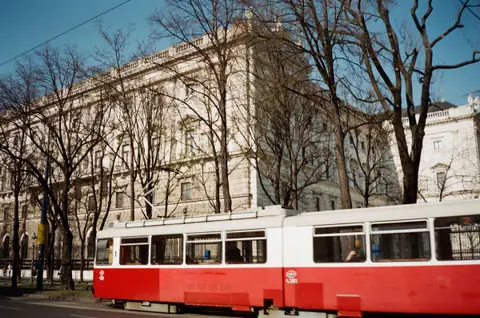
In 1857 Emperor Franz Joseph ordered the demolition of the medieval walls and grassy glacis that still separated the Innere Stadt from the suburbs. In their place rose the Ringstrasse, a tree-lined horseshoe boulevard five kilometres long where the empire and its wealthy industrialists built every civic institution in a different historical costume: neo-Gothic for the city hall, Greek classical for parliament, Italian Renaissance for the museums and university. A generation later, Gustav Klimt, Josef Hoffmann and architect Otto Wagner rebelled against all those borrowed styles and invented Viennese Modernism (Jugendstil) on the very same streets. You can walk this route in half a day, or hop along it using trams 1 and 2.
- The Vienna State Opera. Start at Opernring. Opened in 1869 as the first major public building on the new boulevard, its neo-Renaissance arches set the tone for the rest of the Ring; see our opera guide for how to step inside.
- The Secession Building and Karlsplatz Pavilions. Step just outside the Ring toward Karlsplatz. Joseph Maria Olbrich's white 1898 Secession pavilion, crowned with a sphere of 3,000 gilded laurel leaves (nicknamed "the golden cabbage" by locals), bears the motto To every age its art, to art its freedom; its basement displays Gustav Klimt's 34-metre Beethoven Frieze. Across the square stand Otto Wagner's twin green-and-gold iron Stadtbahn station pavilions and the newly expanded Wien Museum (whose permanent city history exhibition is free).
- Maria-Theresien-Platz and the Hofburg gates. Return to the Ring past the Burggarten (where a marble Mozart statue faces a flowerbed treble clef) to the Kunsthistorisches and Naturhistorisches Museums and the triumphal Burgtor leading into Heldenplatz.
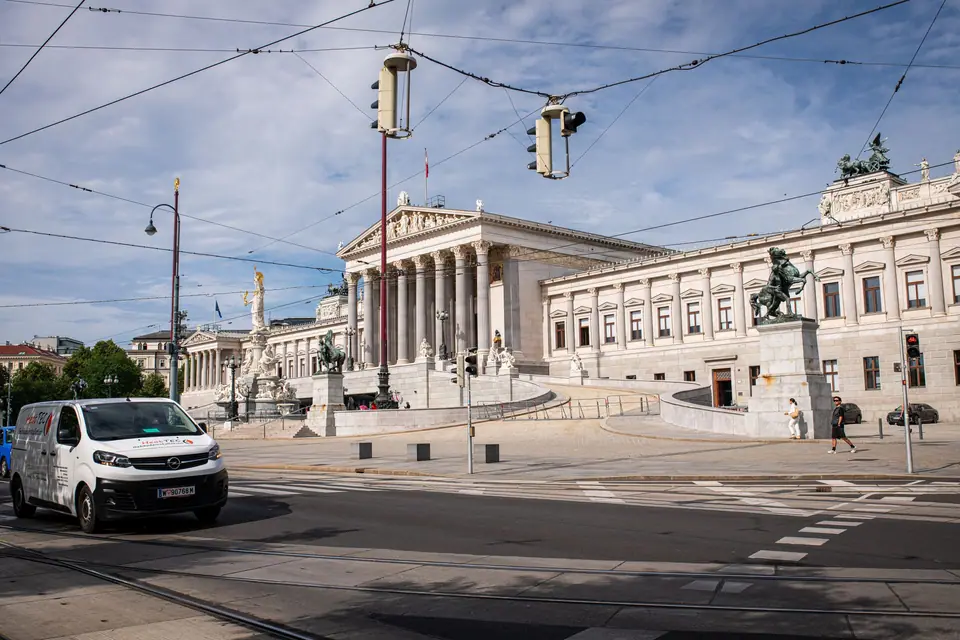
- The Austrian Parliament. Theophil Hansen's Greek-revival temple on Dr.-Karl-Renner-Ring, fronted by the Pallas Athena fountain, reopened in 2023 after a complete restoration with a glass roof over its historic semicircular chamber and a free visitor centre (register online on the parliament website for free guided visits).
- The Rathaus and Burgtheater. Friedrich von Schmidt's neo-Gothic City Hall rises 98 metres behind Rathauspark; across the boulevard sits the opulent Burgtheater, whose grand staircases feature early ceiling paintings by Gustav and Ernst Klimt and Franz Matsch.
- The University of Vienna and Votivkirche. Heinrich von Ferstel's neo-Renaissance university main building has a quiet arcaded courtyard lined with busts of scholars, while the twin open-work Gothic spires of the Votivkirche stand just beyond on Rooseveltplatz.
- Otto Wagner's Postal Savings Bank (Postsparkasse). Take tram 2 east along the Donaukanal to Georg-Coch-Platz at the far end of the Ring. Built between 1904 and 1912 with granite slabs bolted by aluminium-capped rivets and a glass-block banking hall floor, Wagner's building looks less like the 19th-century palaces you just passed and more like the functional architecture of the 20th century.
Traveller tips
Real advice from people who have been to The Ringstrasse and Otto Wagner's Vienna. Every tip is read by our team before it goes live.
No tips yet. Been here? Yours could be the first.
Thank you! Your tip will appear here after a quick review.
More in Vienna
Continue exploring Vienna with related neighbourhood, food, and planning guides