Vienna Coffee Houses: How They Work and Which to Pick
The unwritten rules of the Viennese Kaffeehaus, what the coffee names mean and seven rooms to try.
The traditional Viennese coffee house (Kaffeehaus) was listed by UNESCO as intangible cultural heritage in 2011, not for the roast of the beans, which is medium-dark and familiar, but for the social contract: for the price of a single cup of coffee you rent a marble table, a Thonet bentwood chair or velvet booth, and a stack of newspapers for as long as you wish to sit.
How does a traditional coffee house work?
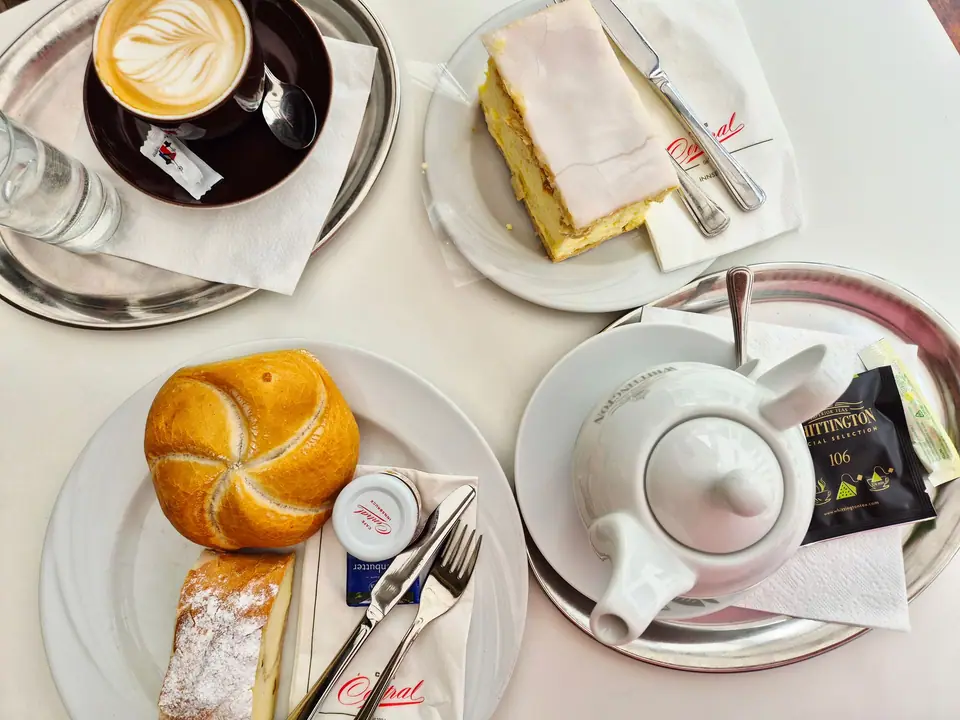
Unless a sign at the door asks you to wait (as at the busiest tourist cafés), walk in and take any free table that does not carry a Reserviert card. Waiters (Herr Ober) wear black waistcoats and have a reputation for dry, unhurried formality; do not take it personally. Your coffee arrives on a small silver tray with the spoon balanced face-down on the rim of a glass of cold Alpine tap water. A waiter who refills that water glass without being asked is quietly telling you that you are welcome to stay another hour. When you are ready to leave, ask "Zahlen, bitte" and round the total up by about 5 to 10 percent as you pay.
What should I order?
Ask for "a coffee" in an older café and the waiter will ask what you actually mean:
- Wiener Melange: Vienna's default cup, an espresso diluted with hot water and topped with steamed milk and foam, close to a cappuccino.
- Verlängerter: an espresso lengthened with hot water, served with a tiny jug of milk on the side.
- Kleiner or Großer Brauner: a single or double espresso with a small porcelain jug of milk or cream.
- Einspänner: a double espresso in a tall glass with a handle, crowned with cold whipped cream that keeps the coffee hot underneath.
- Franziskaner: a lighter Melange topped with whipped cream instead of milk foam.
Is Café Central worth the queue?
Café Central on Herrengasse in the Innere Stadt, where Trotsky, Freud, Stefan Zweig and Peter Altenberg once sat under vaulted neo-Gothic columns, is a beautiful room, and from mid-morning a queue snakes down the pavement outside. Go at opening time on a weekday to walk straight in, or skip the line for another café of the same era.
Which traditional cafés do locals actually use?
- Café Sperl (Gumpendorfer Straße, 6th district): opened in 1880 near the Naschmarkt, with original billiard tables, parquet floors and brocade booths.
- Café Prückel (Stubenring, 1st district): across the Ringstrasse from the MAK design museum, preserving a 1950s Oswald Haerdtl interior.
- Café Hawelka (Dorotheergasse, 1st district): dark wood, worn upholstery and hot plum buns (Buchteln) baked in the evening, two minutes from Stephansplatz.
- Café Diglas (Wollzeile, 1st district): strong cake counter and red velvet booths east of the cathedral.
- Kleines Café (Franziskanerplatz, 1st district): a tiny box designed by Hermann Czech on a calm cobbled square, cash only.
When is the quietest time to go?
Between 9am and 10:30am for a Viennese breakfast (a soft-boiled egg in a glass, Kaiser rolls, butter and jam), or after 4pm before an evening at the opera.
Traveller tips
Real advice from people who have been to Vienna Coffee Houses: How They Work and Which to Pick. Every tip is read by our team before it goes live.
No tips yet. Been here? Yours could be the first.
Thank you! Your tip will appear here after a quick review.
More in Vienna
Continue exploring Vienna with related neighbourhood, food, and planning guides