


























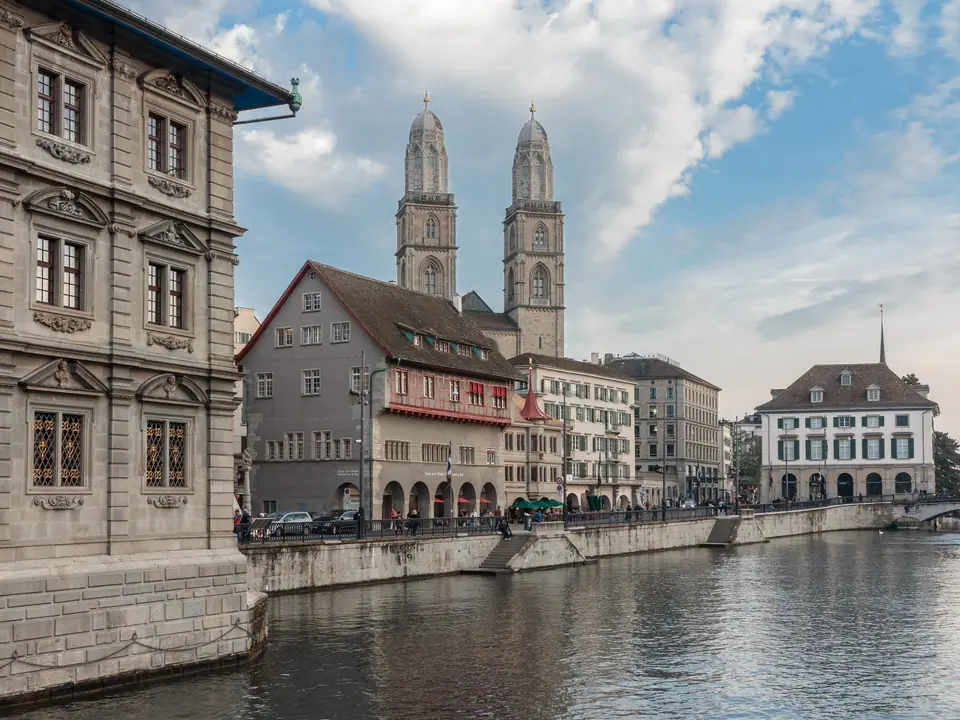
Zurich's Historic Churches: Grossmünster, Fraumünster, St. Peter & Wasserkirche
An architectural and historical guide to the churches along the Limmat that shaped Zurich's medieval guilds and the sixteenth-century Reformation.
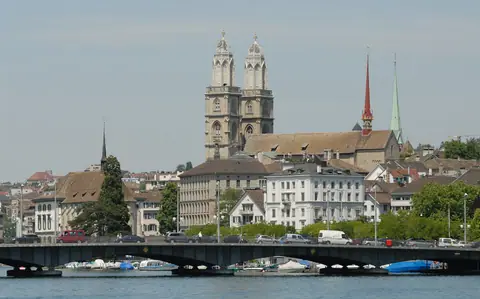
Four Evangelical Reformed churches anchor the skyline of Zurich's Altstadt: the Grossmünster, the Fraumünster, St. Peter, and the Predigerkirche, joined on the riverfront by the late Gothic Wasserkirche. Together they trace the city's evolution from Carolingian convents and medieval guild rule to the birthplace of the Swiss-German Reformation and twentieth-century liturgical art. Because all of them stand within a short walk of the Limmat bridges, visitors can explore the entire ensemble in a single morning or afternoon.
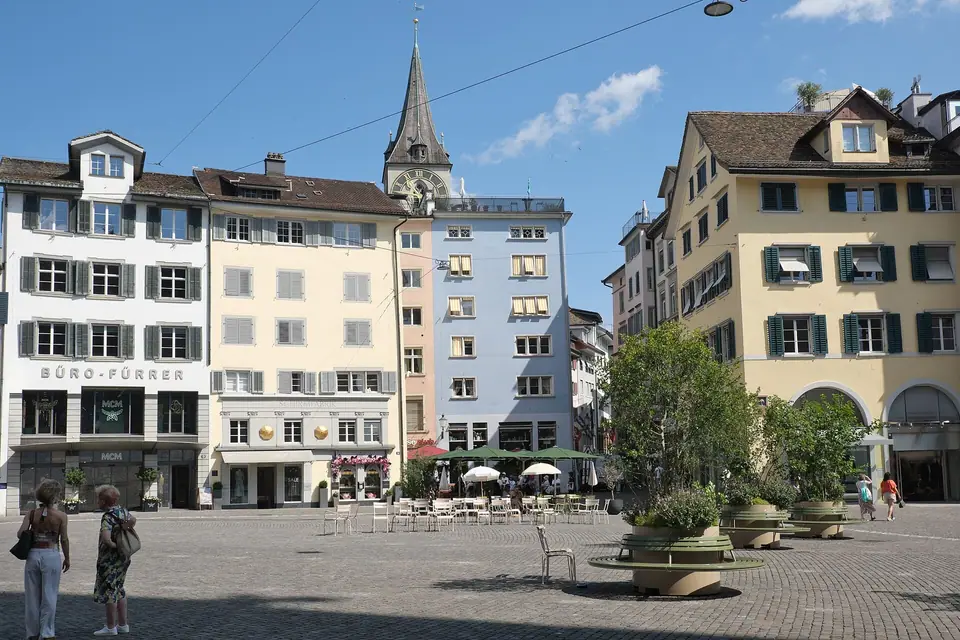
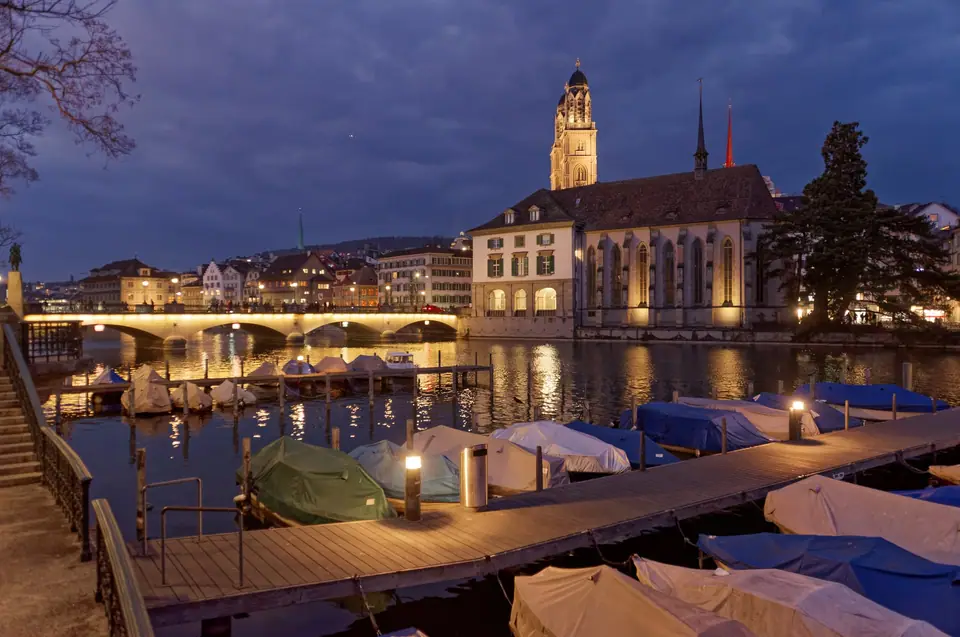
Grossmünster: Romanesque Twin Towers and Zwingli's Reformation
Built of Bollinger sandstone on a terrace above the right bank of the Limmat, the Romanesque Grossmünster ("great minster") was constructed between around 1100 and 1220 over a Carolingian church site. According to twelfth-century legend, Charlemagne founded the collegiate chapter where his horse fell to its knees over the tombs of Zurich's patron saints Felix, Regula, and Exuperantius. From his pastoral office here starting in 1520, Huldrych Zwingli initiated the Swiss-German Reformation; following public disputations in 1523, reformers removed the church organ and statues in 1524, leaving a plain whitewashed interior continued under Zwingli's successor Heinrich Bullinger. The twin towers, erected between 1487 and 1492, lost their wooden steeples to fire in 1763 and received their octagonal neo-Gothic tops in 1787. Modern additions include stained-glass choir windows by Augusto Giacometti (1932), bronze north and south portal doors by Otto Münch (1935 and 1950), and a Reformation museum in the late twelfth-century cloister.
Visitors who climb the interior wooden and stone steps of the Karlsturm (Charles Tower) are rewarded with an elevated perspective across the red-tiled roofs of the old town, the river bridges, and the northern basin of Lake Zurich. Down below, the quiet Romanesque cloister surrounds a courtyard garden carved with grotesque medieval capitals, animals, and stone reliefs, while the subterranean crypt preserves faded wall paintings and a stone statue of Charlemagne. Notice also the modern sliced-agate nave windows created by Sigmar Polke, which filter soft amber and mineral tones across the stone piers.
Fraumünster: Imperial Abbey and Chagall Windows
Directly across the Münsterbrücke on the left bank, the Fraumünster ("women's minster") was founded on 21 July 853 by King Louis the German, Charlemagne's grandson, for his daughter Hildegard. Granted the right to hold markets, collect tolls, and mint coins by King Henry III in 1045 and imperial immediacy (Reichsunmittelbarkeit) by Emperor Frederick II in 1218, the Benedictine abbess effectively governed Zurich until Rudolf Brun's guild revolution (Zunftordnung) of 1336. The last abbess, Katharina von Zimmern, handed the convent to the city on 30 November 1524 during the Reformation. Today the church is famed for five choir stained-glass windows designed by Marc Chagall and installed in 1970 (Prophets, Jacob, Christ, Zion, and Law) as well as Augusto Giacometti's 9-metre north transept window from 1940 and a ninth-century crypt museum opened to the public on 19 June 2016.
In the surrounding cloister arcade next to Münsterhof square, frescoes by Paul Bodmer depict the founding legend of the convent alongside historical scenes of the city's patron saints. Morning light filters sharply through the eastern choir windows, making early visits ideal for viewing the rich blues, reds, yellows, and greens of Chagall's biblical glass panels. Audio guides included with church admission explain the theological symbolism of each pane alongside the archaeological foundations excavated beneath the floor.
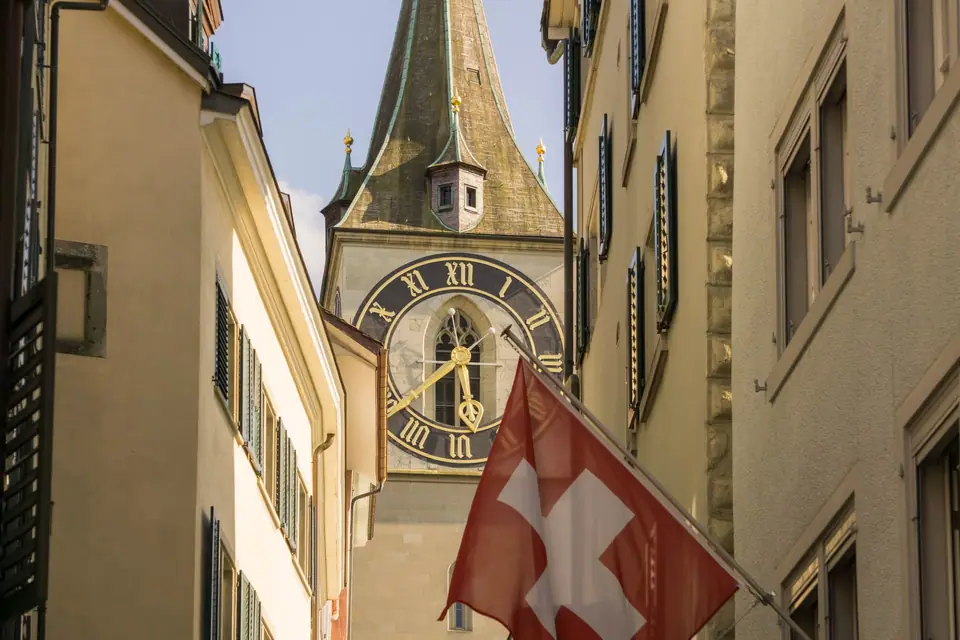
St. Peter, Predigerkirche, and the Wasserkirche
Beside the Lindenhof hill and steps from Bahnhofstrasse and Augustinergasse stands St. Peter, Zurich's oldest parish church, built over a site with an eighth- or ninth-century 10-by-7-metre predecessor and a Romanesque tower raised to 64 metres in 1450 (its 24-metre helmet roof is clad in 42,000 Engadine larch shingles). While the Baroque nave consecrated in 1706 belongs to the Reformed parish, the steeple belongs to the City of Zurich and housed the municipal fire watch from 1340 until 1911. Its clock face measures 8.7 metres in diameter, the largest church clock face in Europe, while Rudolf Brun (buried 1360) and pastor Johann Kaspar Lavater rest here. Inside the bright whitewashed nave, curved wooden galleries, crystal chandeliers, and a carved stone font reflect early eighteenth-century Protestant parish architecture.
On the right bank below the Grossmünster, the late Gothic Wasserkirche ("Water Church") and adjoining Helmhaus mark the traditional execution site of Felix and Regula on what was once a small river island. Rebuilt in the late fifteenth century and later used as Zurich's municipal library before becoming an exhibition and contemplation space, the church preserves the ancient martyr stone in its crypt. Further north in the Niederdorf at Zähringerplatz rises the slender bell tower of the Predigerkirche, a former Dominican monastery church whose high Gothic choir now houses the central library alongside collections connected to the university and museum quarter.
Together, these sanctuaries offer a calm architectural trail through the heart of the city. Visitors can link all of the sites in a leisurely loop across the Münsterbrücke and Rathausbrücke while pausing at quiet riverside squares such as Weinplatz, Münsterhof, and Kirchgasse along the way. Modest dress and quiet voices are appreciated during sightseeing hours, as all of these historic churches remain active places of worship that host regular organ recitals, choral performances, and community services throughout the calendar year. Stepping from the sunlit cobbles of the river bridges into the cool stone naves provides a memorable look at how medieval monastic craft, sixteenth-century Reformation austerity, and modern stained-glass artistry coexist within the historic centre. Outside on the church terraces, stone benches and bubbling drinking fountains invite walkers to rest and admire the opposing riverfront facades.
When planning your church visits, note that all of these landmarks sit within a compact walking radius around the Münsterbrücke and Rathausbrücke, so you can easily move from one river bank to the other without boarding a tram. Comparing the austere Romanesque stonework of the Grossmünster with the luminous modern stained glass of the Fraumünster and the Baroque parish interior of St. Peter reveals how five centuries of religious and artistic change unfolded along a single stretch of the Limmat. Check noticeboards at each portal for weekly lunchtime or evening organ concerts open to visitors.
Traveller tips
Real advice from people who have been to Zurich's Historic Churches: Grossmünster, Fraumünster, St. Peter & Wasserkirche. Every tip is read by our team before it goes live.
No tips yet. Been here? Yours could be the first.
Thank you! Your tip will appear here after a quick review.
More in Zurich
Continue exploring Zurich with related neighbourhood, food, and planning guides
Day Trips from Zurich: Rhine Falls (Rheinfall) & Lindt Home of Chocolate
Zurich, Switzerland

What to Eat in Zurich: Zürcher Geschnetzeltes, Rösti, Birchermüesli & Luxemburgerli
Zurich, Switzerland
How to Get to & Around Zurich: Airport (ZRH), Hauptbahnhof, Trams & ZVV
Zurich, Switzerland
Where to Stay in Zurich: Best Neighbourhoods & Areas Compared
Zurich, Switzerland
