


























Zurich Old Town (Altstadt): Lindenhof, Schipfe, Rathaus & Niederdorf
A walking guide through District 1 on both banks of the Limmat, covering the Roman hilltop of Lindenhof, waterfront Schipfe, the Rathaus, and Niederdorf.
Encompassing the entire historical city as it stood before the 1893 municipal expansion, Zurich's Altstadt corresponds to administrative Kreis 1 (District 1). Divided by the statistical office into four quarters (Lindenhof and City on the west bank of the Limmat, and Rathaus and Hochschulen on the east bank), the district is home to 5,617 residents, or roughly 1.4 percent of the municipal population. Walking through these compact quarters reveals how a Celtic and Roman river crossing evolved into a self-governing imperial free city and a hub of European intellectual life.
Left Bank: Lindenhof Hill and the Schipfe
Rising to 428 metres above sea level, around 25 metres above the Limmat at the Schipfe (405 m), the flattened glacial moraine hill of the Lindenhof ("lime trees courtyard") forms the oldest core of Zurich. Archaeological excavations in 1997 confirmed a late La Tène Celtic oppidum here, followed around 15 BC by a Roman military post under Augustus's stepsons Drusus and Tiberius. Located on the customs border between the Roman provinces of Raetia and Germania Superior, the settlement became known as vicus Turicum, attested on a tombstone of the late second century AD for the infant Lucius Aelius Urbicus bearing the inscription STA(tio) TURICEN(sis); the original stone rests in the Swiss National Museum while a replica is set into the Pfalzgasse wall on the hill. Under Emperor Valentinian, a late Roman fortress crowned the plateau, and in Carolingian times a royal palace stood here before its stones were quarried by thirteenth-century burghers.
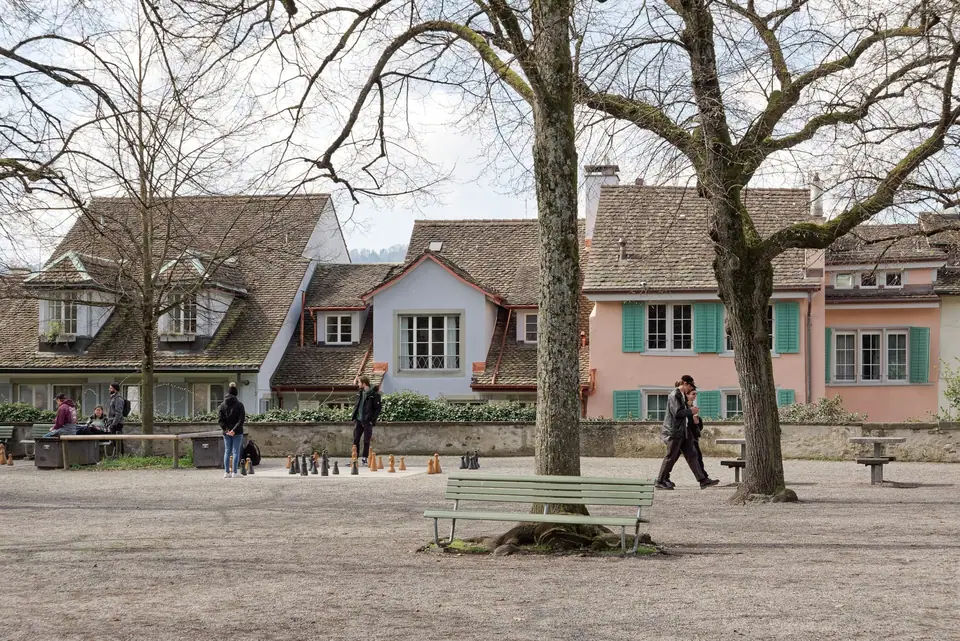
Today the car-free gravel terrace of the Lindenhof is shaded by dozens of lime trees and equipped with public chessboards, stone benches, and the Hedwig Fountain, which commemorates the legendary women of Zurich who defended the city in medieval times. From the eastern parapet, visitors look straight down onto the river current, the steep gable roofs of the Rathaus quarter, and the twin towers of the Grossmünster. Quiet cobbled passages wind off the hill in every direction, sheltering Freemason lodges, medieval tower houses, and shaded courtyard gardens.
Waterfront Alleys, Roman Baths, and Münsterhof
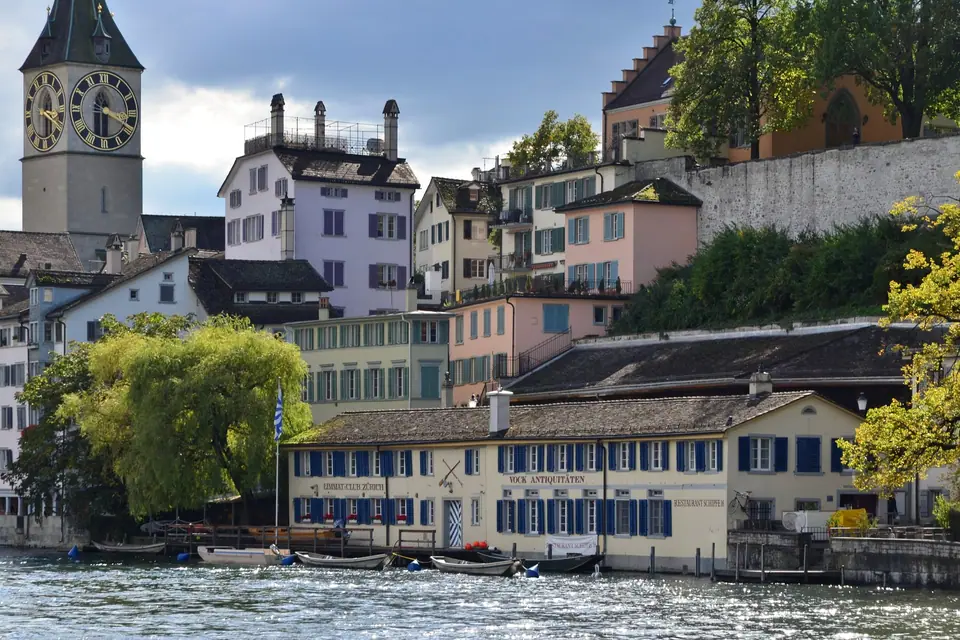
Directly below the northern and eastern slopes of the hill, the narrow Schipfe waterfront preserves a historic mercantile landing stage on the river, where silk weavers and boatmen once worked and artisan studios now occupy vaulted ground floors. Just south toward Weinplatz, the narrow lane of Thermengasse exposes excavated stone remains of the public Roman baths beneath protective grating, while Rennweg served as the main medieval street leading to Bahnhofstrasse.
Continuing south past the painted oriel windows of Augustinergasse and the parish church of St. Peter brings you to Münsterhof. Freed from parked cars and transformed into an open pedestrian plaza, this historic square sits in front of the Fraumünster and the baroque guild house Zunfthaus zur Meisen. Surrounded by arcaded stone facades and outdoor café tables, Münsterhof hosts concerts, cultural gatherings, and seasonal markets while offering a clear view up toward the church spires and across the Münsterbrücke toward the opposite bank.
Right Bank: Limmatquai and the 1690s Rathaus
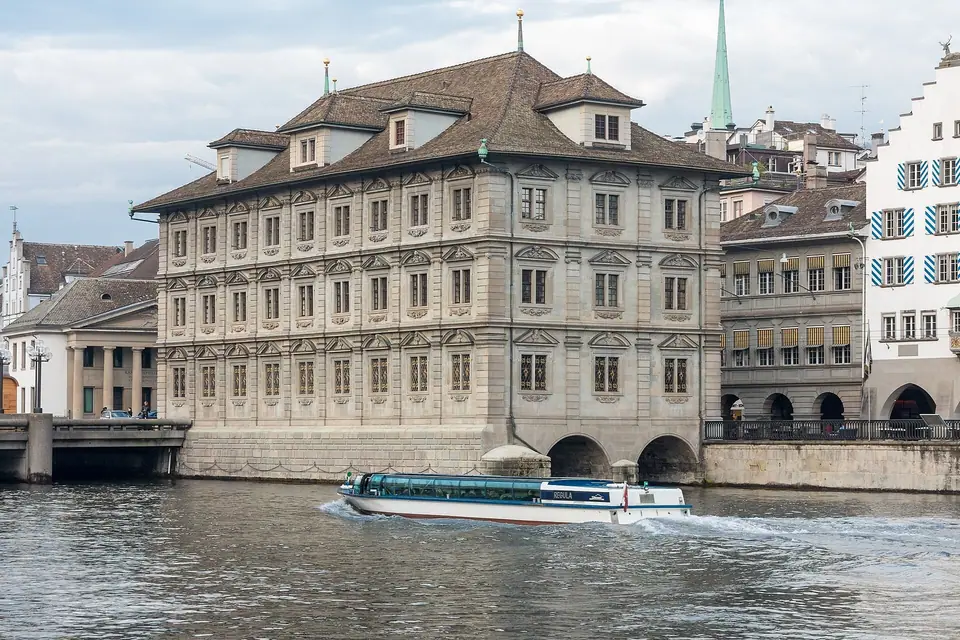
Across the Rathausbrücke, the Rathaus quarter takes its name from Zurich's Town Hall, built over the Limmat in the 1690s. Constructed between 1823 and 1859 along a river line set some 28 metres west of the medieval shoreline, Limmatquai runs from Central square south to Bellevue and Lake Zurich. Closed to private motor traffic since 2004 and served by VBZ tram lines 4 and 15, the waterfront promenade passes arcaded ground floors and historic guild houses including the Zunfthaus zur Zimmerleuten, Zunfthaus zur Haue, Zunfthaus zum Rüden, and Zunfthaus zur Saffran.
Each of these guild halls recalls the 1336 constitution that shared civic authority between patrician knights and craft corporations. Their ornate stone portals, leaded-glass windows, and timbered assembly halls remain active venues for civic banquets and public restaurants overlooking the water and the historic pedestrian bridges. Walking from Central down to Bellevue lets you compare Baroque, Gothic, and Neoclassical stonework reflected directly in the green waters of the Limmat.
Niederdorf, Oberdorf, and Cabaret Voltaire
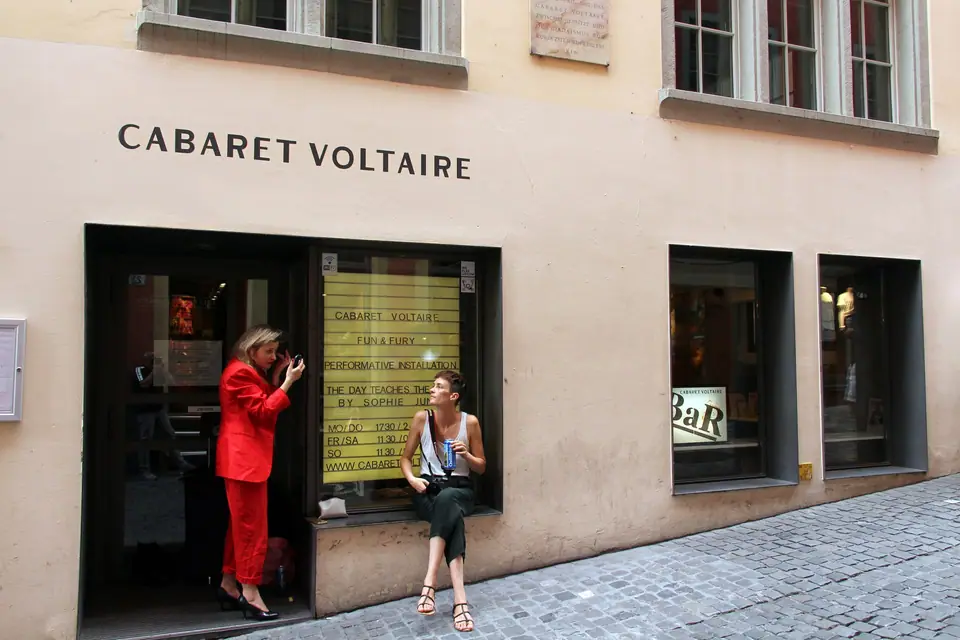
Parallel to the river and one block inland, the pedestrian spine of the right bank splits into the lively lanes of the Niederdorf (downstream of Kirchgasse toward Central) and the Oberdorf (upstream toward Bellevue). At Spiegelgasse 1 in the Niederdorf, just a few doors from Vladimir Lenin's former residence at Spiegelgasse 14, Hugo Ball and Emmy Hennings opened the Cabaret Voltaire on 5 February 1916 in the upper room of the Holländische Meierei. Joined by Hans Arp, Tristan Tzara, Marcel Janco, Richard Huelsenbeck, and Sophie Taeuber, their experimental sound poems and masked performances between February and June 1916 launched the Dada movement, whose name was printed in May 1916. Reopened as a Dada house and exhibition space on 29 September 2004, it remains a key cultural stop alongside the neighbouring alleys of Münstergasse, Rindermarkt, and Neumarkt, where traditional taverns serve classic Zurich dishes.
During the daytime, the upper lanes around Kirchgasse, Römergasse, and Münstergasse invite unhurried browsing among antiquarian print dealers, violin makers, tea shops, and pastry counters. Steep stone steps and narrow alleys such as Froschaugasse and Predigergasse preserve medieval house names painted above doorways and lead toward the high Gothic choir of the Predigerkirche on Zähringerplatz. After dusk, lanterns illuminate the cobbled alleys of the lower Niederdorf as students and visitors fill the wine bars, fondue parlours, and historic beer halls that line the route back toward Central square. Because the entire historic core is closed to through traffic and crossed by frequent footbridges, you can easily zigzag between the quiet elevated courtyards of the left bank and the animated guild lanes of the right bank in a single unhurried walk, discovering carved stone portals, medieval tower walls, and peaceful garden terraces around every corner. Early morning is an especially rewarding time to photograph the empty cobbles and bridge reflections before the shops and cafés open their shutters.
Look closely at the building facades as you wander through both halves of the Altstadt and you will notice carved stone house signs, guild emblems, and painted dates above the lintels that record centuries of urban craftsmanship. Many ground-floor workshops along the Schipfe, Kirchgasse, and Neumarkt still house goldsmiths, bookbinders, and independent ateliers, preserving the residential and artisanal character of District 1 alongside its historic churches and civic squares.
Traveller tips
Real advice from people who have been to Zurich Old Town (Altstadt): Lindenhof, Schipfe, Rathaus & Niederdorf. Every tip is read by our team before it goes live.
No tips yet. Been here? Yours could be the first.
Thank you! Your tip will appear here after a quick review.
More in Zurich
Continue exploring Zurich with related neighbourhood, food, and planning guides
What to Eat in Zurich: Zürcher Geschnetzeltes, Rösti, Birchermüesli & Luxemburgerli
Zurich, Switzerland
How to Get to & Around Zurich: Airport (ZRH), Hauptbahnhof, Trams & ZVV
Zurich, Switzerland
Where to Stay in Zurich: Best Neighbourhoods & Areas Compared
Zurich, Switzerland
Best Time to Visit Zurich: Monthly Weather, Lake Season & Sechseläuten
Zurich, Switzerland
