Quick Field Data
- UNESCO Inscription: Reference 664, inscribed in 1993 as a Cultural World Heritage Site under criteria (iii) and (iv).
- Scale & Footprint: Encompasses 22 component sites covering 30.77 hectares (around 31 hectares) inside and around modern Mérida at 217 metres above sea level where the Albarregas joins the Guadiana River.
- Access & Ticketing: The Puente Romano pedestrian crossing, Arch of Trajan, Temple of Diana exterior, and Acueducto de los Milagros parklands are open public spaces. Fenced excavations including the Roman Theatre, Amphitheatre, Circus, Alcazaba, and Morerías require individual or combined monument tickets managed by Mérida's Heritage Consortium. Check the official consortium website before visiting.
- Arrival Logistics: Seville Airport (SVQ, 171 km south) and Madrid (MAD, 294 km) handle major international air arrivals via AVE rail and highway (Badajoz Airport, BJZ, 43 km west, is a minor regional airfield with limited schedules). Extremadura highways (roughly 50 km by road from BJZ) and regional trains reach town, pairing well with our Seville destination guide (173 km south).
Augusta Emerita: Capital of Lusitania and Veteran Colony
Long before Roman legions bridged the Guadiana, prehistoric communities inhabited this western Iberian river crossing. A girl's grave excavated in 1870 yielded a prestigious gold jewellery hoard of two penannular bracelets, an armlet, and a chain of six spiral wire rings, acquired by the British Museum. Urban history opened formally in 25 BC at the close of Emperor Augustus's conquest of northern Hispania. Rome founded Colonia Augusta Emerita ("veterans of Augustus") to settle discharged veteran soldiers of the V Alaudae and X Gemina legions. Positioned to guard the strategic river pass and Guadiana bridge, the colony anchored the southern terminus of the Vía de la Plata (Silver Way). That road linked gold mines near Asturica Augusta across western Iberia, and builders engineered Emerita as an idealised provincial model of Rome itself.
Rapidly growing into one of Hispania's largest cities, Augusta Emerita operated first as capital of Lusitania, the westernmost Roman province, and after Diocletian's fourth-century administrative reforms as capital of the entire Diocese of Hispania. Jewish historical tradition preserved in Abraham ibn Daud's twelfth-century Sefer ha-Qabbala even recounts noble Jewish exiles arriving in Mérida after Jerusalem's destruction in 70 AD, including silk craftsman Baruch, described as progenitor of the influential medieval Albalia family of Córdoba.
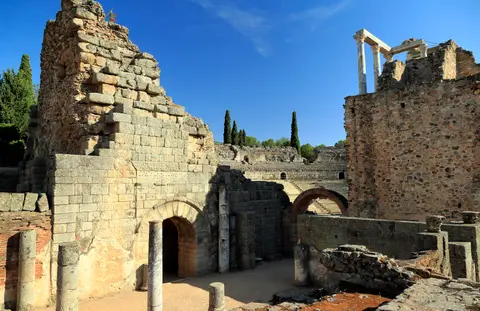
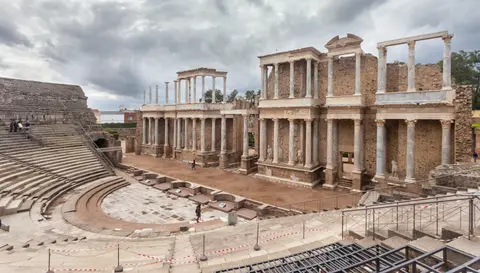
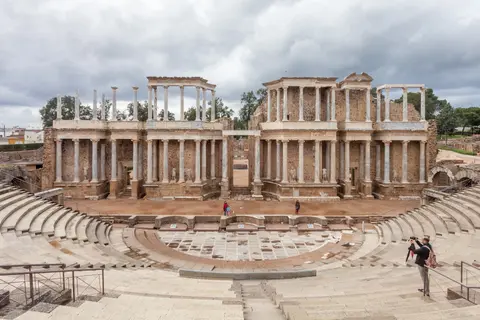
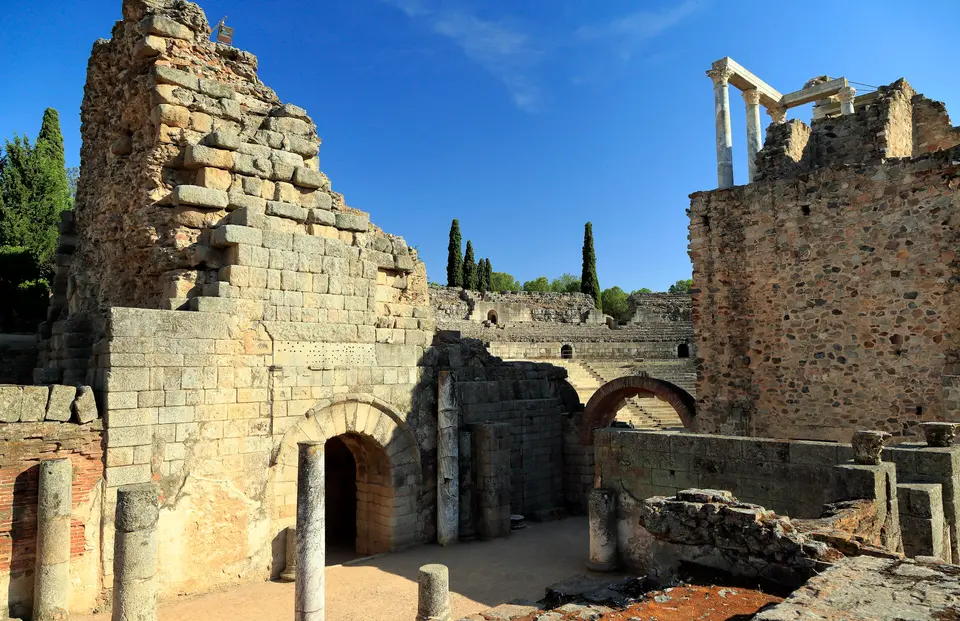
Modern Mérida (60,119 residents in 2017) became regional capital of Extremadura in 1983 and ecclesiastical seat of the Archdiocese of Mérida-Badajoz. Because the city grew steadily atop ancient foundations without clearing underground masonry, twentieth-century excavations uncovered more major Roman monuments than anywhere else in Spain. Twenty-two protected components span 30.77 hectares (around 31 hectares). Public leisure ensembles link the Roman Theatre, which has staged classical Greek and Roman dramas each summer since the 1930s festival opened, with the adjacent gladiatorial Amphitheatre and a landscaped peristyle. Nearby lies the first-century BC Circus Maximus, one of the best-preserved Roman chariot racecourses in Europe. Religious, administrative, and private survivals include the Temple of Diana, fragments of the Temple of Mars, and the Arch of Trajan anchoring both forums. Excavations also reveal the Morerías archaeological zone and patrician houses retaining mosaic floors at the Villa Mitreo, Casa del Anfiteatro, and Casa Basílica, interpreted in Rafael Moneo's National Museum of Roman Art. Contemporary landmarks frame these ruins, including Moneo's Guadiana Hydrographic Confederation, Santiago Calatrava's Lusitania Bridge, the Extremadura Parliament, the State Library, and the Palacio de Congresos.
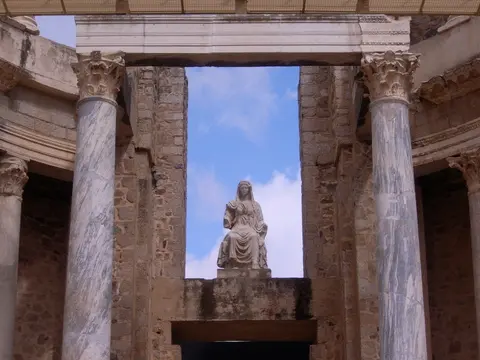
Hydraulic Dams, Aqueduct Piers, and the Guadiana Crossing
Beyond its temples and stages, Mérida ranks among the Roman world's clearest open-air lessons in civil and hydraulic engineering, with several structures extending outside the ancient walls into countryside still comparable to antiquity. Spanning the Guadiana River stands the Puente Romano, the longest surviving Roman stone bridge in existence, still walked daily by pedestrians near Santiago Calatrava's modern Lusitania Bridge. Although certain bridge spans were altered in medieval and modern centuries, its monumental Roman arches and cutwaters continue to carry foot traffic into town.
Mérida's semi-arid plateau receives only 300 to 400 mm of annual rainfall and experiences periodic two-to-five-year droughts. To supply bathhouses, fountains, and private homes, Roman engineers built two external storage reservoirs, the Proserpina Dam and Cornalvo Dam, both still operational today. North of town across the Albarregas valley rise the towering granite-and-brick arcades of the Acueducto de los Milagros ("Aqueduct of the Miracles"). Additional hydraulic works include the Aqueduct of San Lázaro, Roman clean-water and waste-sewer networks, the defensive river dyke, and rural thermal springs extending to the baths of Alange.
Inside the walled perimeter, street alignments continue ancient cardo and decumanus axes directly. Modern pedestrians cross the same river bridge, walk beneath the monumental Arch of Trajan, and pass functional drainage corridors laid down two millennia ago. This continuity reveals how municipal topography preserved imperial urban geometry across two thousand years.
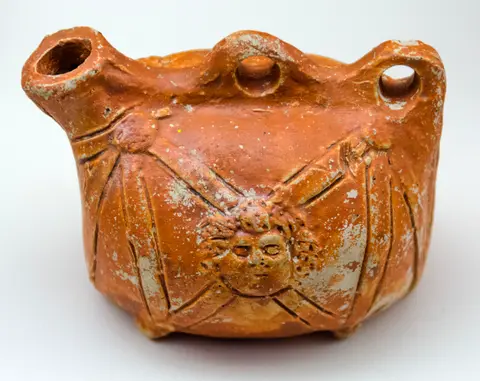
Visigothic Basilicas, the Umayyad Alcazaba, and Urban Continuity
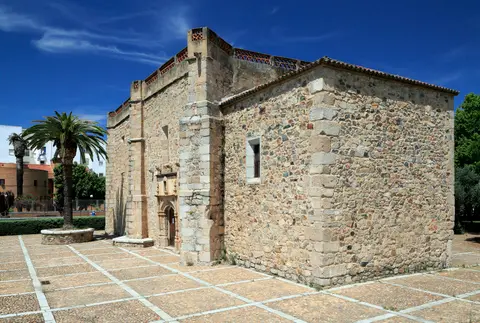
Following imperial Rome, Mérida passed briefly to the Kingdom of the Alans under King Attaces in 409 and fell to Vandal control after his death in 418. After 469, it became a major seat of the Visigothic Kingdom. Excavated Paleo-Christian basilicas at Santa Eulalia, Casa Herrera, and Santa Lucía del Trampal preserve this transition. Dating to the fourth century and rebuilt in the thirteenth, Santa Eulalia's church retains Visigothic, Romanesque, Gothic, and Baroque stonework and reuses parts of the Temple of Mars in its portico. Seventeenth-century Christian monuments including the Obelisk of Santa Eulalia likewise incorporate pagan marble altars into their masonry. Medieval and early modern additions include the thirteenth-to-fourteenth-century Cathedral of Saint Mary Major and the fifteenth-to-sixteenth-century Gothic church of Nuestra Señora de la Antigua. The seventeenth-century Church of Santa Clara, Baroque Nuestra Señora del Carmen, and a Renaissance Town Hall complete this architectural palimpsest.
Conquered by Musa ibn Nusayr in 713, Arab Mérida became capital of the Cora of Mérida. With Toledo and Zaragoza, it served as one of the three northern border capitals of Al-Andalus. In 835, Umayyad Emir Abd ar-Rahman II built the massive riverside Alcazaba fortress directly atop Roman walls beside the Puente Romano. Granite blocks were reused to enclose a garrison yard housing Roman mosaics and a subterranean Visigothic cistern (aljibe) supplied from the river. Frequent ninth-century Mozarab revolts weakened the town before it passed under the Taifa of Badajoz and Almohad control, when Mérida backed rival leader Ibn Hud. After Santiago de Compostela claimed its former metropolitan seat in 1119, King Alfonso IX of León reconquered Mérida in 1230. The city was entrusted to the priory of San Marcos de León of the Order of Santiago under a later fifteenth-century recovery led by Grand Master Alonso de Cárdenas.
Mérida later served as capital of the 1720 Intendencia of Mérida and as a pilgrim stop on the Vía de la Plata Camino de Santiago. Borderland battlegrounds with Portugal, Napoleonic damage, nineteenth-century railway expansion, and Nationalist capture on 10 August 1936 left scars. Buried treasures nevertheless survived until twentieth-century excavation. Statutory protection rests on Law 16/1985 on Spanish Historical Heritage, Law 2/1999 on Extremadura's Cultural Heritage, and Title IX of Mérida's 12 September 2000 Town Planning Plan (Supplement E of Official Journal 106). Succeeding the former Monumental City Board, the Consortium of the Monumental City of Mérida unites the regional government, Spanish Culture Ministry, Mérida City Council, and Badajoz Provincial Government. It manages all 22 components with annual preservation budgets on strict consolidation principles. Selective anastylosis applies only to defined elements such as parts of the Theatre stage front and Amphitheatre blocks and vaults. Policy resists speculative reconstruction while reinforcing urban archaeological protection against inappropriate city growth.
Monument Sectors Across Mérida's Roman and Medieval Circuit
Although the 22 inscribed components are scattered across central Mérida and outlying valleys, a single combined consortium pass unlocks the main fenced enclosures, while bridges, dams, and forum arches remain open outdoors.
| Complex Zone | Key Highlights | Access & Ticket Rule |
|---|---|---|
| Theatre, Amphitheatre & Roman Art Museum | Augustan Theatre stage front, gladiatorial Amphitheatre, Casa del Anfiteatro, Rafael Moneo museum | Fenced archaeological zone requires a consortium ticket (or combined pass); National Museum operates separate state ticketing. |
| Guadiana Riverfront & Umayyad Alcazaba | Puente Romano pedestrian span, 835 Alcazaba ramparts, underground aljibe cistern, Morerías site | Bridge is permanently open to foot traffic; Alcazaba courtyard and Morerías ruins sit within the consortium ticket circuit. |
| Municipal & Provincial Forums | Temple of Diana, Arch of Trajan, and surrounding Renaissance Town Hall and Cathedral squares | Open public squares allow close exterior viewing without a ticket at any hour. |
| Circus Maximus & Villa Mitreo | First-century BC chariot racecourse, Villa Mitreo mosaic floors, and Basilica of Santa Eulalia | Circus, Villa Mitreo, and Santa Eulalia crypt sit on the combined consortium pass; check seasonal entry schedules locally. |
| Acueducto de los Milagros & Roman Dams | Albarregas aqueduct piers, San Lázaro channel, and Proserpina and Cornalvo reservoirs | Parks around the aqueduct piers and rural reservoir embankments carry open public access. |
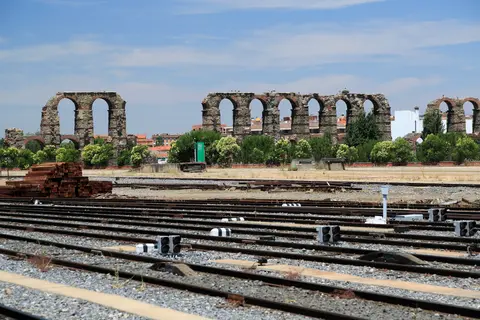
Field Evidence of Roman Engineering and Later Stone Reuse
Walking between the Guadiana bank and the Albarregas valley lets you trace three physical building practices directly in stone and brick.
- Granite Ashlar and Brick Courses on the Milagros Aqueduct: Inspect the tall piers of the Acueducto de los Milagros where Roman masons alternated bands of heavy cut granite blocks with five-course red brick lacing layers to absorb structural movement across the valley floor.
- Pagan Marble Inside the Obelisk and Portico of Santa Eulalia: Outside the Basilica of Santa Eulalia, study how seventeenth-century builders stacked cylindrical Roman marble altars atop one another to construct the martyr's obelisk. Inside the church porch, look for fluted marble capitals reused directly from the Temple of Mars.
- Descending to the Alcazaba Cistern: Inside Abd ar-Rahman II's 835 fortress beside the Guadiana bridge, follow the twin stone staircases carved down below court level. They lead into the vaulted Visigothic aljibe water tank filtered through river gravel, showing how Muslim engineers reused older stone infrastructure for siege endurance.
Seasonal Heat, Festival Timing, and Western Spain Connections
Mérida's cold semi-arid Mediterranean climate stays mild in winter, rarely dipping below 0 °C, with low humidity and frequent autumn-winter fog. Rainfall averages highest in November and December, while summer afternoons regularly exceed 40 °C under dry skies. Late spring and autumn bring mild daytime temperatures suited to open-air ruins. From late May into early June, Emerita Lvdica stages a city-wide Roman reenactment festival with gladiator parades and amphitheatre displays. Summer brings evening classical plays inside the Roman Theatre alongside cultural events around the 14,600-capacity Estadio Romano. Visiting the outer Amphitheatre, Circus, and Acueducto de los Milagros early in the morning allows comfortable walking between the Guadiana bridge and Albarregas parklands before midday heat builds. Save midday hours for shaded mosaics inside the Villa Mitreo and Rafael Moneo's red-brick Roman Art Museum.
Arriving through Badajoz Airport (43 km) or via regional rail links along western Spain, travellers can link Mérida's imperial monuments with Andalusian history in our Seville travel guide (173 km south), and explore other Roman capitals across our UNESCO World Heritage Atlas. Allow enough time between the Theatre peristyle, the Guadiana bridge promenade, and the outer Milagros arcades to trace how Roman, Visigothic, Islamic, and Christian layers occupied one continuous Iberian crossing, turning veteran colonists' streets into Extremadura's living historical capital.