Quick Field Data
- UNESCO Inscription: 2000 (Ref. 875), serial Roman archaeological ensemble across Tarragona and neighbouring municipalities, Catalonia, Spain; Criteria (ii) and (iii).
- Scale & Footprint: 32.65-hectare serial zone (32.83 hectares in nomination synthesis) covering city terraces, amphitheatre, circus, necropolis, Les Ferreres aqueduct, Tower of the Scipios, Mèdol quarry, Centcelles, Els Munts and Berà Arch.
- Access & Ticketing: Protected under Law 16/1985 and Catalan Law 9/1993 by Tarragona Council and the Catalan Cultural Heritage Directorate; verify municipal monument passes locally before visiting individual excavations.
- Arrival Logistics: Major international flights serve Josep Tarradellas Barcelona-El Prat Airport (BCN), 69 kilometres northeast, near Barcelona (79 kilometres); closer Reus Airport (REU) sits 10 kilometres inland with regional and seasonal schedules.
From Scipio's 218 BC Garrison to Augustus's Provincial Capital
Rising on a stepped limestone hill above Spain's northeastern Mediterranean coast, modern Tarragona Spain preserves ancient Tarraco, the earliest Roman stronghold founded on the Iberian Peninsula. Before Roman legions landed, local Iberian communities settled the lower Ebro coast from the fifth century BC around Cissis or Kesse, trading actively with Greek and Phoenician merchants. That coastal balance shifted permanently in 218 BC during the Second Punic War when Gnaeus Cornelius Scipio Calvus landed at Empúries, seized Punic supply fields near Cissis and occupied this strategic ridge. Reinforced by brother Publius Scipio in 217 BC, Roman soldiers fortified upper walls atop Cyclopean Iberian stone foundations and built a fortified military harbour.
Between 211 and 210 BC, Scipio Africanus used Tarraco as his winter headquarters to assemble Iberian leaders in conventus before local piscatores Tarraconenses supplied boats for his siege of Carthago Nova. For two Republican centuries, legions fighting Celtiberian tribes relied on this upper military camp, today the historic Part Alta quarter, as supply nexus and administrative hub for Hispania Citerior. Consul Gaius Porcius Cato chose Tarraco for exile in 108 BC, proving its allied or free status, while Julius Caesar rewarded food supplies during his 49 BC Ilerda campaign with colonial rank around 45 BC as Colonia Iulia Urbs Triumphalis Tarraco.
Imperial prominence surged in 27 BC when Emperor Augustus reorganised Iberia, naming Tarraco capital of vast Hispania Tarraconensis spanning central, northern and northwestern Spain. Suffering poor health while overseeing Cantabrian campaigns, Augustus stayed in Tarraco, where Quintilian later recorded his dry remark when citizens boasted of a palm growing atop his altar that it showed how rarely sacrifices burned there. Converting the ancient Via Herculea into the paved Via Augusta milestone highway between 12 and 6 BC linked Tarraco northeast toward Barcino and south toward Dertosa, Saguntum and Valentia. First-century geographer Pomponius Mela hailed Tarraco as the richest port along this coast, minting civic coins and raising an Imperial cult temple soon after Augustus's deification in 15 AD.
Subsequent centuries added civic prestige before third-century crises and late-antique change reshaped the hillside. Governor Galba governed from Tarraco eight years prior to his 68 AD imperial proclamation, after which Vespasian granted Latin citizenship and spurred Flavian building between 70 and 180 AD across the upper temple, Provincial Forum and Amphitheatre. Senator Lucius Licinius Sura served as Trajan's city patron and Hadrian wintered here around 122 to 123 AD, though late-second-century troubles saw military inscriptions overtake merchant ordo decurionum dedications. Severus restored the arena, Diocletian shrunk provincial borders and Frankish and Alemannic raids hit outer harbour quarters around 260 AD before a quiet 476 AD Visigothic takeover under King Euric and Muslim arrival in 713 or 714 AD.
Three Terraced Urban Zones, Circus Vaults, and Seaside Amphitheatre
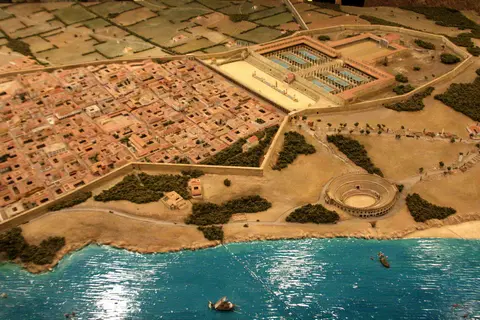
What defines Tarraco inside classical Roman town planning is how architects carved a steep coastal slope into three deliberate ascending terraces. At the highest elevation, later occupied by medieval Tarragona Cathedral, stood the monumental Imperial cult temple enclosure overlooking sea and inland plains. Stepping downward opened the vast colonnaded Provincial Forum square, flanked by civic halls and provincial governance chambers finished with imported Roman marble brought by metropolitan craftsmen. Below this official terrace stretched the long vaulted Circus track separating formal administrative quarters from lower residential blocks, Colonial Forum, baths, Roman theatre and coastal port stretching to the sea.
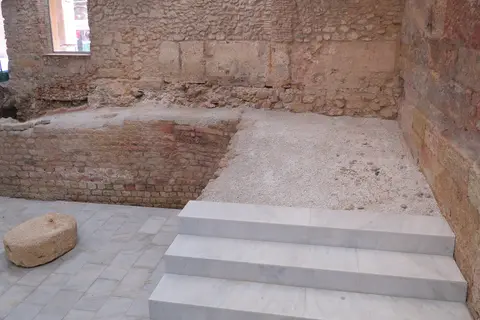
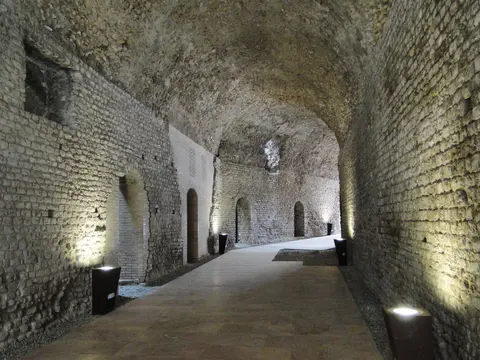
Today massive stone arches and barrel-vaulted substructures of the Roman Circus thread directly beneath medieval Part Alta cellars and plazas, showing how medieval streets inherited ancient monumental lines. Adjacent rises the tall fortified tower traditionally dubbed Pilate's Palace, guarding ancient Cyclopean foundations where Roman commanders and later medieval rulers anchored urban defences. Around the upper city edge, nearly intact sections of Republican defensive walls preserve towering stone bastions, narrow postern gates and megalithic lower masonry blocks raised over 2,200 years ago, bearing Latin and even Phoenician inscriptions. Down below on the lower slopes leading toward the commercial harbour, excavated baths, streets, port structures and the Roman theatre show how domestic residential quarters stepped naturally toward seafront wharves. Walking the shaded Archaeological Promenade beside upper city walls connects visitors smoothly between defensive ramparts and panoramic upper town vistas.
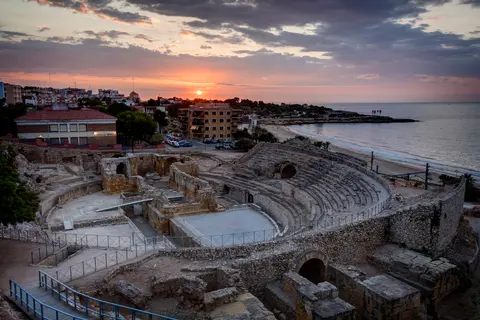
Just outside the eastern city walls overlooking Mediterranean surf rests the second-century AD Tarragona Amphitheatre, measuring 130 by 102 metres with seating carved partly into coastal bedrock for up to 15,000 spectators. Built around the turn of the first and second centuries AD and renewed under Emperor Elagabalus, the arena witnessed gladiatorial combats and animal spectacles beside sea spray. In 259 AD under Emperor Valerian, authorities burned Bishop Fructuosus and deacons Augurius and Eulogius alive inside the arena, turning the spot into a hallowed Early Christian shrine. Excavated tombs, a stone Visigothic basilica and a 12th-century Romanesque church stood across the arena floor until 1915 demolition, preceded by a 1576 Trinity convent and a 1780 port-builders' prison before mid-20th-century Bryant Foundation excavations exposed Roman tiers.
Les Ferreres Aqueduct, Outlying Villas, and Modern Urban Protection
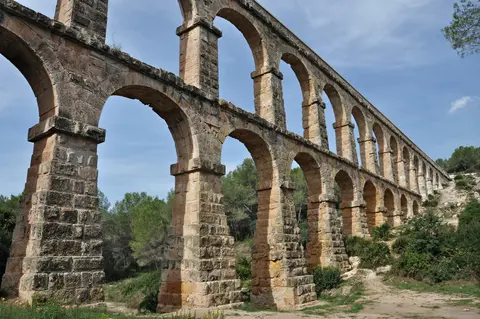
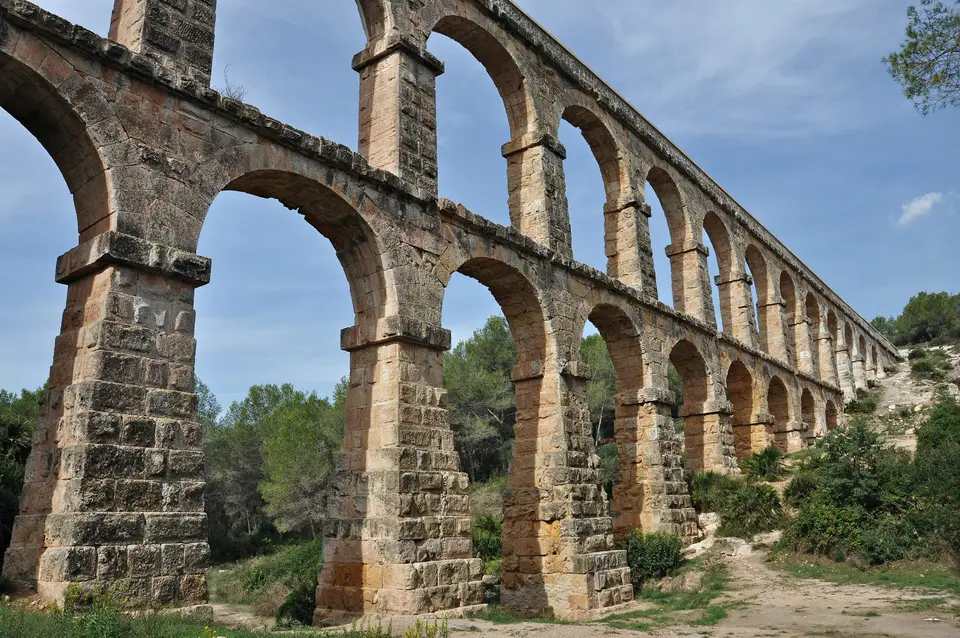
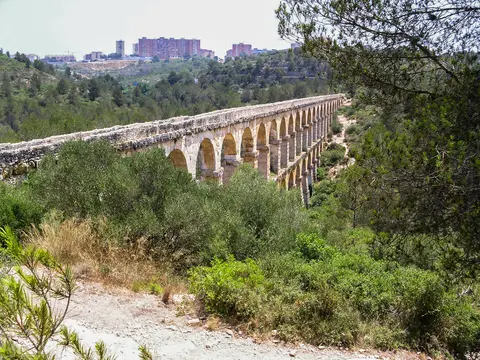
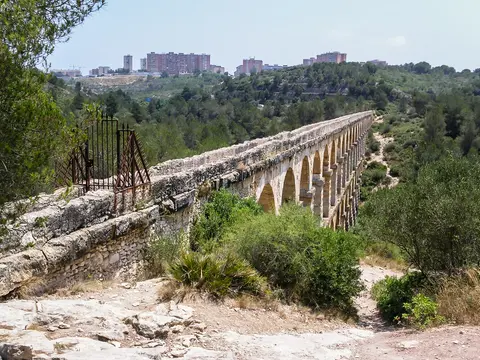
Fourteen serial heritage monuments extend Tarraco's urban narrative outward across Tarragona's surrounding agricultural plain and coastal hills. Four kilometres north of the city centre, the monumental Les Ferreres Aqueduct, known in Catalan as Pont del Diable or Devil's Bridge, bridges a wooded ravine along the Augustan canal drawing water from the Francolí River 15 kilometres north. Built without mortar in two graceful stone arch tiers, the bridge stretches 249 metres long and climbs 27 metres high with 25 upper arches resting atop 11 lower spans. Consistent imperial engineering shows across every arch measuring 20 Roman feet (5.9 metres) wide spaced on 26-Roman-foot (7.95-metre) pillar centres.
Further protected monuments complete a vivid provincial portrait across Tarragona's hinterland within the 32.65-hectare UNESCO serial property. Just 1.5 kilometres northwest stands the slender Roman funerary monument called the Tower of the Scipios, accompanied farther afield by the Mèdol limestone quarry whose deep rock canyon yielded ashlar blocks for city walls, temples and arches. Beyond urban boundaries lie the monumental Early Christian necropolis, the mosaic-domed Centcelles villa and mausoleum, the seaside Els Munts Roman villa complex and the triumphal Berà Arch framing the ancient Via Augusta northeastward toward Barcino. Together with excavated remains of the port quarter, Colonial Forum, public baths and Roman theatre down near the harbour, these satellite monuments demonstrate how imperial builders linked urban spectacle directly with rural estates and coastal roads.
Balancing modern urban vitality in coastal Tarragona with fragile Roman stonework beneath active streets depends on strict Spanish and Catalan heritage statutes. Decree 652/1966 first designated the town and archaeological subsoil a historical complex, reinforced today by Law 16/1985 and Catalan Historical Heritage Law 9/1993 protecting all monuments as National Items of Cultural Interest. Ownership spans the Catalan Government, Tarragona Town Council and private parcels across larger wall or circus blocks, guided by Tarragona's Municipal Urban Organisation Plan, Roda de Barà zoning and the Tarragona Territorial Committee for Cultural Heritage together with proposed Roman Tarraco Consortium coordination. Excavated monuments like the Amphitheatre, Berà Arch and Tower of the Scipios retain high authenticity without heavy modern reconstruction, even where later medieval buildings absorbed original Roman vaults, while ancient epigraphs, coins and texts continue illuminating daily civic life. Ongoing excavations, site conservation and visitor interpretation protect subterranean structures from modern development pressures across growing urban quarters.
Access Zones Across Tarraco's City Terraces and Outlying Sites
Consulting a Tarragona Spain map groups sightseeing cleanly between walled upper Part Alta monuments, seaside arena grounds and suburban road excursions. Verify municipal combined tickets and Monday closure schedules before setting out across open-air excavations.
| Complex Zone | Key Highlights | Access & Ticket Rule |
|---|---|---|
| Part Alta Walls & Provincial Forum | Cyclopean and Roman defensive walls, Archaeological Promenade, Pilate's Tower and Tarragona Cathedral terrace. | Upper old town pedestrian streets; check municipal monument tickets and cathedral cloister admission locally. |
| Seaside Amphitheatre & Lower City | Second-century rock-cut Amphitheatre, Visigothic basilica foundations, Colonial Forum and Roman theatre remains. | Separate fenced park steps from waterfront avenues; verify combined heritage passes at park gates. |
| Les Ferreres Aqueduct (Pont del Diable) | 249-metre two-tiered Augustan aqueduct arches and wooded eco-park paths four kilometres north of town. | Free open woodland access over dry-stone arches; local city buses and highway turnoffs reach park entrances. |
| Hinterland Monuments & Quarry | Tower of the Scipios, Mèdol stone quarry, Early Christian necropolis, Centcelles mausoleum, Els Munts and Berà Arch. | Dispersed outer sites along coastal highways; confirm seasonal hours at rural archaeological villas before driving out. |
Three Roman Construction Techniques Visible Across Tarragona
- Dry-Jointed Two-Tier Arching at Les Ferreres Aqueduct: Walk atop the 249-metre stone channel to inspect ashlar masonry blocks locked tight solely by weight and precision cutting without mortar.
- Vaulted Circus Substructures Embedded Beneath Medieval Houses: Duck inside Praetorium and Circus corridors where massive Roman concrete-and-stone barrel vaults still support upper city streets.
- Megalithic Cyclopean Lower Wall Courses Below Roman Ashlar: Compare rough giant base boulders dating back to Iberian and Second Punic War defences against cleanly dressed upper Roman blocks.
How to Reach Tarragona From Barcelona and Pace Your Visit
Two days comfortably covers Tarraco's Part Alta terraces and outlying aqueducts, though brisk one-day rail excursions from Barcelona also work smoothly. Reserving one morning for the Archaeological Promenade, Roman Circus and Tarragona Cathedral leaves afternoon sun for seaside amphitheatre tiers above Mediterranean beaches. Dedicating a second day unlocks peaceful morning walks across Les Ferreres Aqueduct, Mèdol quarry cliffs, Centcelles and coastal Els Munts villa without rushing back to trains. Mild spring and autumn temperatures make climbing steep stepped alleys between lower harbour avenues and upper terraces thoroughly pleasant.
Travellers checking how to reach Tarragona from Barcelona or how to reach Tarragona from Barcelona airport enjoy frequent coastal train links and highway connections along Catalonia's shore. Direct regional and high-speed rail corridors run south from Barcelona (79 kilometres northeast) straight toward Tarragona station below the amphitheatre or suburban high-speed hubs, making Tarragona Spain to Barcelona transfers effortless without driving. Sea visitors arriving via Tarragona cruise port terminals sit close to lower Serrallo port avenues within easy bus, taxi or walking reach of lower Roman monuments and upper city steps. International flights land mainly at Josep Tarradellas Barcelona-El Prat Airport (BCN), 69 kilometres northeast, while Reus Airport (REU) operates just 10 kilometres inland with regional seasonal flights. Checking local municipal pass schedules ahead ensures smooth entry across amphitheatre gates, circus vaults and outlying archaeological villas. Explore more Mediterranean Roman monuments inside our UNESCO World Heritage Atlas.