





















Agra Fort Guide: Amar Singh Gate, Jahangiri Mahal, Diwan-i-Khas & Shah Jahan's Musamman Burj Tower
Explore UNESCO-listed Agra Fort: enter via Amar Singh Gate, compare Akbar's red sandstone Jahangiri Mahal with Shah Jahan's white marble Khas Mahal, and stand at the Musamman Burj.
Towering above the western bank of the Yamuna River 2.5 kilometres northwest of the Taj Mahal, Agra Fort (Qila-i-Akbari) served as the primary residence of the Mughal Emperors. Inscribed as a UNESCO World Heritage Site in 1983 (Reference 251) across a 38-hectare (94-acre) semicircular plan with a 2.5-kilometre circuit of double ramparts, the fortress is a walled imperial city. Although the northern enclosure remains an Indian Army garrison, the open southern and riverfront zone showcases Emperor Akbar's red sandstone palaces (1565 to 1573) and Emperor Shah Jahan's white marble pavilions (1628 to 1658). Below is our chronological walking route through every open courtyard and tower.
| Fort Sector & Order | Mughal Ruler & Material | What to Look For | Best Time & Duration |
|---|---|---|---|
| 1. Amar Singh Gate & Elephant Ramp | Emperor Akbar & Shah Jahan (Red Sandstone & Glazed Tile) | 90-degree dog-leg defensive gate, wet & dry moats, and ribbed brick ramp | 15 mins (enter at 08:30 or 09:00 after Taj Mahal) |
| 2. Jahangiri Mahal & Hauz-i-Jahangiri | Emperor Akbar (c, 1570, Red Sandstone with White Inlay) | Monolithic rose-water cistern (1611) and Hindu-Islamic carved brackets | 30 mins (inspect the river-facing courtyard) |
| 3. Khas Mahal & Anguri Bagh | Emperor Shah Jahan (1637, White Makrana Marble) | Curved Bengali do-chala gilded roofs and 85-square sunken Grape Garden | 25 mins (morning sunlight over the Yamuna) |
| 4. Musamman Burj & Shish Mahal | Emperor Shah Jahan (1631-1640, White Marble & Pietra Dura) | Octagonal river tower where Shah Jahan died in 1666 gazing at the Taj Mahal | 25 mins (best unobstructed river view of the Taj) |
| 5. Diwan-i-Khas, Nagina Masjid & Diwan-i-Am | Emperor Shah Jahan (Red Sandstone & Plastered Shell Lime) | Black Onyx Throne of Jahangir, ladies' marble mosque & 40-pillared Audience Hall | 30 mins (finish loop before midday heat) |
Entering via the Amar Singh Gate: How the double ramparts defeated invaders
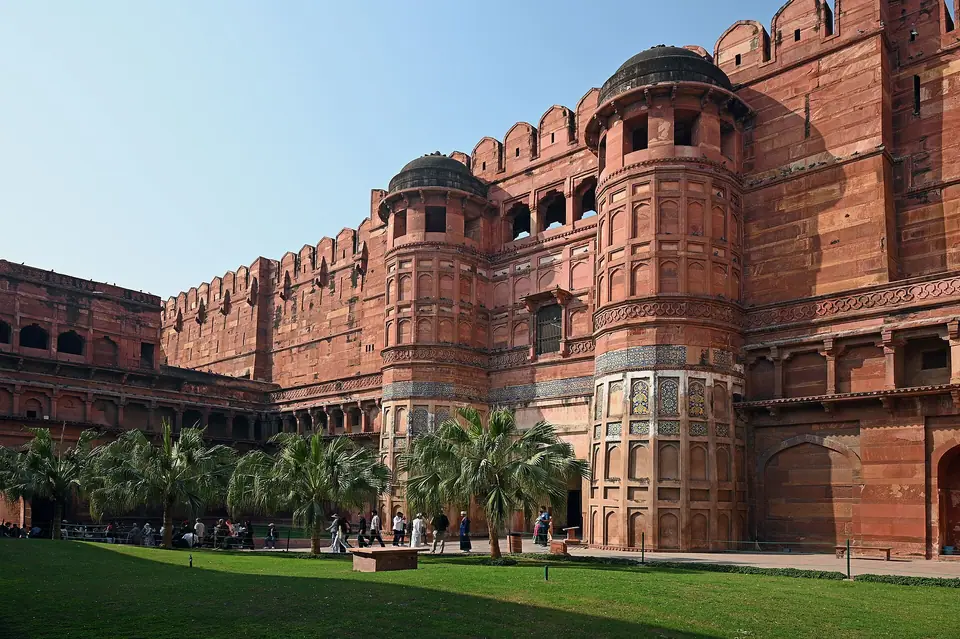
Agra Fort originally had four monumental gates, including the western Delhi Gate (Hathi Pol) and the riverfront Water Gate (Khizri Darwaza). Today, only the southern Amar Singh Gate (Akbar Darwaza) is open to visitors. Entry costs around 650 INR for foreign adults at the window or 600 INR online as of November 2026 (50 INR for Indian citizens), and the fort opens daily from 06:00 to 18:00, including Fridays.
The site was originally occupied by an eleventh-century Rajput brick citadel known as Badalgarh, held by Sultan Ibrahim Lodi until Emperor Babur defeated him at Panipat in 1526. In 1565, Emperor Akbar demolished the damaged brick walls and rebuilt the fortress in red sandstone quarried at Barauli in Rajasthan. Under Chief Architect Qasim Khan Mir Barr-o-Bahr, 4,000 builders completed the double ramparts in 1573. Crossing the drawbridge over the outer wet moat and inner dry moat brings you into the Amar Singh Gate, named after Rajput noble Rao Amar Singh Rathore of Nagaur. Notice how the entrance forces attackers through a sharp 90-degree dog-leg turn between 21.4-metre-high walls while climbing a steep, ribbed brick elephant ramp.
Akbar's red sandstone fusion: The Hauz-i-Jahangiri and Jahangiri Mahal
At the top of the elephant ramp, the road forks (the left branch leads into the restricted military zone, turn right onto the open lawn). On the lawn in front of the palace sits the Hauz-i-Jahangiri, a monolithic stone cistern carved in 1611 CE from a single block of pinkish-grey porphyry. Measuring 1.5 metres high and 2.4 metres across, it has steps chiselled inside and out together with a Persian rim inscription naming Emperor Jahangir.
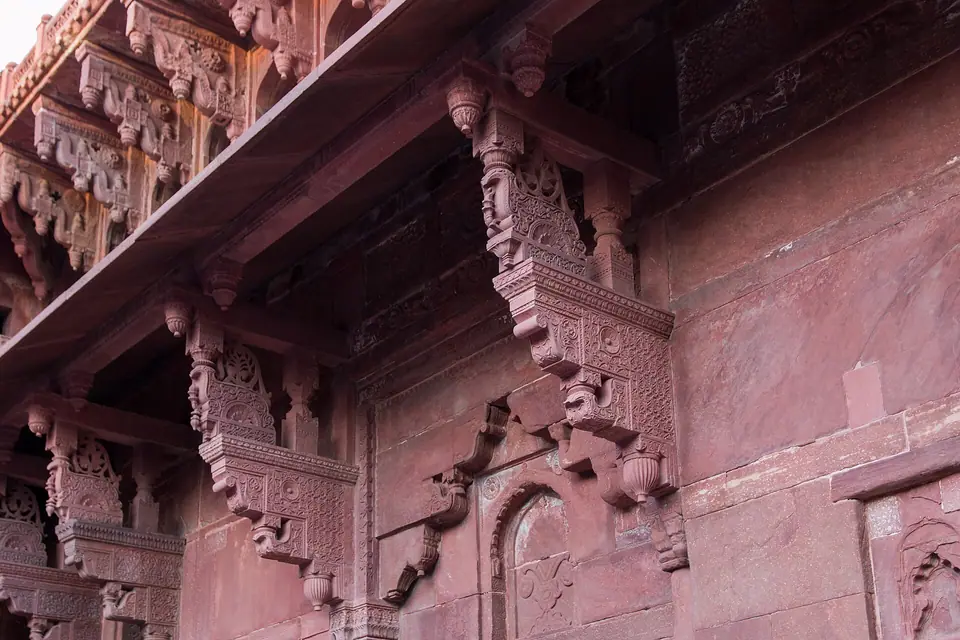
Behind the cistern rises the Jahangiri Mahal, built around 1570 by Akbar as the principal zenana palace for his Rajput queens, including Mariam-uz-Zamani. Because Akbar recruited temple stonemasons from Gujarat, Gwalior, and Rajasthan, the palace blends Hindu and Islamic design in red sandstone. Its two-storey courtyard features overhanging stone eaves (chhajjas) supported by carved serpentine brackets, lotus medallions, peacocks, and mythical elephants, anticipating the style of Fatehpur Sikri.
Shah Jahan's white marble court: Khas Mahal, Anguri Bagh, and Musamman Burj
Walking north along the eastern river rampart from the Jahangiri Mahal, the stone shifts from red sandstone to polished white Makrana marble. Between 1628 and 1637, Fifth Emperor Shah Jahan replaced several older sandstone halls here with a white marble riverside palace complex.
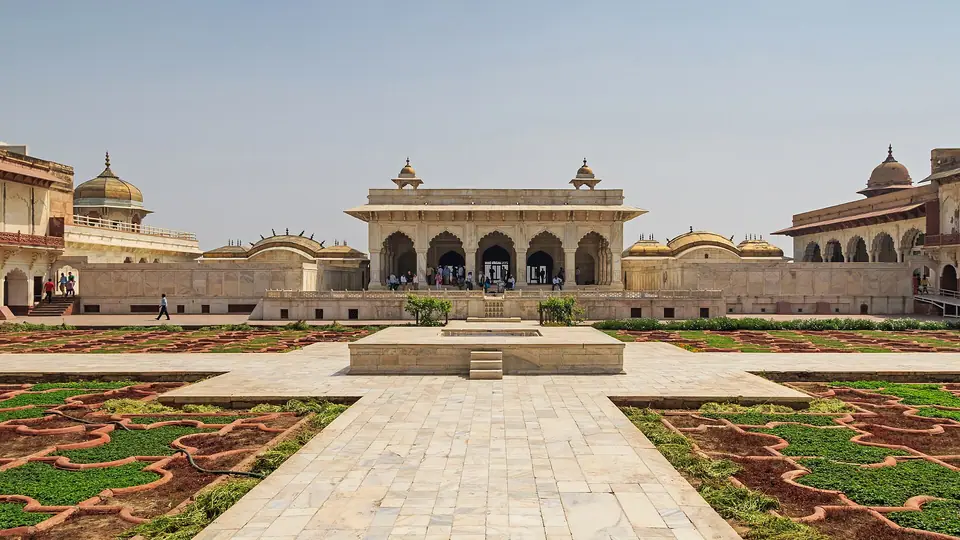
- The Khas Mahal ("Private Palace", 1637) and Golden Bangla Pavilions. Facing a sunken courtyard stands Shah Jahan's white marble sleeping pavilion, flanked by two open marble pavilions capped with curved Bengali-style roofs (do-chala bangla) once plated in gilded copper. Inside the Khas Mahal, wall niches held night oil lamps, while outside lies the sunken Anguri Bagh ("Garden of Grapes"), whose geometric sandstone beds were fed by terracotta water pipes.
- The Musamman Burj ("Octagonal Tower" / Shah Burj), Where Shah Jahan Died Viewing the Taj Mahal. Immediately north of the Khas Mahal projects the two-storey octagonal white marble tower of the Musamman Burj. Built by Shah Jahan for Mumtaz Mahal and later his daughter Jahanara Begum, its marble pillars and sunken fountain basin (kunda) are inlaid with parchin kari floral vines. In June 1658, Shah Jahan's third son Aurangzeb seized the throne and confined the aged emperor to these marble river apartments for eight years until his death on 22 January 1666. Stand at the carved marble lattice balcony of the Musamman Burj and look 2.5 kilometres southeast down the Yamuna bend to see the white dome of the Taj Mahal.
Shish Mahal, Diwan-i-Khas (Black Throne of Jahangir), and Diwan-i-Am
Complete your circuit through the northern courts of the open zone.
- The Shish Mahal ("Palace of Mirrors", 1637). Below the Musamman Burj sits the imperial summer bathhouse (hammam). Its vaulted walls and ceilings are inlaid with thousands of tiny convex glass mirrors imported from Aleppo in Syria.
- The Diwan-i-Khas (Hall of Private Audience) and the Cracked Black Throne of Jahangir. On the open river terrace outside the Diwan-i-Khas sit two monolithic stone thrones: Shah Jahan's white marble seat and the Black Throne (Takht-i-Jahangir). Carved in 1602 in Allahabad from a single slab of black slate (3.2 by 2.9 metres) for Prince Salim, the black throne bears a long diagonal crack linked to the eighteenth-century Jat occupation and the 1803 British siege under Lord Lake.
- The Machchi Bhawan ("Fish Enclosure"), Nagina Masjid, and Diwan-i-Am (Hall of Public Audience). From the upper gallery of the Machchi Bhawan courtyard, view the three white marble domes of the Nagina Masjid ("Gem Mosque"), built for the ladies of the court above the old Mina Bazaar. Finish your walk in the vast Diwan-i-Am, where forty red-sandstone pillars coated in white shell-plaster (chuna) frame the marble alcove that housed Shah Jahan's Peacock Throne before 1648. On the lawn outside rests the tomb of British Lieutenant-Governor John Russell Colvin, who died inside the fort in 1857.
Traveller tips
Visit Agra Fort at 09:00 right after your sunrise visit to the Taj Mahal when morning sun illuminates the river-facing marble balconies of the Khas Mahal and Musamman Burj. Show your same-day Taj Mahal ticket at the counter for the small ADA toll rebate, or scan a pre-booked online QR code to enter directly. Look closely at two additional architectural details inside the fort that hasty tour groups walk past. On the northern rise beyond the Diwan-i-Am gleams the white marble roofline of the Moti Masjid ("Pearl Mosque"). Shah Jahan built this mosque between 1648 and 1654 with three bulbous domes and a white Makrana marble prayer hall. Along the eastern river terrace beside the Machchi Bhawan sit the ruins of Akbar's Bengali Mahal. Its sixteenth-century underground river chambers (tehkhana) kept the court cool during the 42°C May heat. After sunset, Uttar Pradesh Tourism stages a 50-minute Sound and Light Show (Son et Lumière) inside Agra Fort. Tickets cost around INR 200 to INR 300 for foreign visitors and INR 70 to INR 100 for Indian citizens as of November 2026, with separate Hindi and English sessions. Unlike the Taj Mahal, Agra Fort permits small daypacks, water bottles, and smartphones without the strict Shilpgram locker restrictions. Pair this visit with our 3-day Agra itinerary and East Bank Baby Taj guide.
Where it is
- 1Agra Fort
- Agra Airport / Agra Air Force Station (AGR) · about 6 km from here in a straight line
- Directions in Google Maps
Traveller tips
Real advice from people who have been to Agra. Every tip is read by our team before it goes live.
No tips yet. Been here? Yours could be the first.
Thank you! Your tip will appear here after a quick review.
More in Agra
Continue exploring Agra with related neighbourhood, food, and planning guides
How to Get to Agra & Around: Gatimaan & Vande Bharat Express Trains, Yamuna Expressway, Metro & Rickshaws
Agra, India
Best Time to Visit Agra: IMD Climate Normals, Winter Morning Fog vs Summer Heat & Full-Moon Taj Nights
Agra, India
What to Wear in Agra: Taj Mahal Shoe Covers, Hot Marble Socks, Modest Dress & Strict Prohibited Items
Agra, India
Where to Stay in Agra: Taj East Gate Road (Tajganj) vs Fatehabad Road Resorts & Colonial Cantonment
Agra, India
