





















Best Things to Do in Agra: Taj Mahal at Dawn, Agra Fort, Baby Taj, Mehtab Bagh & Fatehpur Sikri
Discover the 12 best things to do in Agra: sunrise at the Taj Mahal, Agra Fort's marble palaces, the Baby Taj, sunset at Mehtab Bagh, Fatehpur Sikri, and Sikandra.
Too many travellers treat Agra as a hurried four-hour train hop from New Delhi. They rush into the Taj Mahal at 11:00 under harsh midday glare and board an evening train out without ever crossing the Yamuna River. In reality, Agra was the wealthiest imperial metropolis of sixteenth- and seventeenth-century Asia, and its red sandstone fortresses, riverfront Persian tombs, deer parks, and lively spice bazaars reward a full two- to three-day stay. Below are the top experiences in Agra, organized with approximate November 2026 entry fees, ideal lighting windows, and practical field tips.
| Monument / Experience | Zone in Agra | Approx. Nov 2026 Foreign Fee | Ideal Duration & Lighting Window |
|---|---|---|---|
| 1. Taj Mahal & Mausoleum Chamber | Tajganj (South Bank) | 1,100 INR + 200 INR Mausoleum | 2.5 to 3 hours (enter 30 mins before sunrise) |
| 2. Agra Fort (Red Fort of Agra) | West Bank (2.5 km north) | ~650 INR (600 INR online) | 2 to 2.5 hours (08:30 to 11:00 morning light) |
| 3. Tomb of Itimad-ud-Daulah (Baby Taj) | East Bank of Yamuna | ~310 INR (card/QR) | 1 hour (15:00 to 16:15 warm afternoon sun) |
| 4. Mehtab Bagh Sunset Viewpoint | East Bank (opposite Taj) | ~300 INR (card/QR) | 1 hour (arrive 45 mins before sunset) |
| 5. Fatehpur Sikri Ghost Capital | 37 km west of Agra | ~610 INR (card/QR) | 2.5 to 3 hours (08:00 morning excursion) |
| 6. Akbar's Tomb at Sikandra | 10 km northwest on NH-19 | ~310 INR (card/QR) | 1.5 hours (morning or late afternoon) |
Watch the Taj Mahal change colour at dawn through the East Gate
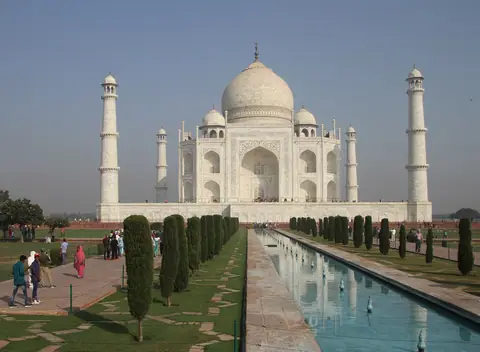
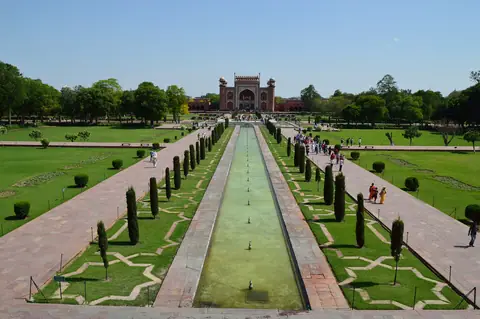
Fifth Mughal Emperor Shah Jahan commissioned the Taj Mahal in 1632 for his beloved wife Mumtaz Mahal (Arjumand Banu Begum). Completed between 1648 and 1653 by 20,000 artisans under Chief Architect Ustad Ahmad Lahori, it stands as the supreme masterpiece of Indo-Islamic architecture. Because its translucent Makrana marble quarried in Rajasthan contains trace iron and crystalline dolomite, the 73-metre central dome shifts colour continuously with the sky. It glows soft pearl-pink before sunrise, dazzling ivory-white by 09:00, and warm champagne-gold at dusk. Queue at the East Gate 30 to 40 minutes before official sunrise (1,100 INR base + 200 INR mausoleum ticket as of November 2026). Entering at dawn lets you walk through the 30-metre red sandstone Great Gate (Darwaza-i-Rauza) before the Delhi tour buses arrive.
Explore the marble palaces and Musamman Burj inside Agra Fort
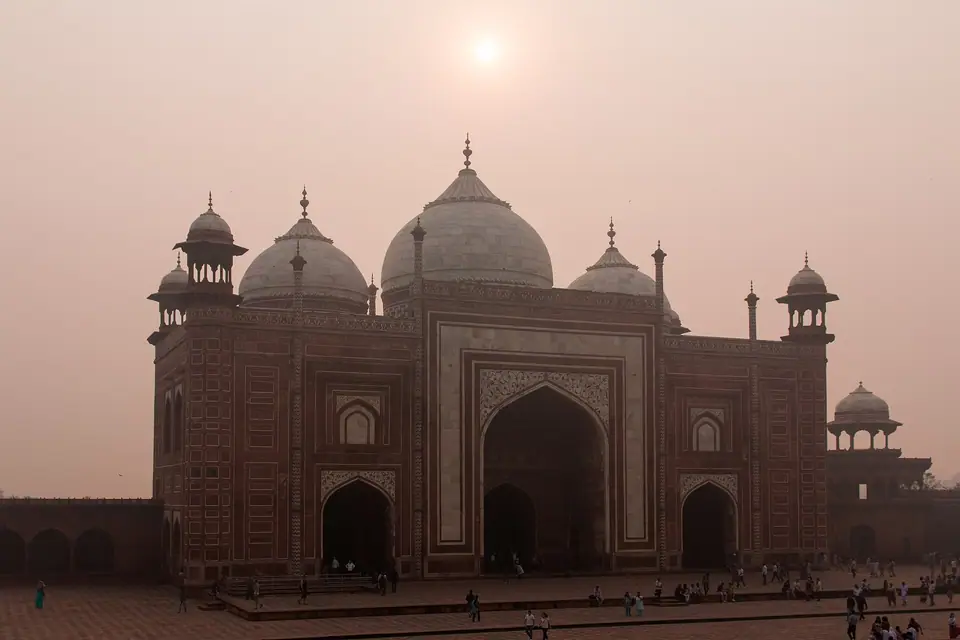
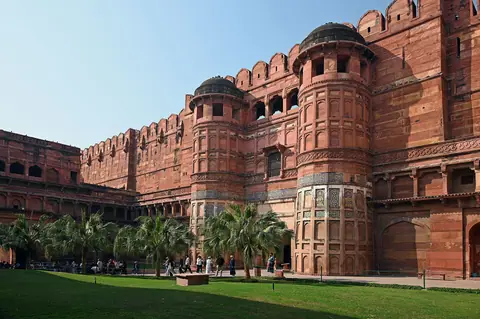
Just 2.5 kilometres northwest along the Yamuna bend stands Agra Fort (Qila-i-Akbari). This UNESCO World Heritage fortress is enclosed by double red sandstone ramparts rising 21.4 metres (70 feet) high across 38 hectares (94 acres). Emperor Akbar the Great began the fortress in 1565 over an earlier Lodi brick citadel, and his grandson Shah Jahan later added gleaming white marble palaces. Enter through the southern Amar Singh Gate (around 650 INR for foreign visitors and 50 INR for Indian citizens as of November 2026). Inside, walk up the ribbed elephant ramp to tour the carved red sandstone Jahangiri Mahal and the monolithic stone bath of the Hauz-i-Jahangiri. Next door stand the gilded marble pavilions of the Khas Mahal overlooking the geometric Anguri Bagh courtyard. Continue to the forty-pillared Hall of Public Audience (Diwan-i-Am), the three-domed white marble Nagina Masjid, and the octagonal marble tower of the Musamman Burj. In that riverfront tower, an aged Shah Jahan spent his final eight years (1658 to 1666) under house arrest by his son Aurangzeb, gazing downriver at the Taj Mahal.
Cross the Yamuna to the "Baby Taj" (Itimad-ud-Daulah) and Chini Ka Rauza
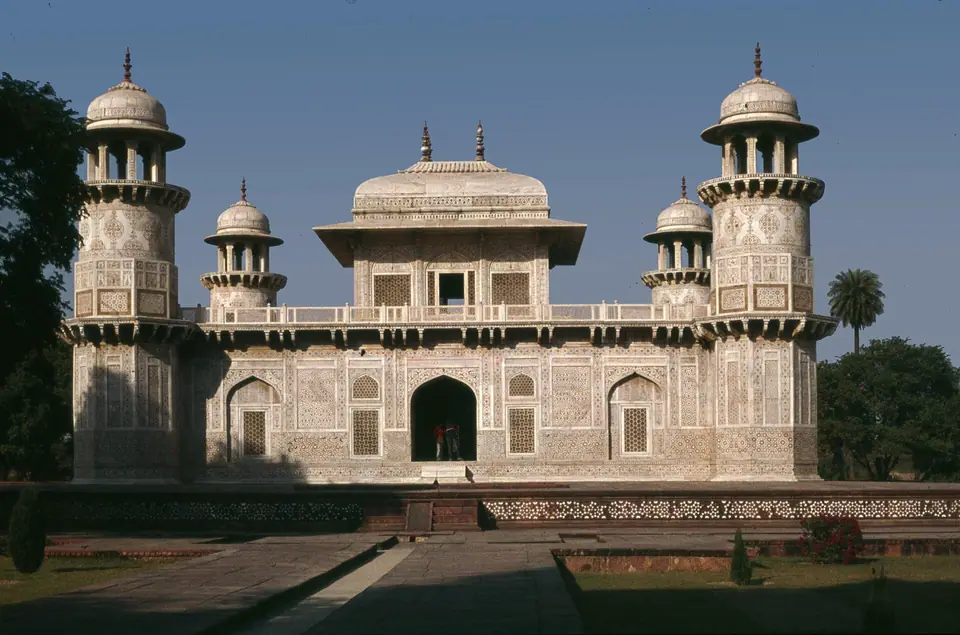
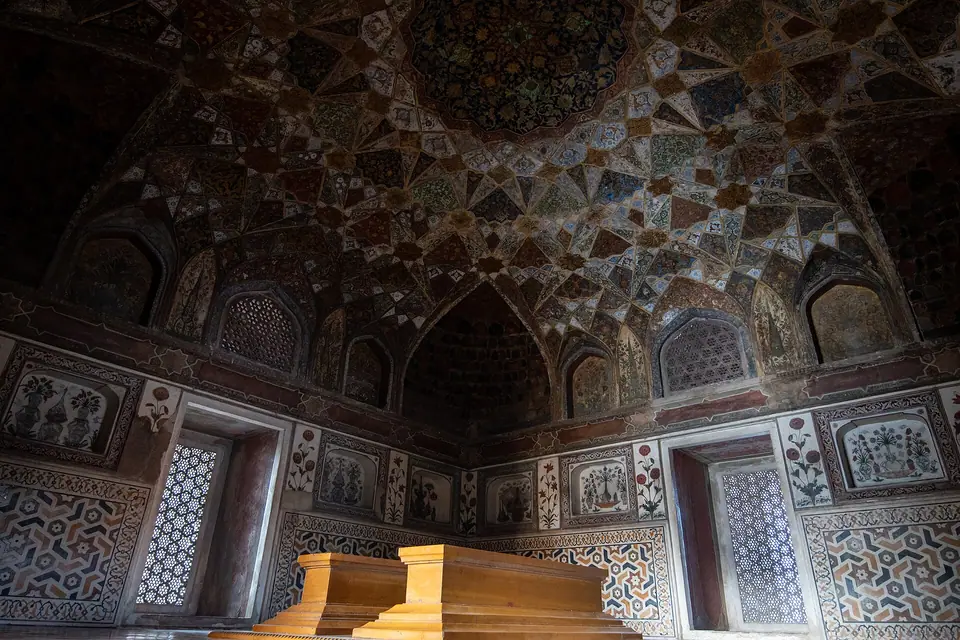
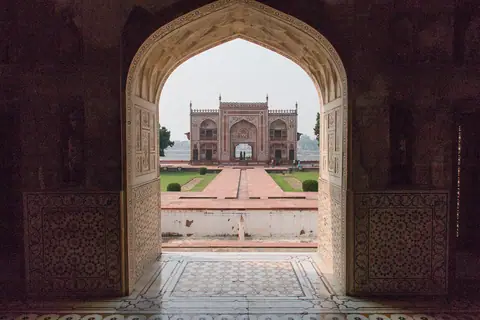
Crossing the Ambedkar Bridge to the quieter East Bank of the Yamuna reveals the architectural bridge between Akbar's robust red sandstone style and Shah Jahan's white marble refinement. Empress Nur Jahan, wife of Emperor Jahangir, commissioned the Tomb of Itimad-ud-Daulah (~310 INR as of November 2026) between 1622 and 1628. She built this riverside marble mausoleum for her Persian-born father Mirza Ghiyas Beg, titled Itimad-ud-Daulah ("Pillar of the State"). Set inside a quiet riverside garden with four octagonal corner towers, it was the first Mughal monument in India clad entirely in white marble and inlaid with semi-precious parchin kari stones. Take time to inspect its delicate carved marble jali lattice screens and painted inner chambers depicting Persian wine vessels, cypress trees, and floral vases. One kilometre north along the eastern riverbank stands the free-to-enter Chini Ka Rauza (1635), tomb of Shah Jahan's scholar-vizier Allama Afzal Khan Mullah. Its exterior walls still flash with rare cobalt-blue and turquoise Persian glazed tilework (kashi kari), while a short drive further north leads to Emperor Babur's 1528 Ram Bagh pleasure garden.
Photograph the Taj Mahal at sunset from Mehtab Bagh ("The Moonlight Garden")
Unlike earlier Mughal tombs set in the middle of a four-part garden, the Taj Mahal stands at the northern river edge of its walled enclosure. Across the water, Emperor Shah Jahan redesigned the 300-by-300-metre riverfront garden of Mehtab Bagh on the opposite north bank as the monument's moonlit viewing terrace. Arrive at Mehtab Bagh (~300 INR for foreign visitors and 25 INR for Indian citizens as of November 2026) around 16:30, an hour before sunset. From the southern boundary wall beside the red sandstone corner pavilion, you can photograph the northern marble facade of the Taj Mahal reflected in the Yamuna River without crowds in your frame.
Visit Emperor Akbar's Tomb at Sikandra and Fatehpur Sikri
Two monumental excursions to the north and west complete the Mughal story.
- Akbar's Tomb at Sikandra (10 km northwest of Agra, ~310 INR as of November 2026). Emperor Akbar began his own monument around 1600, and his son Jahangir completed the five-storey pyramidal mausoleum in 1613. As detailed in our Sikandra and northern Agra guide, the tomb sits inside a 48-hectare walled garden where wild blackbuck antelopes, spotted deer, and peacocks graze beneath ancient tamarind trees. One kilometre west stands the red sandstone Tomb of Mariam-uz-Zamani (1623 to 1627), while northern Agra's Soami Bagh Samadh in Dayalbagh showcases live white-marble carving that has continued non-stop for over a century. Climb to the open fifth-floor white marble courtyard to see the cenotaph carved with the 99 names of God.
- Fatehpur Sikri (37 km west of Agra, ~610 INR as of November 2026). Emperor Akbar built Fatehpur Sikri between 1571 and 1585 as his ceremonial capital in honour of Sufi mystic Sheikh Salim Chishti, before abandoning the ridge when its water supply failed. Today the red sandstone ghost city preserves the 54-metre Buland Darwaza ("Gate of Magnificence"), the white marble shrine of Salim Chishti, the five-tiered Panch Mahal pavilion, Jodha Bai's Palace, and the lotus-carved central pillar of the Diwan-i-Khas.
Walk Kinari Bazaar, watch a Parchin Kari master, and taste Mughlai street food
Round out your afternoons away from monument turnstiles by strolling the spice, silver-trim (zardozi), and bridal lanes of Kinari Bazaar behind Jama Masjid. Stop at a family workshop in Gokulpura or Tajganj to watch a master artisan use a hand-turned bow wheel to set tiny petals of carnelian and malachite into Makrana marble. Wildlife lovers can also book a day trip to Keoladeo National Park at Bharatpur or the National Chambal Sanctuary to spot gharial crocodiles, Gangetic river dolphins, and winter storks. In the evening, feast on smoky Mughlai kebabs, breakfast bedai, and translucent petha sweets using our Agra food guide.
Traveller tips
If your travel dates overlap with the full moon (Purnima), note that the Archaeological Survey of India opens the Taj Mahal for special 30-minute Night Viewing sessions. These run on the night of the full moon plus two nights before and two nights after, excluding Fridays and the month of Ramadan. Only 400 visitors per night are admitted in eight batches of 50 people between 20:30 and 23:59 to admire the moonlit dome from the red sandstone platform. Tickets cost 750 INR for foreign adults and 510 INR for Indian citizens (as of November 2026) and must be booked online or via the ASI window 24 hours in advance with passport verification. For a greener morning walk without ticket queues, visit the 70-hectare Taj Nature Walk just 500 metres east of the East Gate (entry around 100 INR for foreign visitors and 20 INR for Indian citizens as of November 2026), where elevated wooden watchtowers look across woodland trails and dancing peacocks toward the eastern flank of the Taj Mahal.
Where it is
- 1Agra
- Agra Airport / Agra Air Force Station (AGR) · about 8 km from Agra in a straight line
- Directions in Google Maps
Traveller tips
Real advice from people who have been to Agra. Every tip is read by our team before it goes live.
No tips yet. Been here? Yours could be the first.
Thank you! Your tip will appear here after a quick review.
More in Agra
Continue exploring Agra with related neighbourhood, food, and planning guides
Agra 3-Day Itinerary: Taj Mahal Dawn, Red Sandstone Agra Fort, Baby Taj, Mehtab Bagh & Fatehpur Sikri
Agra, India
Taj Mahal Complete Guide: East vs West Gates, Mausoleum Ticket Add-On, Pietra Dura Inlay & Optical Illusions
Agra, India
Agra Fort Guide: Amar Singh Gate, Jahangiri Mahal, Diwan-i-Khas & Shah Jahan's Musamman Burj Tower
Agra, India
East Bank of the Yamuna Guide: Tomb of Itimad-ud-Daulah (Baby Taj), Chini Ka Rauza & Mehtab Bagh
Agra, India
