























Agra Crafts & Markets: Parchin Kari Marble Inlay, Zardozi, Sadar & Kinari Bazaar
Identify genuine Makrana marble parchin kari vs soapstone in Agra, explore Kinari Bazaar and Sadar Bazaar, and avoid driver commission traps.
In the 1630s, Emperor Shah Jahan summoned master stonecutters, lapidaries, calligraphers, and weavers to ornament the Taj Mahal and Agra Fort. Many of those families settled permanently in Gokulpura, Tajganj, Nai ki Mandi, and Kinari Bazaar. Four centuries later, their descendants still practice four signature Agra crafts: Parchin Kari (marble stone inlay), Zardozi (metallic embroidery), hand-knotted Mughal carpets, and stitched leather footwear. At the same time, Agra's souvenir trade is notorious for aggressive driver-commission showrooms that pass off soft soapstone and dyed synthetic resin as heirloom Makrana marble at exorbitant mark-ups. Below, we explain the step-by-step craft behind parchin kari, how to perform three simple physical tests before buying any stone piece, and how to navigate Kinari Bazaar, Subhash Bazaar, and Sadar Bazaar independently.
| Craft / Market | Primary Quarter in Agra | Authentic Material | Common Tourist Substitute | Typical Fair Price Range (Nov 2026) |
|---|---|---|---|---|
| 1. Parchin Kari (Marble Inlay) | Gokulpura & Tajganj workshops | Makrana white marble + lapis, malachite, cornelian, mother-of-pearl | Soft soapstone / Gorara stone + coloured plastic resin paste | Coaster set: INR 1,800 to 3,500. 12-inch plate: INR 8,500 to 22,000+ |
| 2. Zardozi Embroidery | Kinari Bazaar & Nai ki Mandi | Silk/velvet base worked with dabka coiled wire and kasab thread | Machine-stitched polyester lurex appliqués glued onto stiff backing | Wall hanging / clutch bag: INR 1,200 to 4,500 |
| 3. Hand-Knotted Mughal Rugs | Fatehabad Road & Purani Mandi looms | Pure New Zealand/Bikaner wool on cotton warp or Kashmir silk (140 to 400+ KPSI) | Mercerized cotton ("art silk" / rayon) sold falsely as pure mulberry silk | 3x5 ft wool rug: INR 14,000 to 28,000 |
| 4. Leather Footwear & Goods | Sadar Bazaar, Hing ki Mandi & Munro Road | Full-grain tanned leather uppers with stitched soles | Bonded synthetic pleather with glued cardboard insoles | Men's/women's leather shoes: INR 1,400 to 3,200 |
How Parchin Kari (Pietra Dura) is made and the 3-step authenticity test
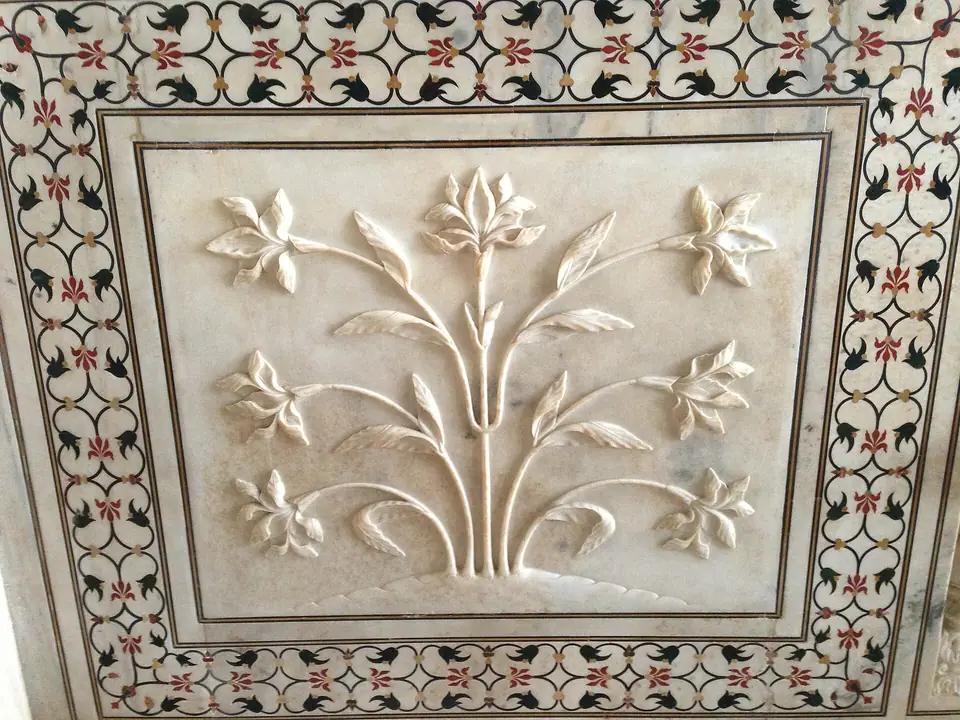
True Parchin Kari (literally "driven-in work") is one of the most labour-intensive lapidary arts in the world. Unlike Florentine pietra dura panels assembled from flat tiles, Agra's artisans carve recessed cavities directly into solid white marble brought 350 km from Makrana in Rajasthan.
- The Traditional Five-Stage Workshop Process. First, the master draughtsman traces a floral motif (jasmine, poppy, iris, or cypress) onto the polished marble using brass stencils and red ochre pigment (geru). Second, a chiseller (naqqash) carves out tiny sockets 2 to 3 millimetres deep with hardened steel micro-chisels. Third, the lapidary shapes paper-thin slivers of lapis lazuli, green malachite, orange-red cornelian (aqiq), turquoise, jasper, and mother-of-pearl against a hand-cranked emery bow wheel (san). Notice how a single 2-centimetre poppy flower in the Taj Mahal's cenotaph screen can contain thirty to sixty microscopic stone petals shaded from dark crimson to pale rose. Fourth, the slivers are set into the cavities using a traditional white lime-and-tree-resin cement (masala) heated over charcoal. Finally, the surface is polished flat with sandstone blocks and water so the joint is invisible to the fingertip.
- Test 1: The Flashlight Translucency Test. High-grade Makrana marble has a crystalline calcite structure with 98 percent calcium carbonate. Press the LED flashlight of your smartphone flat against the back of a marble plate or box in a shaded corner of the shop. Genuine Makrana marble transmits a warm, milky-golden glow through slabs up to 15 millimetres thick, whereas cheap soapstone (pathar) or composite powder blocks light completely or shows blotchy grey patches.
- Test 2: The Fingernail & Coin Hardness Test. Turn the piece over and inspect an unlacquered bottom rim. Soapstone has a Mohs hardness of 1 to 2 and can be scratched easily with a fingernail or brass key, shedding white talcum-like dust. Real Makrana marble (Mohs hardness 3 to 4) will not scratch under a fingernail and feels noticeably heavier and colder against your cheek.
- Test 3: Inspecting the Inlay Edges with a Magnifier. Use your phone camera's macro zoom to inspect the flower petals. In genuine parchin kari, each petal is a distinct piece of polished mineral stone with natural veining. In cheap imitations, hollowed outlines are simply filled with dyed epoxy resin or painted over with clear varnish that yellows and peels within a year.

Walking Kinari Bazaar, Subhash Bazaar, and Rawatpara
For an authentic market walk free of tour-bus showrooms, head east from the Jama Masjid archway opposite Agra Fort into Kinari Bazaar. Visit between 11:00 and 18:30 from Tuesday to Saturday, as many wholesale stalls close on Sundays or Mondays.
- Kinari Bazaar (Zardozi, Gotapatti & Bridal Borders). Named after the silver and gold borders (kinari) on North Indian wedding garments, Kinari Bazaar is lined with mezzanine workshops. Inside, embroiderers stretch silk or velvet over wooden frames (adda) and use a hooked needle (ari) to stitch coiled wire (dabka), seed pearls, and sequins into peacock and paisley motifs. Here you can buy small framed Zardozi panels, embroidered evening clutches, and brocade cushion covers directly from retail counters at a fraction of hotel arcade prices.
- Subhash Bazaar & Lohar Gali. Along the northern wall of the Jama Masjid, Subhash Bazaar specialises in handloom saris, block-printed cottons, brassware, and glass bangles from nearby Firozabad (40 km east).
- Sadar Bazaar (Cantonment Evening Promenade). If you prefer relaxed, fixed-price shopping without narrow-lane scooter traffic, head to Sadar Bazaar in the Agra Cantonment after 17:00. Closed to cars along its central promenade, Sadar Bazaar is the best place in Agra to buy stitched leather shoes, embroidered mojaris, and boxed petha sweets with printed receipts.
How to avoid the Agra driver-commission trap and Traveller tips
Understanding the economics of Agra's tourist showrooms will save you both money and itinerary time.
- Quick Decision Block (Best Bazaars: Kinari Bazaar & Sadar Bazaar · Top Souvenirs: Parchin Kari coasters, Zardozi clutches, Panchhi Petha · Golden Rule: Never shop with a driver in tow). Even when a driver is friendly all morning, any showroom where they walk you to the door adds a 30% to 50% commission to the price.
- How to Shop Independently. To buy a marble plate or tabletop at local prices, finish your tour first, dismiss your driver at your hotel, and take an independent Uber or Ola to the workshop or a state UP Handlooms outlet. When walking in step-by-step from the street alone, inform the shopkeeper immediately at the door: "I came alone by myself, there is no driver or guide waiting outside."
- Shipping Heavy Marble Tops Safely. Never pay in full for an expensive marble dining table to be "shipped later by DHL/cargo" unless you have verified the store's export credentials independently. Unscrupulous outlets have been known to ship lower-grade stone slabs with fewer inlays than the showroom piece you signed on the back. Whenever possible, buy smaller pieces (coasters, jewellery boxes, 8-to-12-inch plates) that fit padded inside your own checked or carry-on luggage, and combine your market walk with our Agra Food Guide.
- How to Verify Hand-Knotted Silk and Wool Mughal Carpets. If you browse Agra's carpet looms for Persian-Mughal floral lattice or tree-of-life designs, turn the rug over to inspect the back. In a genuine hand-knotted rug, every knot is slightly uneven and the pattern is sharp on the underside, whereas machine-tufted rugs have a canvas backing glued with latex. Ask the weaver whether the pile is pure wool, mulberry silk, or mercerized cotton ("art silk"), which looks glossy in showroom spotlights but flattens quickly underfoot.
- Shopping for Stitched Leather in Sadar Bazaar & Hing ki Mandi. Agra produces more than half of India's domestic leather footwear, a craft dating back to the Mughal cavalry saddlers and British Cantonment bootmakers. For reliable quality with printed price tags, visit the established shoe stores along Taj Road in Sadar Bazaar. Hand-stitched leather loafers, boots, and embroidered bridal juttis cost INR 1,400 to INR 3,200 (~USD 16.50 to USD 38 as of November 2026).
Bargaining etiquette, payment rules, and Traveller tips
- Bargaining Etiquette & Payment Tips. In local wholesale lanes like Kinari Bazaar and Subhash Bazaar, polite bargaining of 15 to 25 percent is normal on unlabelled textiles and brassware. By contrast, state emporiums and Sadar Bazaar shoe shops operate on fixed prices. Always carry small INR 100 and INR 500 notes for bazaar purchases, and pair your afternoon walk with our Agra Fort Guide.
Where it is
- 1Agra Crafts & Markets
- Agra Airport / Agra Air Force Station (AGR) · about 6 km from here in a straight line
- Directions in Google Maps
Traveller tips
Real advice from people who have been to Agra. Every tip is read by our team before it goes live.
No tips yet. Been here? Yours could be the first.
Thank you! Your tip will appear here after a quick review.
More in Agra
Continue exploring Agra with related neighbourhood, food, and planning guides

Day Trips from Agra: National Chambal River Safari, Bateshwar Temples & Bharatpur
Agra, India

What to Eat in Agra: Bedai & Jalebi, Panchhi Petha, Mughlai Kitchens & Chaat Gali
Agra, India

Agra Orientation: Taj Mahal Gate Rules, Friday Closures, ASI Cashless QR Tickets & Avoiding Tout Traps
Agra, India

Best Things to Do in Agra: Taj Mahal at Dawn, Agra Fort, Baby Taj, Mehtab Bagh & Fatehpur Sikri
Agra, India
