





















Taj Mahal Complete Guide: East vs West Gates, Mausoleum Ticket Add-On, Pietra Dura Inlay & Optical Illusions
Plan a flawless visit to the Taj Mahal in Agra: compare East vs West Gate sunrise queues, understand the 1,100 + 200 INR mausoleum ticket, and decode Ustad Ahmad Lahori's optical illusions.
Inscribed as a UNESCO World Heritage Site in 1983 (Reference 252) across a 17-hectare (42-acre) walled complex on the Yamuna River, the Taj Mahal ("Crown of Palaces", originally Rauza-i-Munawwara) was commissioned in 1632 by Fifth Mughal Emperor Shah Jahan. He built the monument after his favourite wife, Mumtaz Mahal (Arjumand Banu Begum), died on 17 June 1631 in Burhanpur while giving birth to their fourteenth child, Gauhara Begum. The central white marble mausoleum was completed by 1648, and the outer red sandstone courts, mosque, and gateway were finished in 1653. Across those twenty-one years, 20,000 stonecutters, calligraphers, and inlay masters under Chief Architect Ustad Ahmad Lahori created a symmetrical vision of Paradise on earth. Below is our step-by-step architectural and logistical field guide.
| Gate / Ticket Tier | Access & Rules (As of Nov 2026) | Approx. Fee / Distance | Field Verdict |
|---|---|---|---|
| 1. East Gate (via Shilpgram) | Opens 30 mins before sunrise (closed Fridays). Free golf cart from Shilpgram for foreign ticket holders | 600 m golf-cart shuttle or flat walk from East Gate hotels | Best gate for foreign travellers: shortest dawn security queue and closest to Tajganj resorts |
| 2. West Gate (via Amrood Ka Teela) | Opens 30 mins before sunrise (closed Fridays). Main entrance for domestic day-trippers | 800 m shuttle from West parking. Near Taj Mahal Metro | Best if arriving by morning train/metro, though queues build fast after 07:30 |
| 3. South Gate (Sidhi Darwaza) | EXIT ONLY since 2018 (no morning or daytime entry permitted) | Opens into old Tajganj market lanes | Use only when exiting the complex into Tajganj for breakfast or rooftop cafés |
| 4. Base Ticket vs Mausoleum Add-On | 3-hour maximum stay limit from turnstile scan. Separate Foreign / High-Value turnstile lane | 1,100 INR base + 200 INR Mausoleum = 1,300 INR total | Always buy the 1,300 INR combined ticket online so you can enter the inner cenotaph chamber |
East Gate vs West Gate and the 1,300 INR High-Value Ticket procedure
The Taj Mahal opens its turnstiles 30 minutes before official sunrise and closes 30 minutes before sunset every day except Friday. To stand inside the Great Gate when the gardens are virtually empty, follow this exact sequence.
- Book the 1,300 INR Combined Ticket Online (1,100 INR Base + 200 INR Mausoleum). Purchase your e-ticket on the official ASI portal (asi.payumoney.com or tajmahal.gov.in) with a Visa or Mastercard (1,250 INR total online with the 50 INR digital discount as of November 2026). If you buy only the 1,100 INR base ticket, guards at the foot of the white marble platform will bar you from ascending into the central mausoleum!
- Collect Your Free Shoe Covers, Water, and Golf Cart at Shilpgram (East Gate). Arrive at the Shilpgram parking plaza 45 minutes before sunrise. Show your QR ticket at the ADA High-Value counter to pick up your complimentary 500 ml water bottle and cloth shoe covers. Then board the free battery golf cart to the East Gate security plaza.
- Use the Separate Foreign / High-Value Ticket Security Lane (Men & Women Split). At the gate, CISF security separates into four queues: Foreign/High-Value Men, Foreign/High-Value Women, Domestic Men, and Domestic Women. Because women's security uses a single enclosed curtained frisking booth, the women's queue moves slightly slower than the men's line. Leave all bags, power banks, food, and earbuds at your Tajganj hotel as detailed in our security checklist so you pass in 30 seconds.
Walking the Charbagh axis: The Great Gate optical illusion and the four minarets
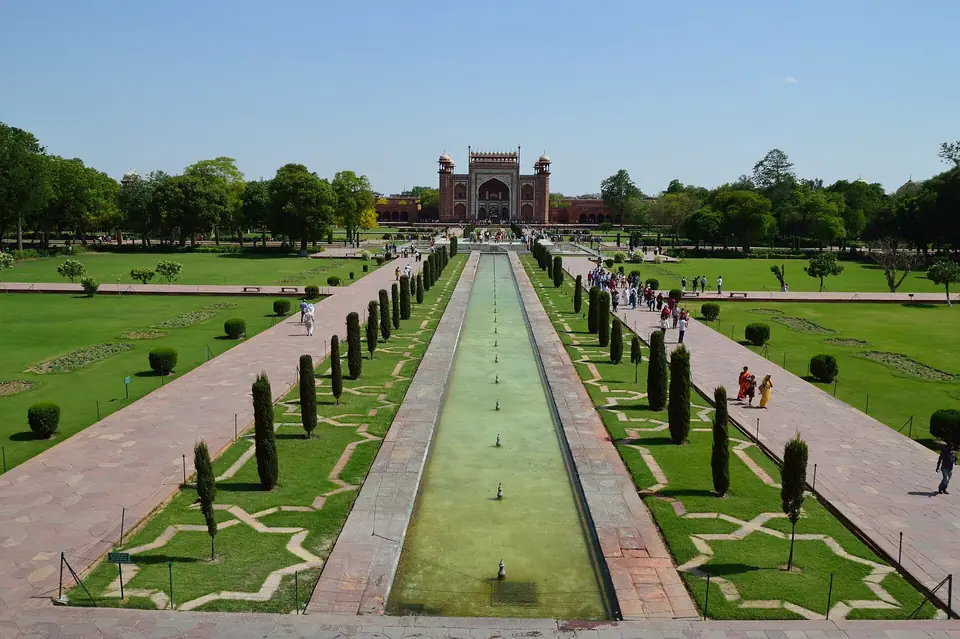
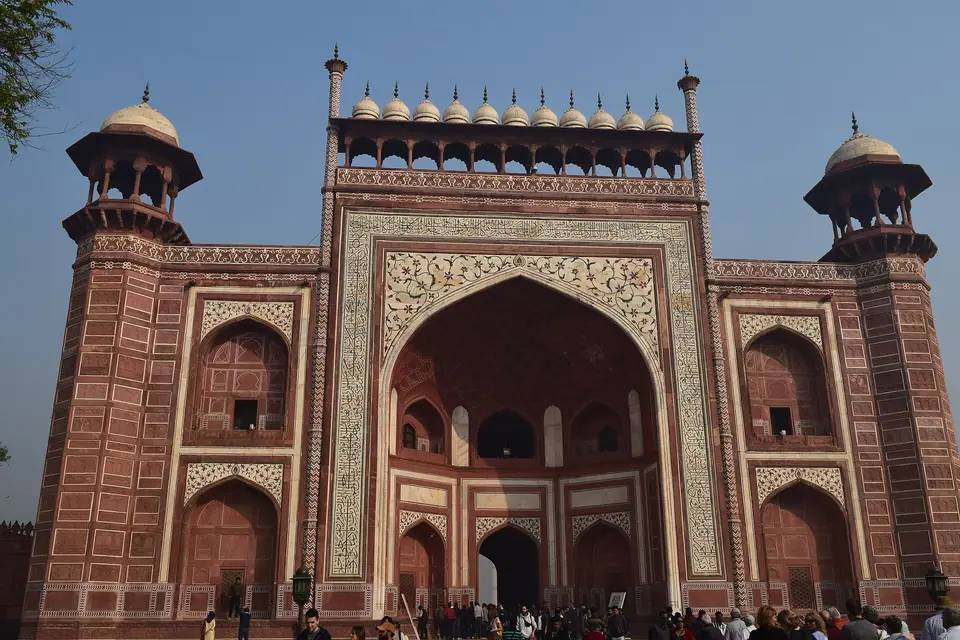
After clearing the East Gate turnstile, you enter the red sandstone outer forecourt (Jilaukhana) and turn right toward the Great Gate (Darwaza-i-Rauza). Standing 30 metres high, the gateway is crowned by two rows of 11 small white marble domes (chhatris), making 22 domes in total to represent the 22 years of construction. Notice three intentional optical illusions engineered by Ustad Ahmad Lahori as you step through the archway.
- 1. The Expanding-and-Shrinking Gate Frame Illusion. Stand at the back of the shadowed interior hall of the Great Gate looking north: the white marble Taj Mahal fills the entire pointed archway, appearing toweringly close. As you walk forward out of the gate toward the mausoleum, the Taj Mahal appears to shrink and recede into the distance as the surrounding sky opens up!
- 2. Uniform-Height Quranic Calligraphy by Amanat Khan Shirazi. Across the white marble arch frames (pishtaq) of the Great Gate and mausoleum, Persian master calligrapher Abd ul-Haq (titled Amanat Khan) inlaid black slate verses from Surah Yasin and Surah Al-Fajr. To prevent the upper lines 25 metres overhead from looking small from the ground, Amanat Khan gradually increased the letter height as the inscription climbed the arch. As a result, every line appears uniform in size to the viewer below.
- 3. The Outward-Tilting 40-Metre Minarets and Chevron Herringbone Columns. Framing the raised 95-by-95-metre white marble plinth stand four 40-metre-tall cylindrical minarets. Each minaret was engineered with a deliberate 2-degree outward tilt away from the central dome. In the event of an earthquake, the towers would fall outward onto the river terrace rather than crashing onto the tomb. Similarly, the black-and-white chevron inlay on the corner engagements of the gates makes the six-sided columns appear octagonal.
Inside the Mausoleum, the Mosque, and the Jawab
Before climbing the central staircase onto the white marble platform (chameli farsh), pull your cloth shoe covers over your sneakers. Explore the two flanking red sandstone buildings first while early morning light warms their facades.
- The Western Mosque and Eastern Jawab ("The Answer"). On the left (west) side of the marble platform stands a working three-domed red sandstone mosque inlaid with white marble prayer mats (musallas) for 569 worshippers. Directly opposite on the eastern flank stands an identical twin building called the Jawab ("The Answer" or Mehmaan Khana guesthouse), erected to preserve bilateral symmetry. Because the Jawab faces west toward the Taj rather than Mecca, its floor replaces prayer-mat outlines with geometric floral patterns.
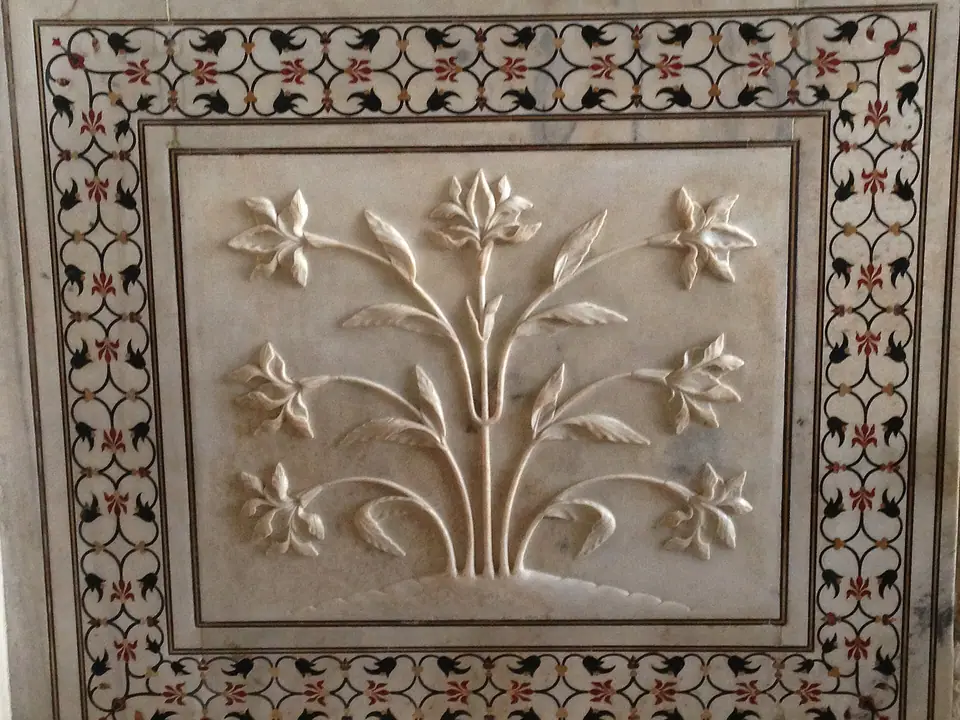
- Parchin Kari (Pietra Dura) and the Octagonal Marble Jali Screen. Stepping inside the central white marble mausoleum (where photography is strictly prohibited), your eyes adjust to the cool semi-darkness beneath the inner dome (24 metres high, above it rises a hollow structural brick-and-marble outer onion dome soaring 73 metres / 240 feet to its gilded bronze lotus-and-crescent finial). Surrounding the cenotaphs stands an octagonal screen of eight carved Makrana marble lattice panels (jali), each chiselled from a single marble slab into lacy floral scrollwork. Artisans inlaid the marble with 28 varieties of semi-precious stones, including Badakhshan lapis lazuli, Tibetan turquoise, Khotan jade, Burmese amber, Red Sea coral, and Gujarati carnelian. Often takes 43 separate microscopic stone slivers to form a single 2-centimetre lily blossom!
- Why Shah Jahan's Cenotaph Breaks the Perfect Symmetry. Inside the octagonal screen rest the two ornate upper cenotaphs, while the actual bodies of Mumtaz Mahal and Shah Jahan lie in plain graves directly below in the subterranean crypt. Notice that Mumtaz Mahal's smaller cenotaph, inscribed with the 99 Beautiful Names of Allah, sits dead-centre on the axis of the Taj Mahal. Beside her, Shah Jahan's larger cenotaph (topped with a sculpted qalamdan pen-box) sits crowded slightly to the west. Added in 1666 when Aurangzeb buried his father next to Mumtaz, it is the only asymmetrical element in the entire complex.
Traveller tips
For a quiet angle without crowds in your frame, walk past the reflecting pool at 06:30 and head straight to the courtyard in front of the eastern Jawab. From its shadowy arched portico, the rising sun backlights the white marble dome and casts long reflections across the red sandstone flagstones. Before exiting through the southern or eastern forecourt, walk into the red sandstone Taj Museum located inside the western Naubat Khana (Drum House) pavilion midway along the garden wall. Entry to the museum is free with your Taj Mahal ticket, and its three galleries display seventeenth-century imperial decrees (farmans) bearing Shah Jahan's royal seal together with architectural drawings. You can also examine Makrana quarry tools, raw stone samples used in parchin kari inlay, and green celadon plates said to change colour if touched by poison. Pair your morning with our Agra Fort guide and 3-day Agra itinerary.
Where it is
- 1Taj Mahal Complete
- Agra Airport / Agra Air Force Station (AGR) · about 8 km from here in a straight line
- Directions in Google Maps
Traveller tips
Real advice from people who have been to Agra. Every tip is read by our team before it goes live.
No tips yet. Been here? Yours could be the first.
Thank you! Your tip will appear here after a quick review.
More in Agra
Continue exploring Agra with related neighbourhood, food, and planning guides
Fatehpur Sikri Guide: Buland Darwaza, Jama Masjid, Salim Chishti & Royal Complex
Agra, India
Sikandra (Akbar's Tomb), Mariam-uz-Zamani & Dayalbagh Soami Bagh Temple Route
Agra, India
Agra Crafts & Markets: Parchin Kari Marble Inlay, Zardozi, Sadar & Kinari Bazaar
Agra, India

Day Trips from Agra: National Chambal River Safari, Bateshwar Temples & Bharatpur
Agra, India
