


























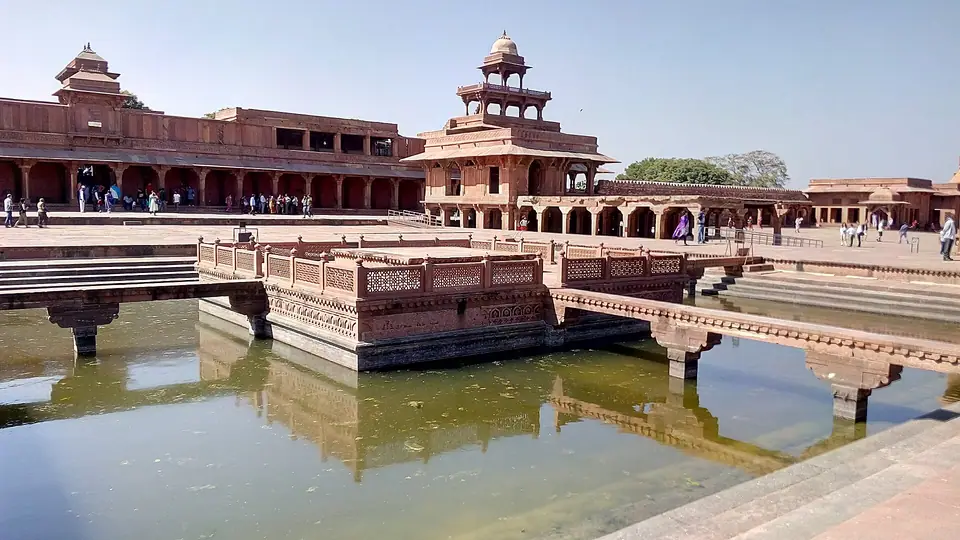
Fatehpur Sikri Guide: Buland Darwaza, Jama Masjid, Salim Chishti & Royal Complex
Plan your visit to Fatehpur Sikri (37 km west of Agra): Buland Darwaza, Salim Chishti's white marble tomb, Diwan-i-Khas, Panch Mahal, and Gulistan shuttle rules.
Perched on a rocky sandstone ridge 37 km west-southwest of Agra along NH-21, Fatehpur Sikri (inscribed as a UNESCO World Heritage site in 1986, Reference 255) was built by Emperor Akbar between 1571 and 1585. Akbar founded the city to honour the Chishti Sufi saint Shaikh Salim Chishti (1478 to 1572), who foretold the birth of Prince Salim (Emperor Jahangir) in 1569. It served as the Mughal capital for fourteen years before Akbar moved his court to Lahore in 1585 when the ridge's water supply failed, leaving the red sandstone palaces untouched. Because the ridge is split between an ASI-ticketed Royal Palace enclave and an active Jama Masjid and Dargah complex, knowing the Gulistan shuttle rules and shrine etiquette prevents tout friction. Below, we compare the main zones, ticket prices, transport options, and a step-by-step walking circuit.
| Zone / Pavilion | Entry Status (Nov 2026) | Key Architectural Highlight | Time Needed | Visitor Rule |
|---|---|---|---|---|
| 1. Royal Complex (Diwan-i-Am to Birbal's House) | ASI Ticket: ~INR 610 foreign / INR 50 domestic | Diwan-i-Khas lotus pillar, Anup Talao, Panch Mahal, Jodha Bai's Palace | 90 to 110 min | Keep ticket for check between Diwan-i-Am and main palace gates |
| 2. Jama Masjid & Buland Darwaza | Free entry (religious precinct) | 54 m gateway above pavement, vast congregational courtyard | 30 to 40 min | Remove shoes at gate. Cover shoulders and knees |
| 3. Tomb of Shaikh Salim Chishti | Free entry (donations optional) | Translucent white Makrana marble lattice screens (jalis) | 20 to 30 min | Head covering required. Decline overpriced chadar cloth bundles |
Getting from Agra to Fatehpur Sikri and navigating the Gulistan shuttle
Reaching Fatehpur Sikri from central Agra is straightforward along the four-lane NH-21 corridor, which continues west toward Bharatpur and Jaipur. Visit Fatehpur Sikri either on a half-day trip from Agra or en route to Keoladeo National Park (Bharatpur, 22 km west) and Jaipur.
- Private AC Car with Driver from Agra. A half-day round-trip taxi from Agra takes 55 minutes each way and costs roughly INR 1,800 to INR 2,500 (~USD 21 to USD 30 as of November 2026), including waiting time.
- UPSRTC State Buses from Idgah Bus Stand. Frequent Uttar Pradesh State Road Transport Corporation buses depart Agra's Idgah Bus Stand every 25 to 30 minutes between 06:30 and 18:00. The journey takes 75 to 90 minutes and costs roughly INR 60 to INR 85 (~USD 0.70 to USD 1.00 as of November 2026) one way, dropping passengers near the foot of the ridge.
- Gulistan Tourist Complex Parking and Shuttle Rule. To protect the sandstone monuments from diesel exhaust, all private cars, taxis, and tour coaches must park at the Gulistan Tourist Complex roughly 1 km below the ridge crest. From Gulistan, official CNG or electric shuttle buses depart every 10 minutes for the ridge at a fixed fare of INR 20 per person each way (~USD 0.25 as of November 2026). Tell your driver to wait at Gulistan and ignore parking-lot touts.
Inside the ASI Royal Palace Complex: Diwan-i-Khas, Anup Talao, and Panch Mahal
When the shuttle bus drops you on the ridge, start at the eastern ASI Royal Palace Complex while morning temperatures are still cool. Foreign visitors pay roughly INR 610 (~USD 7.25 as of November 2026, or INR 560 online) and Indian citizens pay INR 50 (INR 35 online). Entering through the Diwan-i-Am (Hall of Public Audience), you step into the ceremonial heart of the palace complex.
- Diwan-i-Khas (Hall of Private Audience) and the Central Lotus Pillar. The two-storey Diwan-i-Khas contains a single vaulted chamber dominated by an octagonal central pillar carved with geometric and floral motifs. Thirty-six serpentine stone brackets fan outward at the capital to support a circular platform linked by four stone catwalks to the corners.
- Anup Talao and Turkish Sultana's Pavilion (Hujra-i-Anup Talao). South of the Diwan-i-Khas lies the Anup Talao ("Peerless Pool"), a 29-metre-square water tank with a central island platform where court musician Miyan Tansen performed evening ragas. Beside it stands the Turkish Sultana's House, whose sandstone panels are carved with pomegranate trees, palms, lions, and pheasants.
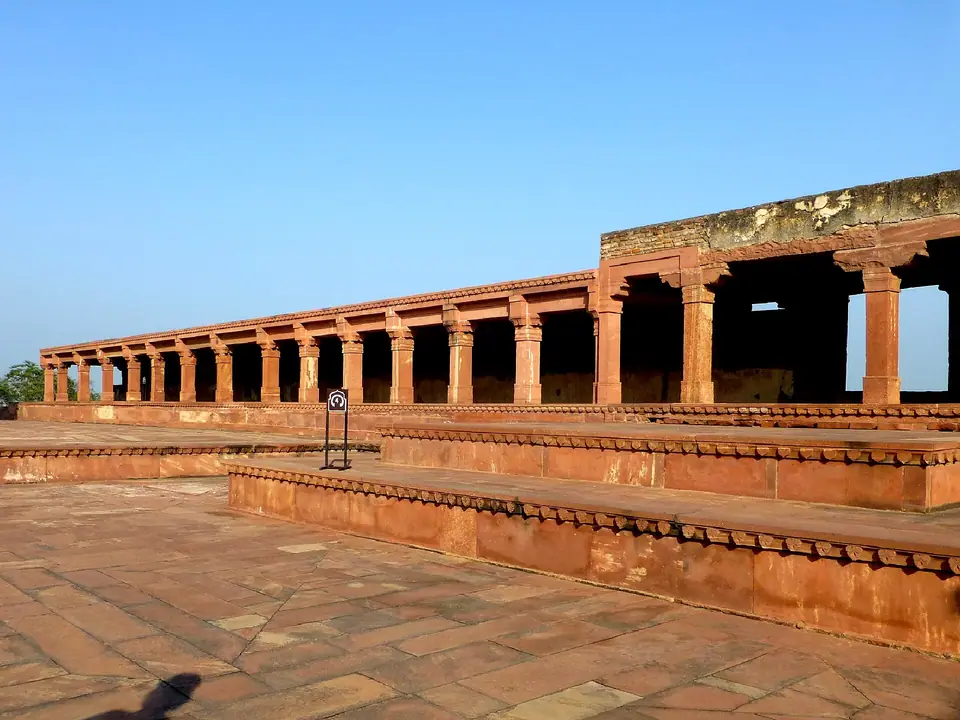
- Panch Mahal (Five-Storeyed Wind Catcher). Rising on the western flank, the Panch Mahal is an open five-tiered wind-catcher supported by 176 carved sandstone columns. These taper from 84 columns on the ground floor to 56, 20, 12, and 4 supporting a top chhatri dome. Every column on the lower tiers carries a unique carved motif, and stone jali screens once gave royal ladies shaded views of the court.
- Jodha Bai's Palace (Shabistan-i-Iqbal) and Birbal's House. Walking south-west brings you into Jodha Bai's Palace, the largest residential compound on the ridge. Its inner courtyard fuses Gujarati and Rajasthani temple brackets with glazed-blue tile roofs. Beyond its north-western corner stands the two-storey Birbal's House (dated by inscription to 1572) and the long arcaded Imperial Stables (Khas Tabela).
Jama Masjid, Buland Darwaza, and the Tomb of Shaikh Salim Chishti
Exiting the western gate of the Royal Complex (the Badshahi Darwaza, reserved originally for the emperor's passage), walk three minutes along the paved path to the vast Jama Masjid precinct (completed 1571 to 1574). Entry to this courtyard is free, and you leave your shoes at the exterior racks for INR 10 to INR 20 while walking in thick socks.
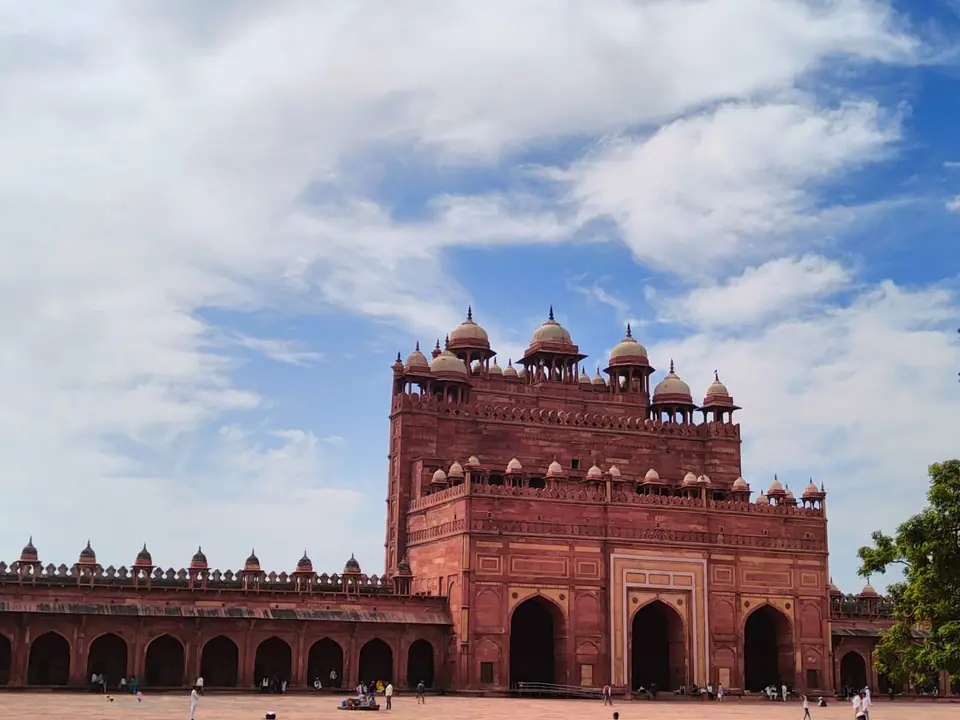
- Buland Darwaza (Gate of Magnificence). Dominating the southern flank of the mosque courtyard, the Buland Darwaza was added by Akbar around 1575 to 1601 to commemorate his victorious Gujarat campaign of 1573. Rising 40 metres from its upper terrace, and a towering 54 metres (177 feet) above the roadway at the base of the 42 monumental entrance steps, it is the highest gateway in the world. Its semi-octagonal recessed portal (pishtaq) combines red and buff sandstone with white marble inlay and carries a famous Persian inscription on its eastern arch quoting Jesus (Isa): "The world is a bridge. Pass over it, but build no house upon it."
- Tomb of Shaikh Salim Chishti. On the northern side of the courtyard gleams the mausoleum of Shaikh Salim Chishti, built in 1580 to 1581 and clad in white Makrana marble by Jahangir in 1606. Its serpentine brackets and lace-like marble jali screens are masterpieces of Mughal stonework. Inside, the saint's cenotaph rests beneath a canopy inlaid with Gujarati mother-of-pearl (sadakari), while pilgrims tie cotton threads (mannat) to the screens.
- Islam Khan's Tomb and Zanana Rauza. East of Salim Chishti's shrine stands the red sandstone domed tomb of Islam Khan I, grandson of the saint and Mughal governor of Bengal.
Touts, Dargah etiquette, and Traveller tips
Because the Jama Masjid and Dargah precinct operates under a local management committee separate from the Archaeological Survey of India, visitor etiquette requires firm boundaries.
- Quick Decision Block (Distance: 37 km · Walking: 2.5 to 3 km on ridge · Duration: 2.5 to 3.5 hrs · Best For: Architecture, Sufi heritage & photography). Arrive at Gulistan parking by 08:00 to beat tour coaches from Jaipur and Delhi. Tour the ASI Royal Complex first (08:15 to 10:00), then visit Buland Darwaza and Salim Chishti's tomb before midday heat peaks on the sandstone paving.
- Declining Forced Chadar Offerings. Inside the Jama Masjid courtyard, unofficial attendants often hand visitors a ceremonial cloth (chadar) or rose-petal tray and then demand INR 500 to INR 2,000 inside the shrine as a mandatory donation. If you wish to donate, drop INR 50 to INR 100 into the locked charity box (golak) and decline pre-packaged cloth bundles.
- Hiring Official Guides Only. For a guided walkthrough of the Royal Complex, hire only a licensed guide carrying a Ministry of Tourism photo badge at the Diwan-i-Am counter (roughly INR 700 to INR 1,000 for two hours as of November 2026).
- Visiting the Archaeological Museum & Hiran Minar. Before leaving the ridge, step into the ASI Treasury Museum opposite the Diwan-i-Am (entry around INR 10 as of November 2026). Its galleries display pre-Mughal Jain and Hindu sculptures together with Mughal celadon ceramics excavated on site. From the northern terrace, look down toward the 21-metre Hiran Minar tower studded with stone elephant tusks that served as the imperial highway zero-mile marker. Pair your trip with our Sikandra & Akbar's Tomb Guide or Agra 3-Day Itinerary.
Where it is
- 1Agra
- Agra Airport / Agra Air Force Station (AGR) · about 30 km from Agra in a straight line
- Directions in Google Maps
Traveller tips
Real advice from people who have been to Agra. Every tip is read by our team before it goes live.
No tips yet. Been here? Yours could be the first.
Thank you! Your tip will appear here after a quick review.
More in Agra
Continue exploring Agra with related neighbourhood, food, and planning guides
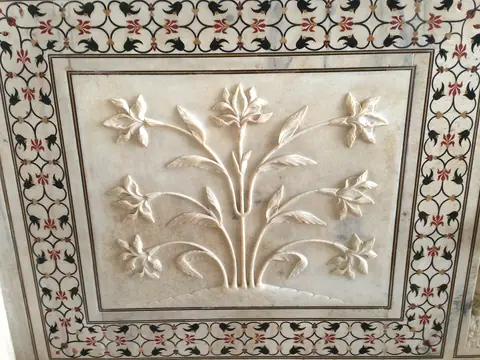
Agra Crafts & Markets: Parchin Kari Marble Inlay, Zardozi, Sadar & Kinari Bazaar
Agra, India
Day Trips from Agra: National Chambal River Safari, Bateshwar Temples & Bharatpur
Agra, India

What to Eat in Agra: Bedai & Jalebi, Panchhi Petha, Mughlai Kitchens & Chaat Gali
Agra, India
Agra Orientation: Taj Mahal Gate Rules, Friday Closures, ASI Cashless QR Tickets & Avoiding Tout Traps
Agra, India
