






















Sikandra (Akbar's Tomb), Mariam-uz-Zamani & Dayalbagh Soami Bagh Temple Route
Explore northern Agra: Emperor Akbar's tiered sandstone-and-marble tomb at Sikandra, Mariam-uz-Zamani's mausoleum, Guru ka Tal, and Dayalbagh Soami Bagh.
Stretching along National Highway 19 (Mathura Road) 10 to 13 km north-west of central Agra, the northern suburb of Sikandra and neighbouring Dayalbagh hold three remarkable monuments. Here stand the garden mausoleum of Emperor Akbar (1604 to 1613) and the sandstone tomb of his Rajput consort Mariam-uz-Zamani (1623 to 1627). Nearby rises the white-marble Soami Bagh Samadh, where master masons have carved botanical reliefs for over a century. Combining Sikandra, the Sikh shrine of Guru ka Tal, and Dayalbagh into a three-hour loop reveals the architectural transition from Akbar's red sandstone to Jahangir's inlaid white marble. Below, we break down each stop, current entry fees, opening hours, and transport logistics.
| Northern Agra Stop | Distance from Agra Fort | Entry Fee (Nov 2026) | Architectural Highlight | Recommended Time |
|---|---|---|---|---|
| 1. Tomb of Akbar the Great (Sikandra) | 11 km north-west (NH-19) | ~INR 310 foreign / INR 30 domestic (online INR 250 / 25) | Four-minaret southern gateway, five-tiered tomb, open marble roof court, blackbuck deer park | 60 to 80 min |
| 2. Tomb of Mariam-uz-Zamani | 12 km north-west (1 km past Sikandra) | ~INR 300 foreign / INR 25 domestic | Forty-chamber brick-and-mortar vault beneath a four-chhatri sandstone baradari pavilion | 30 to 40 min |
| 3. Gurudwara Guru ka Tal | 9.5 km north-west (NH-19) | Free entry (head covering required) | Seventeenth-century 12-tower stone reservoir and shrine where Guru Tegh Bahadur offered arrest in 1675 | 25 to 35 min |
| 4. Soami Bagh Samadh (Dayalbagh) | 9 km north of Agra Fort | Free entry (donations not solicited) | 193 ft white Makrana marble mausoleum under continuous hand-carving since 1908 | 40 to 50 min |
Tomb of Akbar the Great at Sikandra: Gateways, Blackbuck Gardens, and the Roofless Fifth Tier
Named after Sultan Sikandar Lodi, Sikandra was chosen by Emperor Akbar in 1604 for his tomb, which he called Bihishtabad ("Abode of Paradise"). After Akbar died in October 1605, his son Emperor Jahangir rebuilt the upper storeys between 1607 and 1613 in white marble.
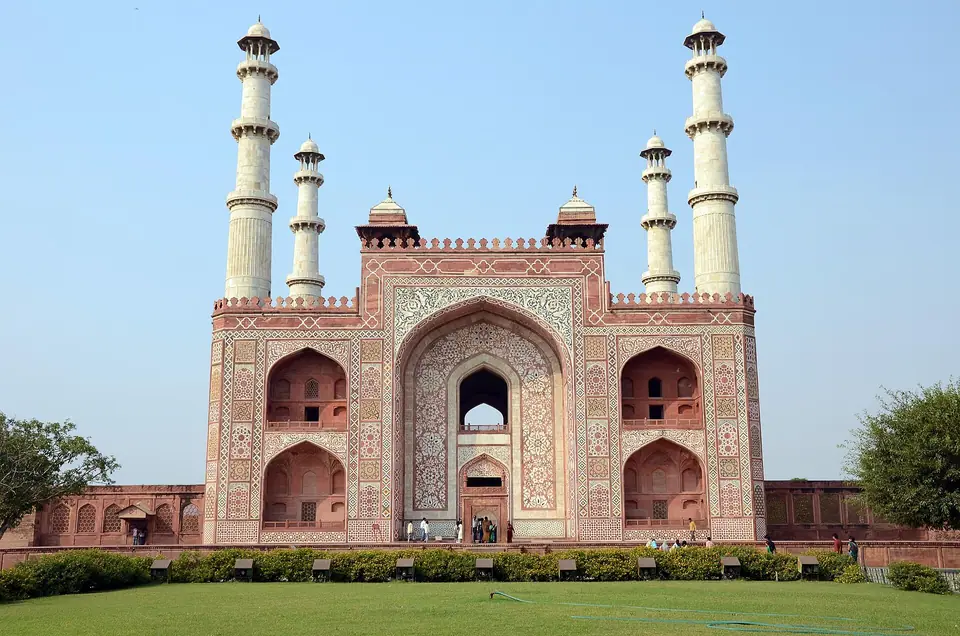
- The Monumental Southern Gateway and Four Marble Minarets. Visitors enter through a colossal two-storey southern gatehouse whose red sandstone facade is completely carpeted in geometric mosaic inlays of white marble, black slate, and yellow and green stone. Crowning the four corners of the gateway roof are four three-storeyed cylindrical white marble minarets. They served as the direct prototype for the corner minarets at the Tomb of Itimad-ud-Daulah and the Taj Mahal.
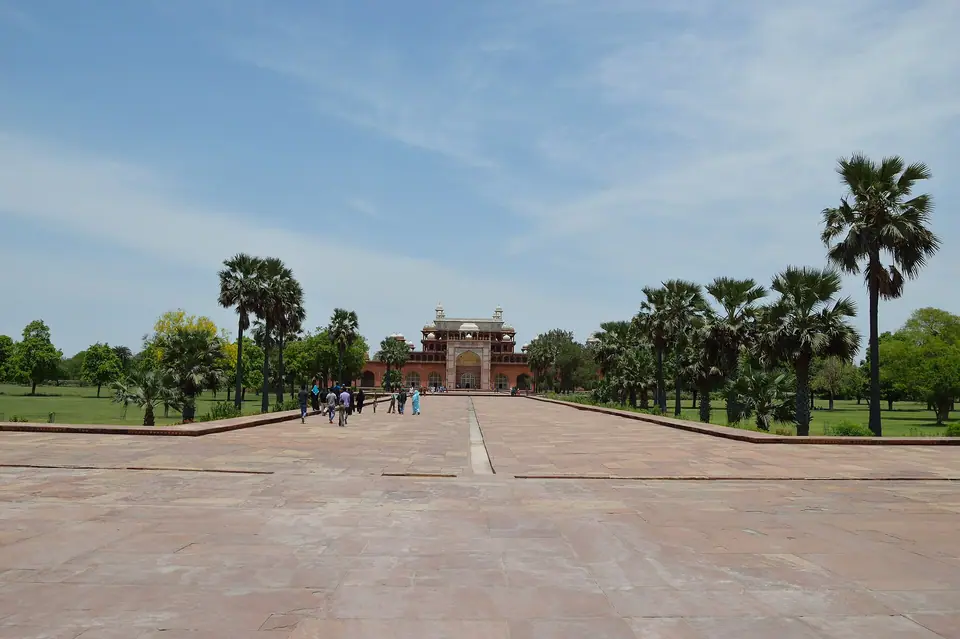
- The 119-Acre Charbagh and Free-Roaming Blackbuck Antelope. Passing through the southern gate reveals a vast walled charbagh (four-quartered garden) divided by raised sandstone water channels and causeways leading to the central mausoleum. Look into the shaded lawns along the causeway, where herds of Indian blackbuck antelope (Antilope cervicapra), spotted chital deer, and peacocks graze beneath old tamarind trees.
- The Vaulted Crypt and the Acoustic Dome Chamber. At the centre of the 105-metre ground-floor arcade, a vestibule ornamented with gold and blue stucco leads down into a high underground crypt. Here lies the plain white marble grave marker above Akbar's actual burial spot, kept intentionally simple and lit by a single hanging brass lamp.
- The Five-Tiered Pyramid and Open Marble Cloister. If the upper staircases are open to visitors on the day of your visit, climb to the fifth and highest storey. Instead of a conventional bulbous dome, Jahangir crowned the red sandstone tiers with a roofless square court of pure white Makrana marble surrounded by thirty-six delicate jali lattice screens and four corner chhatris. In the centre of this open court rests Akbar's marble cenotaph, carved with the ninety-nine names of God together with the phrases Allahu Akbar and Jalla Jalaluhu.
Tomb of Mariam-uz-Zamani and Gurudwara Guru ka Tal
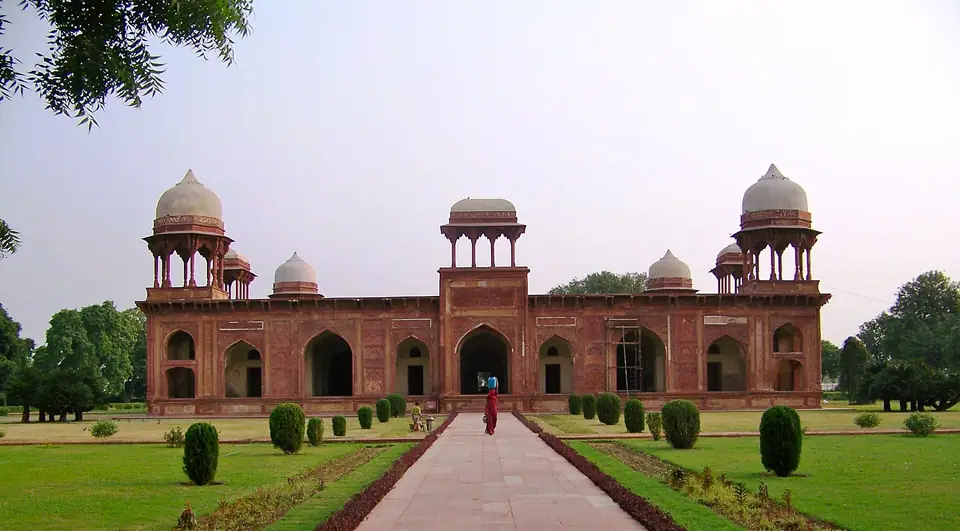
Just 1 km west of Akbar's Tomb on NH-19 stands the garden mausoleum of Mariam-uz-Zamani (1542 to 1623), the Rajput princess of Amer who married Akbar in 1562 and gave birth to Jahangir. Originally built by Sikandar Lodi as an open pavilion (baradari) in 1495, it was converted by Jahangir between 1623 and 1627 into his mother's tomb. Its flat roof carries four octagonal red sandstone corner chhatris, while forty vaulted underground chambers surround the queen's marble cenotaph. Because tour buses rarely stop here, you will often have the entire garden to yourself for INR 300 (foreign visitors) or INR 25 (Indian visitors as of November 2026).
On your drive back toward central Agra along NH-19, stop 1.5 km east of Sikandra at Gurudwara Guru ka Tal. Built in 1610 as a twelve-towered stone reservoir (tal), the site became a revered Sikh shrine in 1675. Here the ninth Sikh Guru, Guru Tegh Bahadur, voluntarily offered himself for arrest in defence of religious freedom. Four of the original twelve carved red sandstone towers survive beside the tank, and visitors of all faiths are welcomed into the Gurudwara and its community kitchen (langar).
Dayalbagh and the Soami Bagh Samadh: Living Marble Craftsmanship
From Guru ka Tal, a 15-minute drive north-east brings you to Soami Bagh, beside the educational community of Dayalbagh. Here stands the Soami Bagh Samadh, the monumental white marble mausoleum enshrining the ashes of Shiv Dayal Singh (1818 to 1878, known as Soamiji Maharaj, founder of the Radhasoami faith).
- Over a Century of Continuous Hand-Carving. First begun in 1908 under a blueprint designed by an Allahabad architect, the current 193-foot-tall superstructure has been under uninterrupted construction for more than a hundred years. Funded by voluntary member contributions without soliciting outside donations, hereditary stone masons from Rajasthan and Agra carve marble blocks daily inside the perimeter workshops.
- Color-Inlaid Marble Reliefs that Rival Pietra Dura. Inside the completed ground-floor hall and outer porticos, inspect high-relief panels of grapevines, banyan leaves, and jasmine garlands carved from solid white Makrana marble. Adjacent walls display coloured stone inlay matching seventeenth-century Mughal parchin kari.
Transport costs, timing, and Traveller tips
To link all four stops smoothly without backtracking across city traffic, hire an auto-rickshaw or app-based cab for a dedicated three-to-four-hour northern loop.
- Quick Decision Block (Distance: 28 km round-trip loop · Walking: 2 to 2.5 km · Duration: 3.5 hrs · Best For: Quiet gardens, deer sightings & live marble craft). Start at Sikandra at 08:30, visit Mariam's Tomb at 09:45, stop at Guru ka Tal at 10:30, and finish at Soami Bagh by 11:15 before lunch in Sadar Bazaar.
- Round-Trip Taxi & Auto-Rickshaw Fares (Nov 2026). A three-to-four-hour round trip covering all four stops costs roughly INR 700 to INR 950 (~USD 8.50 to USD 11.50 as of November 2026) by auto-rickshaw, or INR 1,300 to INR 1,700 by AC sedan with waiting time.
- Shoe Attendants & Monkey Awareness at Sikandra. Carry a small cloth bag in your daypack for your shoes when entering the upper platform at Sikandra, Guru ka Tal, and Soami Bagh. Keep snacks zipped out of sight on the Sikandra causeways, where troops of rhesus macaques patrol the lower garden walls.
- Inspecting the Kanch Mahal and Suraj Bhan ka Bagh at Sikandra. Just outside the eastern boundary wall of Akbar's Tomb stands the Kanch Mahal ("Palace of Glass"), a two-storey square red sandstone pavilion built by Emperor Jahangir around 1605 to 1619 as a royalshikargah (hunting lodge) and zenana residence. Its facade is richly carved with geometric stone bands, projecting jharokha balconies, and remnants of blue, green, and orange glazed ceramic tiles that gave the pavilion its name.
- Kos Minar Milestone on the Grand Trunk Road. As your taxi drives along NH-19 between Guru ka Tal, Sikandra, and Mariam's Tomb, watch the roadside for conical brick-and-plaster towers standing 9 metres high. These are original Mughal Kos Minars erected every kos (3.2 kilometres) along the royal highway from Agra to Lahore so imperial couriers could navigate.
- Best Photography Light & Quiet Hours. Because Sikandra's monumental gateway faces south, its white marble geometric inlay and four corner minarets catch crisp, even sunlight between 08:30 and 10:30 in the morning and warm golden light at 16:00. Combining Sikandra with Kinari Bazaar or our Agra 3-Day Itinerary gives you a peaceful, deer-filled counterpoint to the morning crowds at the Taj Mahal and Agra Fort, with zero tout pressure at the gates. Shaded stone benches let you rest under mature banyan trees.
Where it is
- 1Sikandra (Akbar's Tomb), Mariam-uz-Zamani & Dayalbagh Soami Bagh Temple Route
- Agra Airport / Agra Air Force Station (AGR) · about 7 km from here in a straight line
- Directions in Google Maps
Traveller tips
Real advice from people who have been to Agra. Every tip is read by our team before it goes live.
No tips yet. Been here? Yours could be the first.
Thank you! Your tip will appear here after a quick review.
More in Agra
Continue exploring Agra with related neighbourhood, food, and planning guides

What to Eat in Agra: Bedai & Jalebi, Panchhi Petha, Mughlai Kitchens & Chaat Gali
Agra, India
Agra Orientation: Taj Mahal Gate Rules, Friday Closures, ASI Cashless QR Tickets & Avoiding Tout Traps
Agra, India
Best Things to Do in Agra: Taj Mahal at Dawn, Agra Fort, Baby Taj, Mehtab Bagh & Fatehpur Sikri
Agra, India
How to Get to Agra & Around: Gatimaan & Vande Bharat Express Trains, Yamuna Expressway, Metro & Rickshaws
Agra, India
