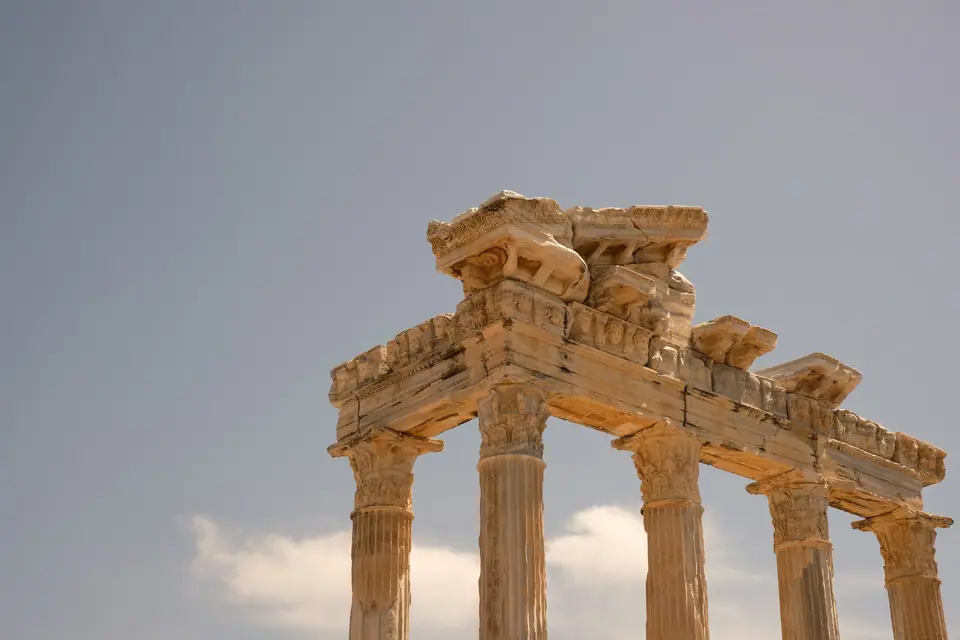
Photo by Aslıhan Altın on Unsplash
Best Things to Do in Antalya
Discover the Roman streets of Kaleiçi, ancient ruins, waterfalls, and Mediterranean beaches across Antalya.
Antalya combines Roman monuments, cliffside waterfalls, premier museum galleries, and scenic beaches across Turkey's southern Mediterranean coastline.
Wandering Historic Kaleiçi and the Roman Marina
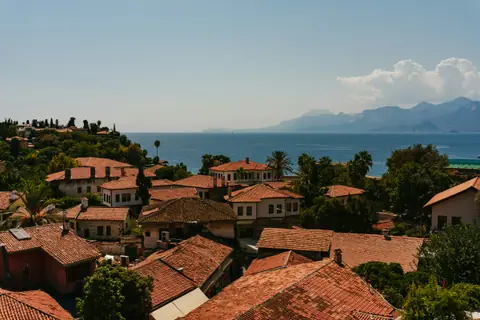
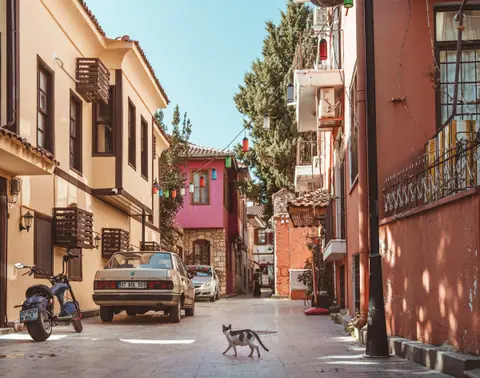
Kaleiçi forms the historic core of the city centre. Within its fortified stone walls, you will find about 3000 houses with tile roofs. These preserved buildings showcase traditional Ottoman architecture. Winding streets lead visitors between secluded courtyards, boutique restaurants, and maritime viewpoints.
Hadrian's Gate serves as the grandest entrance to this old quarter. Workers built the Roman monument during 130 CE to honour Roman Emperor Hadrian during his visit. Its three marble arches and carved columns stand strong after nearly two thousand years. Deep grooves worn by ancient carts remain visible in the stone paving beneath the arches.
Alleys through the district descend towards the water. You can follow these stone lanes or take an elevator down to the port. This working marina originated as an ancient Roman port. Today, small boats depart from its piers to take visitors around coastal cliffs. For a detailed route across the quarter, see our Kaleiçi guide.
On the clifftop above, green paths lead into Karaalioğlu Park. This central park overlooks the Mediterranean. It frequently hosts open-air exhibitions arranged by the Antalya Museum, offering a peaceful retreat away from narrow alleys.
Before leaving the historic quarter, sample traditional culinary specialities. Try grilled shish skewers paired with Antalya piyaz dressed with sesame oil. You can make piyaz vegetarian by ordering the piyaz bread without eggs. Finish your meal with burnt ice cream for dessert.
Masterpieces of Classical Sculpture at Antalya Museum
The Antalya Museum is situated at Bahçelievler Mahallesi Konyaaltı Caddesi No 88 in Muratpaşa. Teacher Süleyman Fikri Erten founded the museum in 1922. He gathered artefacts to protect them from looting by occupation forces following World War I. The collection stood inside Alaaddin Mosque, moved to Yivli Mosque, and arrived at its current home in 1972.
The complex occupies an impressive 30,000-square-metre site. It contains 14 exhibition halls, open-air sculpture galleries, and landscaped grounds. The Council of Europe awarded the institution the Museum of the Year title in 1988. It won an Excellence Award in 2016 for its display of antiquities.
Exhibition halls present ancient items chronologically from the Palaeolithic Age through classical Greek and Roman eras. Families can explore a dedicated children's section. Turkish citizens can enter using the MüzeKart, while foreign visitors purchase standard tickets. Public transport brings visitors directly to the gates via tram, city bus, minibus, or taxi.
Several Roman sculptures represent high points of the collection. The Heracles Sarcophagus features exceptionally carved friezes. Nearby, the Weary Heracles statue commands attention. It represents a 2nd century AD Roman copy of a 4th century BC masterpiece by Greek sculptor Lysippos.
The recovery of the Weary Heracles is famous in archaeological history. Workers found the lower section in 1980 during excavations at Perge. The upper torso was smuggled abroad before authorities secured its return in 2011, reuniting both halves inside the gallery.
Ancient Marvels of Perge and Aspendos
Remarkable archaeological sites lie just outside modern suburbs. Perge sits 18 kilometres east of the city centre. This sprawling site features on UNESCO's Temporary List of World Heritage Sites. The settlement reached its peak of prosperity under Roman imperial rule during the 2nd and 3rd centuries AD.
Two round entrance towers dating from the 3rd century BC greet arriving visitors. Beyond them, an ancient colonnaded street stretches about 500 metres towards a monumental fountain. The nearby Stadion could hold up to 12,000 people and stands as Anatolia's second-largest ancient sports stadium. Ongoing restoration means the ancient theatre remains temporarily closed to visitors.
Perge holds great value in early Christian history. St Paul stopped at Perge multiple times during his journeys. Today, the central street serves as the official beginning of St Paul's Way, an established hiking route across the region. Excavators unearthed numerous classical sculptures here, now preserved at the Antalya Museum.
Further east lies the ancient theatre of Aspendos, built in the second century BC south of the Taurus Mountains. Scholars consider it one of the world's most well-preserved ancient theatres. The site hosts the Aspendos International Opera and Ballet Festival, which is the first opera and ballet festival organized at the ancient theatre of Aspendos. For transit ideas, read our day trips guide.
Waterfalls of the Upper and Lower Düden
Karst geography across the Antalya basin creates unusual river paths and dramatic cascades. Düden Waterfall, known locally as Düdenbaşı Waterfall, lies within the Kepez district. Water entering Bıyıklı Düdeni flows underground for about fourteen kilometres before surfacing briefly at the Varsak sinkhole. It plunges back underground for two kilometres before emerging at Düdenbaşı.
Water tumbling over the cliff at Düdenbaşı includes discharge from the Kepez hydroelectric power plant. Shaded walkways allow travellers to enter rock caverns right behind the rushing curtain of water. Municipal public transport vehicles reach the entrance, and visitors can now use Antalyakart for entry.
After emerging at Düdenbaşı, the Düden river continues through eastern Antalya towards the coast. At Lower Düden Waterfall, the torrent plunges forty metres off a travertine shelf straight into the Mediterranean. Visitors enjoy views of this drop from cliffside parks in Lara or from sightseeing boats on the water.
Other regional cascades include Kurşunlu, Manavgat, and Uçansu waterfalls. These river systems drain freshwater south from the Taurus Mountains toward the sea, creating cool woodland sanctuaries close to main roads.
Beaches and Coastal Waters from Konyaaltı to Lara
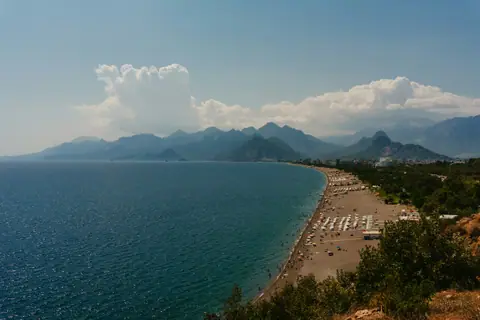
Antalya possesses a coastline of 640 kilometres around bays and headlands, measuring 500 kilometres in a straight line. Konyaaltı Beach lies about 3 kilometres west of central Antalya. It extends for approximately 1.5 kilometres, presenting a Blue Flag beach of pebbles and sand set against towering mountains.
East of the centre, Lara beach, locally called Altınkum, provides a broad stretch of fine sand. Its seabed deepens gently into warm waters. Both beaches provide waterfront walking tracks, showers, and rapid transit links back to metropolitan districts.
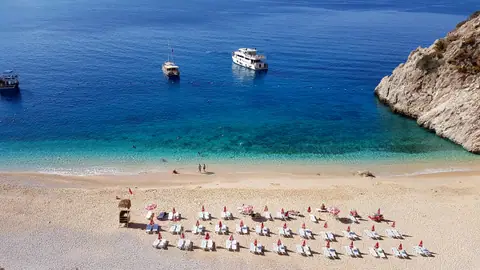
Further along the shoreline, notable beaches include Kaputaş, Adrasan, Çıralı, and İncekum. Cleopatra Beach runs for 2 kilometres on the western side of Alanya. Patara Beach spans 800 metres wide and 15 kilometres long, making it Turkey's widest and longest beach. At Koru Beach in Gazipaşa, natural stone formations create a self-filtering marine pool.
Swimmers should observe coastal safety flags. A red flag means you must not enter the water. If you hire a moped to visit remote coves, Turkish law requires drivers and passengers to wear helmets.
Performing Arts, Heritage Trails, and Outdoor Adventures
Antalya ranks as Turkey's ninth-largest city, welcoming over 14 million foreign guests every year. Modern municipal complexes host extensive artistic programming throughout the season. The Antalya Cultural Center in the city centre houses two performance halls for the State Symphony Orchestra, Opera, and Ballet. Atatürk Cultural Park contains the Glass Pyramid Sabancı Congress and Exhibition Center.
The Haşim İşcan Cultural Center serves as the permanent home for the State Theater and State Opera. For visual arts, visit Antalya Culture and Arts, founded in 2015 by the ATSO Education, Research and Culture Foundation. In Kaleiçi, the Suna & İnan Kıraç Kaleiçi Museum displays ethnographical items in a compound that includes a historic church built for Aya Yorgi.
Excursions reveal exceptional landscapes. Termessos sits 30 kilometres northwest of Antalya as one of Turkey's best preserved ancient cities. Phaselis, founded by colonists from Rhodes in the seventh century BCE, offers quiet pine-fringed harbours. Southwest lies Olympos, located 85 kilometres from Antalya and 45 kilometres from Kemer. An aerial tramway carries passengers directly to the peak of nearby Mount Olympus.
Adventurous travellers can raft down the Köprüçay river in Köprülü Canyon National Park, one of Turkey's premier whitewater centres. Rock climbing routes await around Geyikbayırı and Çitdibi. Hikers can follow marked sections of the Lycian Way or the Pisidia Heritage Route, while Altınbeşik Cave holds Turkey's largest subterranean lake.
Where it is
- 1Antalya
- Antalya International Airport (AYT) · about 8 km from Antalya in a straight line
- Directions in Google Maps
Stations and taxi ranks: OpenStreetMap. Airports: OurAirports. Distances are in a straight line.
Traveller tips
Real advice from people who have been to Antalya. Every tip is read by our team before it goes live.
No tips yet. Been here? Yours could be the first.
Thank you! Your tip will appear here after a quick review.
More in Antalya
Continue exploring Antalya with related neighbourhood, food, and planning guides