























Generalife Gardens & Palace Guide: Patio de la Acequia, Water Stairway & Silla del Moro
Explore the Nasrid sultans' summer retreat on the Cerro del Sol, including the Royal Canal, Patio de la Acequia fountains, Escalera del Agua, and the Silla del Moro watchtower.
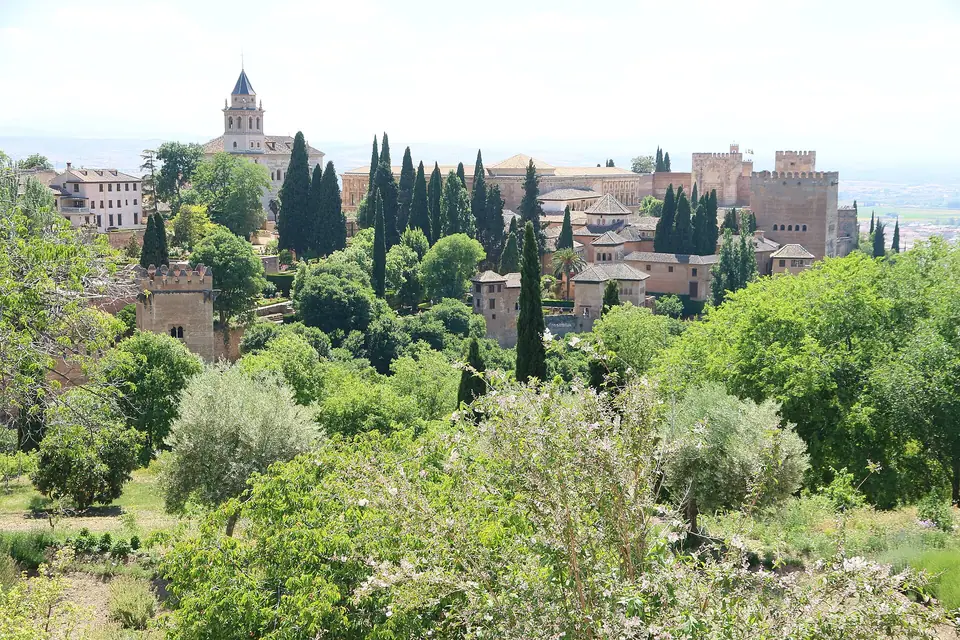
Perched on the Cerro del Sol ("Hill of the Sun") across the ravine from the Alhambra stands the Generalife. Its name derives from the Arabic Jannat al-'Arif ("Architect's Garden"), established in the late 13th century by Sultan Muhammad II as a country estate and summer retreat. Unlike the fortified Alhambra, the Generalife was designed as a rural sanctuary of terraced orchards (huertas), cypress walks, and cooling water courts. Use this guide together with our Alhambra and Nasrid Palaces guide and our best time to visit Granada calendar.
| Generalife Sector / Site | Elevation & Walk Time | Ticket Requirement (Nov 2026) | Key Architectural or Landscape Feature |
|---|---|---|---|
| Lower Gardens (Jardines Nuevos) & Amphitheatre | 805 m; 5 min from Access Pavilion | Included in €19.09 General or €10.61 Gardens Ticket | 20th-century cypress mazes, rose parterres, and Festival of Music and Dance stage |
| Medieval Huertas (Mercería & Grande) | 815 m; 10 min along Paseo de los Cipreses | Included in General or Gardens Ticket | 700-year-old continuously cultivated Nasrid vegetable and fruit terraces |
| Patio de la Acequia & Palacio del Generalife | 825 m; 15 min from Access Pavilion or Partal bridge | Single barcode scan at the Generalife gate (1 entry per ticket) | 48-metre Royal Canal fountain court and Mirador de Ismail I stucco belvedere |
| Patio de la Sultana & Escalera del Agua | 835 m to 845 m. Upper palace terraces | Included inside the Generalife palace circuit | 14th-century hydraulic handrail staircase and romantic upper oleander promenade |
| Silla del Moro (Castillo de Santa Elena) | 895 m; 15 min uphill hike above the Generalife | Included in General or Dobla de Oro tickets (check seasonal weekend hours) | Elevated Nasrid water-security watchtower with panoramic bird's-eye views over the entire Alhambra |
How the Acequia Real hydraulic system created the Generalife
Neither the Alhambra nor the Generalife could have existed on the arid rocky spur of the Sabika without a feat of 13th-century Nasrid civil engineering: the Acequia Real (Royal Canal). Six kilometres upstream near Jesús del Valle, Nasrid engineers built a diversion weir (azud) across the Río Darro. This captured Sierra Nevada snowmelt at an elevation high enough to feed both the Cerro del Sol and Sabika ridges entirely by gravity.
Following the hillside through tunnels and open channels, the Acequia Real enters the Generalife down the central axis of the Patio de la Acequia. From there, it irrigates four medieval agricultural terraces (Huerta Colorada, Grande, Mercería, and Fuentepeña) before crossing a brick aqueduct over the ravine into the Alhambra. Even today, the four Generalife huertas are cultivated using traditional organic flood-irrigation methods to grow pomegranates, figs, quinces, broad beans, and heritage vegetables.
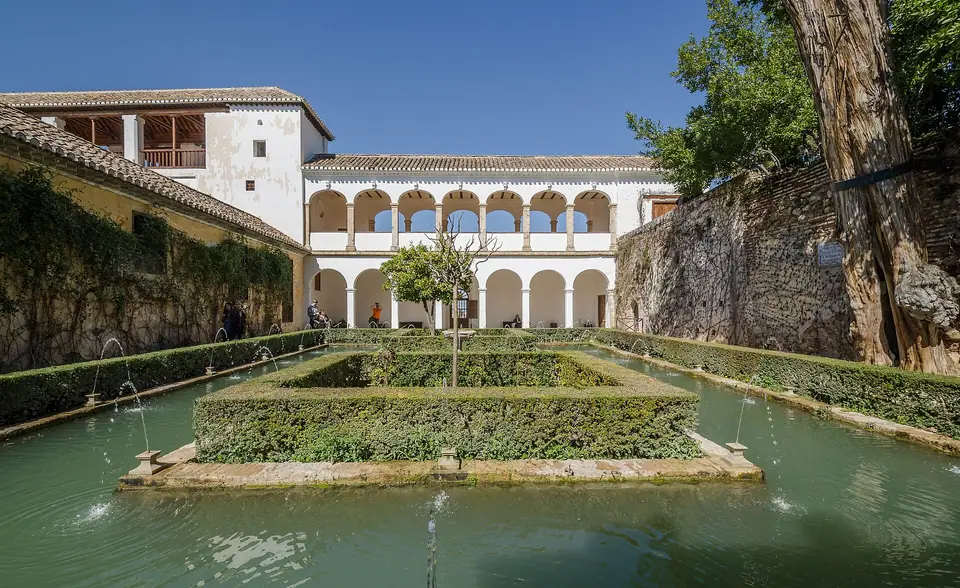
Patio de la Acequia and the Royal Pavilion
Your ticket barcode is scanned once at the Generalife entrance turnstile. Remember that your ticket permits only one entry into the Generalife sector, so do not exit the turnstile until you have seen the entire palace and upper gardens. Walking north through the Jardines Nuevos, laid out between 1931 and 1951 with clipped cypress arches and pebble mosaics, you climb into the 14th-century palace core.
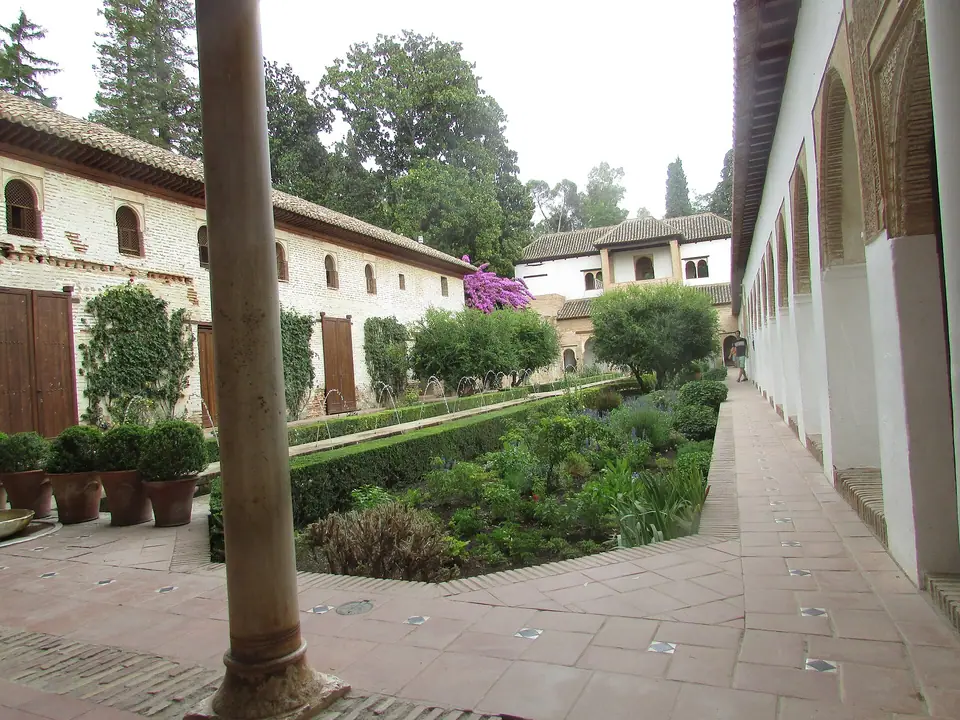
At its heart lies the Patio de la Acequia, a 48.7-metre-long courtyard divided into four sunken flowerbeds (riyad) by the Royal Canal. Although the rows of crossed parabolic water jets were added in the 19th century, archaeological excavations beneath the soil confirmed the original Nasrid cross-axial pavilion layout. Along the western flank runs an 18-arch portico looking across the ravine toward the Alhambra. Its central belvedere, the Mirador de Ismail I, was richly decorated in 1319 with geometric stucco and Arabic verses celebrating water and garden shade. At the northern end, the Sala Regia leads behind a double arcade of columns to an open loggia framing the entire Albaicín and Sacromonte valley.
Patio del Ciprés de la Sultana and the Escalera del Agua
Narrow brick steps from the Sala Regia lead up into the Patio del Ciprés de la Sultana, shaded by myrtles and the trunk of a 600-year-old cypress tree. According to 16th-century tales by Ginés Pérez de Hita, this cypress witnessed secret meetings between a Nasrid queen and a knight of the Abencerrajes clan.
At the back of the courtyard ascends the Escalera del Agua (Water Stairway), one of the most ingenious medieval garden structures in Spain. Built to lead the Sultan up to a private hilltop prayer oratory beneath bay laurels, the stairway rises in three flights broken by octagonal landing basins. Instead of dry banisters, its side walls are topped with hollowed ceramic roof tiles. Cold mountain water rushes down these channels beside your hands, cooling the shade and allowing ritual ablutions (wudu) in running water. From the top landing, descend via the tree-lined Paseo de las Adelfas (Promenade of the Oleanders), shaded by massive fragrant oleander bushes and cypresses, back toward the exit.
Climbing above the Generalife to Silla del Moro
If you have an extra 35 minutes, follow the signposted forest trail climbing 60 vertical metres above the Generalife to the Silla del Moro (Castillo de Santa Elena). Built in the 13th and 14th centuries to guard the upper water tanks of the Acequia Real, this brick watchtower sits at 895 metres elevation. Its upper terrace looks directly down over the Generalife roofs, the entire Alhambra citadel, and the Albaicín in a single panoramic frame.
Traveller tips
- Visit the Generalife either at 08:30 or right after your morning Nasrid Palaces slot. If your Nasrid Palaces slot is at 10:30 or 11:00, enter the Generalife at 08:30 right when the gates open. You will have the Patio de la Acequia and Escalera del Agua almost entirely to yourself before walking 15 minutes across the ravine to the Nasrid Palaces.
- Check Silla del Moro opening days. Interior access to the Silla del Moro terrace operates on Friday, Saturday, and Sunday (09:00 to 14:00 and 16:00 to 18:00/20:00), while the outer viewpoint path stays open daily.
- Night Visit to the Generalife Gardens (spring and autumn seasons). Beyond the Nasrid Palaces night slot, the Patronato runs a separate Visita Nocturna a Jardines y Palacio del Generalife (€7.42 as of November 2026). It operates on Tuesday to Saturday evenings during spring (April to May) and autumn (September to mid-November). Because it is less publicised than the Nasrid Palaces night ticket, it rarely sells out early and offers a tranquil walk past lit fountains.
- Walking back to the city via Cuesta de los Chinos. When finishing the Generalife along the Paseo de los Nogales, take the cobbled footpath of Cuesta del Rey Chico descending outside the brick viaduct. Named after Boabdil ("El Rey Chico"), this shaded 15-minute descent passes medieval water mills and leads straight down to Paseo de los Tristes.
- Botanical highlights of the Generalife across the seasons. Nasrid court agronomists treaties by Ibn Bassal and Ibn Luyun guided the historic replanting of the Generalife orchards. Look for Seville orange trees, myrtle hedges (arrayán), pomegranates, and jasmine. Clipped cypress arcades also filter wind and cool the courtyards by 5°C in summer.
- Photography etiquette in the Patio de la Acequia. The narrow northern loggia and the western Mirador de Ismail I inside the Patio de la Acequia are the two most sought-after photo spots in the Generalife. Pause briefly between tour groups for five seconds of clear reflection across the water jets, and avoid stepping into the sunken soil parterres bordered by low boxwood and myrtle hedges.
- Shaded benches and drinking water in the Generalife. Bronze drinking fountains and stone benches line the Lower Gardens and the Paseo de los Cipreses. Refill your water bottle here before climbing the sun-exposed steps toward the upper palace or Silla del Moro.
- Comparing the Generalife with the Partal gardens. While the Partal sits inside the fortified Alhambra walls facing north over the Darro gorge, the Generalife faces west and southwest across open agricultural terraces. Visiting both shows how Nasrid architects adapted water courts to both urban palaces and rural hillsides.
- Audio guide numbers for the Generalife sector. Official Patronato audio guides cover the Generalife on tracks 25 through 32. Listen to the commentary on the Acequia Real while standing on the central axis of the Patio de la Acequia.
Where it is
- 1Generalife Gardens & Palace
- F.G.L. Airport Granada-Jaén Airport (GRX) · about 17 km from here in a straight line
- Directions in Google Maps
Traveller tips
Real advice from people who have been to Granada. Every tip is read by our team before it goes live.
No tips yet. Been here? Yours could be the first.
Thank you! Your tip will appear here after a quick review.
More in Granada
Continue exploring Granada with related neighbourhood, food, and planning guides
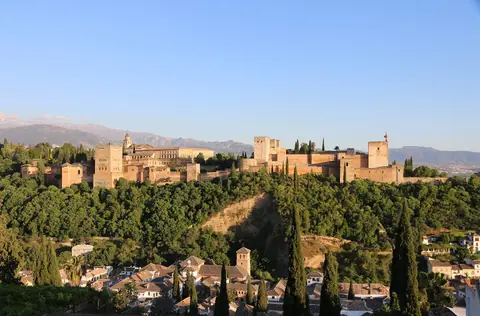
Granada: Alhambra Palaces, Albaicín Hills & Essential Logistics
Granada, Spain
Best Things to Do in Granada: Alhambra, Albaicín & Cultural Highlights
Granada, Spain
How to Get to Granada: AVE Trains, Málaga & Granada Airports & ALSA Buses
Granada, Spain
Best Time to Visit Granada: Seasonal Weather, Festivals & Crowd Calendar
Granada, Spain
