




















Granada Cathedral & Royal Chapel Guide: Catholic Monarchs, Alcaicería & Corral del Carbón
Tour Granada's monumental lower centre, including the tombs of Isabella and Ferdinand in the Royal Chapel, Diego de Siloé's Renaissance Cathedral, La Madraza, and the Alcaicería.
Following the surrender of Nasrid Granada on 2 January 1492, Queen Isabella I and King Ferdinand II reshaped the lower city around the former Great Mosque. Within a compact 300-metre square around Plaza Bib-Rambla, you can walk from the Gothic burial chapel of the Catholic Monarchs into Spain's first great Renaissance cathedral. Two paces away stand a 1349 Islamic university, a reconstructed silk bazaar, and an intact Nasrid caravanserai. Use this walking guide together with our Dobla de Oro monuments guide and our Granada Cathedral dress code tips.
| Monument | Entrance Street | Ticket Price (Nov 2026) | Key Masterpiece Inside |
|---|---|---|---|
| Royal Chapel (Capilla Real) | Calle Oficios (pedestrian lane) | €7.00 (includes mobile/handheld audio guide) | Carrara marble tombs of Isabella & Ferdinand, royal crypt lead coffins, and Flemish paintings |
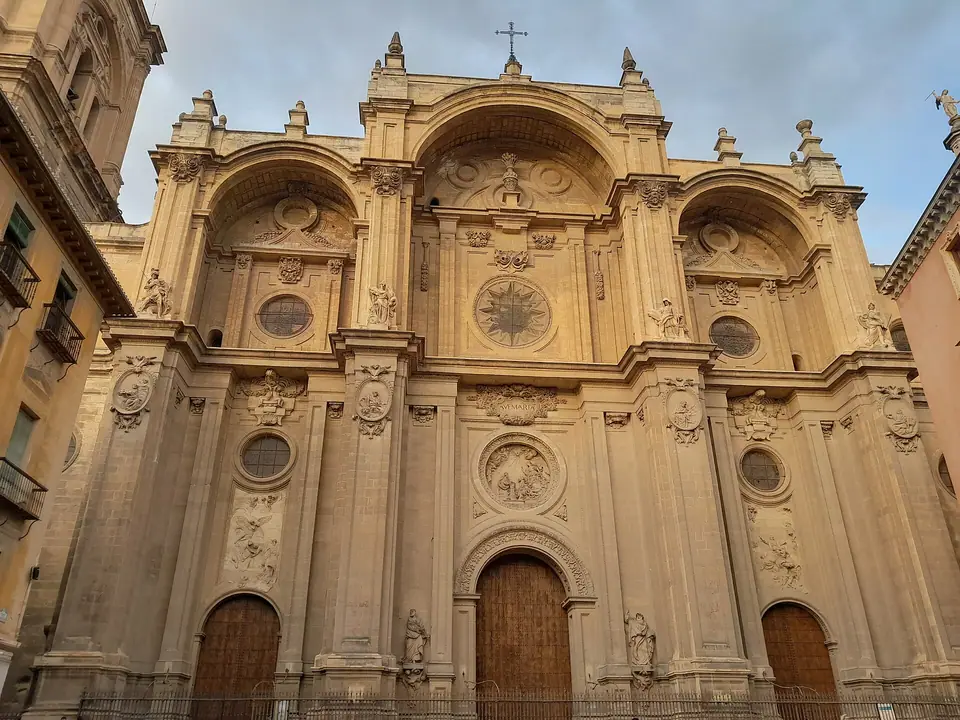
| Granada Cathedral (Catedral de la Encarnación) | Plaza de las Pasiegas (main west portal) | €7.00 (includes audio guide) | Diego de Siloé's 45-metre white-and-gold circular Capilla Mayor rotunda and Alonso Cano facade |
| Palacio de la Madraza | Calle Oficios 14 (opposite Royal Chapel) | €2.00 general admission | 1349 Nasrid octagonal stucco prayer hall (mihrab) and Baroque Knights' Hall wooden dome |
| Alcaicería Silk Bazaar & Plaza Bib-Rambla | Calle Reyes Católicos / Calle Oficios | Free public pedestrian streets (shops open ~10:00 to 21:00) | Neo-Moorish horseshoe arcades, Fajalauza ceramics, and marquetry (taracea) workshops |
| Corral del Carbón (Alhóndiga Gidida) | Calle Mariana Pineda (off Reyes Católicos) | Free entry to courtyard and ground gallery | 14th-century Nasrid brick muqarnas gateway and three-tiered merchant courtyard |
The Royal Chapel (Capilla Real): Tombs of the Catholic Monarchs
Although Isabella and Ferdinand ruled from itinerant courts across Spain, they viewed Granada as their greatest achievement. On 13 September 1504, they decreed by royal charter that they be buried here forever. Designed by Enrique Egas between 1505 and 1517 in flamboyant Isabelline Gothic style with ribbed star vaults, the Capilla Real (€7.00 as of November 2026, strict no-photography rule enforced inside) is entered separately from the Cathedral along the narrow granite-paved lane of Calle Oficios.
Passing through Master Bartolomé's gilded 1520 wrought-iron screen (reja), you stand before two twin Carrara marble cenotaphs. On the right rest Domenico Fancelli's 1517 effigies of Ferdinand and Isabella, where Isabella's head sinks slightly deeper into the marble cushion. On the left, Bartolomé Ordóñez's taller mausoleum for their daughter Queen Joanna I ("Juana la Loca") and her husband Philip the Handsome. A short flight of steps between the marble tombs leads down into the austere stone Royal Crypt. Here five plain lead coffins marked with the crowned initials F and Y hold the actual remains of the monarchs and young Prince Miguel da Paz. Before exiting, visit the Sacristy-Museum housing Isabella's personal silver-gilt crown, sceptre, and Ferdinand's sword. Its galleries also display her prized 15th-century paintings by Rogier van der Weyden, Hans Memling, Dirk Bouts, and Sandro Botticelli.
Granada Cathedral: Diego de Siloé's Renaissance rotunda
Stepping onto Plaza de las Pasiegas reveals the towering 1667 Baroque west facade of Granada Cathedral (€7.00 as of November 2026). Granadino master Alonso Cano designed this portal as a monumental three-arched stone triumphal arch. Begun in 1523 on a Gothic plan, the cathedral was taken over in 1528 by Renaissance architect Diego de Siloé under Emperor Charles V.
Inside, five broad naves rest on twenty white stone piers topped by classical Corinthian capitals that soar 30 metres overhead. Everything converges on the circular Capilla Mayor, a 45-metre-high domed rotunda inspired by the Church of the Holy Sepulchre in Jerusalem. Ringed by gilded arches, it displays kneeling statues of the Catholic Monarchs by Pedro de Mena, canvases by Alonso Cano, and two towering 18th-century pipe organs.
Palacio de la Madraza and the Alcaicería silk market
Directly across narrow Calle Oficios from the Royal Chapel stands the painted 18th-century Churrigueresque facade of the Palacio de la Madraza (€2.00 entry as of November 2026). Founded in 1349 by Sultan Yusuf I, the Madrasa Yusufiyya served as Granada's first university, teaching medicine, astronomy, and law. It functioned until 1500, when Cardinal Cisneros confiscated its library and burned Arabic manuscripts in Plaza Bib-Rambla. Inside the courtyard survives the 14th-century octagonal Nasrid Oratory with polychrome stucco calligraphy and a carved mihrab. Upstairs, the Salón de Caballeros XXIV preserves a gilded 1513 Mudéjar wooden artesonado ceiling.
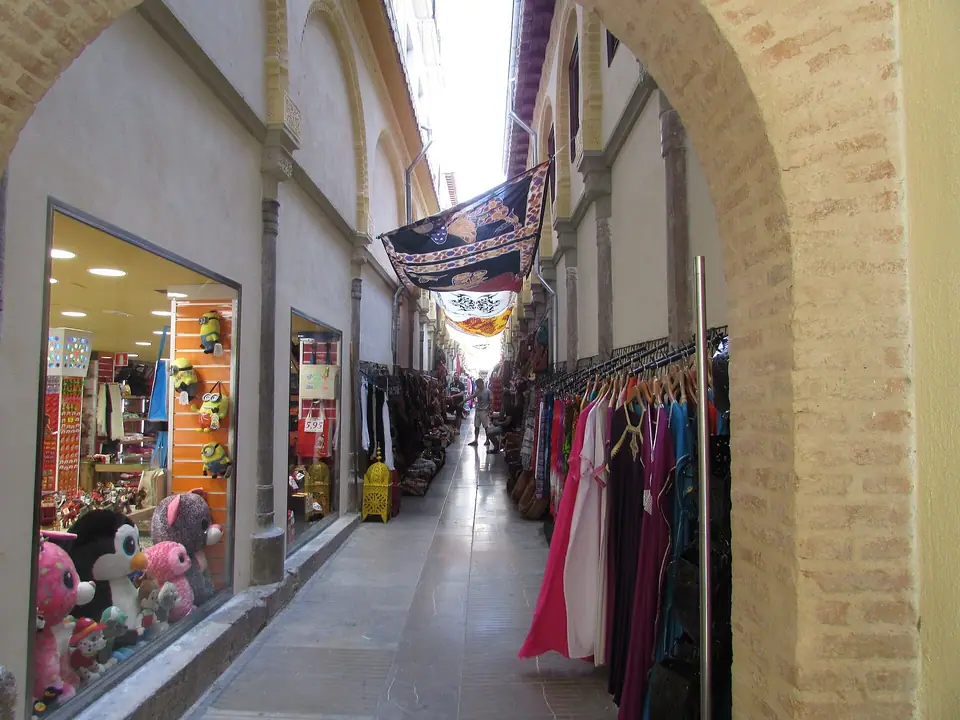
Immediately west of the Cathedral and Madraza extends the Alcaicería (from the Arabic al-Qaysariyya, "Caesar's market," recalling an ancient Byzantine imperial grant to trade raw silk). During the Nasrid era, this walled quarter contained over 200 shops guarded by ten night-time chain gates where raw and woven Alpujarras silk was taxed and sold across the Mediterranean. Although a fire in a match factory destroyed the medieval timber bazaar in 1843, it was rebuilt on its miniature grid of narrow lanes with slender Neo-Nasrid stucco horseshoe arches. Today it is the best place near the Cathedral to browse traditional Granada taracea (geometric marquetry boxes inlaid with walnut, sycamore, bone, and mother-of-pearl) and green-and-blue Fajalauza ceramics emblazoned with pomegranates and birds.
Corral del Carbón: Iberia's only surviving Nasrid caravanserai
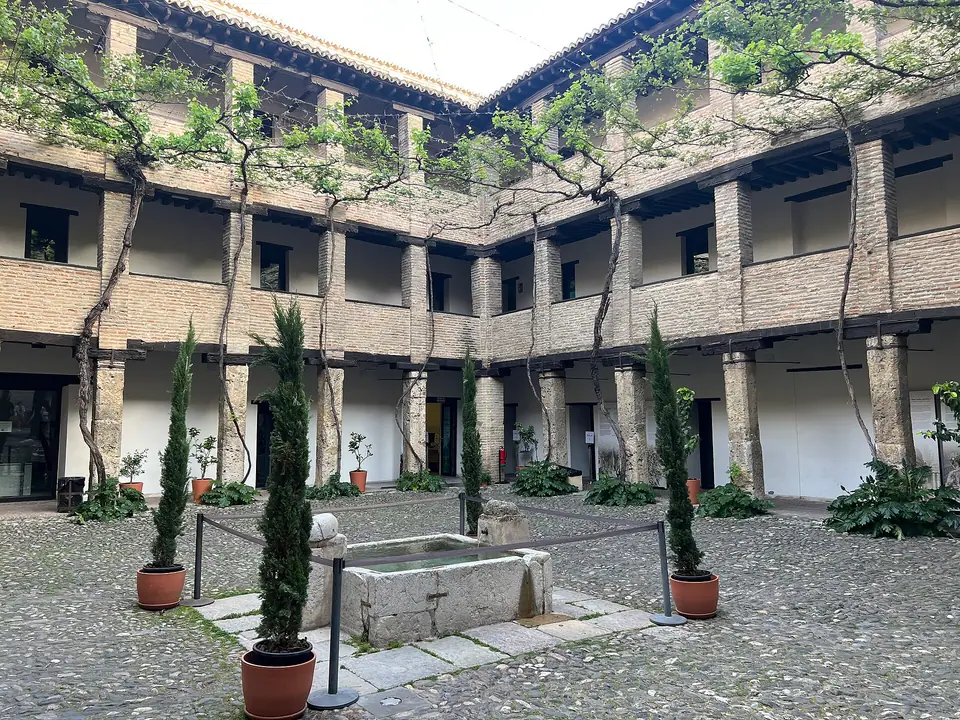
Two minutes south of the Alcaicería, just across Calle Reyes Católicos down the short lane of Calle Mariana Pineda, stands the Corral del Carbón (free entry, open daily). Built before 1336 under Yusuf I as the Alhóndiga Gidida ("New Merchant Exchange"), it is the only medieval Islamic funduq (caravanserai) preserved intact in Spain. Merchants tethered their pack mules beside the central stone trough, locked goods in ground-floor vaults, and slept along the three upper galleries. Its monumental gateway, framed by a double horseshoe arch and vaulted muqarnas plasterwork, survived because the courtyard later served as a 16th-century theatre and a 19th-century coal yard.
Traveller tips
- Visit the Royal Chapel before 10:45 or between 14:00 and 15:30. Because the Royal Crypt is a narrow single-file stone passageway beneath the marble tombs, arriving early in the morning or during the Spanish lunch window avoids queuing on Calle Oficios.
- How to spot genuine handmade taracea marquetry. In the Alcaicería and on Cuesta de Gomérez, inexpensive factory boxes use printed plastic veneer sheets that feel completely smooth. Authentic hand-inlaid Granada wood taracea has subtle tactile grain variations between the tiny star pieces and smells of natural cedar or walnut inside.
- Inspect the 1507 Church of the Sagrario and the Lonja de Mercaderes. Attached to the Cathedral on Plaza de Alonso Cano stands the 1704 Iglesia del Sagrario, built on the footprint of Granada's medieval Great Mosque. Next to it runs the carved 1518 Plateresque arcade of the Lonja de Mercaderes (Merchants' Exchange).
- Combine your Cathedral morning with the Monastery of San Jerónimo. If Diego de Siloé's Renaissance architecture inside the Cathedral captivates you, walk twelve minutes northwest along Calle San Jerónimo to the Real Monasterio de San Jerónimo (€6.00 as of November 2026, open daily). Designed by Diego de Siloé around a two-tiered orange-tree cloister, its church serves as the burial pantheon of general Gonzalo Fernández de Córdoba ("El Gran Capitán"). Kneeling effigies of the commander and his wife flank a soaring Mannerist polychrome altarpiece.
- Hearing the Historic Cathedral Organs and Choral Mass: Granada Cathedral remains an active seat of the Archdiocese. Attending a Sunday choral mass via the parish doors lets you hear Leonardo Fernández Dávila's 18th-century pipe organs fill the 45-metre dome.
- Relaxing in Plaza Bib-Rambla and the flower stalls. Fifty metres west of the Cathedral opens Plaza Bib-Rambla (from the Arabic Bab al-Ramla). Ringed by Belle Époque lampposts and flower stalls, it centres on the marble Fountain of the Gigantones. It is the ideal flat resting point between your morning Cathedral visit and lunch.
- Audio guide apps for the Cathedral and Royal Chapel. Your €7.00 entry ticket at both Granada Cathedral and the Royal Chapel includes a free downloadable mobile audio guide in English, Spanish, French, German, and Italian. Bring headphones so you can listen comfortably while walking through the royal nave and sacristy.
- Visiting the historic Curia and Archbishop's Palace exterior. Facing the Cathedral across Plaza de Alonso Cano stands the 16th-century Palacio Arzobispal, whose courtyard preserves Renaissance stone columns and traditional Granadino pebble paving.
- Coffee and churros on Plaza Bib-Rambla. Café Fútbol (founded in 1922 on Plaza Mariana Pineda) and Gran Café Bib-Rambla (founded in 1907) are Granada's two classic stops for thick hot chocolate with crispy morning tejeringos churros (~€4.50 to €5.50 as of November 2026).
Where it is
- 1Granada Cathedral & Royal Chapel
- F.G.L. Airport Granada-Jaén Airport (GRX) · about 16 km from here in a straight line
- Directions in Google Maps
Traveller tips
Real advice from people who have been to Granada. Every tip is read by our team before it goes live.
No tips yet. Been here? Yours could be the first.
Thank you! Your tip will appear here after a quick review.
More in Granada
Continue exploring Granada with related neighbourhood, food, and planning guides
Granada 3-Day Itinerary: Alhambra, Albaicín, Sacromonte & Tapas Route
Granada, Spain
Alhambra & Nasrid Palaces Guide: Booking Tickets, Gates, Palaces & Timing
Granada, Spain
Generalife Gardens & Palace Guide: Patio de la Acequia, Water Stairway & Silla del Moro
Granada, Spain
Albaicín & Mirador de San Nicolás Guide: Darro Walk, Carmen Gardens & Viewpoints
Granada, Spain
