


























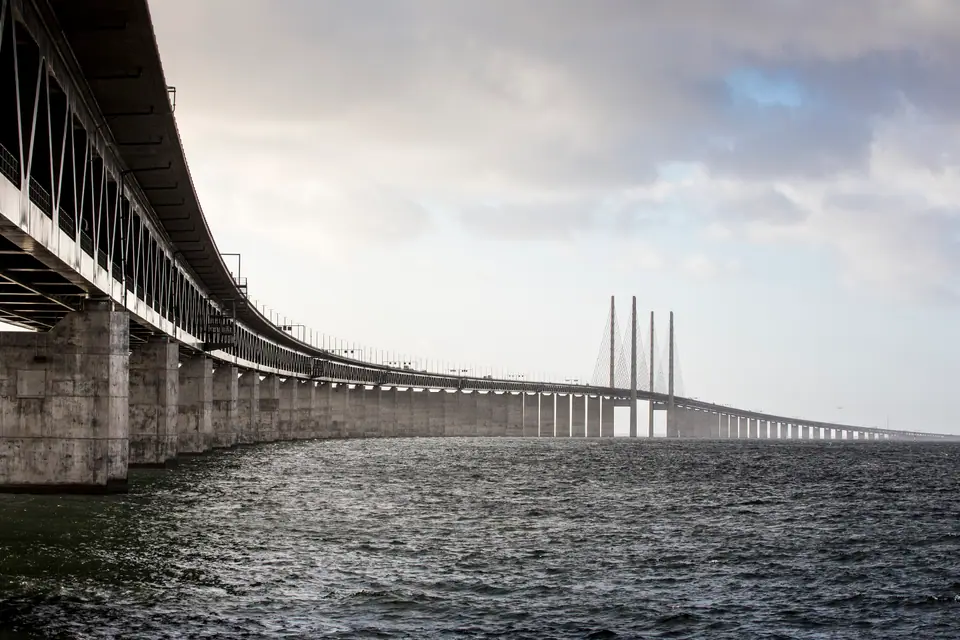
Öresund Bridge & Lernacken: Sweden's Fixed Link to Denmark
Learn how the 15.9-kilometre Öresund Bridge, Peberholm artificial island, and Lernacken viewpoint connect Malmö with Copenhagen across the strait.
Opened to road and rail traffic on 1 July 2000 after construction began on 18 October 1995, the Öresund Bridge (Swedish: Öresundsbron; Danish: Øresundsbroen) is Sweden's only fixed direct road and rail link to continental Europe, and the fourth-longest bridge in Europe. Designed by Jørgen Nissen and Klaus Falbe Hansen of Ove Arup and Partners together with Niels Gimsing and Georg Rotne, the structure received the 2002 IABSE Outstanding Structure Award and gained international screen recognition as the central setting of the Nordic crime series The Bridge (Bron / Broen).
Before the fixed link was completed at the turn of the millennium, crossing the narrow strait between Scania and Zealand required passenger ferries or hydrofoils that were vulnerable to winter ice and storm swells. By uniting the railway networks and motorway systems of Sweden and Denmark into a single continuous corridor, the crossing transformed Malmö from a peripheral national port into the eastern hub of an integrated cross-border metropolitan region where tens of thousands of commuters, students, and leisure travellers cross the water daily.
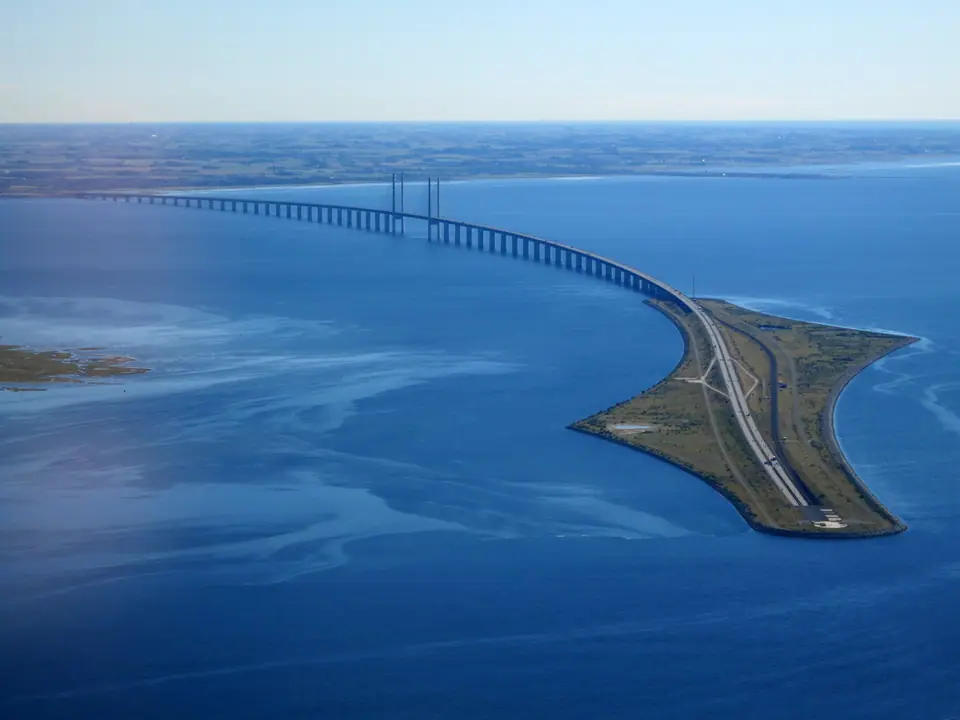
Bridge, Artificial Island, and Underwater Tunnel
The complete cross-strait fixed link (Öresundsförbindelsen) measures 15.9 kilometres (nearly 16 kilometres) from Lernacken in southwestern Malmö to Kastrup on the Danish island of Amager, carrying around 20,000 road vehicles and 33,000 rail passengers per day as well as a major international internet data cable:
- The Bridge Section (7.8 kilometres): Running from the Swedish shore at Lernacken to the middle of the strait, the double-deck cable-stayed bridge carries the four-lane European route E20 motorway on its upper deck and the dual-track Öresund Line railway directly beneath. Its twin concrete pylons rise 204.5 metres (670.9 feet) above the sea, with a main navigation span cleared for international vessels.
- Peberholm (4 kilometres): Rather than continuing as a high bridge all the way to Denmark, the roadway and railway transition onto the four-kilometre artificial island of Peberholm (Swedish: Pepparholm), constructed from dredged seabed material immediately south of natural Saltholm island.
- The Drogden / Øresund Tunnel (4 kilometres): The western four kilometres into Kastrup run through an underwater tunnel so that tall bridge towers do not obstruct aircraft approaching nearby Copenhagen Airport, while maintaining an ice-free international shipping channel above in all weather conditions.
Left undisturbed by public visitors so that nature could colonise the dredged limestone and rocks on its own, Peberholm has evolved into a closely monitored biological reserve where hundreds of plant species, breeding seabirds, and rare spiders thrive alongside the railway tracks and motorway lanes. Biologists and botanists study the island each year to document how wind, waves, and migrating birds introduce flora and fauna to newly created land in the middle of the strait.
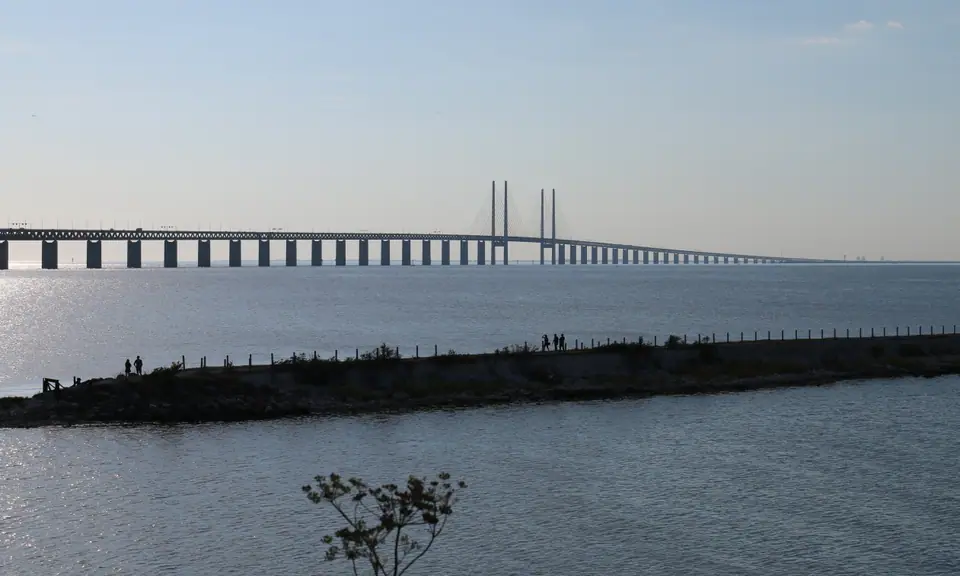
Viewing the Bridge from Lernacken and Luftkastellet
The primary land viewpoint on the Swedish side is Lernacken, a coastal headland in the Limhamn-Bunkeflo borough where the bridge abutment and toll plaza meet the shore. Walking and cycling paths wind across the grassy moraine hills beneath the approach viaduct near the exhibition pavilion Luftkastellet, offering unobstructed views of the 204.5-metre pylons and passing shipping traffic. Originally built from excavated chalk, limestone sludge, and industrial landfill over the twentieth century, the headland was landscaped into a breezy coastal nature area with meadow trails that rise directly beside the concrete piers of the viaduct.
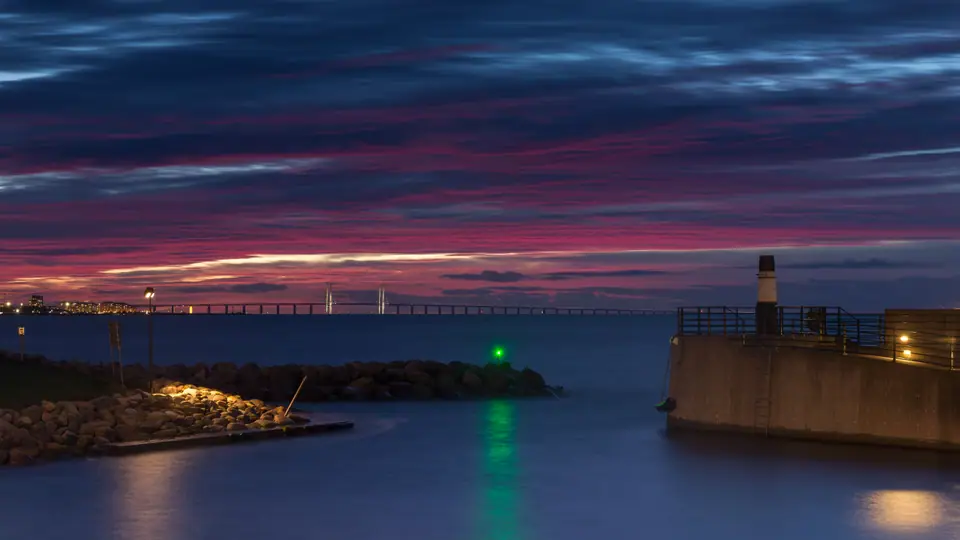
Standing on the gravel paths at Lernacken lets you appreciate the engineering transition where the two transport levels stack on top of each other: heavy freight and passenger trains rumble through the steel truss girder directly underneath the motorway deck before climbing toward the high cable-stayed span over the Flintrännan channel. A second classic vantage point lies further north along Ribersborgsstranden and the boardwalks of Västra Hamnen, where the bridge profile frames evening sunsets across the water.
Crossing by Train or Car Between Malmö and Copenhagen
Pedestrians and cyclists cannot cross the bridge deck directly on their own power. Instead, Öresundståg regional trains carry bicycles and passengers between Malmö Central, Triangeln, Hyllie, Copenhagen Airport, and Copenhagen Central Station four to six times per hour by day and hourly overnight. Because the railway runs on the lower deck of the high bridge before diving into the tunnel at Peberholm, train passengers enjoy wide panoramic views over the Öresund waters and offshore wind turbines during the crossing.
Motorists driving across on the E20 motorway pass through the payment station at Lernacken on the Swedish side, where automated lanes process electronic tags and bank cards. All travellers crossing between Denmark and Sweden by rail or road should keep a valid passport or national identity card handy for border checks at Hyllie station and the Lernacken toll plaza. Cyclists who wish to take their bikes into Denmark simply roll them onto the low-floor carriages of the regional train at Malmö Central, Triangeln, or Hyllie using a bicycle ticket in the transit app. Experiencing the crossing from a train window high above the waves and later photographing the cable-stayed span from the shore paths below shows why the structure remains a defining engineering monument of the region.
Combining Lernacken with Limhamn and the Southern Coast
To turn a bridge viewpoint visit into a half-day coastal outing, follow the shoreline cycle route southwest from Ribersborg through the former fishing and limestone harbour of Limhamn, where small smokehouses and marinas face the strait, or take a local Skånetrafiken bus to the stops near Bunkeflostrand. South of the bridge abutment, the coastal meadows of Bunkeflo strandängar preserve salt-tolerant pastures grazed by cattle along shallow coves and boulder-strewn shorelines. Those following our three-day Malmö itinerary often pair an afternoon stop at Lernacken with a morning swim at Ribersborgs kallbadhus or a walk through the historic parks of Slottsparken and Kungsparken, before returning to Gamla Staden for dinner. Clear afternoons in spring and summer offer the sharpest visibility across the water toward the island of Amager and the skyline of Copenhagen, while windy autumn days highlight the dramatic scale of the concrete pylons rising out of the white-capped strait. Benches along the Lernacken promontory make it easy to linger by the water.
Traveller tips
Real advice from people who have been to Öresund Bridge & Lernacken: Sweden's Fixed Link to Denmark. Every tip is read by our team before it goes live.
No tips yet. Been here? Yours could be the first.
Thank you! Your tip will appear here after a quick review.
More in Malmö
Continue exploring Malmö with related neighbourhood, food, and planning guides
Ribersborg Beach & Kallbadhus: Malmö's 1898 Open-Air Sea Bath
Malmö, Sweden
Moderna Museet, Malmö Konsthall & Malmö Live: Arts & Architecture
Malmö, Sweden
Möllevången & Folkets Park: Open-Air Markets, Jugendstil & Nightlife
Malmö, Sweden
What to Eat in Malmö: Scanian Äggakaka, Spettekaka & Falafel
Malmö, Sweden
