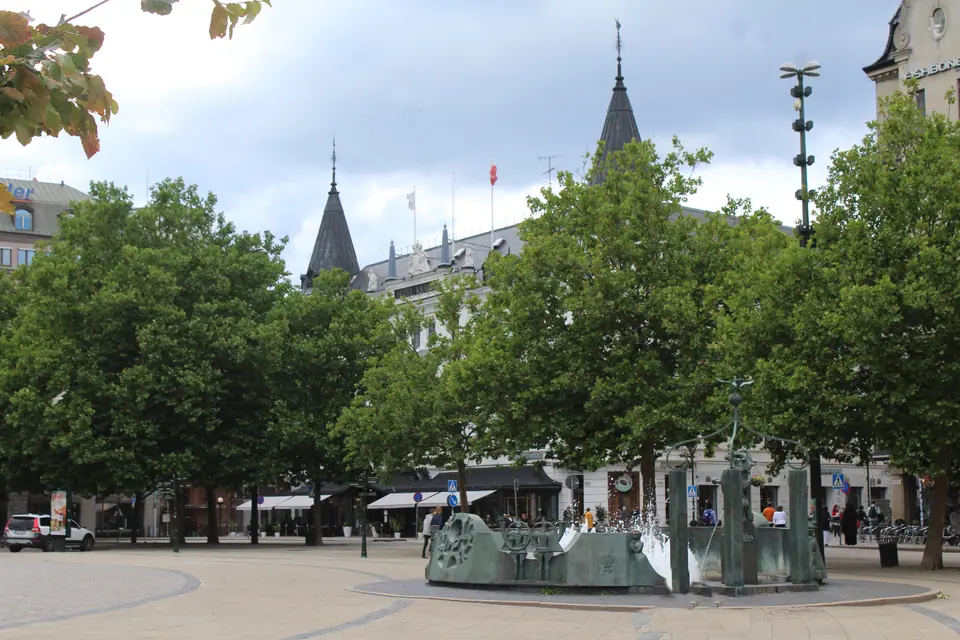
Stortorget, Lilla Torg & Gamla Väster: Malmö's Historic Heart
Walk through Gamla Staden to see the 1546 Malmö Town Hall on Stortorget, 14th-century Sankt Petri kyrka, cobbled Lilla Torg, and Gamla Väster.
Enclosed by the harbour canal to the north and the zig-zagging water moat along the old ramparts, Gamla Staden preserves a street grid laid out between 1300 and 1600 during Malmö's Danish Hanseatic boom. A short walk links Stortorget with 14th-century Sankt Petri kyrka, half-timbered Lilla Torg, and the quiet lanes of Gamla Väster, making the historic core the natural starting point for any sightseeing walk in Malmö.
Because the medieval town grew parallel to the curving shoreline of the Öresund before nineteenth-century harbour reclamation pushed the sea northward, its principal streets still trace the ancient coastal ridge. Stepping across the canal bridges from Malmö Central Station brings you straight into a dense fabric of stepped-gable merchant houses, Renaissance civic monuments, and cobbled market squares where cars are largely restricted.
Stortorget and the 1546 Malmö Town Hall
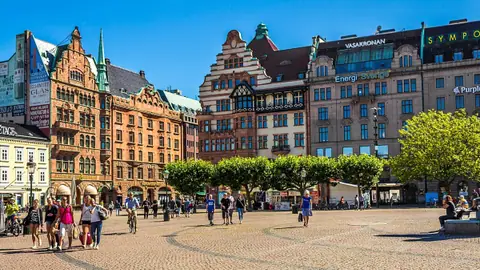
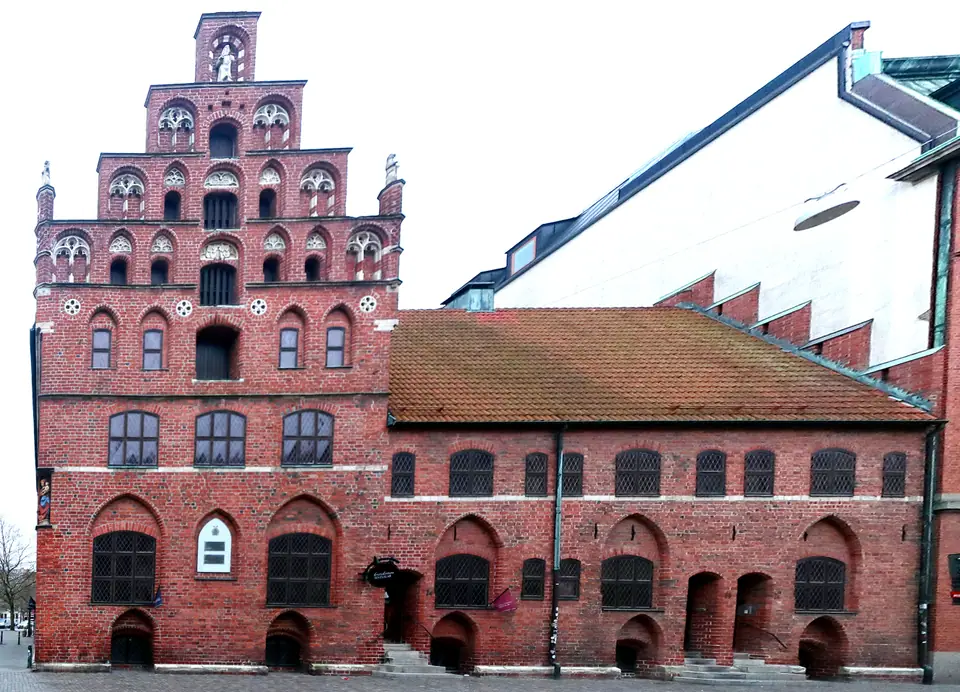
Construction of Stortorget ("The Big Square") began in 1538 during the Danish Reformation after mayor and mintmaster Jörgen Kock demolished the medieval Monastery of the Holy Spirit (Helgeandsklostret), whose grounds and cemetery covered about 70 per cent of the future square. Along its eastern side rises Malmö Town Hall (Malmö rådhus), built between 1544 and 1547 as the largest town hall in the Nordic countries. While its basement preserves two 16th-century barrel vaults housing the restaurant Rådhuskällaren and the upper floor contains the ceremonial Knutssalen, the exterior Dutch Renaissance brick facade was created in the 1860s by architect Helgo Zettervall, who added sculpted figures of goddess Themis and Malmö burghers Jörgen Kock, Mattias Flensburg, Lorenz Isac Bager, and Frans Suell.
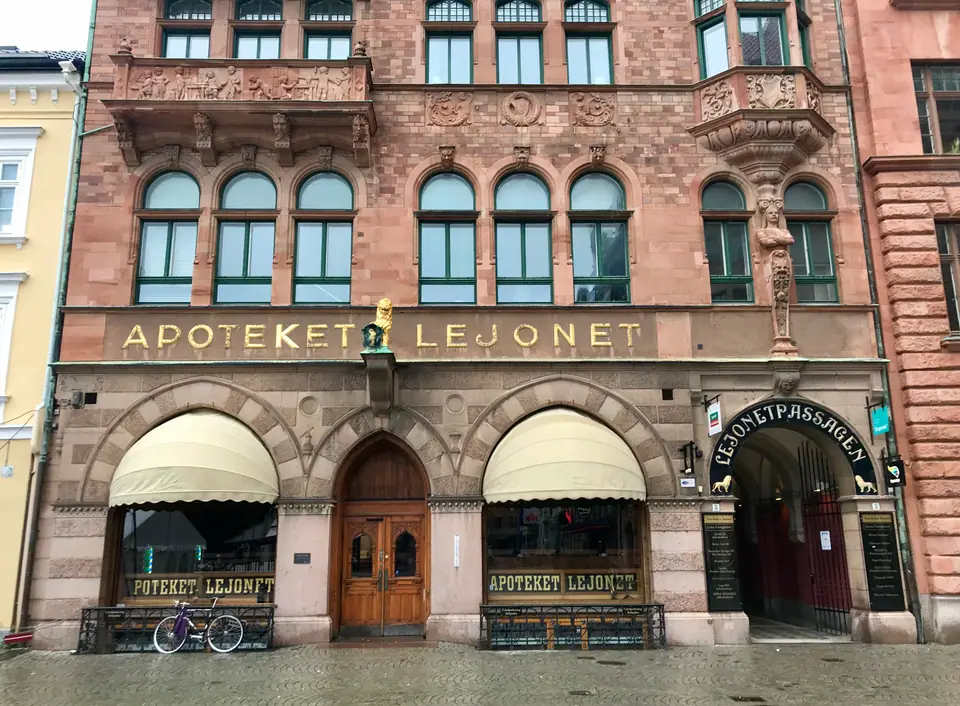
In the centre of Stortorget stands John Börjeson's equestrian statue of King Charles X Gustav, unveiled for the 1896 Malmö Craft and Industry Exhibition, where the 13 degrees east meridian crosses the pavement. Around the perimeter sit the Governor's Residence (Landshövdingeresidenset), Hotel Kramer, the Lion Pharmacy (Apoteket Lejonet), and Jörgen Kock's stepped-gable brick residence, Kockska huset, completed in 1524.
Take time to inspect the architectural details around the edges of the expanse. Kockska huset stands as a premier surviving example of late-medieval secular brick architecture in Scandinavia, with decorative blind arches, stepped gables, and a carved sandstone corner sculpture, while the neo-Renaissance building of Apoteket Lejonet directly opposite retains wooden medicine cabinets and stained glass from the late nineteenth century. Nearby near Adelgatan, the medieval cellar complex known as Tunneln also survives from the start of the fourteenth century.
Sankt Petri Kyrka: Baltic Brick Gothic Masterpiece
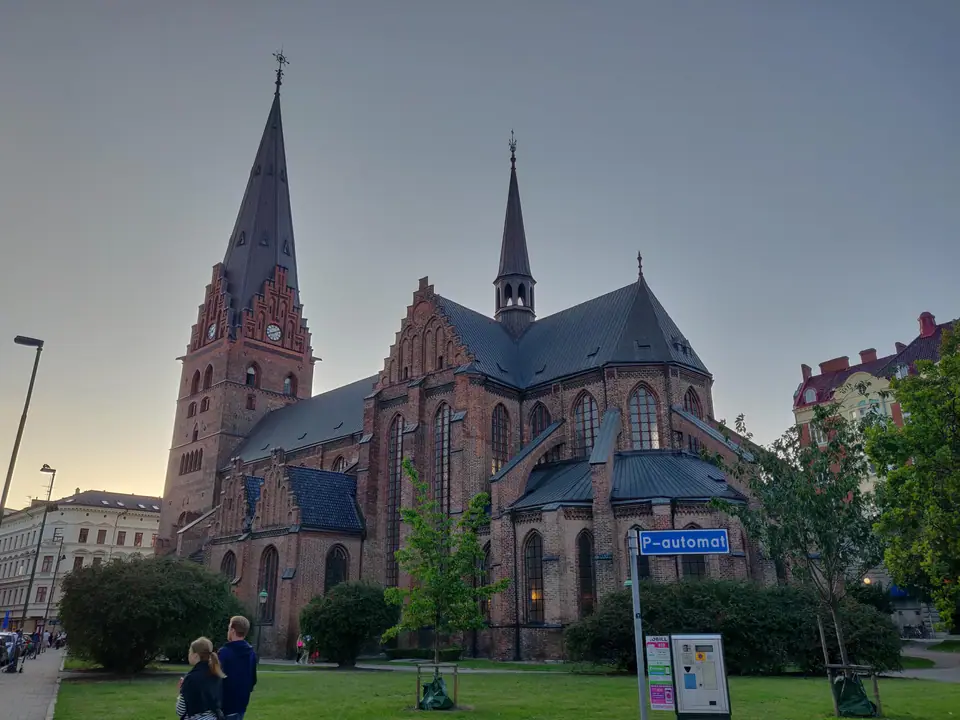
Just behind the Town Hall stands Saint Peter's Church (Sankt Petri kyrka), Malmö's oldest preserved building. Modelled on St Mary's Church in Lübeck as a three-nave Baltic Brick Gothic basilica with transepts and exterior flying buttresses, its high altar was consecrated in 1319 and the main church completed around 1380. After its western tower collapsed in 1420 and again in 1442, a replacement tower was raised and given its current spire in 1890. Inside, the church escaped complete destruction during the 1529 Reformation iconoclasm led by preacher Claus Mortensen and retains late-medieval vault murals in the Merchant's Chapel (Krämarkapellet) alongside a four-storey carved wooden altarpiece made in 1611.
Walking beneath the whitewashed brick vaults reveals how prosperous Hanseatic merchants funded side chapels and liturgical furnishings across centuries. The sandstone and black limestone pulpit carved by Daniel Tommisen and the ornate baptismal font stand in sharp visual contrast to the vivid lime-painted vines, saints, and moralising emblems covering the ceiling of Krämarkapellet, which offer a rare look at pre-Reformation church painting in southern Sweden.
Lilla Torg, Hedmanska Gården, and Market History
Immediately southwest of Stortorget, cobbled Lilla Torg was created by land infill in the 1590s as a food market for bakers, butchers, and fishmongers; after a 1903 brick market hall on the square was demolished in 1968, the open plaza became Malmö's main outdoor dining room. On its southern edge stands Hedmanska gården, a half-timbered merchant courtyard from the 1590s housing the Form/Design Center, opposite the 1760s Faxeska huset and 1720s Ekströmska huset.
Passing through the carriage archway of Hedmanska gården leads into a peaceful cobbled yard surrounded by red-and-black timber framing and old grain warehouses. Inside the warehouse lofts, the Form/Design Center mounts free exhibitions of Swedish furniture, textiles, ceramics, and industrial design, accompanied by a specialist design bookshop and courtyard seating where locals pause for afternoon coffee.
Preserved Artisan Streets of Gamla Väster
West of Lilla Torg toward Kungsparken and Malmöhus Castle, the neighbourhood of Gamla Väster was saved from 1970s road-widening plans by local preservationists (Föreningen Gamla Väster) and Malmö Museum, preserving colourful 19th-century brick and rendered townhouses along Jakob Nilsgatan, Långgårdsgatan, and Slottsgatan. Today these low-rise streets are lined with quiet galleries, antique shops, bakeries, and leafy residential courtyards that reward unhurried morning strolls away from the main commercial thoroughfares. Unlike the grand civic scale of Stortorget, Gamla Väster shows how artisans, clerks, and shopkeepers lived inside the canal loop during the nineteenth century.
Pedestrian Södergatan and Canal Connections
To the east of Lilla Torg, Södergatan forms the historic commercial spine connecting Stortorget with the tree-shaded square of Gustav Adolfs torg and the southern canal bridges. Along the way, bronze sculptures and flower beds mark the transition from the sixteenth-century merchant core to the nineteenth-century stone boulevards. Exploring both the eastern shopping streets around Kalendegatan and the western lanes of Gamla Väster gives you a complete picture of how the canal-ringed core evolved over centuries of Danish and Swedish rule. From Gamla Staden, you can cross west over the water to Slottsholmen, walk north to Malmö Saluhall, visit Moderna Museet Malmö on Gasverksgatan in the eastern part of the Old Town, or compare Old Town hotels in our accommodation guide. Because almost every street inside the canal perimeter is flat and pedestrian-friendly, the entire historic quarter can be explored comfortably at a relaxed walking pace in any season of the year, with sheltered courtyards and historic cafés never more than a few steps away from the water, and with sightseeing canal boats departing along Norra Vallgatan throughout the warmer months.
Traveller tips
Real advice from people who have been to Stortorget, Lilla Torg & Gamla Väster: Malmö's Historic Heart. Every tip is read by our team before it goes live.
No tips yet. Been here? Yours could be the first.
Thank you! Your tip will appear here after a quick review.
More in Malmö
Continue exploring Malmö with related neighbourhood, food, and planning guides