


























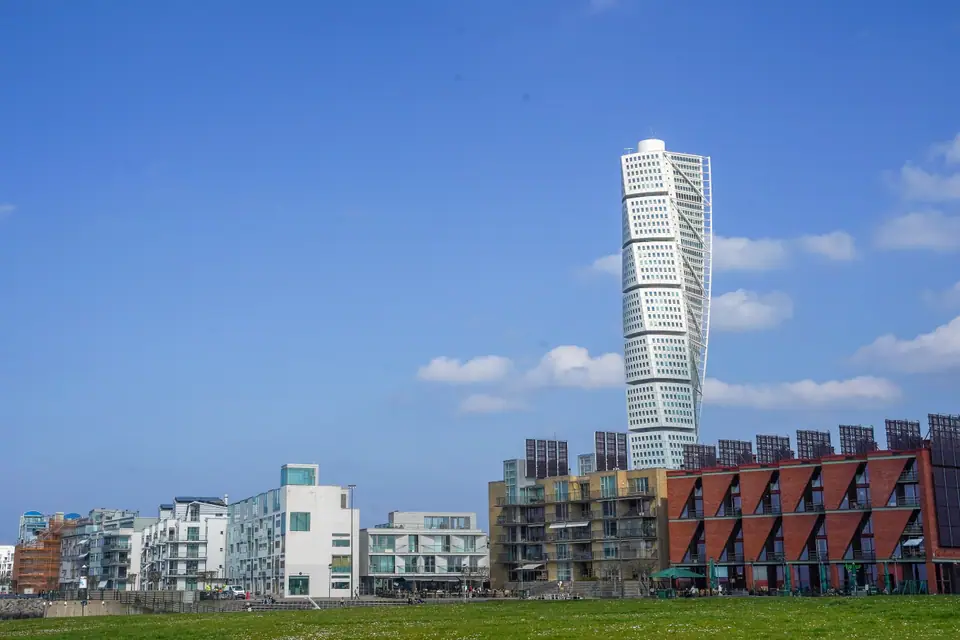
Västra Hamnen & Turning Torso: Malmö's Reborn Shipyard Waterfront
Explore Västra Hamnen, built on the former Kockums shipyard for the 2001 Bo01 exposition and crowned by Santiago Calatrava's 190-metre Turning Torso.
Västra Hamnen (the Western Harbour) occupies an artificial peninsula northwest of central Malmö created by marine land reclamation that began in the 1770s. In the 1870s the Kockums engineering company relocated its shipyard here, and in 1966 it completed the world's largest dry dock on the site. After commercial shipbuilding ceased in 1986 and the landmark 1974 Kockums Crane was dismantled and shipped to South Korea in 2002, the city reimagined the industrial waterfront as an ecological residential and university quarter.
Today the peninsula stands as the clearest physical symbol of Malmö's post-industrial renewal. Separated from Gamla Staden and Malmö Central Station by the inner harbour canal and Universitetsholmen, the district rewards slow exploration on foot or bicycle along its wind-buffered alleys, saltwater rainwater channels, and open sea promenades. Urban planners, students, and travellers come here to see how former heavy-industry docklands were converted into a walkable coastal neighbourhood where maritime heritage and modern sustainability coexist.
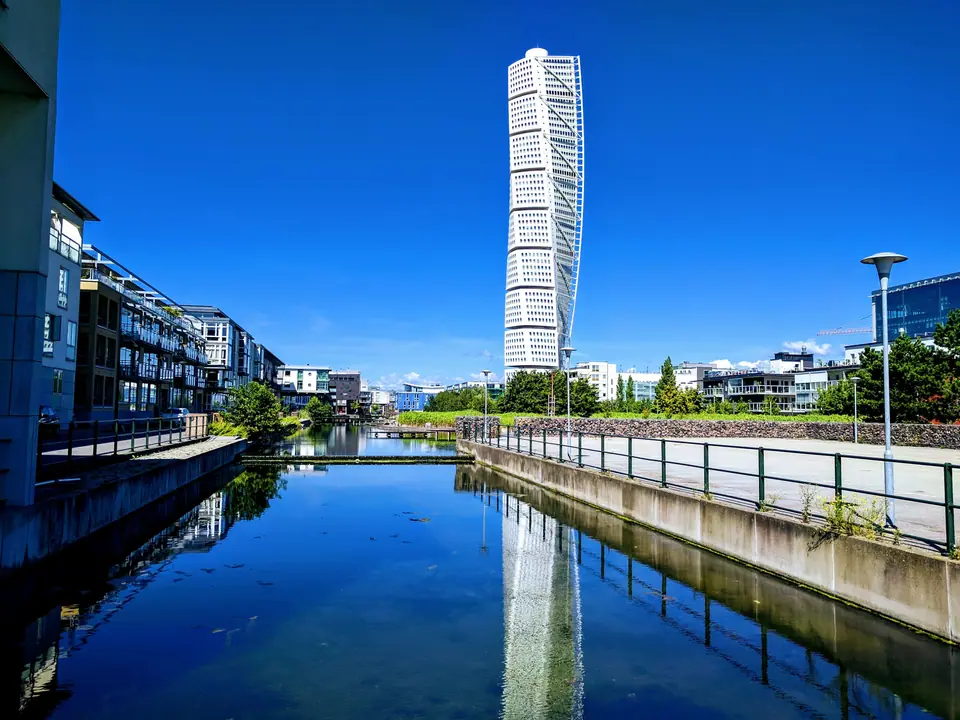
Turning Torso: Calatrava's 190-Metre Twisted Tower
The district's vertical landmark is HSB Turning Torso on Lilla Varvsgatan, designed by Spanish architect, engineer, and sculptor Santiago Calatrava. In 1999 Johnny Örbäck, then managing director of the cooperative housing association HSB Malmö, saw a brochure featuring Calatrava's white marble sculpture Twisting Torso and travelled to Zurich to commission a residential skyscraper based on twisting cubes. Construction began in February 2001, and the building was officially inaugurated on 27 August 2005.
Reaching 190 metres (620 feet) across 54 storeys, Turning Torso was the tallest building in the Nordic region until September 2022, when Karlatornet in Gothenburg surpassed it. The tower is composed of nine five-storey pentagonal segments rotating around a reinforced concrete core and braced by an external white steel exoskeleton. The topmost ninth segment twists a full 90 degrees clockwise relative to the ground floor. The lowest two segments contain office space, while segments three through nine house 147 rental apartments, supplemented since March 2007 by the five-storey Turning Torso Gallery next door.
Because the skyscraper functions primarily as a private residential building, visitors admire its structural steel spine and twisting marble-clad facade from the surrounding plaza, the reflection pools along Lilla Varvsgatan, and the pedestrian bridges of the adjacent canal basin. Viewed from different angles as you walk around the base, the external steel trusses appear to shift geometry against the coastal sky, making the tower an unmistakable orientation beacon across the flat Scanian horizon and across the water from Denmark.
The Bo01 Housing Exposition Quarter
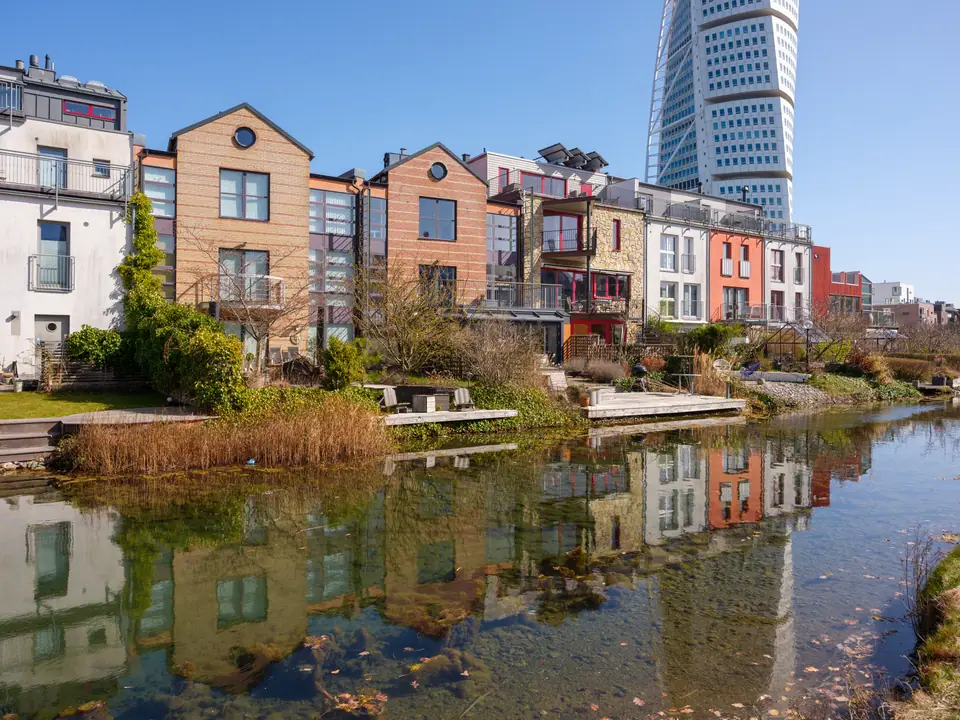
Modern residential development in Västra Hamnen launched in 2001 with the European Housing Exposition, known as Bo01. Planned around 500 self-sufficient housing units powered by local renewable energy and designed to reduce phosphorus emissions, Bo01 brought together multiple architects to build a car-free interior network of narrow wind-sheltered alleys, saltwater canals, and small garden courtyards alongside a pleasure-boat marina.
Walking through the interior of Bo01 feels intentionally different from the wide, windswept sea wall outside. The master plan arranged a taller perimeter barrier of waterfront apartment blocks to break the strong westerly gales off the Öresund, sheltering an intimate labyrinth of crooked lanes, timber bridges, and varied roof profiles where adjacent facades contrast in colour, material, and height. Open stone channels collect rainwater along the pavements and feed small ponds planted with coastal reeds and aquatic vegetation, turning storm-water drainage into a visible landscape feature across the courtyards. Solar panels, wind power, and heat extracted from seawater and underground aquifers were integrated directly into the district's energy grid from its inception.
Sundspromenaden, Daniaparken, and Scaniabadet
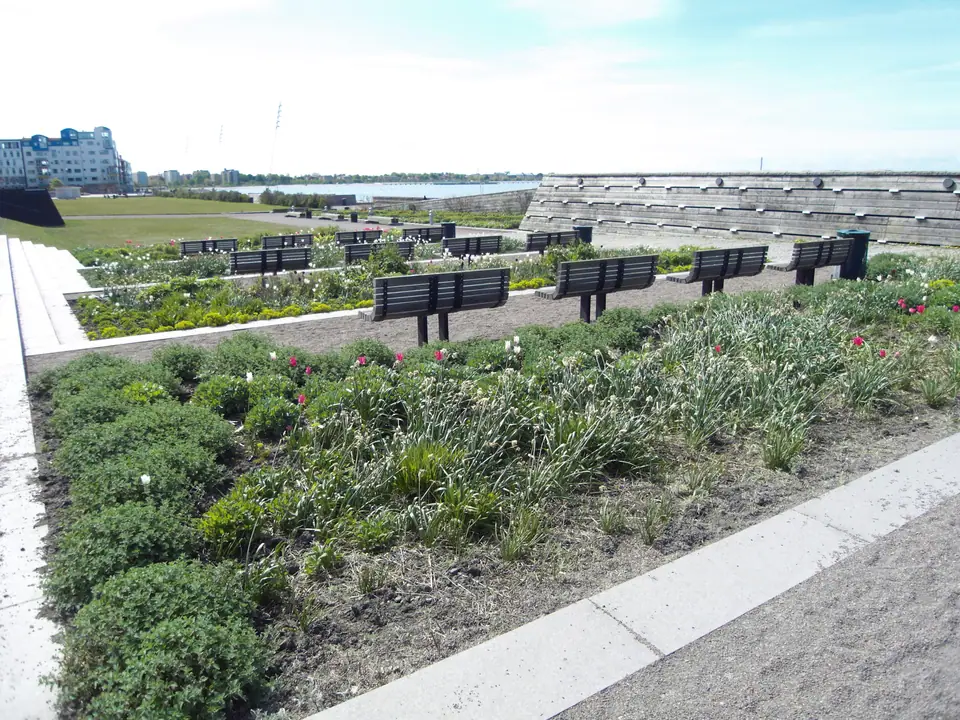
Along the western sea wall facing the Öresund Bridge, the timber decks of Sundspromenaden and the stepped viewing platforms of Daniaparken draw swimmers and sunset crowds throughout summer. Because bathing directly in front of the promenade apartments grew so crowded, Malmö Municipality opened the dedicated deep-water swimming pier Scaniabadet at Scaniaparken in 2005.
Along Sundspromenaden, broad wooden steps angle toward the afternoon sun above protective granite boulders, while three cylindrical concrete viewing bastions at Daniaparken extend out over the waves. Further north at Scaniaparken, grassy hills and three wide wooden bathing jetties give swimmers direct ladder access into deep, clear seawater with lifebuoys and summer amenities. Even outside the summer bathing months, the promenade serves as a popular coastal walkway for watching ships pass through the strait and seeing the sun sink behind the Danish coastline across the water.
Stapelbäddsparken and the Former Kockums Slipways
Inland near the old Kockums slipways, Stapelbäddsparken preserves the memory of the shipyard era while repurposing the open ground for community recreation. Its vast poured-concrete skate bowl, climbing boulders, and cultural events space sit beside the former crane basin, reminding visitors of the industrial scale that once defined this peninsula before residential towers and university buildings took over. Brick assembly halls preserved nearby now house corporate offices, design studios, and media companies, illustrating how industrial heritage buildings were adapted rather than demolished across the eastern half of the harbour. Walking between the surviving brick machine halls and the modern glass office blocks shows how both eras of Västra Hamnen fit together.
Universitetsholmen and Coastal Links to Ribersborg
Immediately east of Västra Hamnen, Universitetsholmen houses Malmö University's Orkanen library building, the World Maritime University, and the concert halls of Malmö Live. Swing bridges for pedestrians and cyclists link the university quays directly to the inner harbour canals and the historic streets near Malmö Central Station. For lunch or coffee after an architecture walk, the brick food hall of Malmö Saluhall sits right where Västra Hamnen meets Universitetsholmen, while a flat coastal cycle path continues directly southwest along Ribersborgsstranden to the timber sea bathhouse and sandy bathing jetties. Green Skånetrafiken city buses also link Turning Torso and the waterfront stops back to Malmö Central Station in a few minutes, making the Western Harbour easy to include in any half-day Malmö sightseeing walk or waterfront hotel stay. Visiting on a warm summer afternoon for a swim off the wooden decks or on a crisp autumn morning to photograph the twisted tower reveals contemporary Malmö at its clearest, and the flat coastal path makes onward walking effortless.
Traveller tips
Real advice from people who have been to Västra Hamnen & Turning Torso: Malmö's Reborn Shipyard Waterfront. Every tip is read by our team before it goes live.
No tips yet. Been here? Yours could be the first.
Thank you! Your tip will appear here after a quick review.
More in Malmö
Continue exploring Malmö with related neighbourhood, food, and planning guides
What to Eat in Malmö: Scanian Äggakaka, Spettekaka & Falafel
Malmö, Sweden
How to Get to Malmö & Get Around: CPH Trains, City Tunnel & Bikes
Malmö, Sweden
Where to Stay in Malmö: Best Areas from Gamla Staden to Västra Hamnen
Malmö, Sweden
Best Time to Visit Malmö: SMHI Climate Normals, Daylight & Festivals
Malmö, Sweden
