


























La Compania de Jesus and Quito's Baroque Gold Churches
Step inside the 23-karat gold-leaf interior of Iglesia de la Compania de Jesus (1605-1765), then explore Santo Domingo and Basilica de la Merced.
One block southwest of Plaza Grande at the corner of Calle Garcia Moreno (the historic Street of the Seven Crosses) and Calle Sucre stands Iglesia de la Compania de Jesus, widely regarded by architectural historians as the most accomplished expression of Spanish Baroque architecture in the Americas. Begun by the Society of Jesus in 1605 and completed 160 years later in 1765, just two years before King Charles III expelled the Jesuits from the Spanish Empire in 1767, the church synthesises Italian Baroque spatial planning with Moorish Mudéjar geometry and indigenous stone-carving mastery. Pair this visit with the adjacent Convent of San Francisco.
The Volcanic Andesite Portal of La Compania
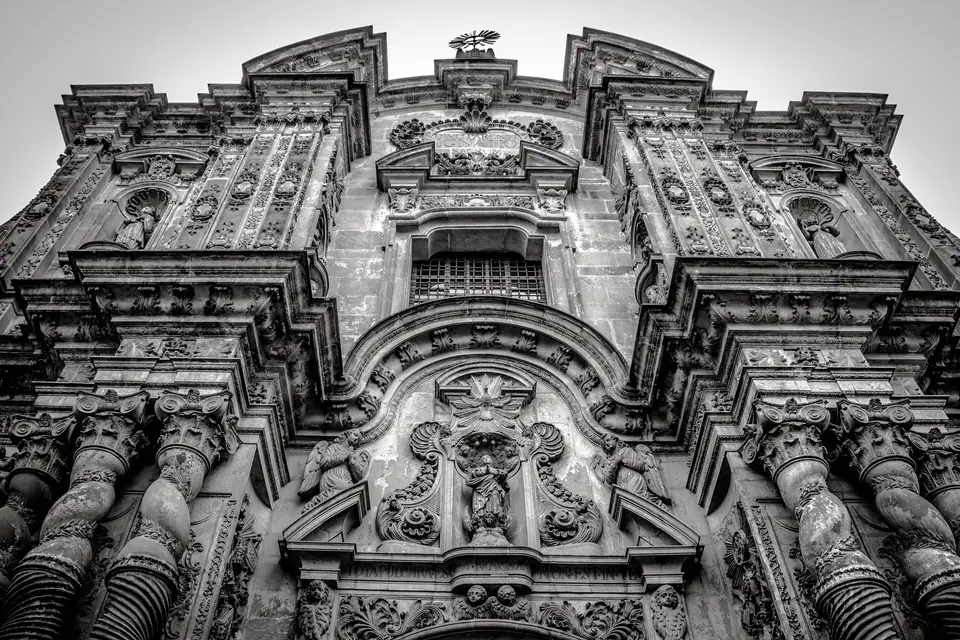
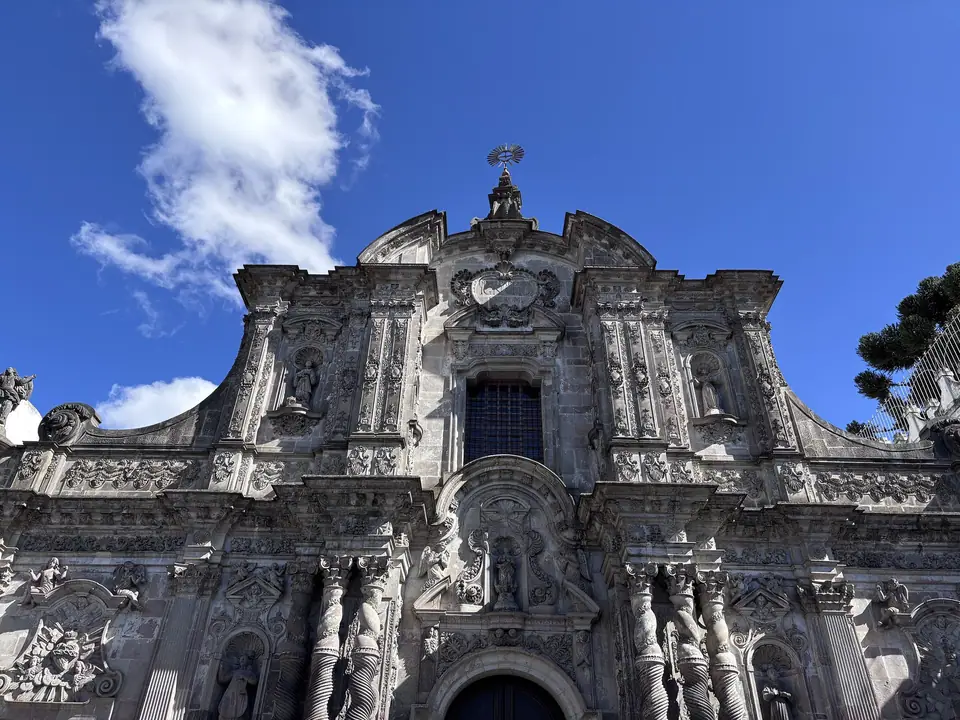
The exterior facade of La Compania was begun in 1722 by Jesuit Father Leonardo Deubler and completed in 1765 by Brother Venancio Gandolfi. Chiselled entirely from grey volcanic andesite quarried on the slopes of Pichincha, the portal rises around six twisted Solomonic columns modelled after Gian Lorenzo Bernini's bronze baldachin in St Peter's Basilica in Rome, flanked by statues of St Ignatius of Loyola and St Francis Xavier alongside cherubs, fruit garlands, and papal tiara reliefs.
The 23-Karat Gold-Leaf Baroque Nave and Altarpieces
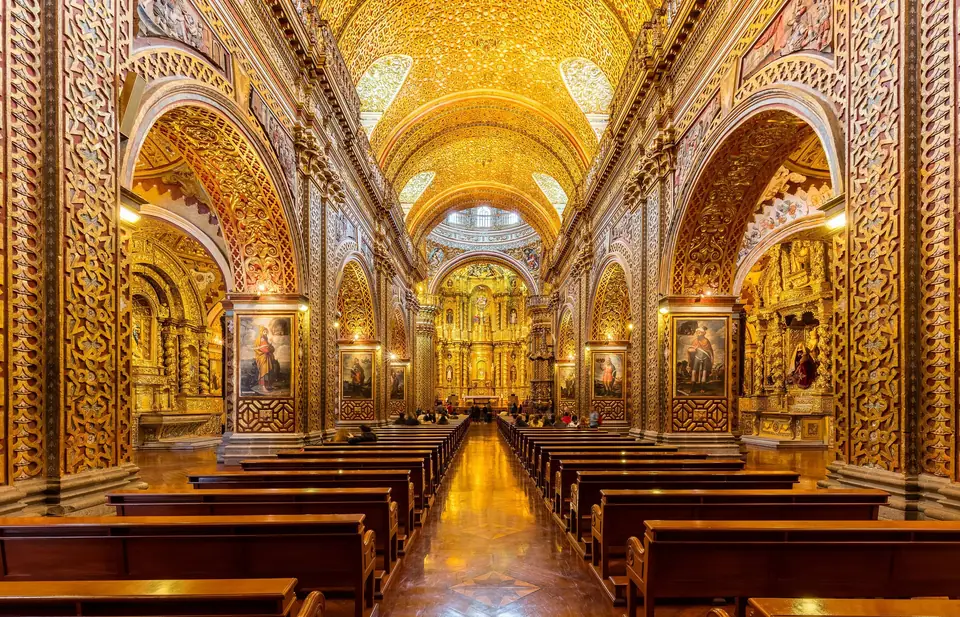
Crossing the carved cedar threshold reveals a Latin-cross floor plan measuring 58 metres long by 26.5 metres wide, designed after the Church of the Gesu and the Church of Sant'Ignazio in Rome by Brother Marcos Guerra. Almost every square centimetre of the barrel-vaulted central nave, Mudéjar geometric ribs, side chapels, pulpit, and high altar (carved between 1735 and 1745 by Bernardo de Legarda) shimmers beneath fine 23-karat gold leaf applied over scarlet bole and gesso. Along the nave pillars hang the striking eighteenth-century paintings of the sixteen Old Testament Prophets alongside Hernando de la Cruz's vivid 1620 canvas of Hell and the Last Judgement.
Iglesia y Convento de Santo Domingo
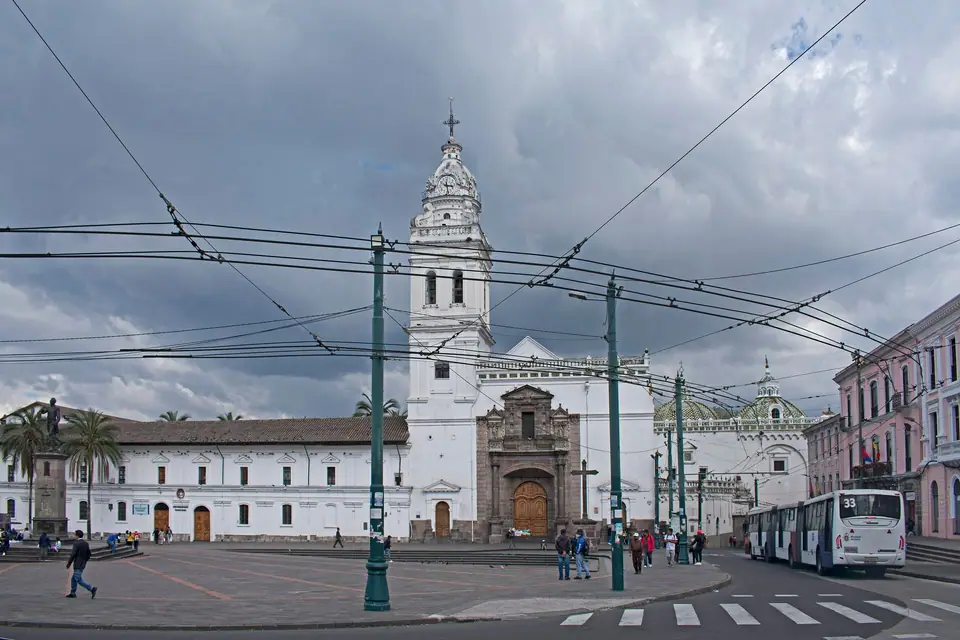
Four blocks southeast at the southern end of Calle Flores, the Dominican church and convent begun in 1540 under architect Francisco Becerra anchors spacious Plaza Santo Domingo. Inside, a red-and-gold cedar Mudéjar ceiling leads to the raised Baroque Capilla de la Virgen del Rosario, built in 1733 atop a vaulted archway over Calle Rocafuerte and housing Bernardo de Legarda's swirling rococo altarpiece.
Basilica de Nuestra Senora de la Merced
Two blocks north of Plaza San Francisco on Calle Cuenca, the whitewashed Mercedarian basilica (constructed between 1701 and 1736 by architect Jose Jaime Ortiz over an earlier sixteenth-century church damaged by eruptions of Guagua Pichincha) stands out for its 47-metre bell tower, pink-and-white stucco domes, and two-tier stone cloister with a central carved Neptune fountain.
Traveller tips
Real advice from people who have been to La Compania de Jesus and Quito's Baroque Gold Churches. Every tip is read by our team before it goes live.
No tips yet. Been here? Yours could be the first.
Thank you! Your tip will appear here after a quick review.
More in Quito
Continue exploring Quito with related neighbourhood, food, and planning guides
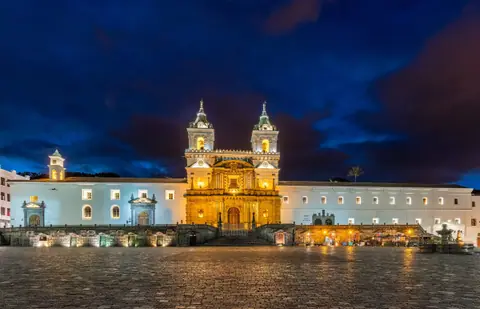
Things to Do in Quito: Baroque Gold Churches, Volcanoes and the Equator
Quito, Ecuador
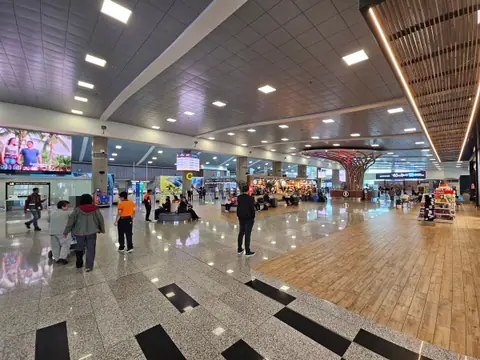
How to Get to Quito: Mariscal Sucre Airport (UIO), Metro and Bus Terminals
Quito, Ecuador
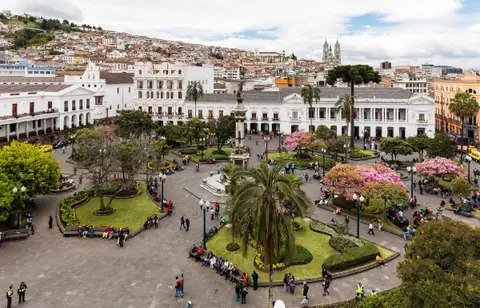
Best Time to Visit Quito: Dry Verano, Equatorial Sunshine and Climate Data
Quito, Ecuador
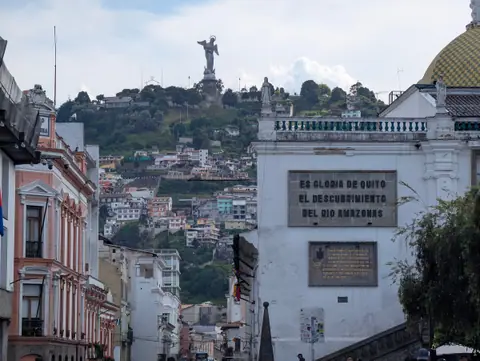
Where to Stay in Quito: Centro Historico, La Floresta and Parque La Carolina
Quito, Ecuador
