


























CERN Science Gateway, Globe of Science & the Large Hadron Collider
How to visit the European Organization for Nuclear Research in Meyrin, from the timber Globe of Science and Innovation to Science Gateway exhibits.
Northwest of central Geneva in the suburb of Meyrin, straddling the Franco-Swiss border at the foot of the Jura mountains, the European Organization for Nuclear Research (CERN) operates the largest particle physics laboratory in the world. Reached directly from Gare de Genève-Cornavin and Plainpalais on TPG tram line 18 (extended to the CERN terminus in May 2011), the Meyrin campus welcomes curious travellers to its public exhibition halls without requiring a physics background. You can easily pair a morning at CERN with an afternoon in the International Quarter or Carouge.
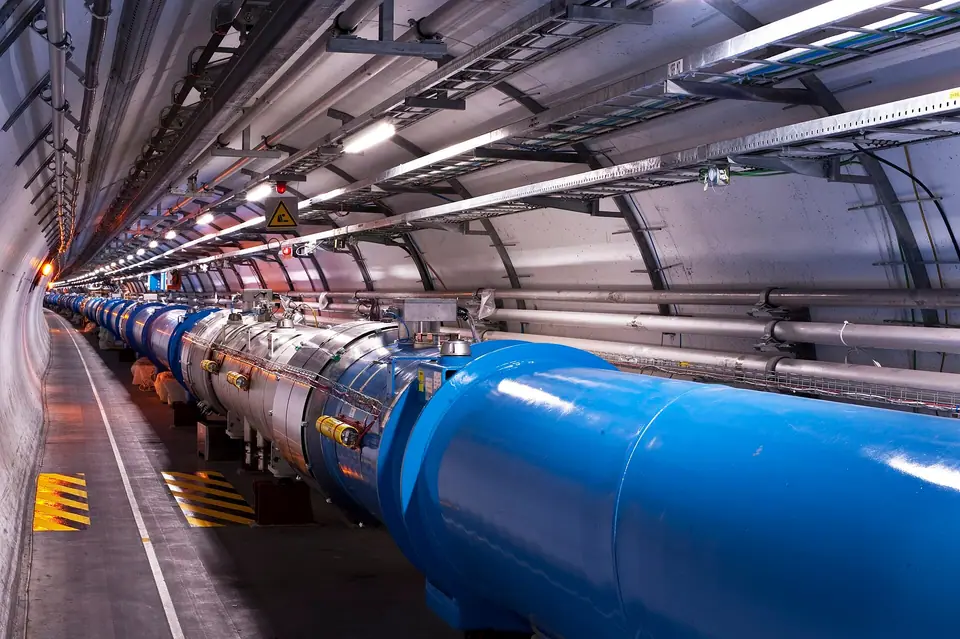
Even if you have never studied subatomic physics, visiting the Meyrin site makes abstract cosmology concrete. Full-scale superconducting dipole magnets, particle detector cross-sections, and multimedia simulations demonstrate how engineers cool underground accelerator rings to temperatures colder than outer space and collide proton beams to recreate conditions a fraction of a second after the Big Bang. Including CERN in our 3-day Geneva itinerary adds a forward-looking scientific dimension to the city's historic and diplomatic landmarks.
How Twelve Founding States Built a European Particle Physics Hub
In the aftermath of the Second World War, European physicists led by Louis de Broglie, Isidor Isaac Rabi, and Edoardo Amaldi proposed pooling scientific resources so European laboratories could build particle accelerators on a scale no single nation could fund alone. The provisional Conseil Européen pour la Recherche Nucléaire was formed by 12 European governments in 1952 (initially working at the University of Copenhagen under Niels Bohr), and October 1952 saw Geneva selected as the host site, confirmed by a cantonal referendum in June 1953.
The convention establishing the permanent Organisation européenne pour la recherche nucléaire was signed in Paris between 29 June and 1 July 1953 and ratified on 29 September 1954 by 12 founding member states: Belgium, Denmark, France, the Federal Republic of Germany, Greece, Italy, the Netherlands, Norway, Sweden, Switzerland, the United Kingdom, and Yugoslavia. Retaining the acronym CERN, the laboratory grew to 25 member states (with Israel admitted in 2013 as the only full member outside geographic Europe); in 2024 it employed 2,704 staff members and hosted about 12,406 visiting researchers from institutions in more than 80 countries. Because the underground accelerator rings expanded across the international boundary line over the decades, surface technical sites now dot both the Canton of Geneva and the neighbouring French department of Ain in the Pays de Gex.
Seven Decades of Breakthroughs: From Bosons to the World Wide Web
Across seven decades, CERN experiments achieved landmark breakthroughs in fundamental physics: discovering neutral currents in the Gargamelle bubble chamber in 1973, identifying the W and Z bosons in the UA1 and UA2 experiments in 1983 (earning Carlo Rubbia and Simon van der Meer the 1984 Nobel Prize in Physics), inventing multiwire proportional chambers under Georges Charpak (1992 Nobel Prize), creating the first antihydrogen atoms in 1995 and trapping 38 antihydrogen atoms in 2010, and discovering a new boson at around 125 GeV/c² consistent with the Higgs boson in 2012 inside the Large Hadron Collider (LHC).
Because thousands of visiting physicists needed a universal system to share experimental data across incompatible computers and international networks, British computer scientist Tim Berners-Lee and Belgian engineer Robert Cailliau invented the World Wide Web at CERN in Meyrin in 1989 to 1990. Visitors can still see early computing hardware and displays explaining how the initial web server operated right on the Meyrin campus before CERN released the underlying web software into the public domain for global use.
CERN Science Gateway and the Timber Globe of Science and Innovation
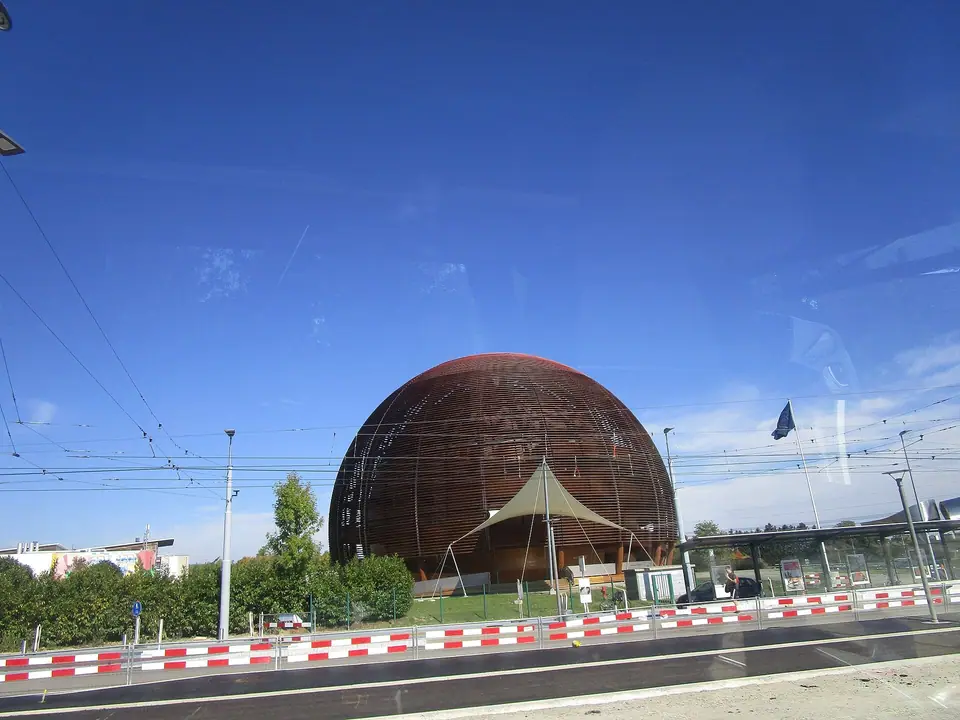
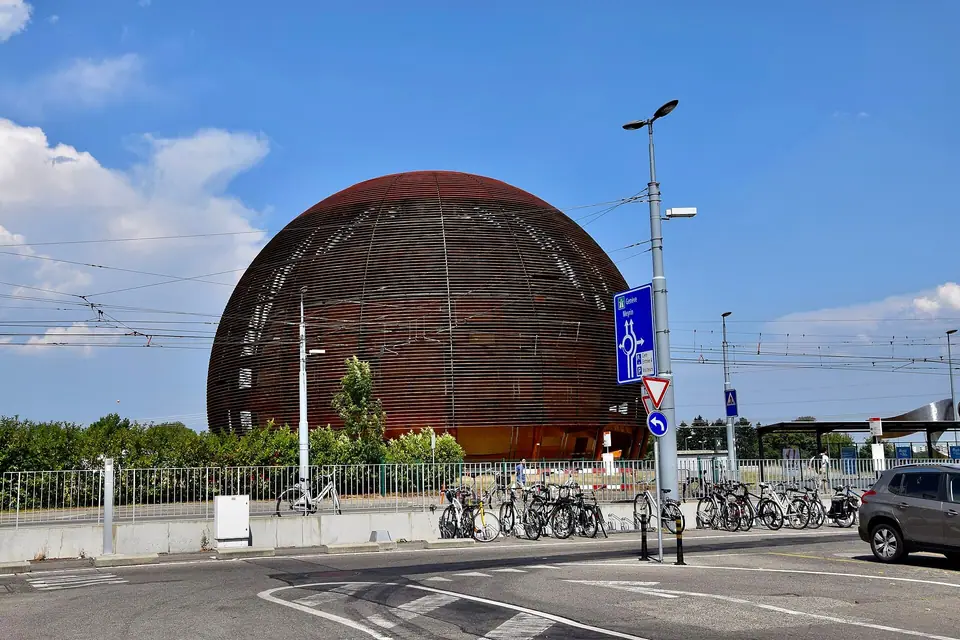
Public visits centre on two architectural landmarks flanking Route de Meyrin right beside the CERN tram stop. On the south side rises the timber lattice dome of the Globe of Science and Innovation, an exhibition and event sphere built from sustainable Swiss wood that serves as CERN's recognizable architectural emblem on the Meyrin horizon. Inside its vaulted wooden shell, atmospheric projections and exhibits introduce the scale of the laboratory and its international community.
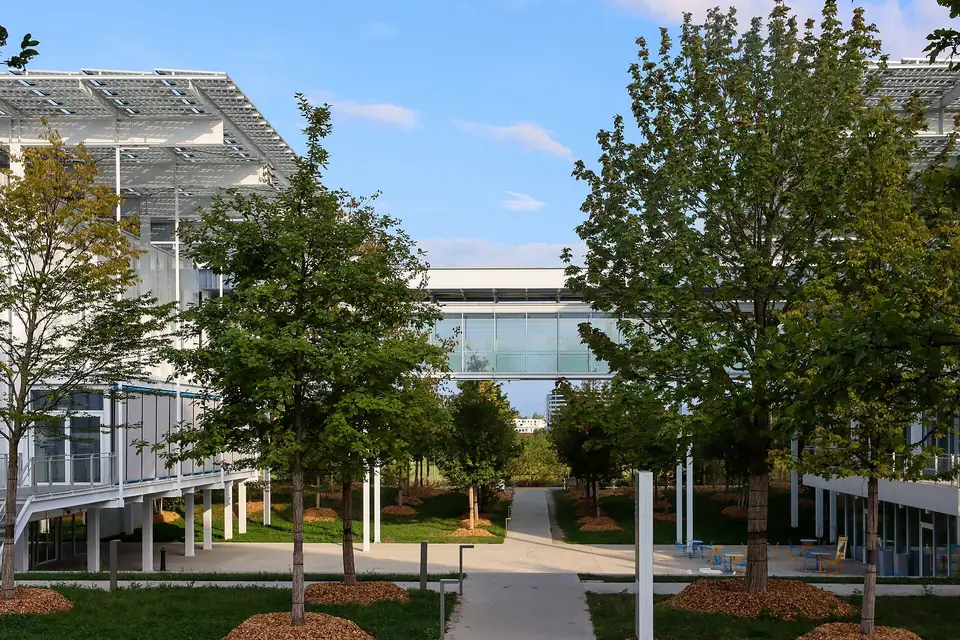
Facing the Globe across the road stands the CERN Science Gateway, connected by elevated white tubular bridges suspended above the ground like giant accelerator beam pipes between planted trees and solar canopies. Inside, hands-on exhibition halls unpack three core themes: the chain of accelerators that feed the underground Large Hadron Collider, the evolution of the universe back toward the Big Bang, and the quantum world at atomic scale. Visitors can also watch live laboratory demonstrations led by science educators, step into interactive physics puzzles, and examine genuine accelerator hardware retired from earlier experimental runs.
What makes a half-day in Meyrin especially rewarding for non-specialists is the way the exhibitions connect subatomic theory with everyday engineering and medical technology. Interactive stations explain how particle accelerators and detector sensors originally developed for fundamental physics research led to advances in Positron Emission Tomography medical imaging, hadron therapy for cancer treatment, solar thermal panels, and touch-screen capacitance interfaces, alongside the open communication standards of the World Wide Web.
Between exhibition halls, visitors can step out onto the planted plaza linking the Science Gateway and the timber Globe of Science and Innovation to see how the campus blends into the agricultural plain at the foot of the Jura ridge. Clear signage in French and English guides you through each gallery floor, making it simple to tailor your visit whether you have ninety minutes for the core accelerator displays or an entire morning for workshops and auditorium talks.
Practical Guidelines for Visiting CERN in Meyrin
- Exhibition access and underground ring rules: Admission to the CERN Science Gateway exhibition galleries is free of charge, though visitors register on arrival for timed entry during busy periods; note that the underground Large Hadron Collider tunnel itself cannot be visited by the public while the accelerator is operating.
- Direct tram 18 connection: Board TPG tram 18 at Gare de Genève-Cornavin, Place de Neuve, Plainpalais, or Carouge and ride straight to the western terminus marked CERN right outside the Science Gateway entrance, covered by a standard Unireso Zone 10 ticket.
- On-site facilities and onward routing: Pause at the Science Gateway café between gallery sessions, then ride tram 18 back into town to visit the Patek Philippe Museum in Plainpalais or dine on traditional Genevan specialities.
Traveller tips
Real advice from people who have been to CERN Science Gateway, Globe of Science & the Large Hadron Collider. Every tip is read by our team before it goes live.
No tips yet. Been here? Yours could be the first.
Thank you! Your tip will appear here after a quick review.
More in Geneva
Continue exploring Geneva with related neighbourhood, food, and planning guides
Geneva Museums: Musée d'Art et d'Histoire, Patek Philippe & Red Cross
Geneva, Switzerland
Day Trips from Geneva: Mont Salève, Lausanne & Chillon Castle
Geneva, Switzerland

What to Eat in Geneva: Lake Perch, Cheese Fondue, Longeole & Escalade
Geneva, Switzerland
How to Get to Geneva & Get Around: Airport, Cornavin, TPG & Léman Express
Geneva, Switzerland
