


























Parc des Bastions, Reformation Wall, Place de Neuve & Plainpalais
Stroll beneath the chestnut trees of Parc des Bastions to the monumental Reformation Wall, the cultural institutions of Place de Neuve, and Plainpalais.
Immediately below the southern ramparts of the Vieille Ville and the chestnut-shaded Promenade de la Treille lies Geneva's greenest academic and cultural corridor. Stretching from the tree-lined alleys of Parc des Bastions through Place de Neuve to the diamond-shaped esplanade of Plaine de Plainpalais, this district links Reformation monuments with student life and open-air markets, steps from the Patek Philippe Museum and Carouge.
Where the upper Old Town feels enclosed by medieval stone walls and narrow stairways, the Bastions and Plainpalais corridor opens into broad nineteenth-century avenues created when Geneva dismantled its outer bastions between 1850 and 1880. Locals cross the park on their way to university lectures, play chess beneath horse-chestnut canopies, attend opera productions on Place de Neuve, and shop for regional produce and antiques across the gravel expanse of Plainpalais.
Parc des Bastions and the 1817 Botanical Garden
Occupying the ground between Geneva's 16th- and 17th-century fortifications (framed by the Bourgeois and Yvoi bastions), Parc des Bastions was laid out in 1720 as the Belle promenade so citizens could walk inside the walls when gates were closed during the Great Plague of Marseille. After serving as cavalry stables during the French annexation (1798 to 1813) and being planted with potatoes during the 1816 to 1817 famine after the eruption of Mount Tambora, the lawn was transformed in 1817 by botanist Augustin Pyrame de Candolle into Geneva's botanical garden, with an 1818 orangery designed by General Guillaume-Henri Dufour, until the garden moved across the Rhône in 1904 and the orangery was demolished in 1910.
De Candolle enlisted nearly the entire population of Geneva to help dig beds and plant specimens across the grounds, leaving a botanical legacy that survives today in the park's rare specimen trees. A marked dendrological tree trail inaugurated in September 1981 identifies historic gingkos, cedars, tulip trees, and oaks shading the gravel paths.
University of Geneva Buildings, Palais Eynard, and Giant Chessboards
Between 1868 and 1872, three neoclassical buildings were erected in the park for the University of Geneva (now housing the Faculty of Letters and the Geneva Library), continuing the academic tradition founded by John Calvin in 1559. On the upper southeastern edge of the park stands the 1817 Florentine-style Palais Eynard, built for philhellene financier Jean-Gabriel Eynard and now serving as the official seat of Geneva's five-member municipal Administrative Council.
Along the central tree-lined avenue (renovated from January to May 2017), students and retirees gather daily around six giant outdoor chessboards and draughts tables just inside the Place de Neuve iron gates. Halfway down the promenade stands an ornate 1882 cast-iron and glass bandstand pavilion, converted in 2008 into a bright park terrace restaurant where you can pause for coffee or lunch beneath the trees.
The International Monument to the Reformation
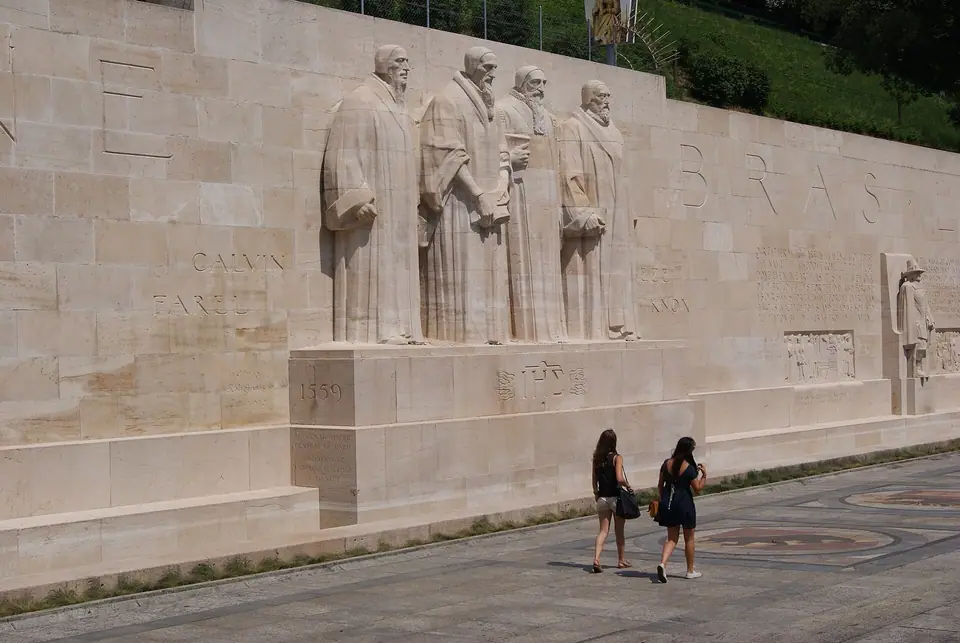
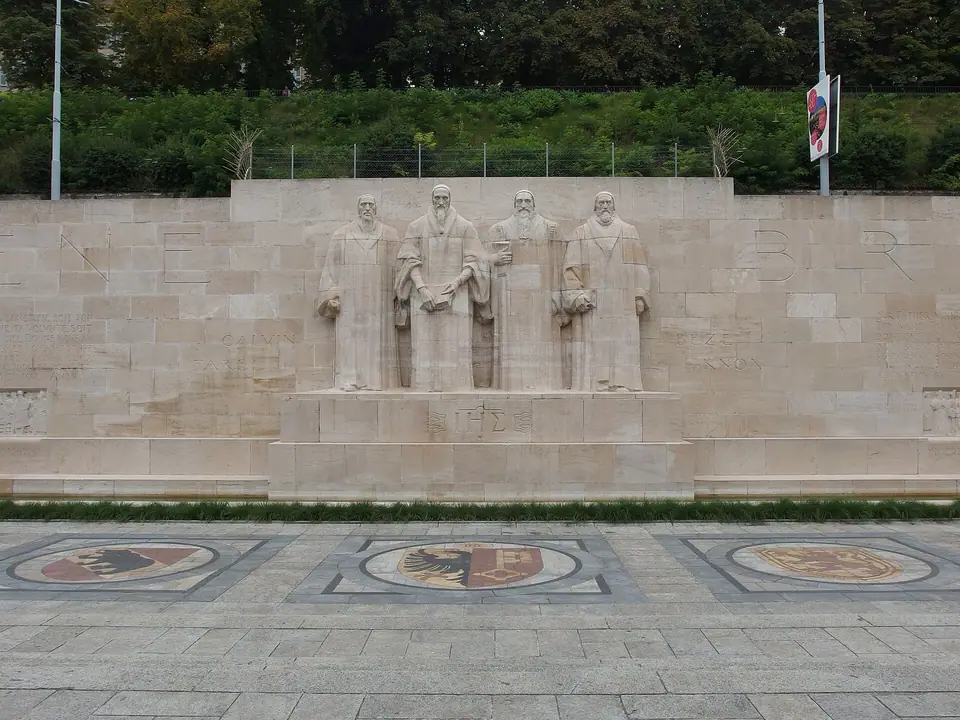
Backed against the 16th-century stone rampart of the Old Town facing the university lawn, the monumental Reformation Wall (Mur des Réformateurs) was begun in 1909 for the 400th anniversary of John Calvin's birth and the 350th anniversary of the Academy of Geneva, and inaugurated on 7 July 1917. Selected from 71 international competition entries, the expansive limestone design by Swiss architects Charles Dubois, Alphonse Laverrière, Eugène Monod, and Jean Taillens was carved in Pouillenay limestone by French sculptors Paul Landowski and Henri Bouchard.
Statues, Bas-Reliefs, and Inscriptions on the Wall
At the centre of the wall stand four 5-metre-tall robed statues of the primary Calvinist theologians: Guillaume Farel, Jean Calvin, Théodore de Bèze, and John Knox. Engraved behind and above them is Geneva's civic motto Post Tenebras Lux ("After darkness, light") alongside the dates 1536 (adoption of the Reformation) and 1602 (the Escalade), while water flows quietly through a shallow moat at the base recalling the old defensive ditch.
Flanking the central group are bas-relief panels and six 3-metre statues of political figures who advanced Reformed Protestantism across Europe and North America: Admiral Gaspard de Coligny of France, William the Silent of the Netherlands, Frederick William the Great Elector of Brandenburg, Roger Williams of Rhode Island, Oliver Cromwell of England, and Prince Stephen Bocskai of Transylvania. Stone steles at the outer ends honour Martin Luther and Ulrich Zwingli, and on 3 November 2002 the names of forerunners Peter Waldo, John Wycliffe, Jan Hus, and theologian Marie Dentière were inscribed into the stone.
Because Parc des Bastions, Place de Neuve, and Plaine de Plainpalais flow directly into one another without steep hills or busy highway barriers, the district works equally well as a morning cultural walk or a relaxed late-afternoon circuit. You can start under the horse-chestnut trees of the Promenade de la Treille, descend the stone steps past the Palais Eynard into the university lawn, trace the carved inscriptions of the Reformation Wall, cross Place de Neuve past the opera house and conservatory, and finish among the market stalls and café terraces bordering the Plainpalais esplanade.
Place de Neuve Cultural Monuments
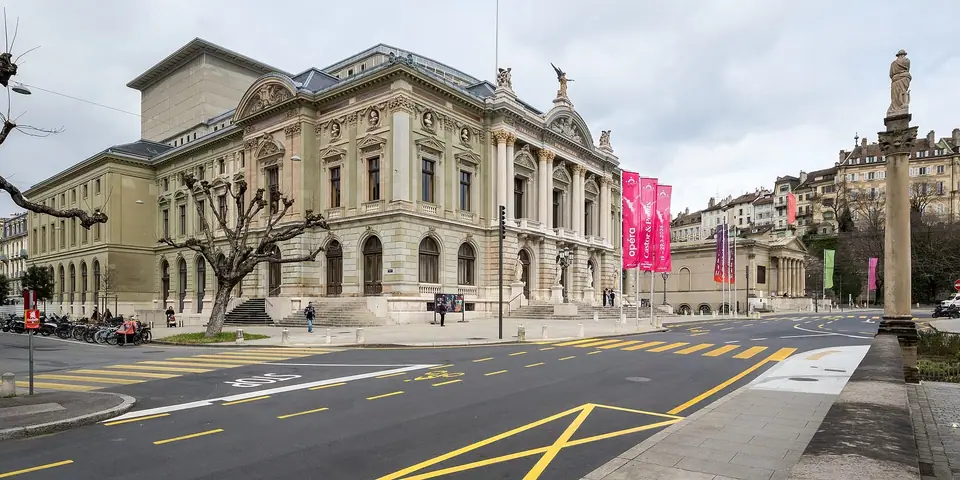
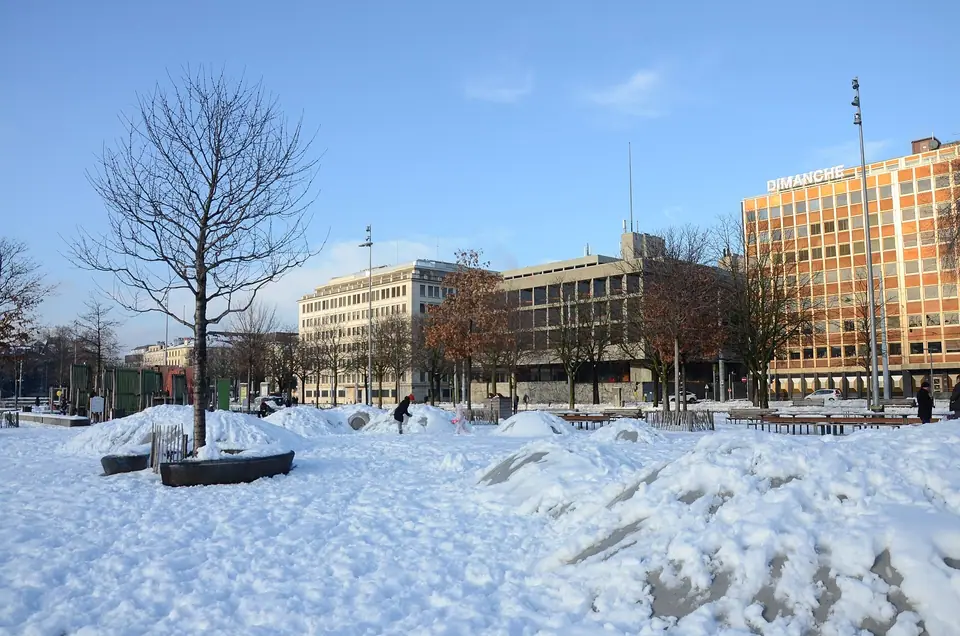
Stepping out through the iron gates at the western end of Parc des Bastions brings you onto Place de Neuve, Geneva's nineteenth-century cultural square. Around an equestrian statue of General Guillaume-Henri Dufour stand three landmark institutions: the neoclassical 1826 Musée Rath (a purpose-built fine art exhibition hall), the terracotta-and-stone Conservatoire de Musique, and the opulent Grand Théâtre de Genève opera house (built using the 1873 bequest of Duke Charles II of Brunswick and modelled on the Paris Opéra), with the symphonic Victoria Hall a block north. Looking uphill from Place de Neuve, you can also admire the steep retaining walls of the Promenade de la Treille, home to the long wooden bench that overlooks the park canopy.
Plaine de Plainpalais and Weekly Open-Air Markets
- History and layout of the Plaine: South of Place de Neuve stretches the vast diamond-shaped esplanade of Plaine de Plainpalais, a former marshy island between the Rhône and the Arve where over 2,000 Savoyard soldiers assembled in the predawn darkness on 12 December 1602 before launching the Escalade attack.
- Flea markets and farmers' stalls: Throughout the week, the gravel esplanade hosts Geneva's principal open-air flea market (marché aux puces) alongside lively farmers' markets selling seasonal vegetables, alpine cheeses, and local Genevan specialities.
- Onward connections: From the Plainpalais tram hub, walk a few minutes to the Patek Philippe Museum or ride tram 12 or 18 south across the Arve to Carouge as part of our 3-day Geneva itinerary.
Traveller tips
Real advice from people who have been to Parc des Bastions, Reformation Wall, Place de Neuve & Plainpalais. Every tip is read by our team before it goes live.
No tips yet. Been here? Yours could be the first.
Thank you! Your tip will appear here after a quick review.
More in Geneva
Continue exploring Geneva with related neighbourhood, food, and planning guides
Geneva: Essential Planning for Lake Geneva's Diplomatic Hub
Geneva, Switzerland
Things to Do in Geneva: Landmarks from the Jet d'Eau to CERN
Geneva, Switzerland
Vieille Ville, St. Pierre Cathedral & Place du Bourg-de-Four
Geneva, Switzerland
Jet d'Eau, Lake Geneva Promenade & Bains des Pâquis
Geneva, Switzerland
