


























Day Trips from Geneva: Mont Salève, Lausanne & Chillon Castle
Three easy excursions from Geneva by cross-border cable car, lake steamer, or SBB train to Mont Salève, Olympic Lausanne, and medieval Chillon Castle.
Because Geneva sits at the southwestern tip of the Lake Geneva crescent immediately below the French Prealps, you can reach a 1,379-metre mountain ridge in half an hour or follow the northern shore of the lake to Gothic cathedrals and island fortresses in under an hour by rail. All three excursions connect directly with Gare de Genève-Cornavin and the TPG bus network, making them easy additions to our 3-day Geneva itinerary.
Each excursion highlights a different facet of the wider Léman basin. Heading south across the French border lifts you onto the limestone balcony of Mont Salève for an aerial view of the city, the Rhône confluence, and the Mont Blanc massif, whereas travelling northeast by train or paddle steamer follows the terraced northern shoreline into the Canton of Vaud to explore medieval Lausanne and the water-bound walls of Chillon Castle.
Mont Salève: Geology, La Varappe, and Frankenstein
Rising south of the city in the French department of Haute-Savoie (geographically part of the French Prealps, geologically a southern fold of the Jura chain), the Salève forms a dramatic limestone cliff slit by vertical gorges such as the Grande Varappe, which gave the French language its word for rock climbing (la varappe) when alpine clubs began training on its rock faces in the late 19th century.
Culminating at 1,379 metres at the Grand Piton and divided from the lower Petit Salève by the Monnetier Valley, the mountain was served between 1892 and 1935 by the Chemin de fer du Salève, the first electric rack railway in the world, and famously appeared in Chapter 7 of Mary Shelley's novel Frankenstein, when Victor Frankenstein watches lightning illuminate the ridge above Geneva.
Riding the Téléphérique du Salève from Veyrier
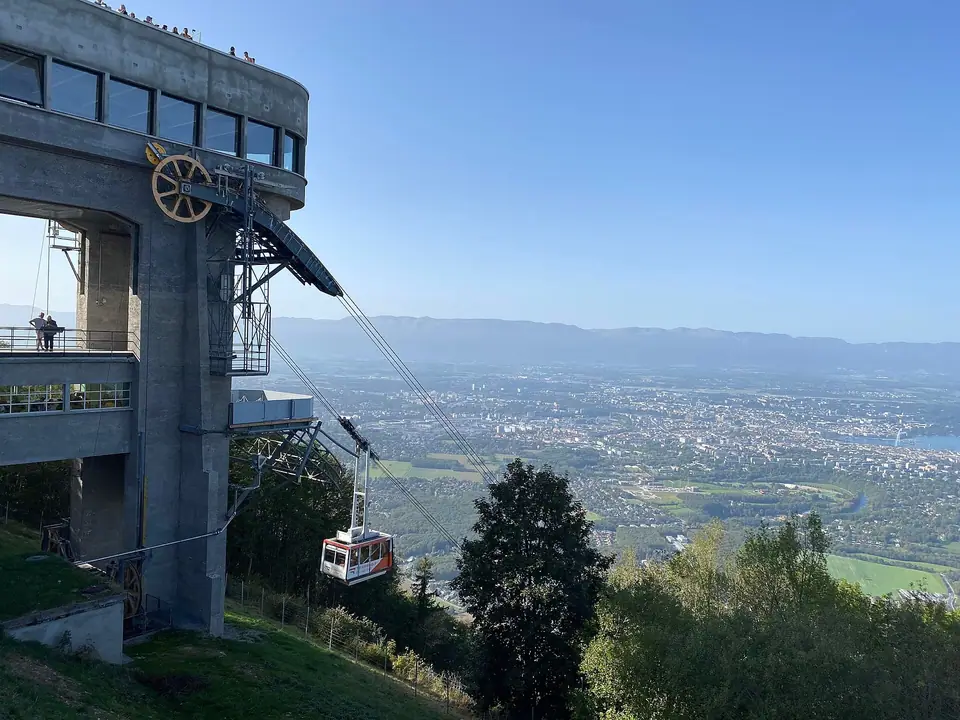
Since 1932 (with the upper and lower concrete stations rebuilt in 1983), visitors ascend the cliff aboard the Téléphérique du Salève aerial cable car from Étrembières/Veyrier just across the French border. To reach the lower terminal without a car, board TPG bus line 8 in central Geneva to the Veyrier-Douane border stop and walk across the frontier post to the valley station, remembering to carry your passport or national identity card for the border crossing.
From the upper viewing terrace and the nearby Shedrub Choekhor Ling (a Tibetan Buddhist monastery opened on the ridge in September 2010), the panorama spans the entire Geneva basin, the Jet d'Eau, the Jura crest, Lake Annecy to the south, and the glaciated summits of Mont Blanc to the southeast. Paragliders regularly launch from the grassy meadows beside the upper station, while marked ridge trails lead hikers through beech woods and limestone pastures toward the Grand Piton. On the northern slope, the Maison du Salève cultural and environmental centre opened in September 2007 inside a restored 1733 Mikerne farmhouse.
Lausanne: Cathedral Hill and the 1275 Gothic Nave
Located 51.7 kilometres northeast of Geneva along the northern shore of Lake Geneva, Lausanne is the capital of the Canton of Vaud and Switzerland's fourth-largest city with about 150,000 municipal residents (420,000 across its wider agglomeration). Grown from the Roman military and trading camp of Lousanna down by the shore at Vidy and Ouchy, the medieval population shifted uphill for defence during the Early Middle Ages.
At the summit of the Cité hill rises the Gothic Cathedral of Notre-Dame, begun in the 12th century and solemnly consecrated in 1275 in the presence of Pope Gregory X and King Rudolf of Germany. Inside, a celebrated thirteenth-century painted portal and a rose window depicting the medieval cosmos anchor the limestone nave, while covered wooden steps (the Escaliers du Marché) lead down to the market squares below.
Olympic Capital and the Ouchy Waterfront
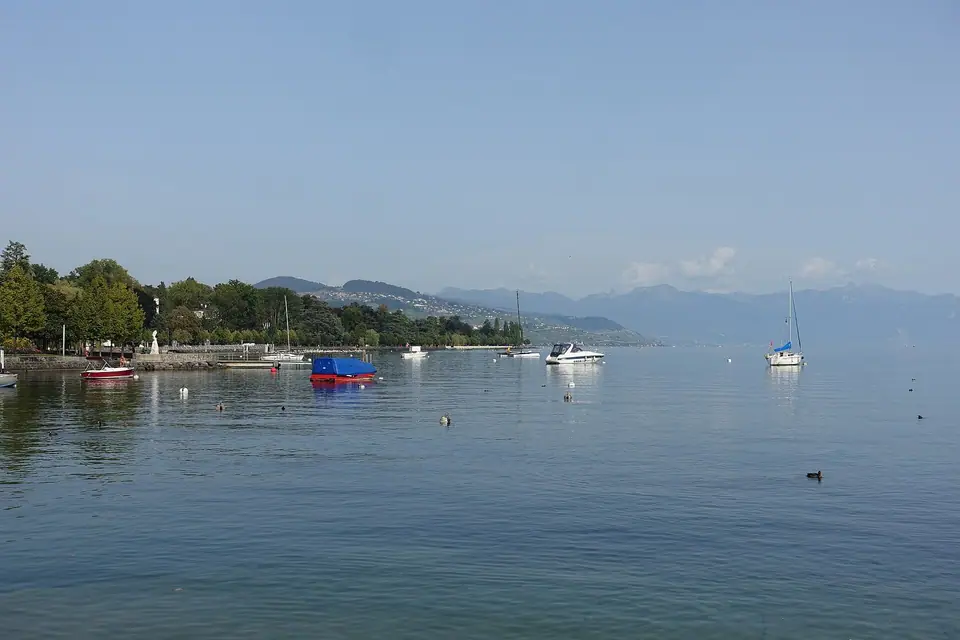
Recognised since 1994 as the official "Olympic Capital", Lausanne hosts the headquarters of the International Olympic Committee (founded in 1894 and based in Lausanne since 1915) alongside 55 international sports federations and the Federal Supreme Court of Switzerland. Steep hills between the Cité and the lakefront are linked by a 28-station rubber-tyred metro system that descends to Ouchy, where Belle Époque promenades, the Olympic Museum park, and CGN steamer piers face the Savoy mountains across the Grand Lac.
When deciding between a mountain half-day on Mont Salève and a full-day lakeshore journey to Lausanne and Chillon Castle, check the morning cloud ceiling over the basin before setting out. When high pressure clears the sky above the Petit Lac and the Savoy Alps, the cable car ride from Veyrier delivers an unmatched bird's-eye perspective over the entire canton, the meandering ribbons of the Rhône and the Arve, and the white glaciers of the Mont Blanc massif.
On days when high clouds veil the upper peaks or when you prefer a combination of Gothic architecture, lakeside promenades, and medieval castle halls, the SBB rail line and CGN paddle steamers along the northern Vaud shoreline offer comfortable all-weather travel with frequent connections back to Gare de Genève-Cornavin throughout the afternoon and evening.
Chillon Castle: Count Peter II and Master James of Saint George
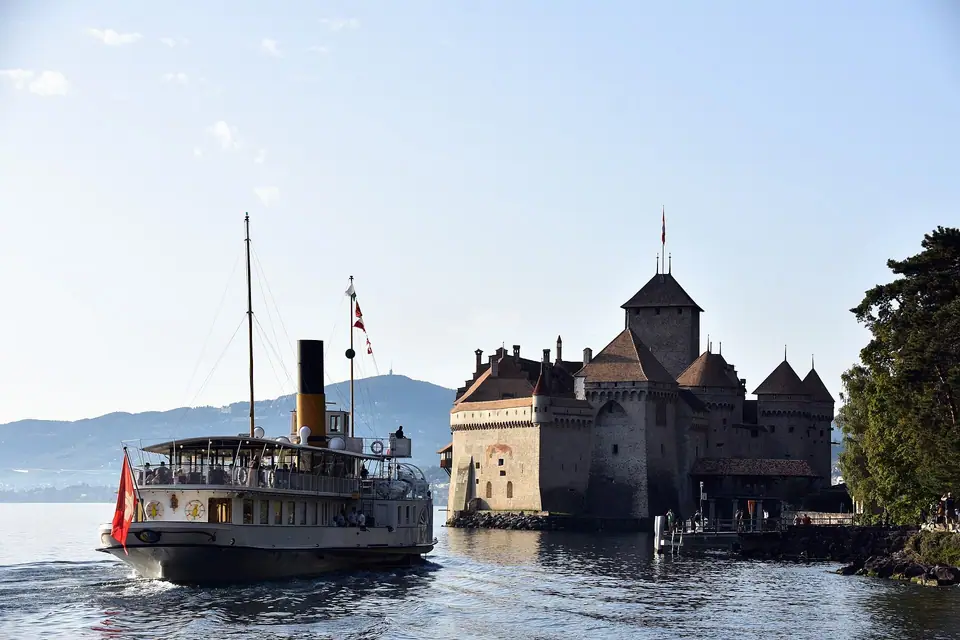
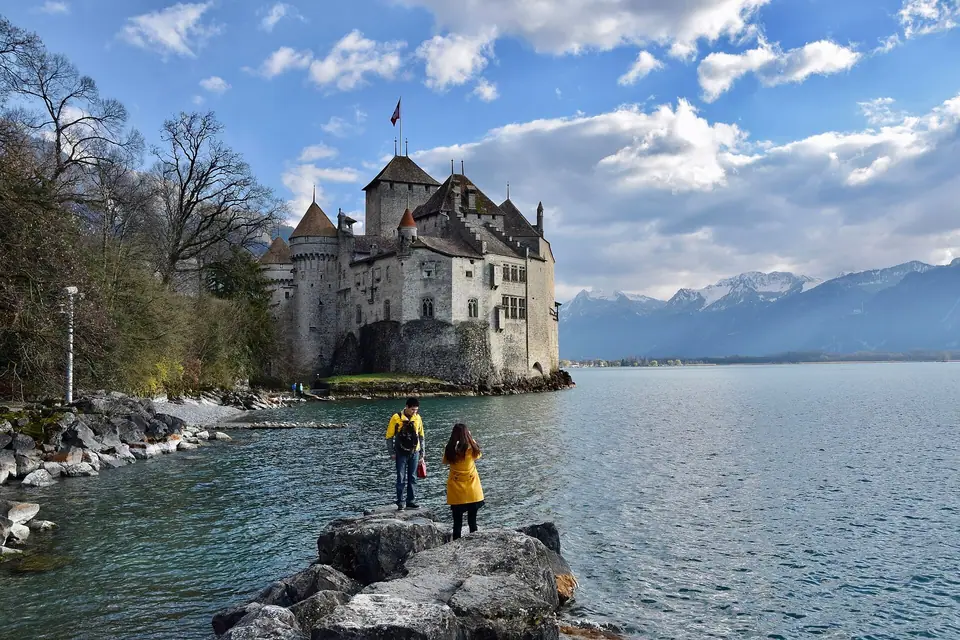
At the eastern end of the lake between Montreux and Villeneuve stands Chillon Castle (Château de Chillon), built on an oval limestone island rock just offshore to command the narrow passage between the steep Vaud Prealps and the water on the strategic route toward the Great Saint Bernard Pass. Attested as Castrum Quilonis in 1195 and held by the House of Savoy by 1150, the fortress was reshaped and expanded in 1248 and 1266 by Count Peter II of Savoy with Gothic hall windows designed by master military mason James of Saint George.
François de Bonivard, Lord Byron, and Rail or Steamer Access
- Bonivard and the vaulted dungeon: Genevois prior and historian François de Bonivard was chained inside the rock-cut lakeside vault for six years from 1530 for defending Geneva's independence against Savoy until Bernese troops captured the castle in 1536, an episode later immortalised by Lord Byron in 1816.
- Restoration and courtyard halls: Carefully excavated and restored at the end of the 19th century by cantonal archaeologist Albert Naef, the castle preserves subterranean vaults, the Count's Great Hall, a frescoed chapel, four courtyards, and wooden defensive walkways overlooking the deep lake water.
- Planning your excursion: Check the best time to visit Geneva for clear mountain visibility on Mont Salève, and return to the city in the evening for dinner in Carouge or the Vieille Ville.
Traveller tips
Real advice from people who have been to Day Trips from Geneva: Mont Salève, Lausanne & Chillon Castle. Every tip is read by our team before it goes live.
No tips yet. Been here? Yours could be the first.
Thank you! Your tip will appear here after a quick review.
More in Geneva
Continue exploring Geneva with related neighbourhood, food, and planning guides
Geneva Museums: Musée d'Art et d'Histoire, Patek Philippe & Red Cross
Geneva, Switzerland

What to Eat in Geneva: Lake Perch, Cheese Fondue, Longeole & Escalade
Geneva, Switzerland
How to Get to Geneva & Get Around: Airport, Cornavin, TPG & Léman Express
Geneva, Switzerland
Where to Stay in Geneva: Best Areas on the Right Bank, Left Bank & Carouge
Geneva, Switzerland
