


























Palais des Nations, Broken Chair & Geneva's International Quarter
Visit the European headquarters of the United Nations in Ariana Park, Daniel Berset's Broken Chair on Place des Nations, and the diplomatic avenue.
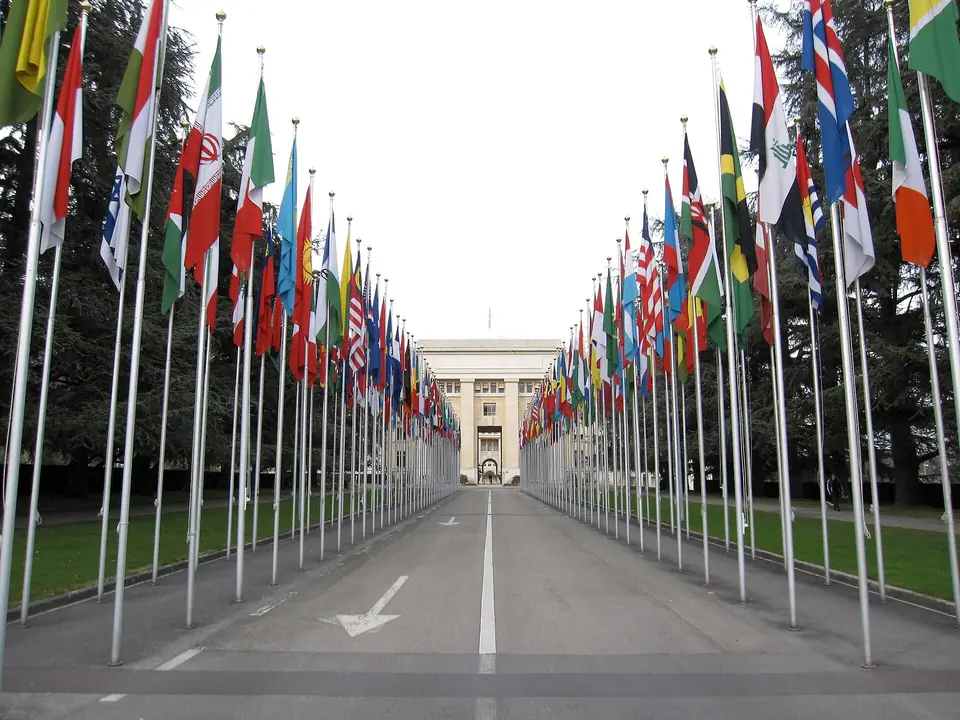
Stretching across the northern hills of the right bank in the Nations and Sécheron districts, Geneva's International Quarter is a global hub of multilateral diplomacy. While the Canton of Geneva hosts 39 international organisations and 431 non-governmental organisations, the civic centrepiece of the district is Place des Nations, where tram 15 arrives from Gare de Genève-Cornavin in front of the Broken Chair sculpture and the gates of the Palais des Nations, steps from the International Red Cross and Red Crescent Museum on Avenue de la Paix.
Unlike the tightly packed medieval lanes of the Vieille Ville across the lake, the right-bank diplomatic district unfolds along broad tree-lined avenues, landscaped estates, and glass-and-limestone institutional headquarters looking down across the Petit Lac toward Mont Blanc. Visiting the quarter on a weekday morning lets you experience international Geneva in active session while combining architectural history with peaceful parkland walks.
From the 1920 League of Nations to the 1926 Architectural Competition
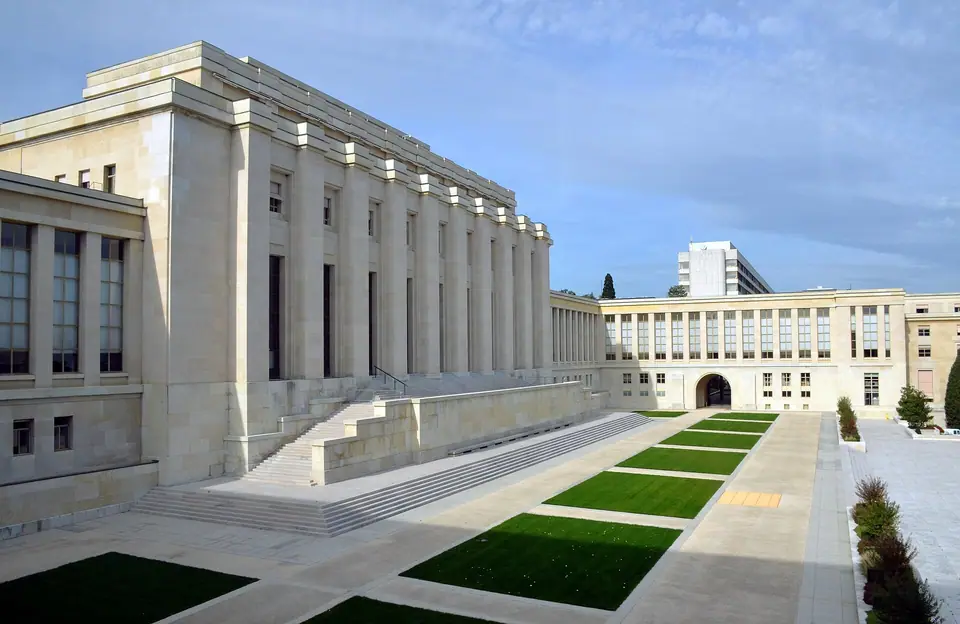
After the League of Nations was founded on 10 January 1920 and initially met at the Salle de la Réformation and the waterfront Palais Wilson, the City of Geneva donated parkland in Ariana Park for a permanent headquarters. An international architectural competition held in 1926 drew 377 entries from across Europe; unable to settle on a single winner, the nine-member jury appointed five architects (Julien Flegenheimer of Switzerland, Camille Lefèvre and Henri-Paul Nénot of France, Carlo Broggi of Italy, and József Vágó of Hungary) to collaborate on a monumental neoclassical design clad in pale travertine and limestone.
The foundation stone was laid on 7 September 1929 over a time capsule holding a copy of the League Covenant, the list of member states, and coins of the represented nations, and the complex was completed between 1936 and 1938. Measuring 440,000 cubic metres at completion, it stood as the second-largest building complex in Europe by volume after the Palace of Versailles (460,000 cubic metres), symbolising interwar hopes for collective security and treaty negotiation.
Expansion Under the United Nations and the Major Council Chambers
Transferred to the United Nations under a 1946 Headquarters Agreement (and designated the European headquarters of the UN in 1966, decades before Switzerland itself joined the UN in 2002), the complex grew steadily as global membership expanded. Wings were added in 1950 to 1952 (Building K and Building D for the World Health Organization), in 1968 to 1973 (Building E, adding 11 conference rooms and 380,000 cubic metres), and with the SOM-designed Building H completed in 2022.
Today the 600-metre-long complex spans 853,000 cubic metres with 34 conference rooms and 2,800 offices, hosting 8,000 to 10,000 intergovernmental meetings a year and welcoming about 100,000 visitors on guided tours. Tours typically pass through the vast Assembly Hall, the historic Council Chamber decorated with monochromatic gold-sepia murals by José María Sert depicting human progress and peace, the lofty Salle des Pas Perdus overlooking the Court of Honour and the Celestial Sphere armillary monument, and Room XX (the Human Rights and Alliance of Civilizations Room), crowned by Miquel Barceló's stalactite-like painted dome inaugurated on 18 November 2008.
Parc de l'Ariana, Peacocks, and the 1668 Chalet
The Palais des Nations sits inside the 45-hectare Parc de l'Ariana, a picturesque nineteenth-century estate bequeathed to the City of Geneva in 1890 by art collector and philanthropist Gustave Revilliod de la Rive on condition that he be buried in the park and that peacocks roam freely across the grounds. To this day, Indian peacocks strut across the lawns and cedar groves outside the diplomatic wings, framed by open vistas across Lake Geneva toward the Savoy Alps.
Alongside monumental diplomatic gifts donated by member states and the neighbouring Ariana Museum (the Swiss Museum of Ceramics and Glass, housed in an Italianate palace built by Revilliod to display his porcelain and earthenware collections), the park grounds also preserve a historic wooden alpine chalet dating from 1668, creating a quiet pastoral contrast beside the twentieth-century conference halls. Below the hill toward the lakeshore, manicured paths also connect with Parc Barton, Parc Moynier, and Parc de la Perle du Lac, allowing a continuous green walk down to the water.
Beyond the gates of Ariana Park, the wider Avenue de la Paix and Place des Nations corridor illustrates a century of institutional architecture dedicated to international law, public health, telecommunications, intellectual property, and refugee protection. Glass-walled conference centres, manicured memorial gardens, and multilingual directional signs give the district an atmosphere found in very few cities, yet a short ride downhill on tram 15 or a walk through the lakeside parks of Sécheron and Perle du Lac brings you straight back to the calm waters of the Petit Lac.
Daniel Berset's Broken Chair on Place des Nations
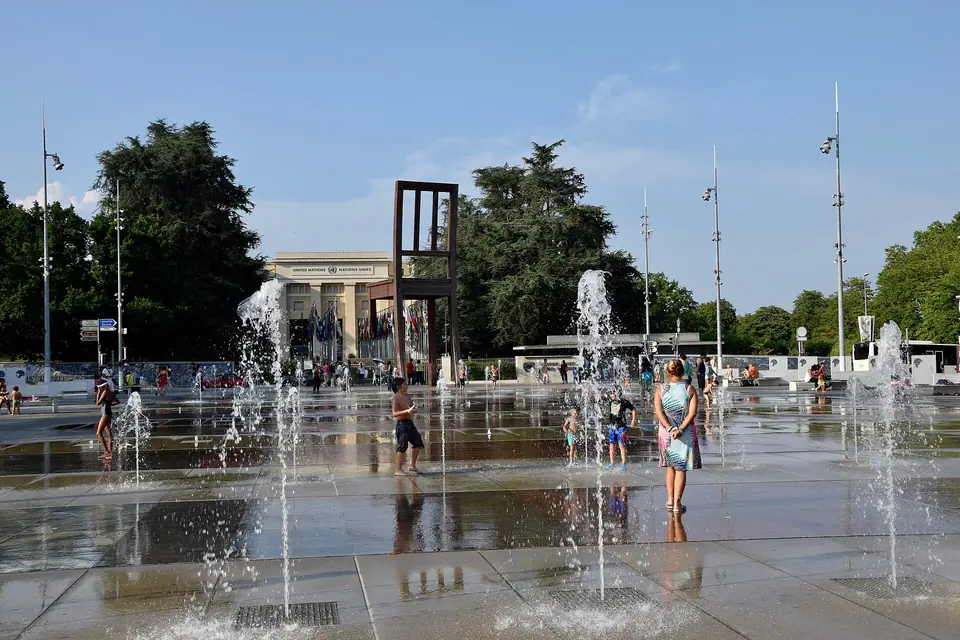
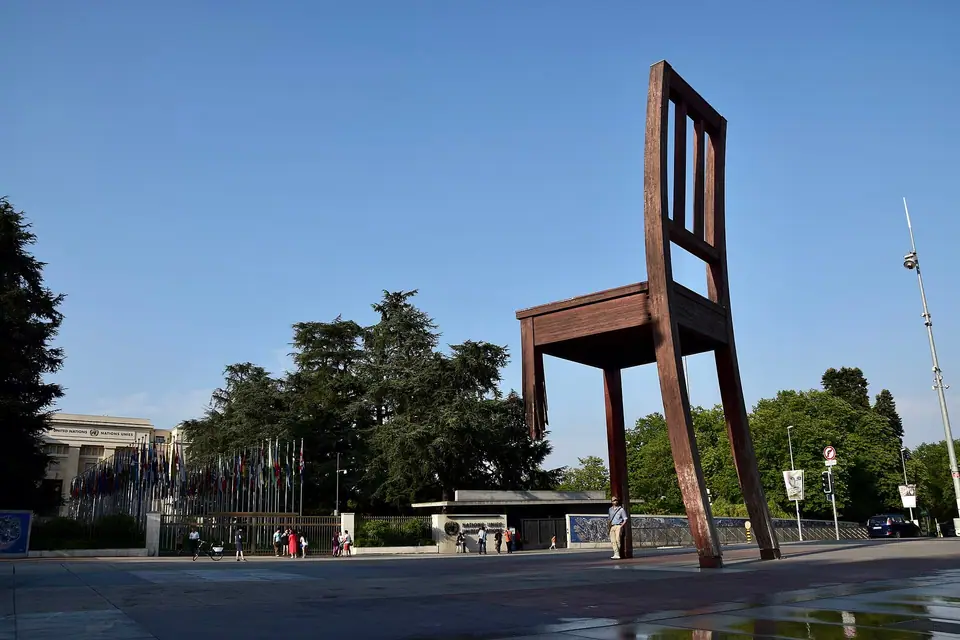
Directly opposite the main entrance gates on Place des Nations rises the Broken Chair, one of Geneva's best-known contemporary landmarks. Conceived by Handicap International Switzerland co-founder Paul Vermeulen, designed by Swiss artist Daniel Berset, and constructed by master carpenter Louis Genève from 5.5 tons of Douglas fir timber standing 12 metres high, the three-legged chair with its jagged snapped fourth leg was erected on 18 August 1997 to urge governments to sign the December 1997 Ottawa Treaty banning anti-personnel landmines (which entered into force on 1 March 1999 after 40 ratifications).
Originally planned as a temporary installation for a few months, the sculpture was kept in place by popular demand, briefly removed during square tramway renovations in 2005, and reinstalled on 26 February 2007 ahead of the December 2008 Oslo convention banning cluster munitions. Water jets embedded in the granite paving stones of Place des Nations cool the esplanade on warm afternoons while delegations, journalists, and visitors cross between the tram stop and Avenue de la Paix.
Practical Planning for Visiting the UN Quarter
- Security screening and identification: All visitors entering the Palais des Nations for guided tours must present a valid original passport or national identity card at the Pregny Gate security pavilion on Avenue de la Paix, and should book tour slots online ahead of arrival.
- Getting there by tram and train: See our Geneva transport guide to take TPG tram 15 directly from Gare de Genève-Cornavin to the Nations terminus, or ride the Léman Express to Genève-Sécheron and walk uphill through the park.
- Pairing your visit: Combine a morning tour of the Palais des Nations and the Red Cross Museum with an afternoon ride on tram 18 to CERN in Meyrin or follow our 3-day Geneva itinerary.
Traveller tips
Real advice from people who have been to Palais des Nations, Broken Chair & Geneva's International Quarter. Every tip is read by our team before it goes live.
No tips yet. Been here? Yours could be the first.
Thank you! Your tip will appear here after a quick review.
More in Geneva
Continue exploring Geneva with related neighbourhood, food, and planning guides
Best Time to Visit Geneva: Lake Geneva Weather, Bise Wind & L'Escalade
Geneva, Switzerland
Geneva 3-Day Itinerary: Old Town, Harbour, UN Quarter, CERN & Day Trips
Geneva, Switzerland
Geneva: Essential Planning for Lake Geneva's Diplomatic Hub
Geneva, Switzerland
Things to Do in Geneva: Landmarks from the Jet d'Eau to CERN
Geneva, Switzerland
