


























Jet d'Eau, Lake Geneva Promenade & Bains des Pâquis
Walk both shores of Geneva's harbour, from the 140-metre Jet d'Eau and Jardin Anglais to the 1932 Bains des Pâquis pier.
Lake Geneva (Le Léman) is the largest body of water in Switzerland and on the course of the Rhône, forming a south-pointing crescent shared between Switzerland (60 percent, or 345.31 square kilometres) and France (40 percent, or 234.71 square kilometres). While the broad Grand Lac between Lausanne and Évian-les-Bains plunges to 310 metres, the narrow southwestern Petit Lac terminates in Geneva's harbour (la Rade) at 372 metres above sea level. Walking both quays and crossing by boat is the centrepiece of any 3-day Geneva itinerary.
Unlike inland river capitals where the water sits below high floodwalls, Geneva meets its lake across low stone embankments, wooden bathing decks, and long breakwaters that invite pedestrians out into the middle of the harbour basin. On clear days, the snow-capped dome of Mont Blanc rises directly behind the left-bank hills and bridges, giving the waterfront an Alpine backdrop that changes colour from pale morning silver to rose at dusk. Combine this harbour loop with our Geneva travel guide to connect the lakefront with the surrounding neighbourhoods.
From 1886 Hydraulic Safety Valve to the 1951 Jet d'Eau
Geneva's vertical water plume began as an engineering solution rather than a decorative monument. On 17 May 1886, the city commissioned the Usine hydraulique de la Coulouvrenière on the Rhône to supply pressurised water power to artisanal and watchmaking workshops. When artisans shut down their machines each evening, overpressure built up in the pipes, prompting engineers to install a safety valve that vented a 30-metre column of water into the sky. After the valve moved to the Bessinge reservoir in 1889, the Administrative Council installed a 90-metre fountain at the tip of the Jetée des Eaux-Vives in July 1891 for the Federal Gymnastics Festival and the 600th anniversary of the Swiss Confederation.
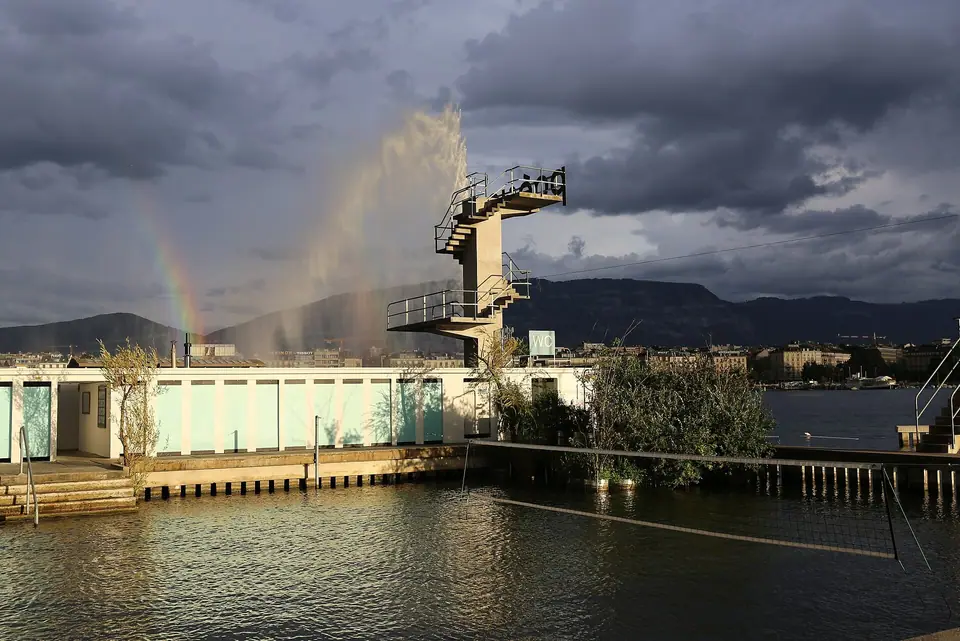
Inaugurated in its partially submerged pumping station on 3 May 1951, the modern Jet d'Eau draws water directly from Lake Geneva using two 500-kilowatt motor-pump groups (named Salève and Jura, totalling 1,000 kilowatts at 2,400 volts). They force 500 litres per second through a 10-centimetre nozzle at 200 km/h to an average height of 140 metres (up to 150 metres), keeping about 7,000 litres (8 tonnes) of water suspended in the air for 16 seconds per drop. Operated year-round by day since 2003 except in frost or high winds, it is lit after dark by a 9-kilowatt illumination array. Walking out along the Jetée des Eaux-Vives brings you right beside the pumping dome, where a specially designed nozzle ring injects air bubbles around the water column to give the plume its bright snow-white appearance against the sky.
Jardin Anglais, the 1955 Flower Clock, and Pierres du Niton
On the left bank between Pont du Mont-Blanc and Eaux-Vives, the 1854 Jardin Anglais (expanded in 1862 and 1870 to 1871) provides a shaded lakeside promenade beneath mature trees. At its centre stands an 1862 cast-iron fountain cast at the Val d'Osne foundry, while the waterfront edge features the 1869 Monument National bronze group depicting Helvetia and Geneva standing shoulder to shoulder.
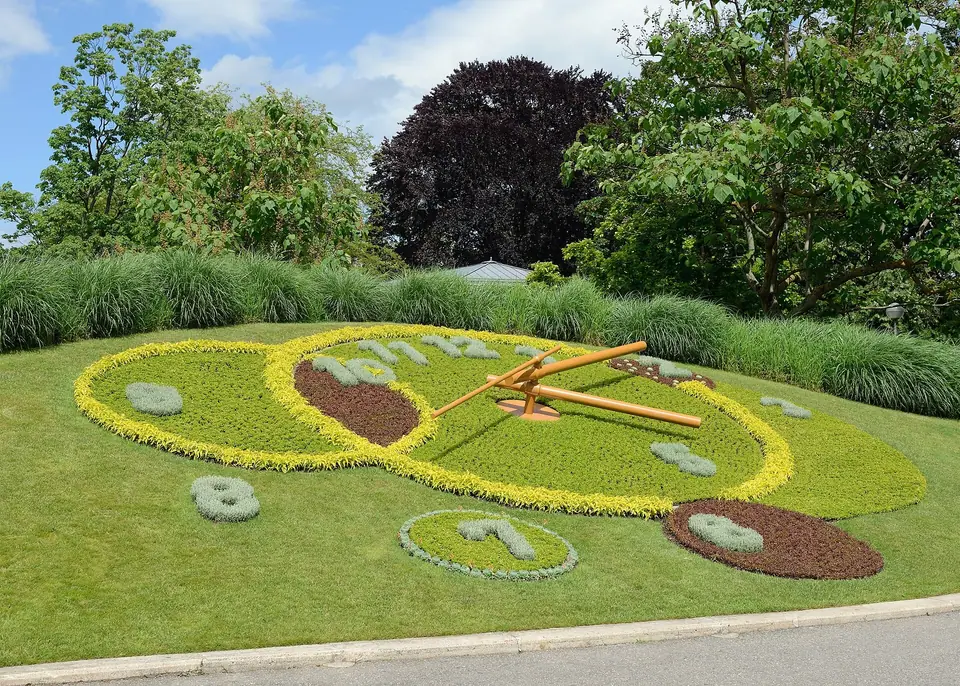
At the western entrance of the park beside the bridge sits the Horloge fleurie, created in 1955 by landscape architect Armand Auberson to honour Geneva's watchmaking heritage: its 4-metre-diameter dial is divided into 8 floral segments replanted with the seasons and swept by a 2.5-metre seconds hand. Further east along the shore toward Eaux-Vives rise two emergent glacial erratic boulders offshore, the Pierres du Niton, which engineer Guillaume-Henri Dufour selected as the reference datum for elevation measurements across Switzerland, beyond which the rose gardens and lawns of Parc La Grange and Parc des Eaux-Vives slope down toward the lakeside path.
Bains des Pâquis: 1932 Bauhaus Architecture and the 1988 Referendum
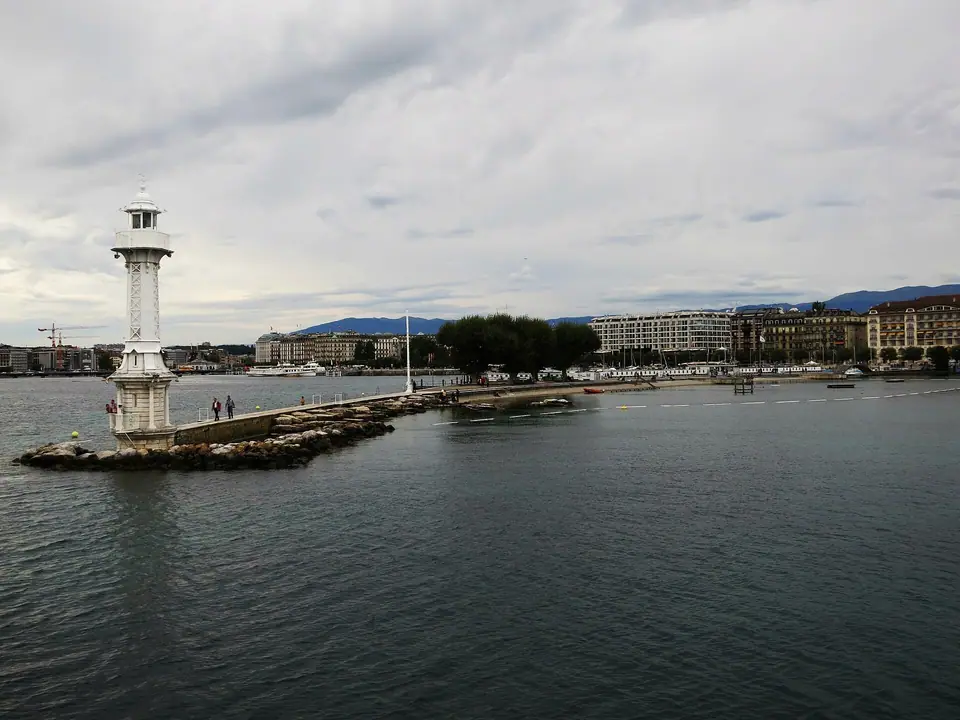
Across the Rade on the right-bank mole stands the Bains des Pâquis. Opened as wooden baths in 1872, municipalised in 1890, and crowned with its iron beacon lighthouse in 1894 (on an 1857 stone base), the complex was rebuilt in 1932 in reinforced concrete and glass under Bauhaus influence by engineer Louis Arnichard and architect Henry Roche. Long horizontal sun decks, clean white concrete railings, and open changing cabines give the pier the streamlined profile of an ocean liner moored in the harbour.
When municipal authorities proposed demolishing the aging concrete structure in the late 1980s, residents formed the Association d'usagers des Bains des Pâquis (AUBP) in February 1987 to defend affordable public access to the lakefront. Their campaign forced a municipal referendum on 25 September 1988 in which 72 percent of voters rejected demolition, leading to a careful restoration between 1991 and 1995 that preserved the 1932 architecture for public use. Today the baths remain an egalitarian gathering place where diplomats, students, and retirees share the same wooden benches and diving boards.
Walking the full lakeside arc from the right-bank parks of Perle du Lac and Mon Repos down past the Bains des Pâquis, over Pont du Mont-Blanc, and out along the left-bank Quai Gustave-Ador to Parc La Grange gives you a continuous waterside promenade of several kilometres. Along the way, wooden benches, stone steps, and willow-shaded lawns face the marina moorings where wooden motor launches, classic Lake Geneva lateen-rigged sailboats, and white CGN Belle Époque paddle steamers pass back and forth between the harbour piers and the open waters of the Petit Lac.
Even on cooler spring or autumn afternoons when the bathing ladders are quiet, the twin moles of Eaux-Vives and Pâquis draw walkers out into the middle of the water for unobstructed views back toward the cathedral towers, the neoclassical facades of the Grand Quai, and the snow-covered ridgelines of Haute-Savoie.
Mouettes Genevoises Crossings and Waterfront Dining
- Year-round bathing, sauna, and fondue: Open 12 months a year, the Bains des Pâquis offer summer lake swimming platforms, winter sauna, hammam, and Turkish bath sessions overlooking the icy water, sunrise concerts (Les Aubes, held at daybreak since 2007), and a beloved fondue buvette serving seasonal lunches and bubbling pots of Gruyère and Vacherin.
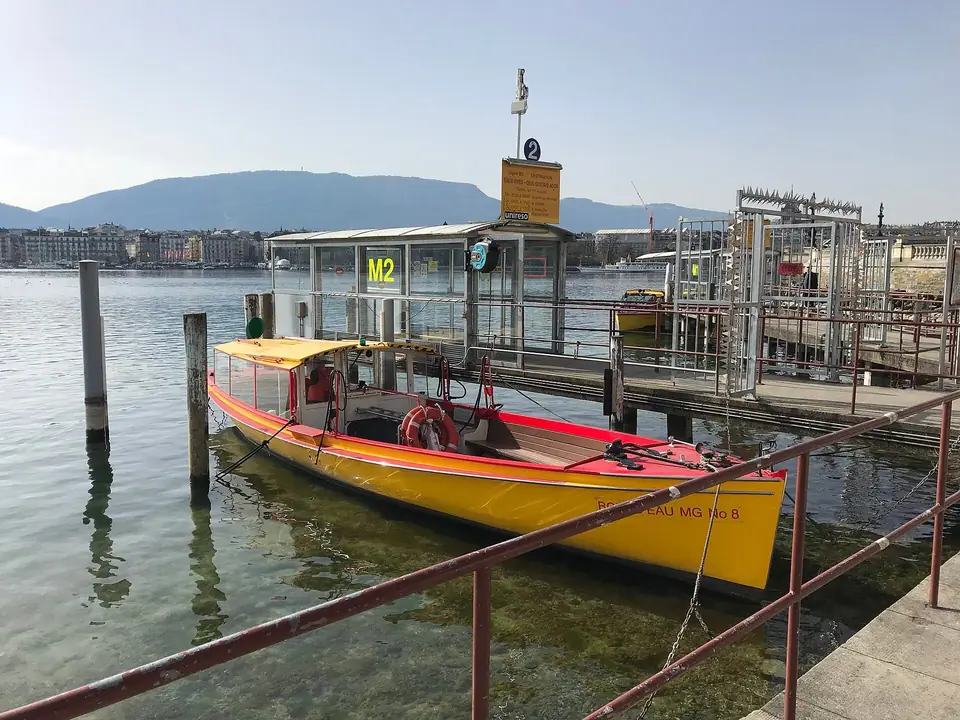
- Mouettes Genevoises water buses: Founded in 1897, the yellow-and-red launches link both shores on four Unireso lines included in standard TPG Zone 10 transit tickets: M1 (Pâquis to Molard), M2 (Pâquis to Quai Gustave-Ador near the Jet d'Eau), M3 (Pâquis to Genève-Plage), and M4 (Genève-Plage to De-Chateaubriand).
- Right-bank promenade and Île Rousseau: After leaving the baths, stroll past the 1879 Monument Brunswick and across Pont des Bergues to Île Rousseau in the Rhône, or check our guide to where to stay in Geneva for lakefront hotels along Quai du Mont-Blanc.
Traveller tips
Real advice from people who have been to Jet d'Eau, Lake Geneva Promenade & Bains des Pâquis. Every tip is read by our team before it goes live.
No tips yet. Been here? Yours could be the first.
Thank you! Your tip will appear here after a quick review.
More in Geneva
Continue exploring Geneva with related neighbourhood, food, and planning guides
Where to Stay in Geneva: Best Areas on the Right Bank, Left Bank & Carouge
Geneva, Switzerland
Best Time to Visit Geneva: Lake Geneva Weather, Bise Wind & L'Escalade
Geneva, Switzerland
Geneva 3-Day Itinerary: Old Town, Harbour, UN Quarter, CERN & Day Trips
Geneva, Switzerland
Geneva: Essential Planning for Lake Geneva's Diplomatic Hub
Geneva, Switzerland
